
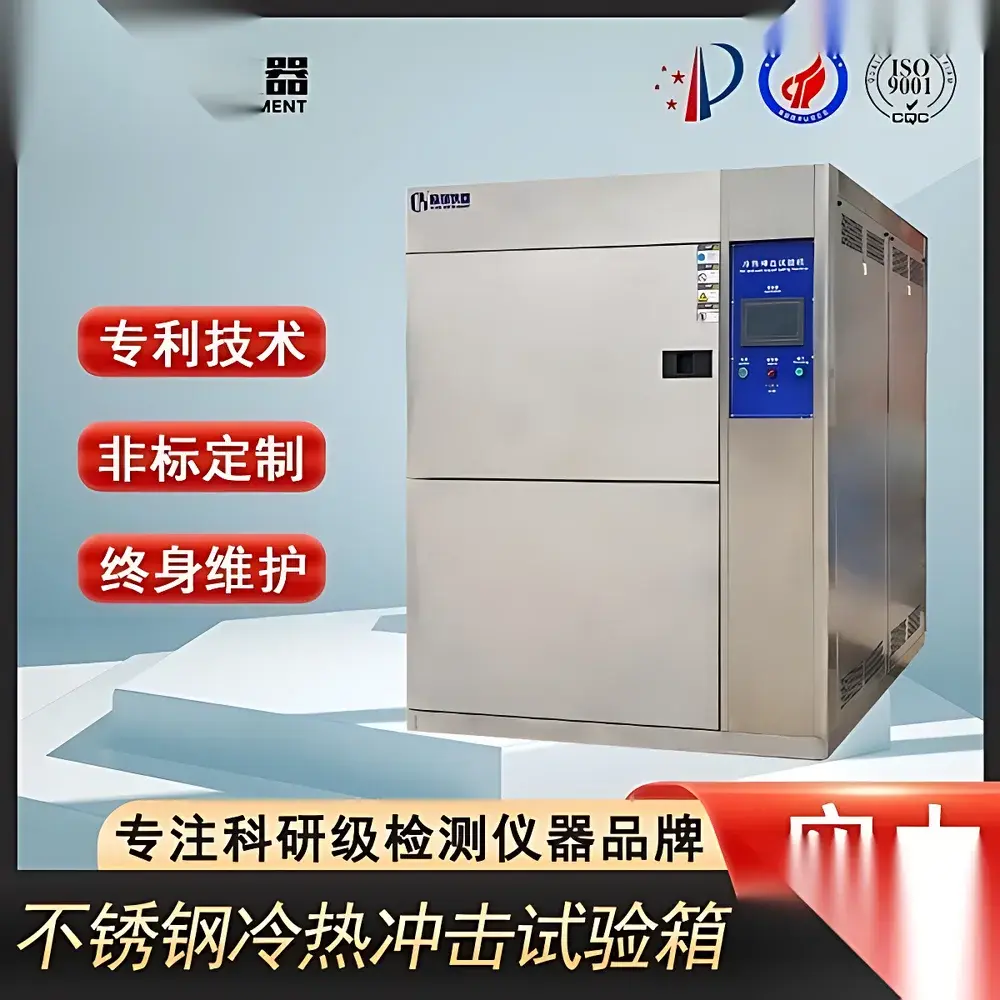
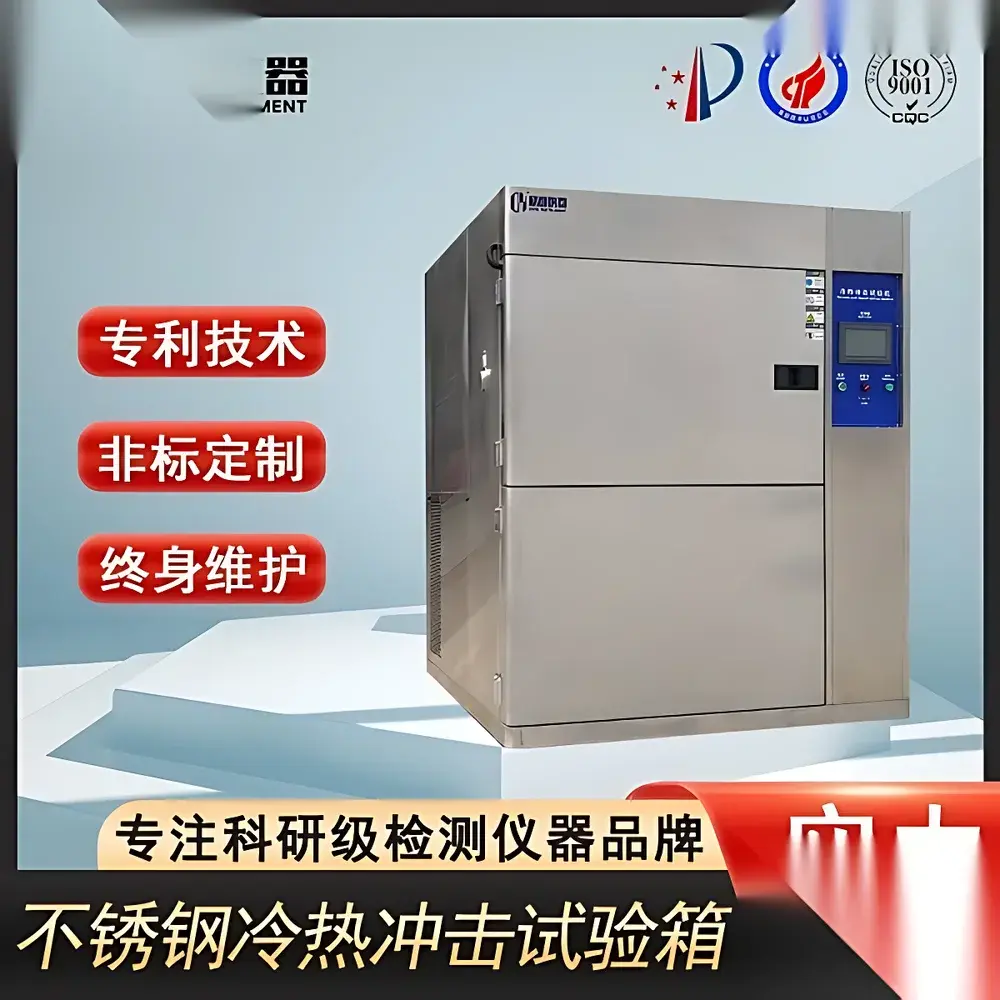
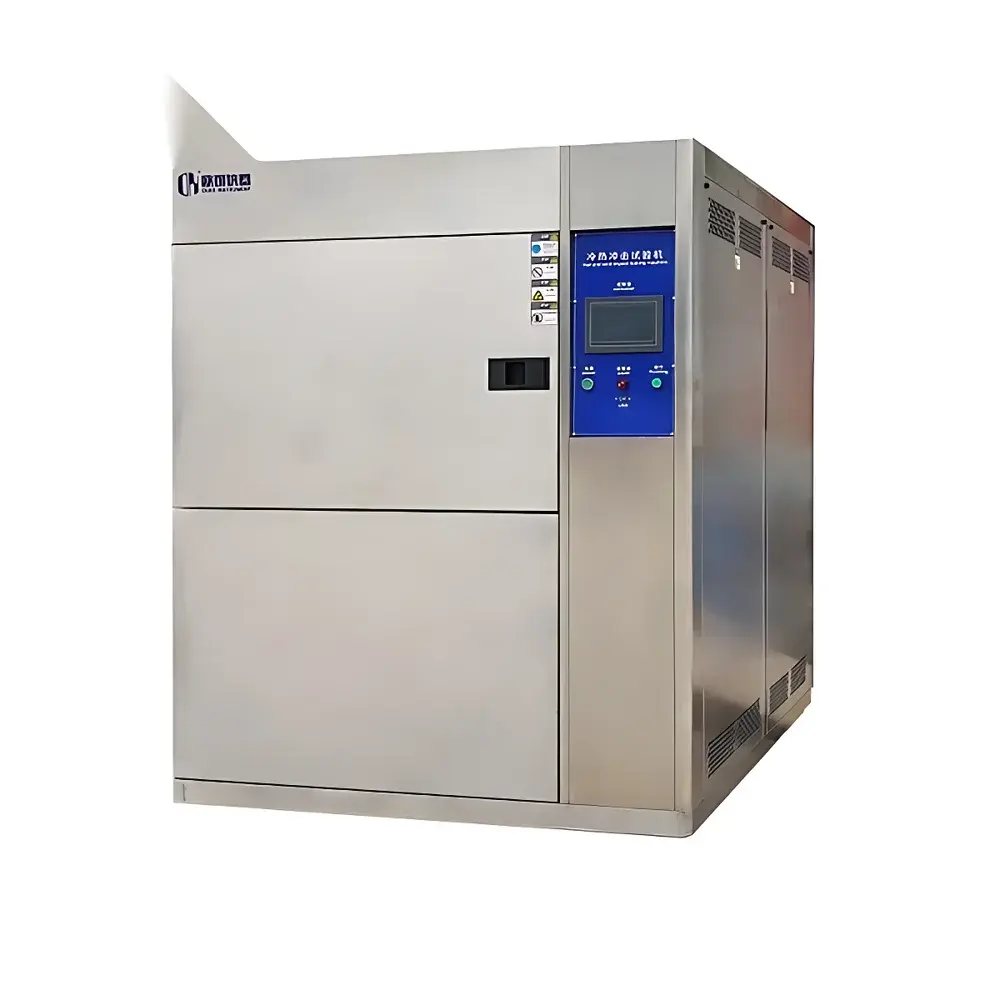
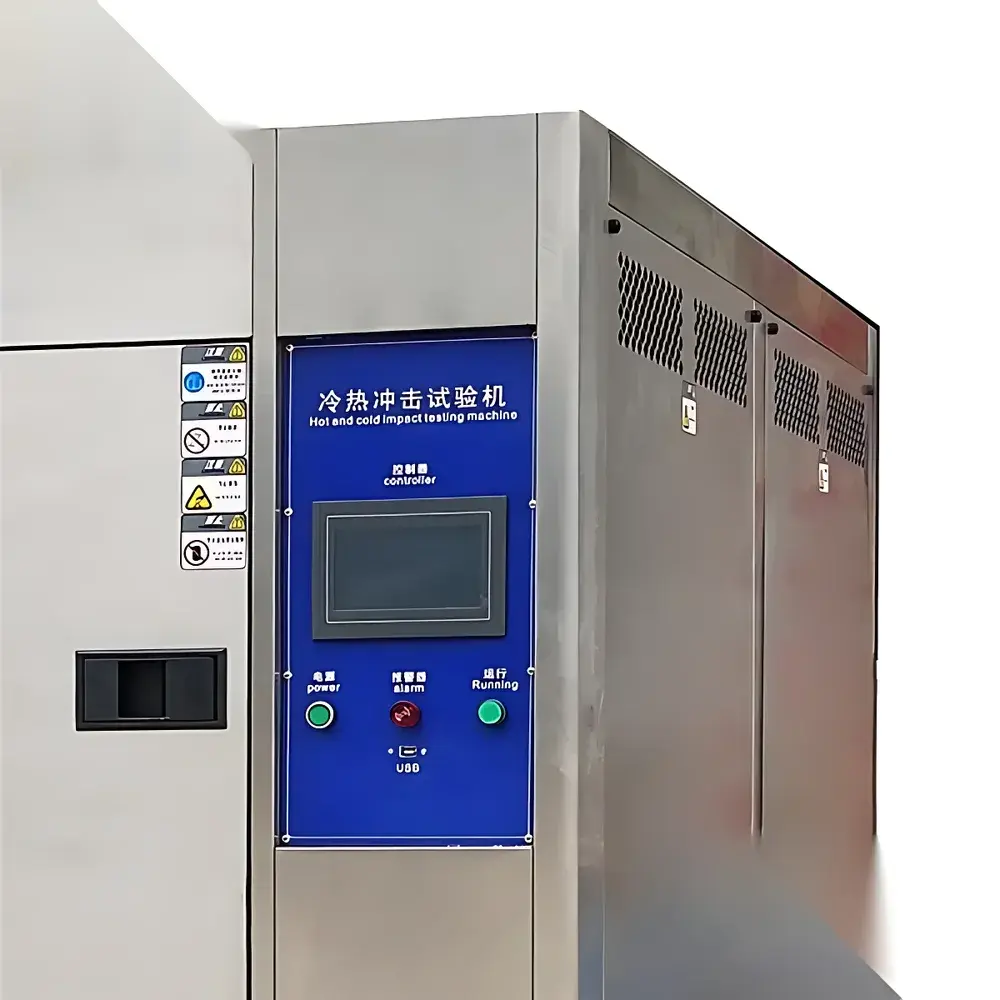
Thermal Shock Test Chamber – OK-HH Series (Custom-Configurable, Two-Zone & Three-Zone Designs)
| Key Features | Two-zone (hot/cold chambers with basket transfer) or three-zone (hot chamber / cold chamber / test chamber) architecture |
|---|---|
| Temperature Range | Hot Zone up to +200 °C |
| Test Zone | −65 °C to +150 °C |
| Temperature Transition Time | ≤5 min (typical recovery) |
| Uniformity | ±2.0 °C |
| Control Accuracy | ±0.5 °C |
| Refrigeration System | Dual-stage cascade refrigeration with imported semi-hermetic compressors (Germany) |
| Refrigerants | R404A / R23 (ozone-friendly) |
| Insulation | High-density fire-retardant PU foam |
| Interior | Mirror-finish SUS304 stainless steel |
| Exterior | SUS304 or powder-coated steel |
| Power Supply | AC 380 V ±5%, 50 Hz ±0.5 Hz, 3-phase 5-wire |
| Cooling Water Requirement | External cooling tower (10 m³/h capacity required) |
| Compliance | GB/T 2423.1–2001, GB/T 2423.2–2001, GB/T 2423.22–2002, GJB 150.5–86, IEC 60068-2-14, EIA-364-32, QC/T 17–92, SJ/T 10186–91 & 10187–91 |
| Customizable Internal Dimensions | 40×35×30 cm to 70×60×60 cm (W×H×D) |
Overview
The OK-HH Series Thermal Shock Test Chamber is an engineered environmental stress screening system designed for accelerated reliability validation of electronic components, automotive modules, aerospace hardware, and precision optical assemblies under rapid, extreme temperature transitions. It operates on the principle of thermal shock—subjecting test specimens to abrupt shifts between high- and low-temperature environments to expose latent defects such as interfacial delamination, solder joint fatigue, seal failure, and coefficient-of-thermal-expansion (CTE) mismatch. The system supports two distinct mechanical architectures: the two-zone configuration employs a motor-driven stainless-steel basket that physically transports samples between isolated hot and cold chambers; the three-zone design maintains a dedicated, stationary test chamber flanked by independent hot and cold蓄能 (energy storage) zones—enabling true “zero-load” thermal cycling without mechanical movement of the specimen. Both configurations comply with the thermodynamic requirements of inverse Carnot-cycle refrigeration and are calibrated to meet traceable metrological standards for temperature uniformity and transition repeatability.
Key Features
- Modular thermal architecture: Selectable two-zone (basket-transfer) or three-zone (static-test-chamber) layout based on specimen fragility, throughput needs, and test protocol fidelity requirements.
- Precision dual-stage cascade refrigeration system utilizing imported semi-hermetic compressors (Germany), ensuring stable operation across extended thermal shock cycles with minimal maintenance intervals.
- Energy-regulated refrigeration control: Dynamic modulation of compressor capacity and expansion valve timing maintains consistent cooling power while optimizing energy consumption and reducing mechanical wear.
- High-integrity thermal insulation: Multi-layered polyurethane (PU) foam with fire-retardant certification (UL 94 V-0 equivalent), minimizing heat leakage and stabilizing chamber boundary conditions during transient phases.
- Robust chamber construction: Interior surfaces fabricated from electropolished SUS304 stainless steel (mirror finish) for corrosion resistance and ease of cleaning; exterior options include brushed stainless or industrial-grade epoxy-powder coating.
- Integrated environmental safeguards: Leak-tight refrigerant circuitry compliant with ISO 5149; non-ozone-depleting refrigerants (R404A/R23) charged per ASHRAE Standard 15 protocols.
Sample Compatibility & Compliance
The OK-HH series accommodates specimens ranging from microelectronic packages (QFN, BGA, CSP) to full automotive ECUs and avionics enclosures. Internal dimensions are fully customizable—from 40×35×30 cm to 70×60×60 cm—and optional accessories include 50 mm-diameter cable ports, adjustable SUS304 shelf supports, and inert-gas purge interfaces (N₂ or dry air). All models are factory-verified against national and international thermal shock standards, including GB/T 2423.22–2002 (equivalent to IEC 60068-2-14), GJB 150.5–86, and EIA-364-32 for connector thermal cycling. For regulated industries, the system supports integration with GLP/GMP-compliant data logging systems featuring audit trails, user access controls, and electronic signature capability per FDA 21 CFR Part 11 requirements when paired with validated software platforms.
Software & Data Management
Standard controller firmware includes programmable multi-step profiles with ramp/soak/transition logic, real-time deviation alarms, and automatic cycle counting. Optional PC-based software enables remote monitoring, historical trend analysis, PDF report generation (with timestamped calibration metadata), and export to CSV or XML for LIMS integration. All temperature data points are recorded at ≥1 Hz resolution and stored with NIST-traceable sensor ID tagging. Firmware updates are delivered via secure HTTPS and require cryptographic signature verification prior to installation—ensuring integrity in validated environments.
Applications
- Qualification testing of PCBAs and semiconductor packaging under JEDEC JESD22-A104 and A106 specifications.
- Automotive electronics validation per ISO 16750-4 and QC/T 17–92 for under-hood and battery management systems.
- Aerospace component screening per MIL-STD-810H Method 503.5 and DO-160 Section 4.11.
- Material compatibility studies for adhesives, conformal coatings, and encapsulants exposed to repeated thermal excursions.
- Failure mode acceleration in photovoltaic module backsheet materials and EV battery cell housings.
FAQ
What distinguishes two-zone from three-zone thermal shock configurations?
Two-zone systems use mechanical basket transfer, offering faster throughput but introducing vibration and positional variability; three-zone systems eliminate specimen motion, delivering higher measurement fidelity for metrology-critical applications.
Is external cooling water infrastructure mandatory?
Yes—this system requires a dedicated closed-loop cooling tower rated at 10 m³/h flow capacity, installed outdoors per ASHRAE Guideline 15 ventilation and drainage requirements.
Can the chamber be validated for IQ/OQ/PQ protocols?
Yes—factory-provided validation documentation includes as-built drawings, sensor calibration certificates (ISO/IEC 17025 accredited), and FAT/SAT checklists aligned with Annex 11 and GAMP5 principles.
What is the typical lead time for custom internal dimensions?
Standard configurations ship within 8 weeks; custom builds (including structural reinforcement or special porting) require 12–14 weeks from PO confirmation and final dimensional sign-off.
Does the system support nitrogen purging for moisture-sensitive tests?
Optional inert gas interface kits are available—including mass flow controllers, pressure-regulated inlet manifolds, and O₂ sensors—with full integration into the main controller’s safety interlock logic.



