
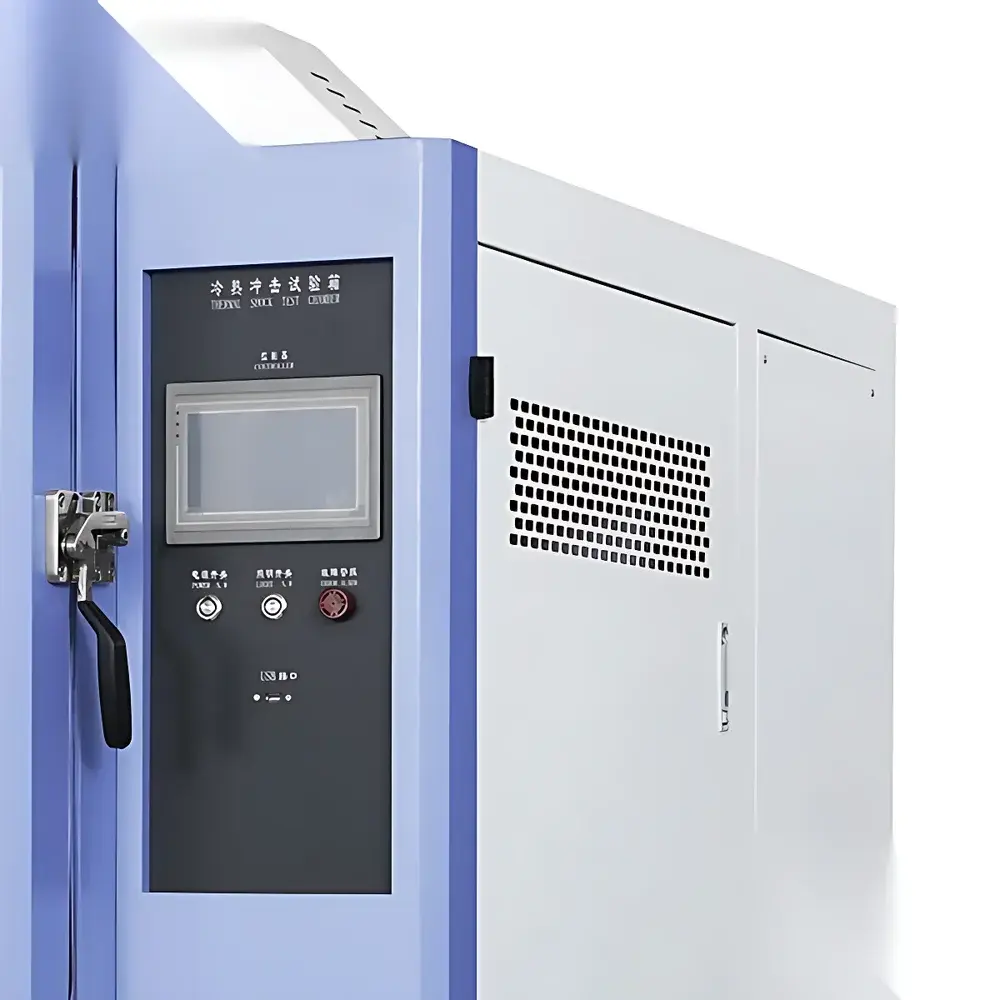
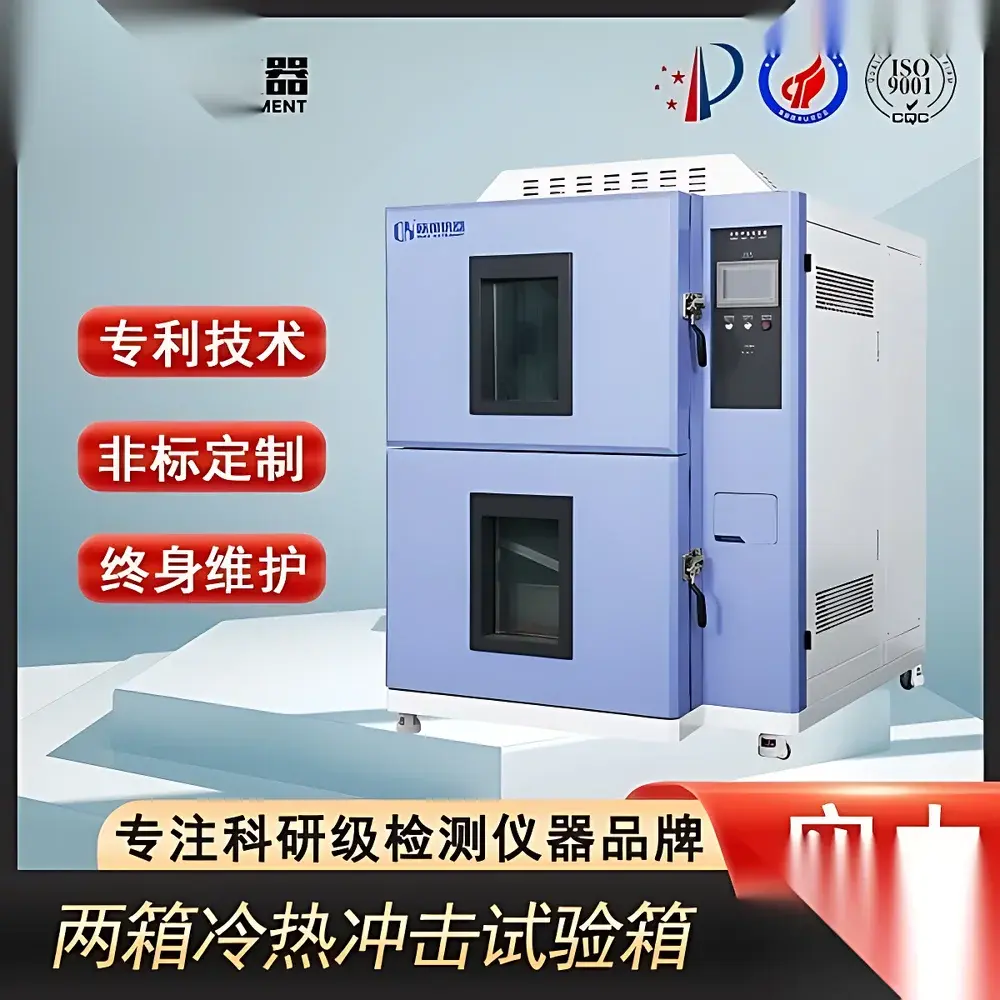
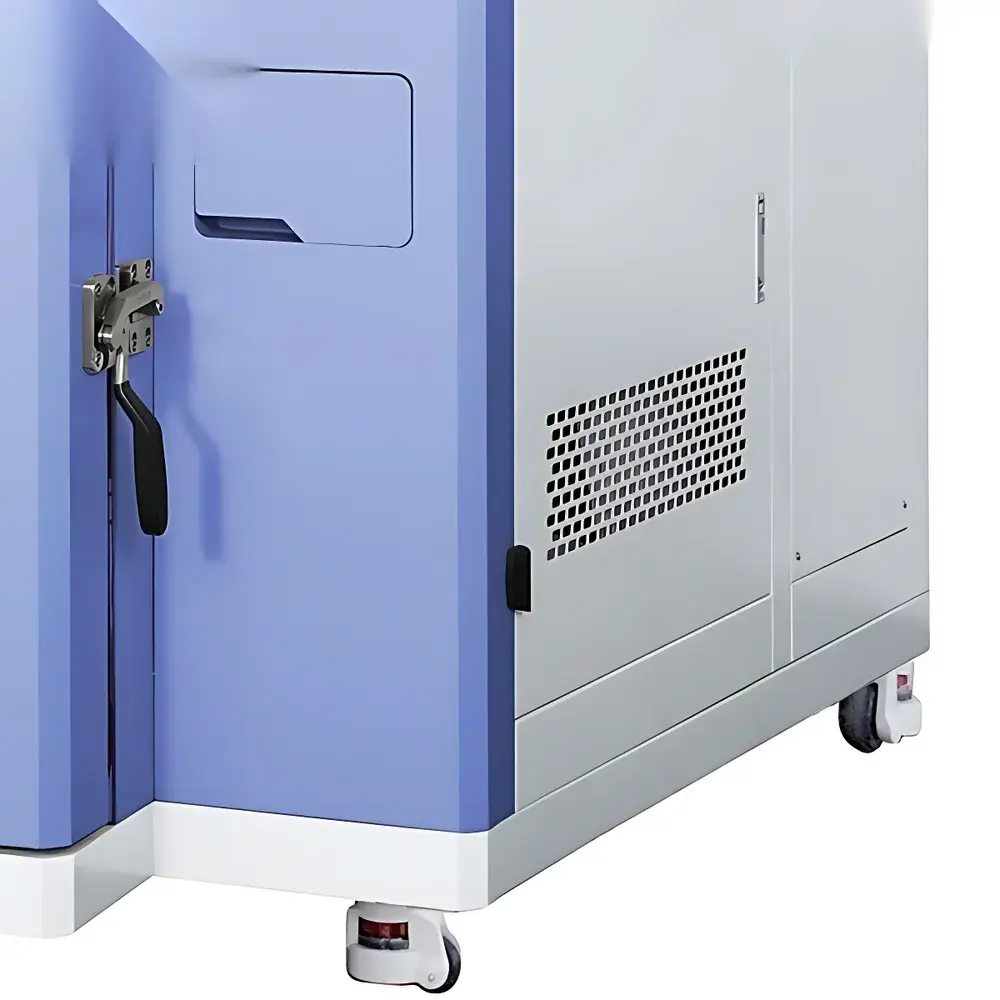
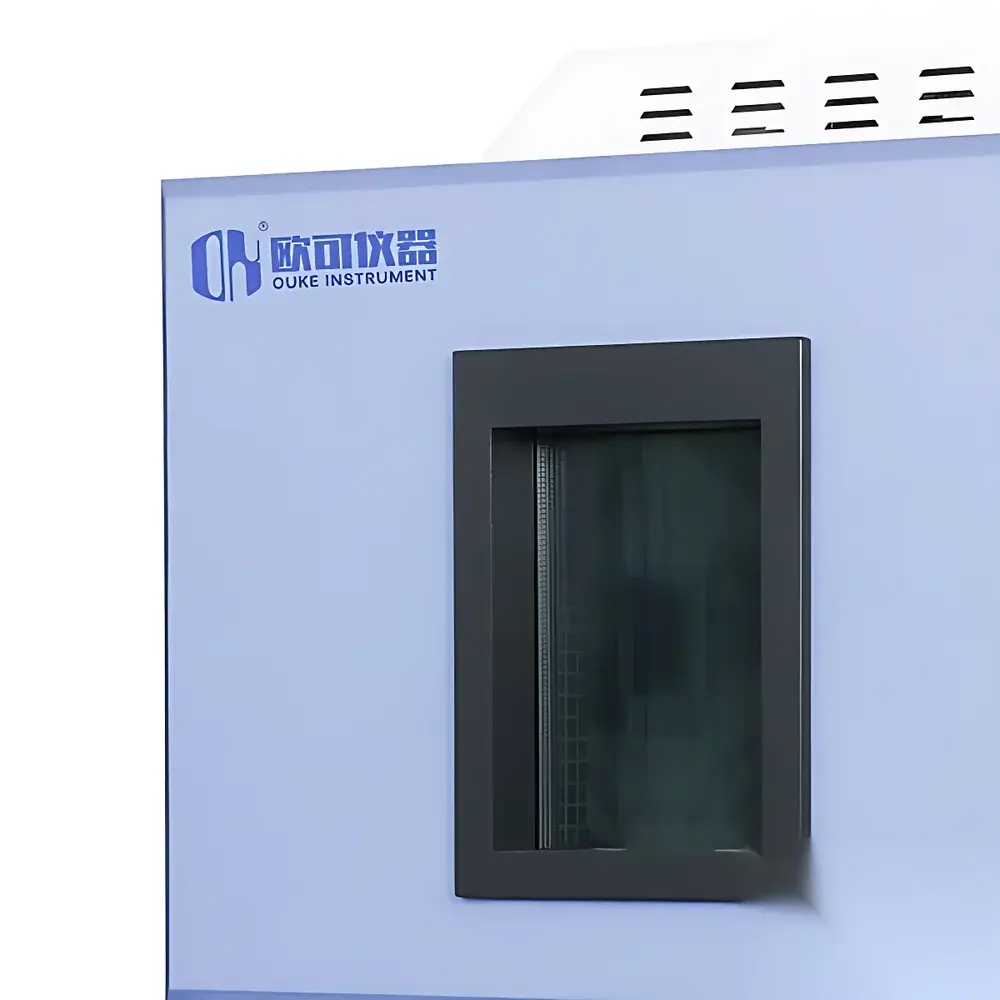
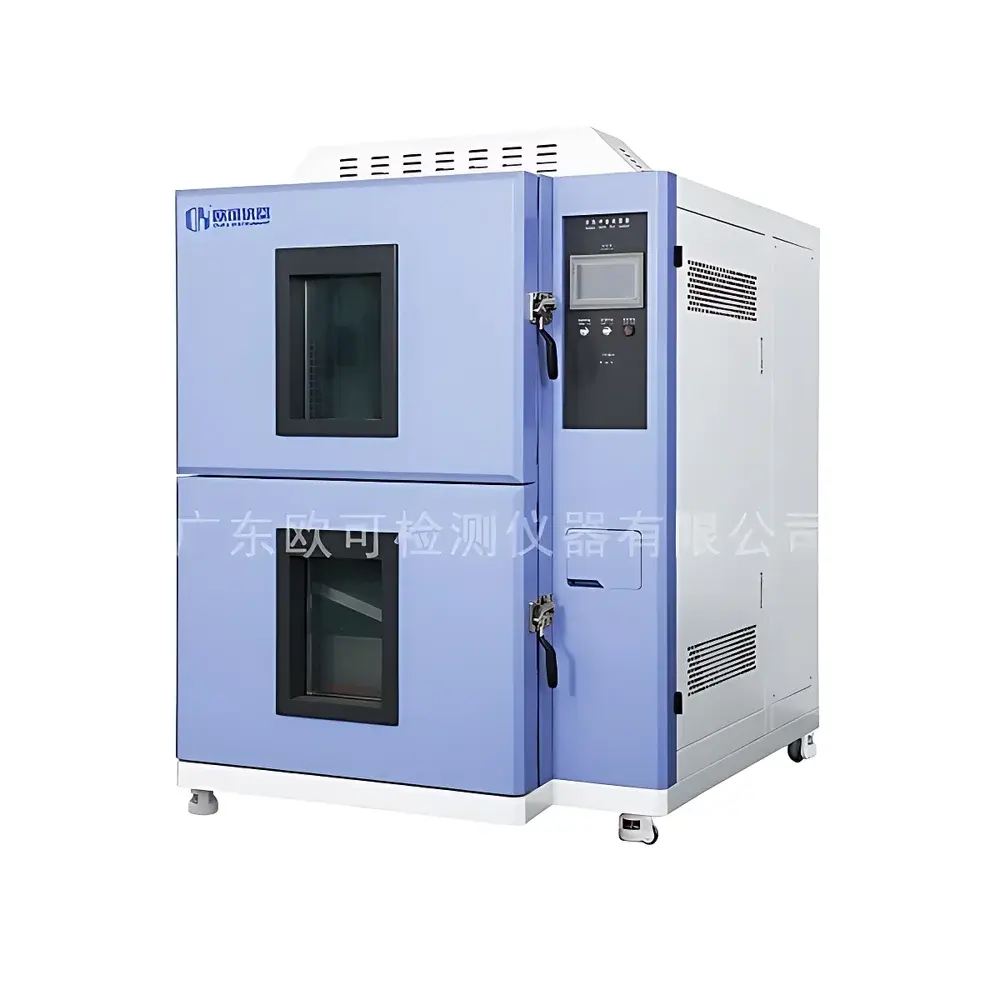
Thermal Shock Test Chamber – OK-HH Series (Three-Zone Configuration)
| Key | Brand: OEM |
|---|---|
| Origin | Imported |
| Manufacturer Type | Authorized Distributor |
| Price | USD 12,500–18,900 (FOB) |
| Temperature Range (Hot Zone) | RT to +200 °C |
| Temperature Range (Cold Zone) | RT to −70 °C |
| Test Zone Range | +60 °C to +150 °C (hot shock) |
| Temp. Uniformity | ±2.0 °C |
| Control Accuracy | ±0.5 °C |
| Refrigeration | Dual-stage cascade system with R404A/R23 refrigerants |
| Construction | Interior—SUS304 mirror-finish stainless steel |
| Insulation | High-density fire-retardant PU foam |
| Power Supply | AC 380 V ±5%, 50 Hz ±0.5 Hz, 3-phase 5-wire |
Overview
The OK-HH Series Thermal Shock Test Chamber is an engineered environmental stress screening (ESS) system designed for rapid, high-fidelity evaluation of material and component reliability under extreme thermal transients. Operating on the principle of two- or three-zone thermal storage and pneumatic compartment switching, it subjects test specimens to abrupt transitions between pre-conditioned high- and low-temperature environments—without mechanical movement of the sample itself (in three-zone configuration) or via motorized basket transfer (in two-zone variants). This methodology replicates real-world thermal shock conditions encountered during aerospace deployment, automotive powertrain operation, semiconductor packaging cycling, and military electronics fielding. The chamber’s core architecture enables precise control over dwell time, transition rate, and thermal gradient exposure—critical parameters defined in MIL-STD-810G Method 503.5, IEC 60068-2-14 (Test N), and ISO 16750-4 for automotive electronics.
Key Features
- Three-Zone Cascade Architecture: Independent hot zone (RT to +200 °C), cold zone (RT to −70 °C), and test zone—eliminating sample motion and ensuring zero vibration-induced artifacts during thermal transition.
- Pneumatic Air-Door Switching System: High-speed, leak-tight isolation valves achieve temperature transition in ≤5 minutes (per ASTM D696 & IEC 60068-2-14), with minimal thermal inertia and repeatable dwell stability.
- Dual-Stage Cascade Refrigeration: German-sourced semi-hermetic compressors operating in a water-cooled binary cycle (R404A/R23), delivering stable sub-zero performance without liquid nitrogen dependency.
- High-Fidelity Thermal Control: PID-based digital controllers with auto-tuning algorithms maintain ±0.5 °C setpoint accuracy and ±2.0 °C uniformity across the test volume (per IEC 60068-3-5).
- Robust Structural Design: SUS304 mirror-finish interior walls, 100 mm thick fire-rated polyurethane insulation (λ ≤ 0.022 W/m·K), and reinforced door sealing ensure long-term thermal integrity and corrosion resistance.
- Configurable Test Volume: Four standard models (OK-HH-49 to OK-HH-225) with internal chambers from 42 L to 252 L—fully customizable for non-standard specimen footprints and fixture integration.
Sample Compatibility & Compliance
The OK-HH chamber accommodates rigid and semi-rigid samples up to 45 kg, including printed circuit board assemblies (PCBAs), encapsulated sensors, battery modules, optical housings, and metallic weld joints. Its design supports standardized mounting via two-tier SUS304 shelves and a single 50 mm diameter cable/port access port. The system complies with full regulatory traceability requirements: built-in calibration ports for external PT100 verification, audit-ready temperature logging (1-second resolution), and configurable data export compatible with GLP/GMP documentation workflows. It meets the technical criteria of GB/T 2423.22–2002 (Temperature Change), GJB 150.5–2009 (Temperature Shock), QC/T 17–2019 (Automotive Component Environmental Testing), and EIA-364-32 (Connector Thermal Cycling). Optional validation packages include IQ/OQ documentation per ISO/IEC 17025 and FDA 21 CFR Part 11-compliant electronic signature support.
Software & Data Management
Built-in embedded controller firmware provides real-time graphing, multi-segment profile programming (up to 99 cycles, 999 steps), and alarm-triggered event logging (door open, compressor fault, sensor drift). USB and RS485 interfaces enable direct connection to laboratory LIMS or MES platforms. Optional PC software (Windows-compatible) adds advanced features: automated report generation (PDF/CSV), statistical process control (SPC) charting of chamber deviation trends, and synchronized multi-chamber fleet monitoring. All recorded thermal data—including timestamps, setpoints, actual chamber temperatures, and alarm history—is stored with immutable metadata, satisfying retention mandates under ISO 9001:2015 Clause 7.5.3 and EU Annex 11 for computerized system validation.
Applications
- Aerospace: Qualification testing of avionics enclosures per DO-160 Section 4.5 (Temperature Shock)
- Automotive: Validation of ADAS camera housings, EV battery thermal interface materials, and power electronics under ISO 16750-4 cycling profiles
- Semiconductors: Reliability screening of wafer-level chip-scale packages (WLCSP) and flip-chip interconnects
- Medical Devices: Accelerated aging of polymer-based diagnostic cartridges and implantable housing seals
- Research Institutions: Fundamental studies of coefficient of thermal expansion (CTE) mismatch failure modes in multi-material laminates
FAQ
What is the difference between two-zone and three-zone thermal shock configurations?
In a two-zone system, the test specimen moves between hot and cold chambers via a motorized basket—introducing mechanical stress and limiting maximum sample mass. In the three-zone OK-HH design, the specimen remains stationary while air doors isolate and connect pre-conditioned zones—enabling higher repeatability, lower vibration, and compatibility with sensitive optical or calibrated instrumentation.
Is external cooling water required?
Yes. The dual-stage cascade refrigeration system requires a dedicated closed-loop water supply at 10 m³/h flow rate and ≤32 °C inlet temperature—typically serviced by an external cooling tower. Chilled water integration is not supported.
Can the chamber be validated for GxP compliance?
Yes. Factory-installed Class A PT100 sensors (traceable to NIST), 21 CFR Part 11–enabled software options, and IQ/OQ protocol templates are available upon request.
What safety certifications does the unit carry?
Standard units comply with CE marking (EN 61000-6-2/-6-4, EN 61000-3-2/-3-3), UL 61010-1 (2nd Ed.), and RoHS 2011/65/EU. Custom configurations may include ATEX or IECEx certification for hazardous area use.
How is temperature uniformity verified across the test volume?
Per IEC 60068-3-5, uniformity is measured using nine calibrated PT100 probes placed at defined geometric locations (corners and center) during steady-state operation at −40 °C, +25 °C, and +125 °C—results documented in the final factory acceptance test (FAT) report.



