
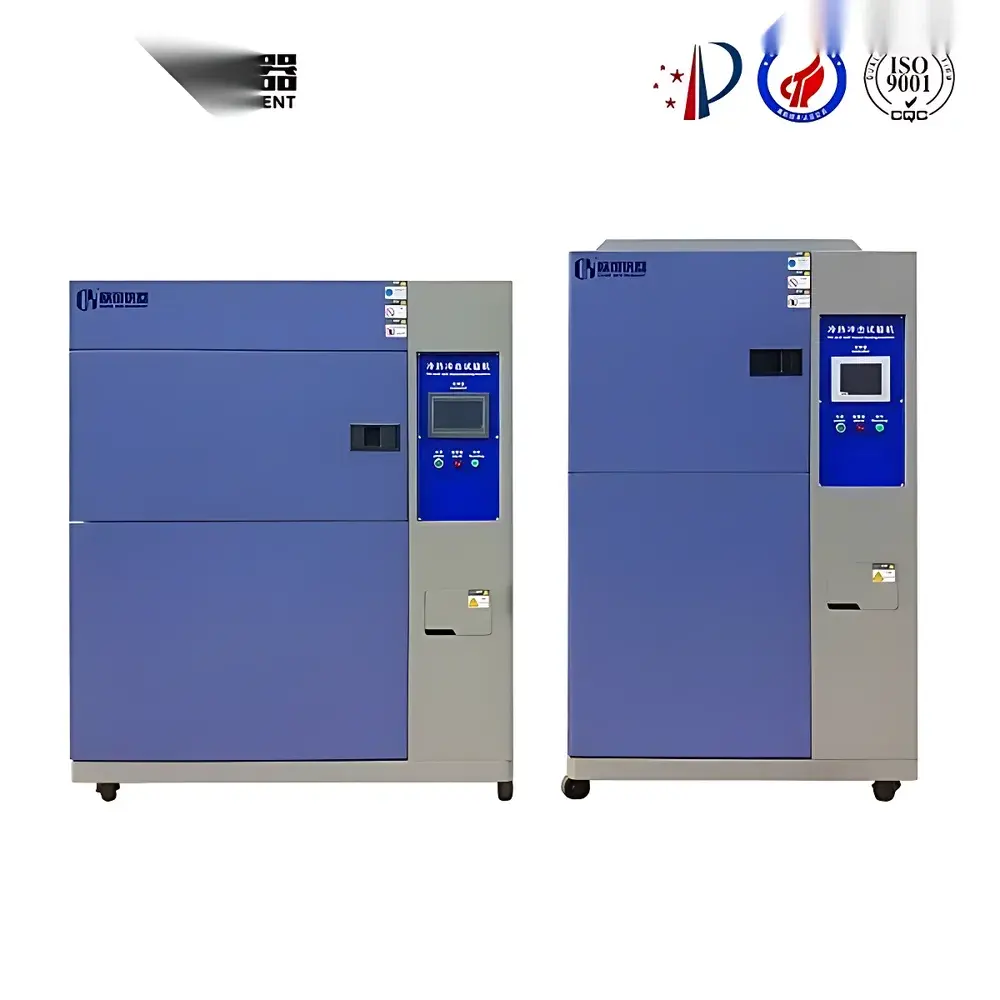
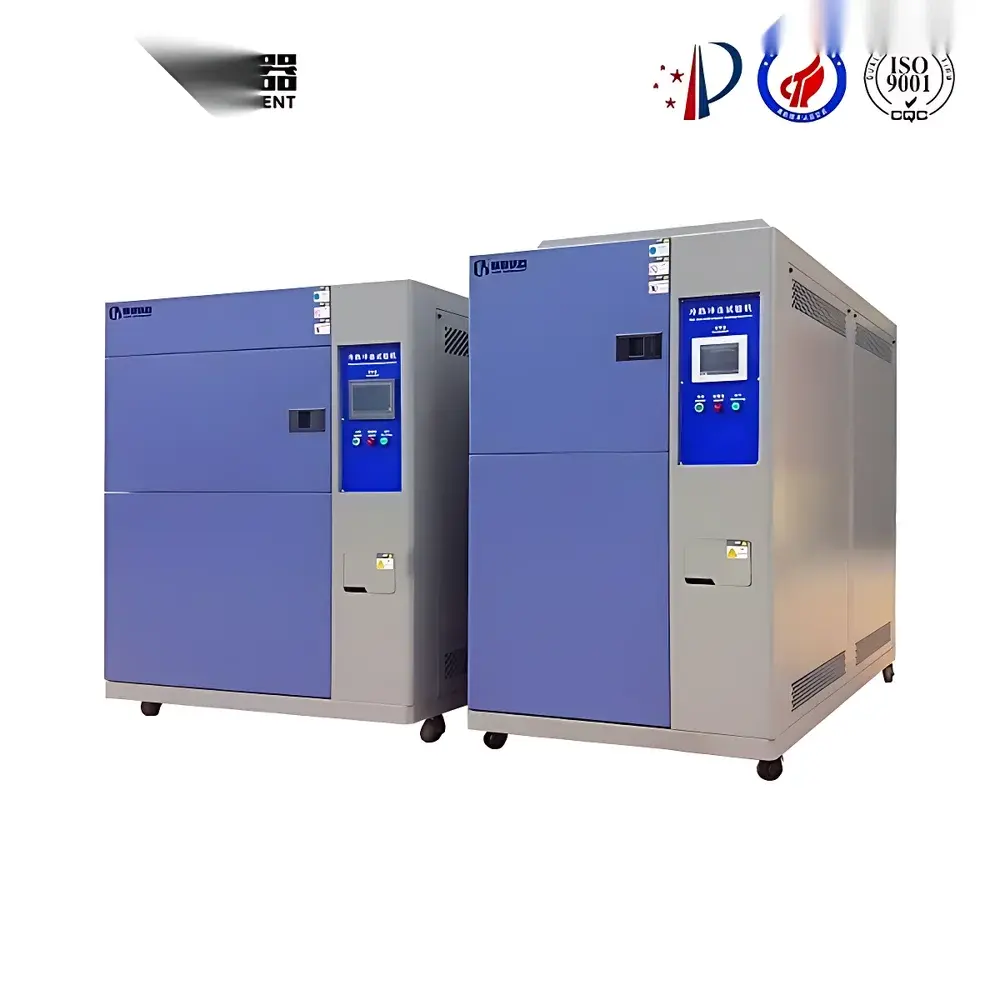
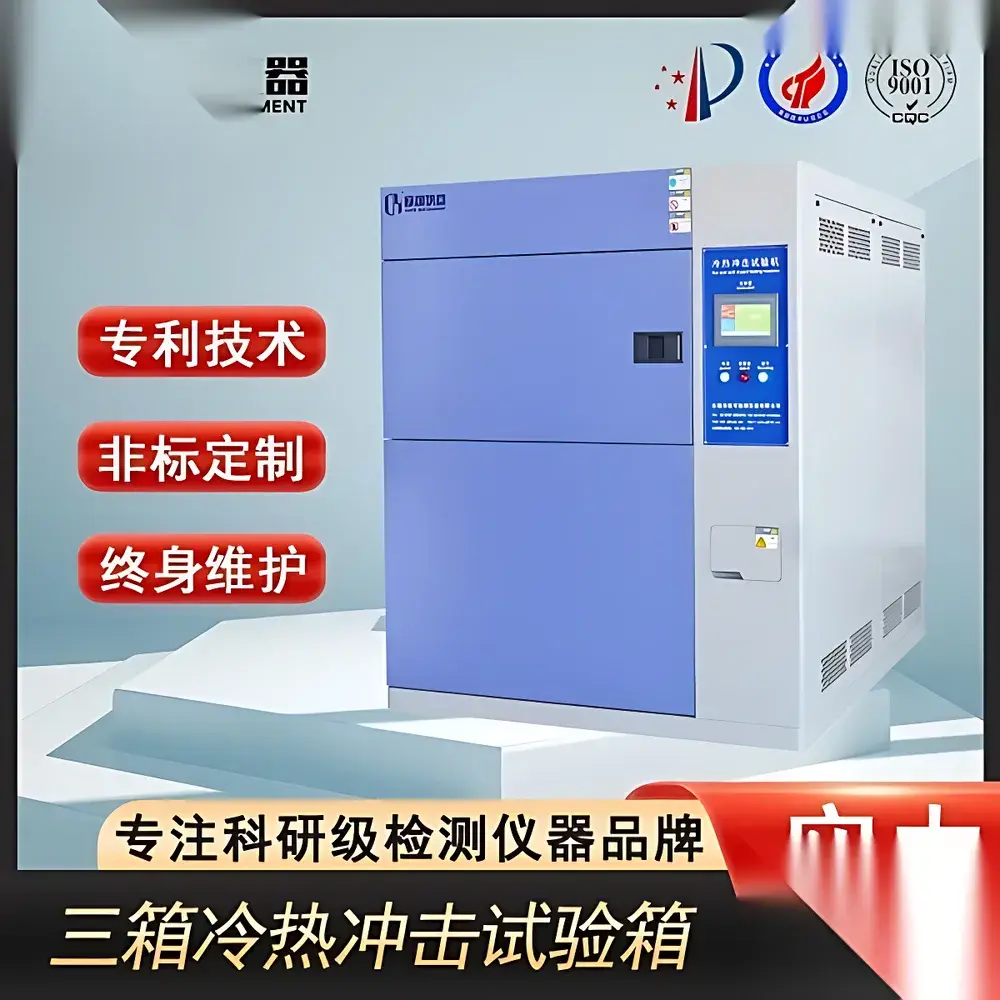
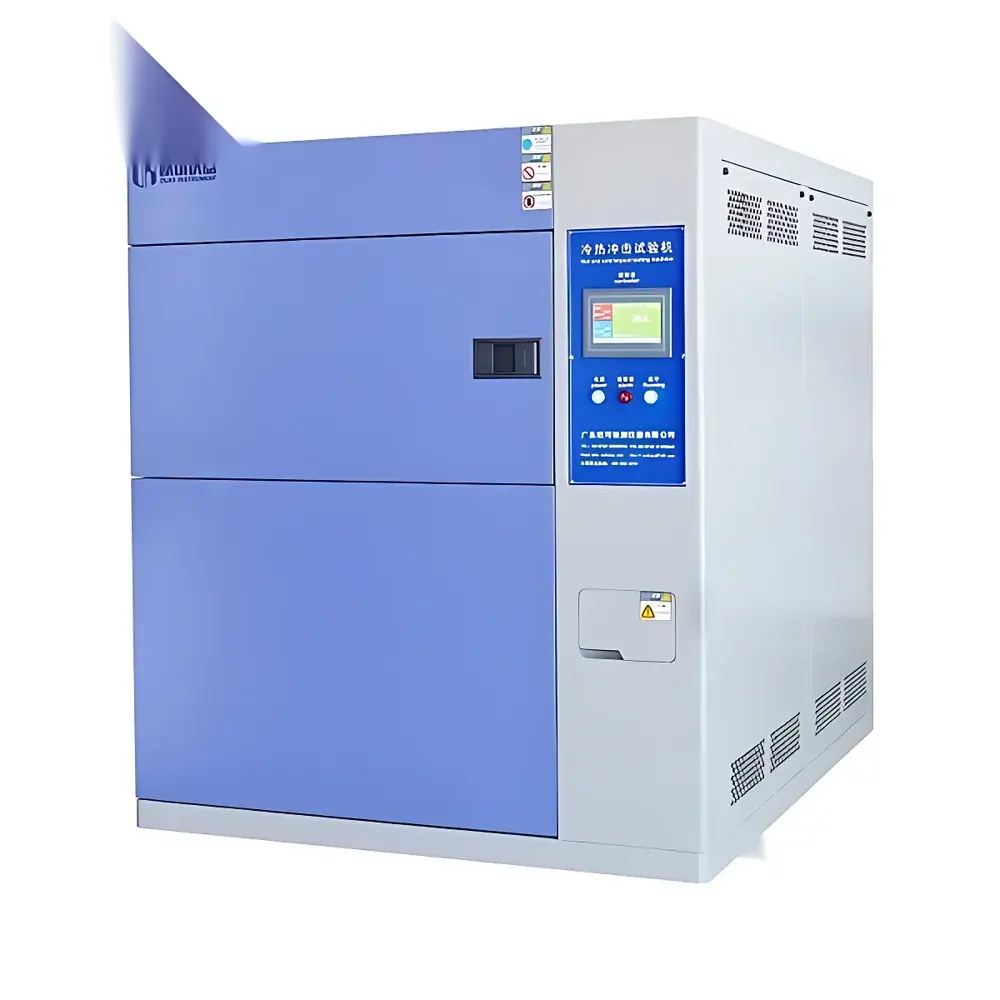
Thermal Shock Test Chamber – Industrial-Grade Dual-Compartment Environmental Test System
| Brand | Other Brands |
|---|---|
| Origin | Imported |
| Manufacturer Type | Authorized Distributor |
| Price | USD 11,200 (FOB) |
| Cooling Capacity | Dual-Stage Cascade Refrigeration System |
| Compressor | Imported Semi-Hermetic German Compressor |
| Cooling Method | Water-Cooled (Requires External 10 m³/h Cooling Tower) |
| Compliance | IEC 60068-2-14 (Test N), MIL-STD-810G Method 503.5, GJB 150.5A-2009, GB/T 2423.22-2022, ISO 16750-4, QC/T 17-2019 |
Overview
The Thermal Shock Test Chamber – Industrial-Grade Dual-Compartment Environmental Test System is an engineered solution for accelerated reliability validation of electronic components, automotive modules, aerospace assemblies, and precision optical devices under rapid thermal transition conditions. It operates on the principle of high-speed, controlled thermal cycling between independently regulated high-temperature and low-temperature chambers—enabling precise simulation of real-world thermal shock events such as power-on/off transients, environmental exposure shifts, or operational duty cycles in extreme climates. Unlike single-chamber thermal cycling systems, this dual-compartment architecture eliminates thermal inertia lag by physically transferring test specimens via a motorized lift-and-transfer mechanism, achieving transition times ≤ 15 seconds between −65 °C and +150 °C (typical). The system employs a two-stage cascade refrigeration cycle—comprising a high-temperature R404A loop and a low-temperature R23 loop—thermally coupled via an evaporative condenser. This configuration ensures stable sub-zero operation down to −70 °C while maintaining ±0.5 °C chamber uniformity (per IEC 60068-3-5) and ≤ 1.5 K/min average ramp rate across the full temperature range.
Key Features
- Dual-compartment design with independent temperature control: High-temp chamber (−10 °C to +200 °C), low-temp chamber (−70 °C to +100 °C)
- Automated specimen transfer mechanism with programmable dwell time (0–9999 min per zone) and transition delay compensation
- Water-cooled semi-hermetic German compressors with oil management system and high-efficiency shell-and-tube condensers
- Energy-regulated refrigeration control: Variable-speed expansion valves and adaptive load-matching logic reduce energy consumption by up to 28% versus fixed-capacity systems
- Stainless steel 304 interior with reinforced insulated doors, silicone gaskets, and anti-condensation heating strips
- Integrated safety interlocks: Over-temperature cut-off, compressor high-pressure shutdown, door-open alarm, and emergency stop circuit compliant with EN 60204-1
Sample Compatibility & Compliance
The chamber accommodates standard test specimens up to 500 mm × 500 mm × 500 mm (W×D×H) and supports mounting fixtures for PCBs, ECUs, sensors, battery packs, and hermetically sealed enclosures. It meets the mechanical and thermal stability requirements for qualification testing under multiple international and industry-specific standards—including IEC 60068-2-14 (Test N), MIL-STD-810G Method 503.5, GJB 150.5A-2009 (Chinese military standard for temperature shock), ISO 16750-4 (road vehicles—environmental conditions), and QC/T 17-2019 (automotive component weathering). Its temperature uniformity, stability, and transition repeatability are verified per ISO/IEC 17025-accredited calibration procedures. Data traceability supports GLP/GMP environments through optional audit-ready logging with timestamped event records.
Software & Data Management
Equipped with a 10.1″ industrial touchscreen HMI running embedded Linux, the system provides intuitive multi-segment profile programming, real-time graphing of chamber temperatures and specimen surface thermocouple inputs (optional K-type or T-type), and USB/RS485/Ethernet connectivity. The embedded controller logs all operational parameters—including compressor run hours, refrigerant pressures, door status, and alarm history—at 1-second intervals. Export formats include CSV and PDF reports compatible with LIMS integration. Optional software add-ons enable FDA 21 CFR Part 11 compliance with electronic signatures, role-based user access control, and automated report generation aligned with ISO/IEC 17025 documentation requirements.
Applications
- Qualification of solder joint integrity in high-density PCB assemblies under repeated thermal stress
- Validation of adhesive bond durability in optoelectronic housings exposed to diurnal cycling
- Screening of MEMS device packaging for delamination or microcrack initiation
- Reliability assessment of lithium-ion battery modules under cold-start and hot-soak scenarios
- Verification of conformal coating performance on automotive engine control units (ECUs)
- Pre-compliance screening for AEC-Q200 stress testing protocols in component suppliers
FAQ
What is the minimum achievable temperature in the low-temperature chamber?
The system achieves a stabilized operating temperature of −70 °C under nominal load conditions, verified per GB/T 2423.1-2022 Annex B.
Is external cooling water infrastructure mandatory?
Yes. A dedicated closed-loop cooling tower delivering 10 m³/h at 32 °C inlet temperature is required for continuous operation above 85% duty cycle.
Can the chamber be configured for single-zone thermal cycling?
No. This model is strictly dual-compartment; single-zone configurations require separate product SKUs.
Does the system support remote monitoring via Ethernet?
Yes. Standard Ethernet port enables Modbus TCP communication and integration with building management systems (BMS) or centralized lab monitoring platforms.
What calibration documentation is provided upon delivery?
Each unit ships with a factory calibration certificate traceable to NIM (National Institute of Metrology, China) and includes verification data for temperature uniformity, stability, and transition time per IEC 60068-3-5.



