
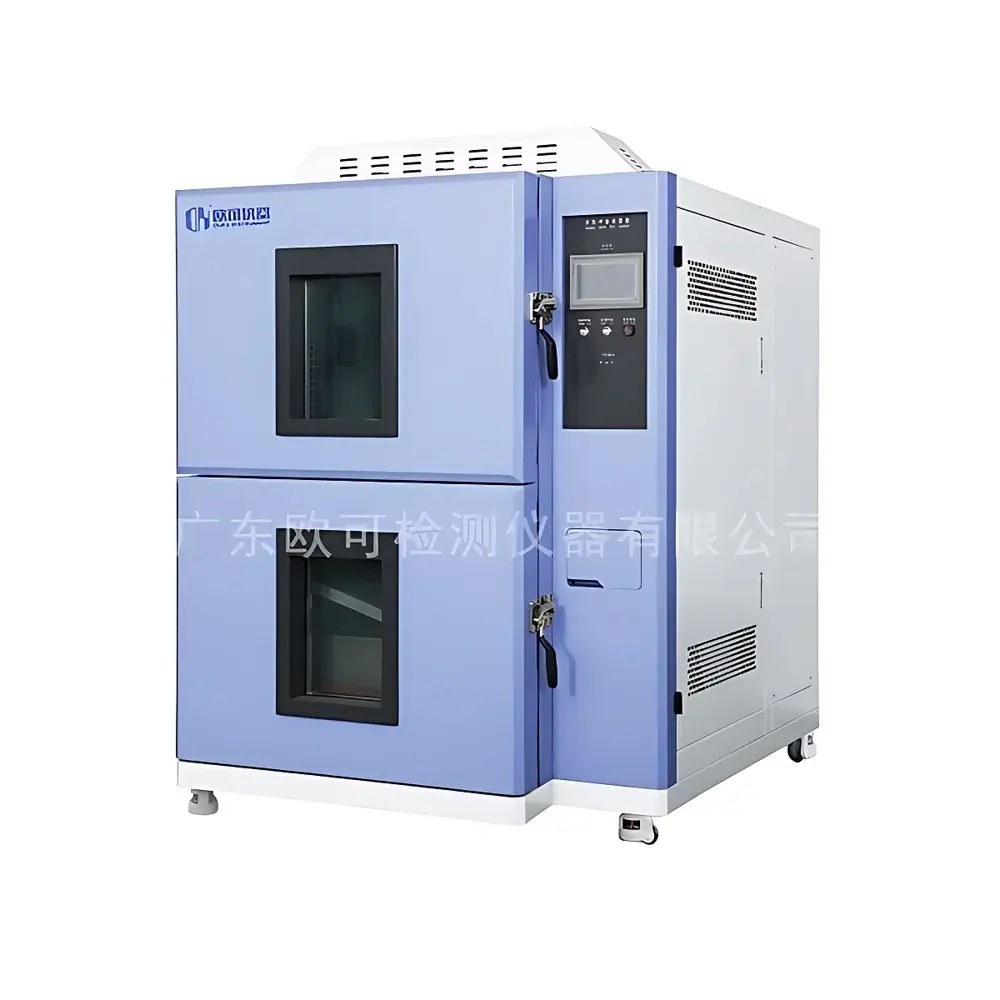
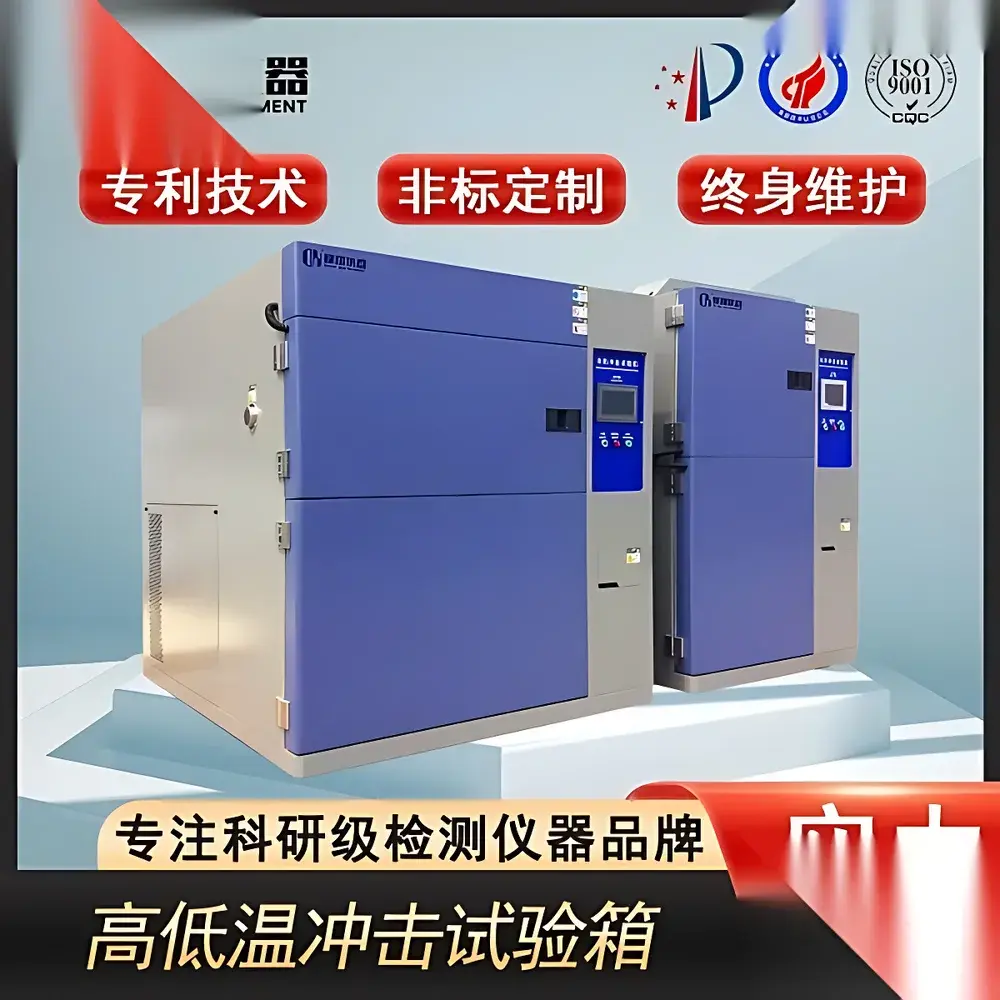
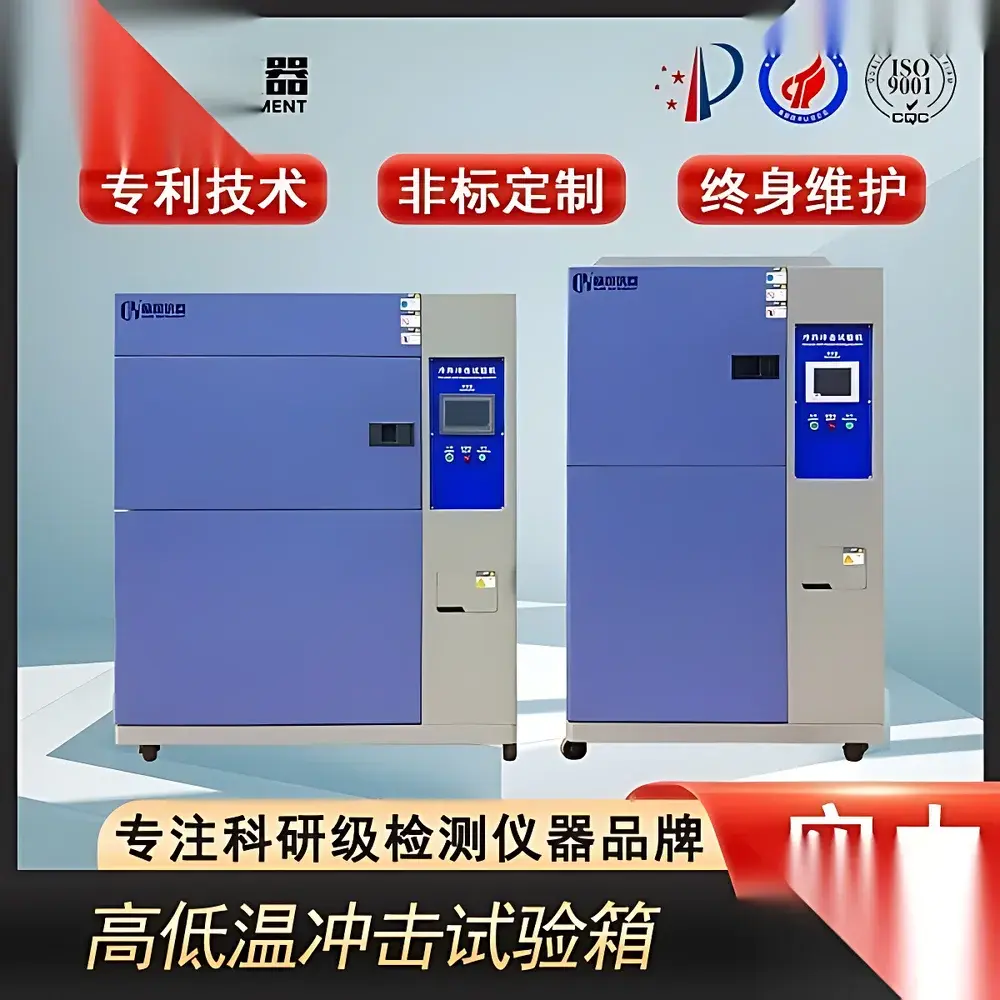
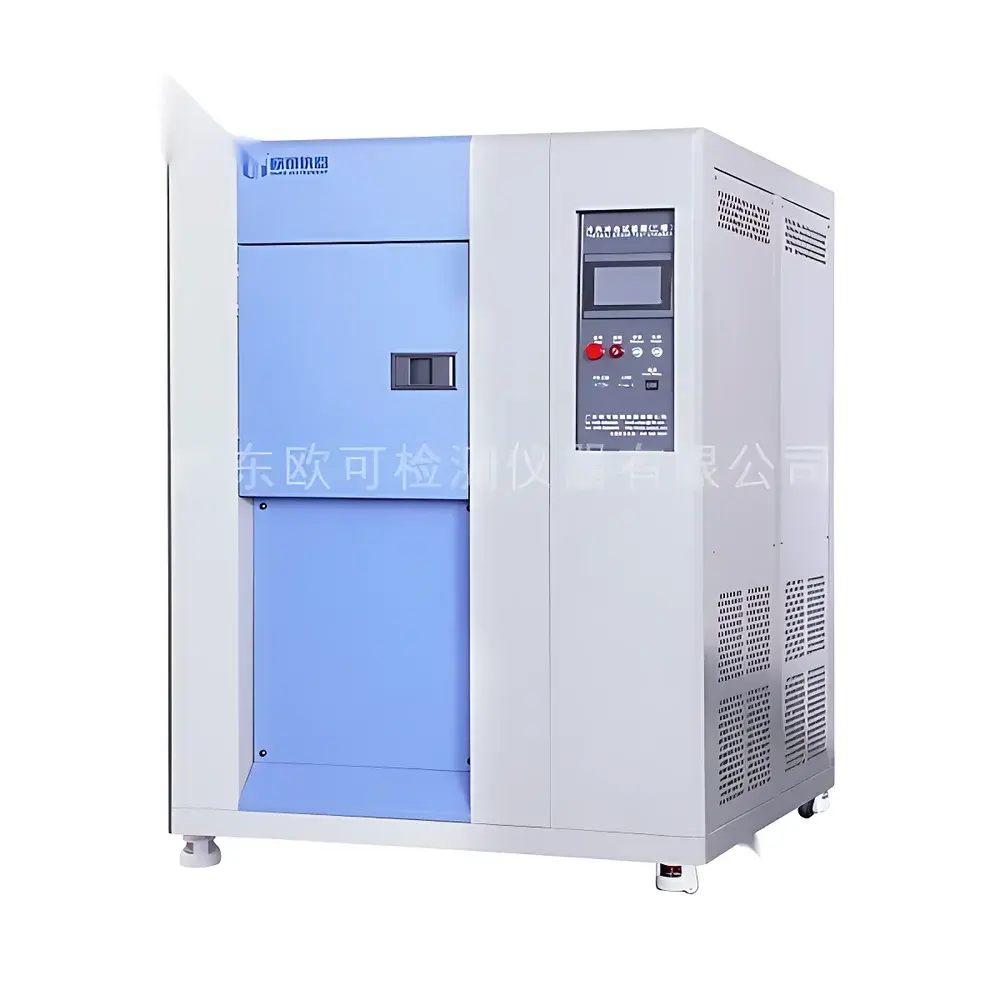
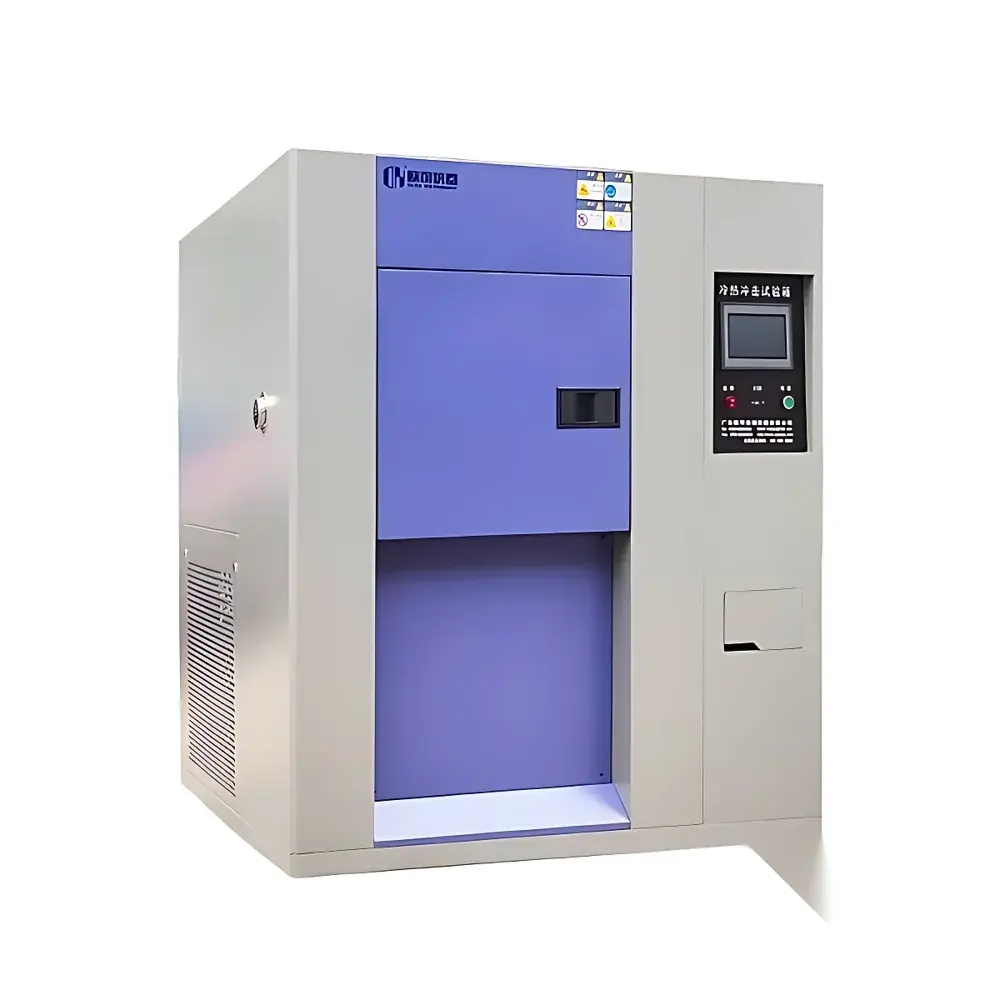
Thermal Shock Test Chamber – Industrial-Grade Dual-Zone Rapid Temperature Transition System
| Brand | Generic OEM |
|---|---|
| Origin | Imported |
| Manufacturer Type | Authorized Distributor |
| Price | USD 11,200 (FOB) |
| Control System | Touchscreen PID Controller with Schneider Electrical Components |
| Display Resolution | 0.01°C |
| Operation Modes | Constant & Programmable |
| Max Program Capacity | 120 Programs × 99 Steps Each |
| Total Cycles | Up to 999 |
| Power Failure Recovery | Resume from Breakpoint or Abort |
| Real-Time Monitoring | Segment Time, Remaining Time, Cycle Count, Temp Deviation, Heating/Cooling Status, Calendar Timestamp |
| Fault Diagnostics | On-Screen Error Code Indexing |
| Alarm Types | Absolute Limit, Deviation, Sensor Failure |
| Comprehensive Safety Interlocks | Phase Loss/Sequence Imbalance, Fan Overload, Overtemperature (Chamber & Compressor), High-Pressure Cutout, Ground Fault, Emergency Stop |
Overview
The Thermal Shock Test Chamber is an industrial-grade environmental stress screening (ESS) system engineered for rapid, repeatable thermal transition testing between extreme high- and low-temperature zones. It operates on a dual-chamber (hot/cold) or single-chamber with liquid nitrogen or mechanical cascade refrigeration architecture—enabling temperature transitions as fast as 15–30 seconds between preset extremes (e.g., −65°C ↔ +150°C). Unlike standard thermal cycling chambers, this system isolates thermal mass transfer through pneumatic door actuation and insulated partitioning, minimizing thermal lag and ensuring high reproducibility of shock profiles. Designed for reliability under continuous qualification testing, it supports accelerated life testing (ALT), HALT/HASS pre-screening, and failure mode analysis in electronics, aerospace components, automotive ECUs, and polymer-based assemblies.
Key Features
- High-fidelity 7-inch color LCD touchscreen controller with full Chinese/English bilingual interface and intuitive menu navigation—compliant with IEC 61000-4-30 Class A power quality logging requirements.
- Precision PID control algorithm with auto-tuning capability; achieves ±0.3°C temperature uniformity (at 100 mm from chamber wall, per ISO 16750-4 Annex B) and ±0.5°C stability over 2-hour dwell periods.
- Programmable logic with up to 120 independent test profiles; each profile supports 99 sequential steps—including ramp rate definition (°C/min), dwell duration (s/min/h), and conditional branching (e.g., “if deviation > ±2°C, pause and log”)
- Robust safety architecture: integrated phase monitoring (voltage imbalance ≤2%, phase loss detection), dual-stage compressor high-pressure cutout, redundant overtemperature sensors (chamber air + heater surface), and ground-fault circuit interrupter (GFCI) compliant with UL 61010-1.
- Intelligent fault diagnostics: real-time error code display (e.g., E07 = cold chamber sensor open circuit; E23 = SSR failure) linked to embedded troubleshooting guide accessible via controller menu.
- Power interruption resilience: configurable recovery mode—either resume execution from last completed step or terminate and retain full audit trail of interrupted cycle parameters.
Sample Compatibility & Compliance
This chamber accommodates test specimens up to 500 mm × 500 mm × 500 mm (W×D×H) with standardized mounting rails and optional internal load thermocouple ports (J/K-type, 6-channel input). It meets the mechanical and climatic test requirements specified in MIL-STD-810H Method 503.5 (Temperature Shock), IEC 60068-2-14 (Test Nb: Change of Temperature), and automotive standards such as GMW 3172 and Ford CETP 00.00-L-467. All thermal performance verifications are traceable to NIST-calibrated reference probes and documented per ISO/IEC 17025:2017 calibration procedures. The unit is CE-marked and conforms to EN 61000-6-2 (immunity) and EN 61000-6-4 (emission) directives.
Software & Data Management
Equipped with optional PC-based data acquisition software (Windows 10/11 compatible), the system supports real-time streaming of up to 16 channels—including chamber setpoints, actual temperatures (hot/cold zones, payload surface), compressor discharge pressure, and door status. Data is logged at user-defined intervals (100 ms–60 s) in CSV and binary formats, with built-in timestamping synchronized to UTC via NTP. Audit trails include operator ID, program version hash, parameter change history, and electronic signatures—fully compliant with FDA 21 CFR Part 11 requirements when configured with role-based access control and digital certificate authentication.
Applications
- Qualification testing of printed circuit board assemblies (PCBAs) per IPC-9701A for solder joint integrity under repeated thermal stress.
- Evaluation of encapsulant delamination resistance in optoelectronic packages (e.g., LED modules, laser diodes).
- Validation of adhesive bond strength in multi-material automotive sensors exposed to under-hood thermal transients.
- Stress screening of MEMS devices prior to burn-in, per JEDEC JESD22-A106B guidelines.
- Material compatibility assessment of conformal coatings (acrylic, silicone, parylene) under cyclic condensation conditions aligned with IEC 60068-2-30.
FAQ
What is the minimum achievable transition time between extreme temperatures?
Typical hot-to-cold transfer time is 15–25 seconds for a 200°C delta (e.g., +150°C → −50°C), verified using calibrated black-body target probes per ASTM E2847 Annex A3.
Does the system support custom alarm escalation protocols (e.g., email/SMS alerts)?
Yes—when integrated with optional Ethernet-enabled I/O module and third-party SCADA platforms (Modbus TCP, OPC UA), external notification triggers can be configured for critical faults.
Can the chamber be validated for IQ/OQ/PQ in GMP environments?
Absolutely—the controller firmware includes 21 CFR Part 11-compliant audit trail generation, electronic signature capture, and password-protected configuration lockdown modes required for pharmaceutical and medical device validation.
Is nitrogen purging available for moisture-sensitive test samples?
Optional dry-air or LN₂ purge kits are available with flow-controlled inert gas manifolds and dew point monitoring (−40°C Td) to suppress condensation during low-temperature exposure phases.



