
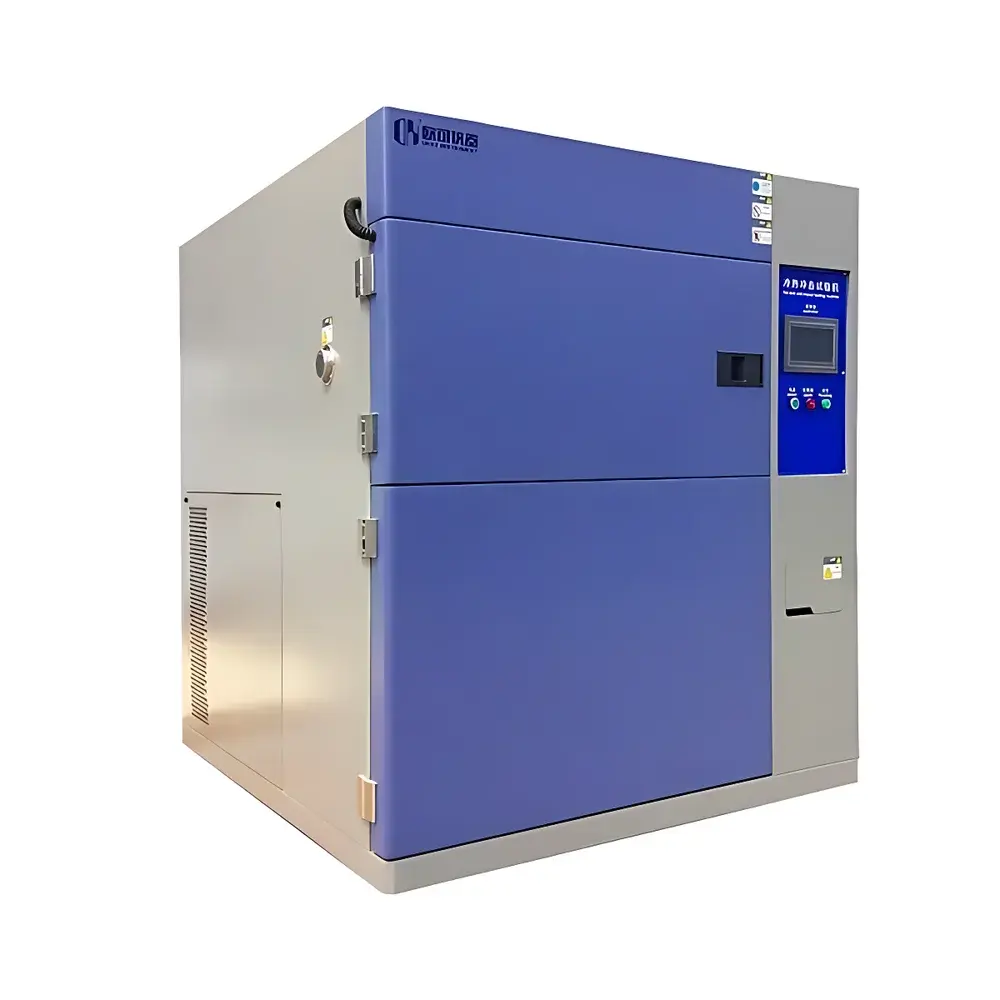
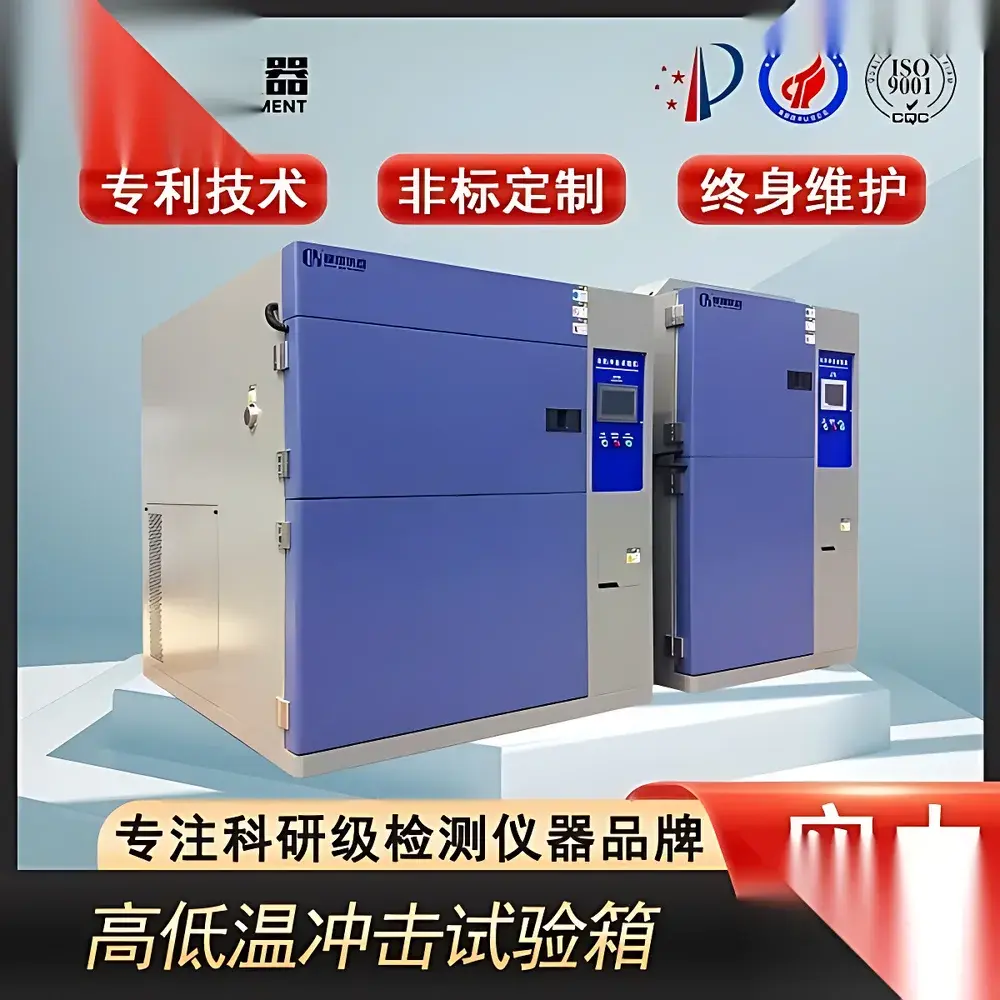
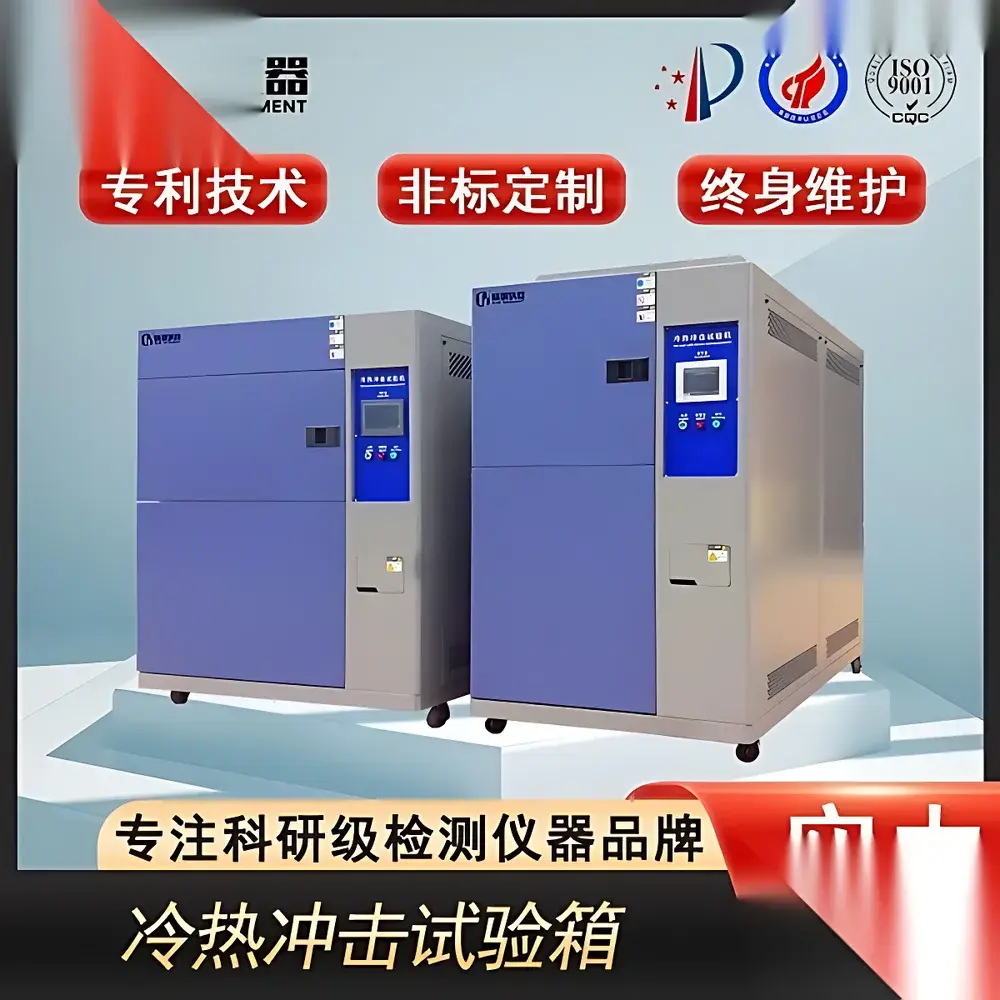
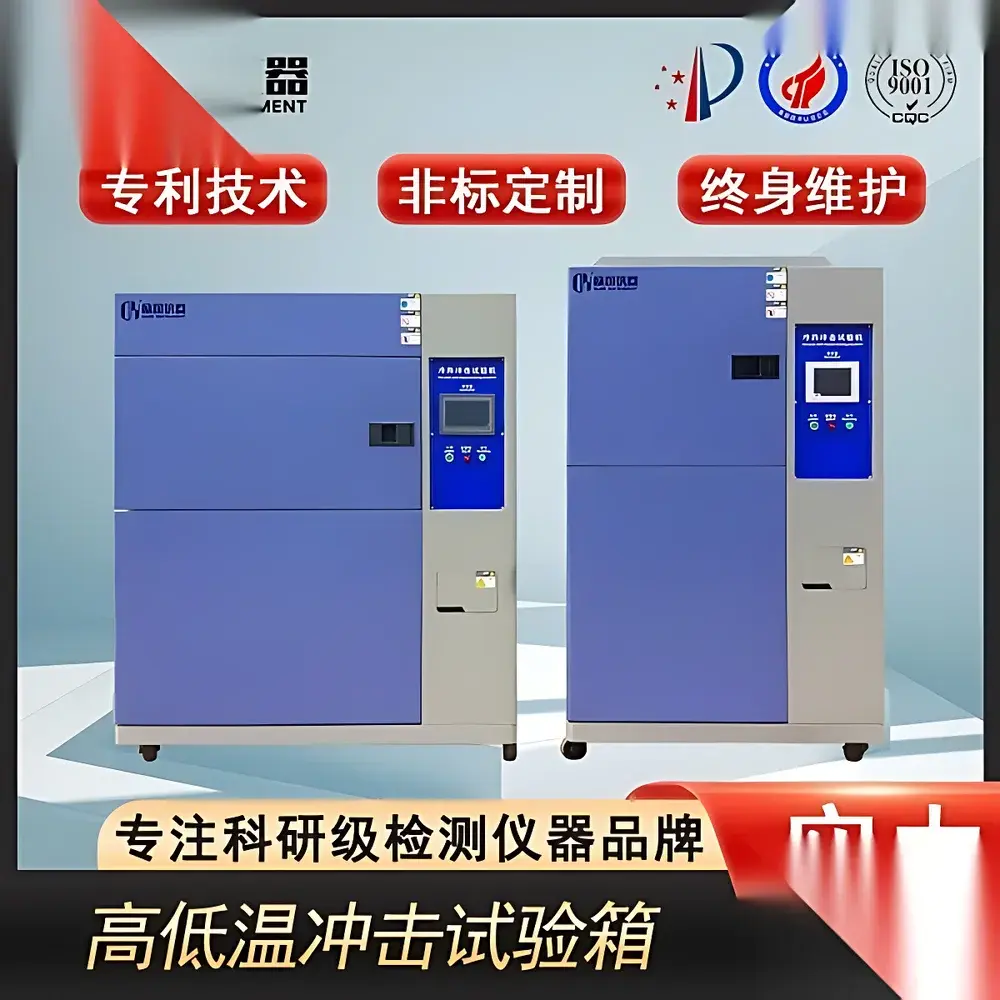
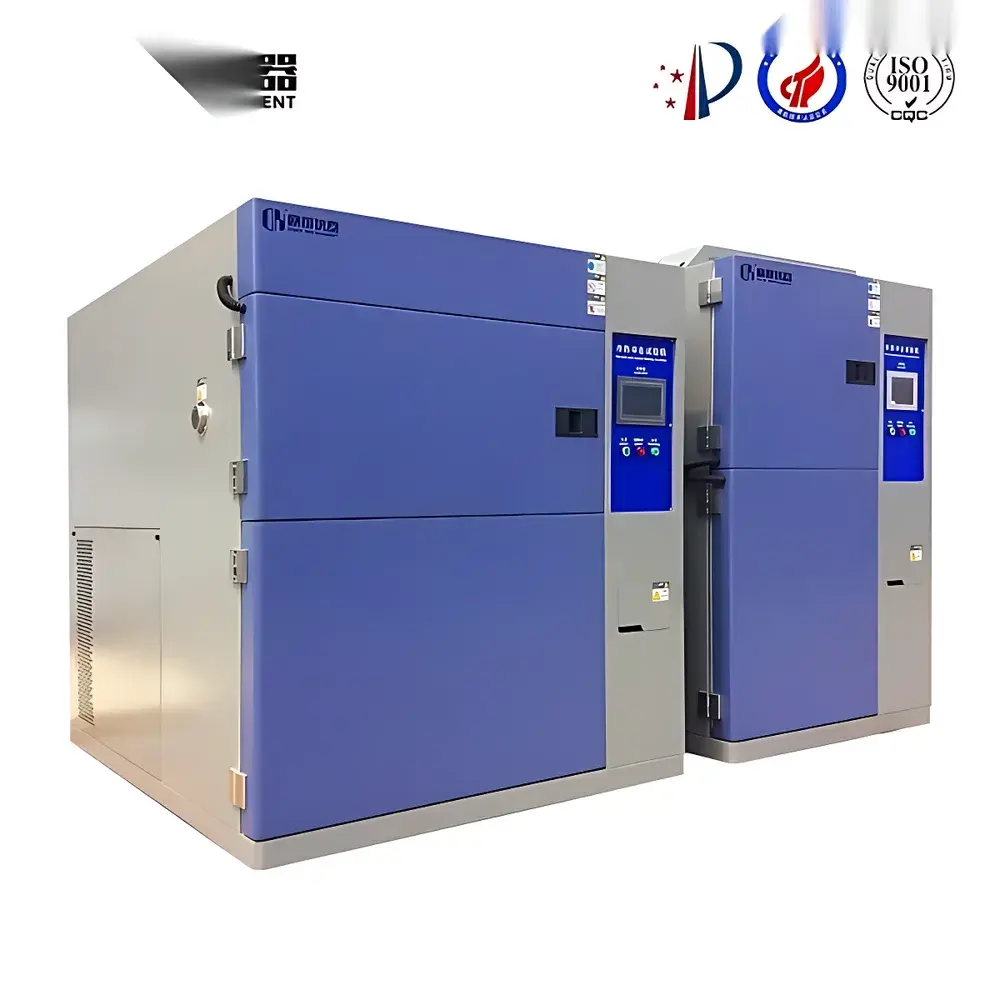
Thermal Shock Test Chamber – Standard Dual-Zone Rapid Transition Environmental Test System
| Key | Temperature Range (Hot Zone): RT to +150 °C (unloaded) |
|---|---|
| Temperature Range (Cold Zone) | RT to −20 °C (unloaded) |
| Temperature Fluctuation | ±1 °C |
| Temperature Uniformity | ±3 °C |
| Ramp Rate (Heating) | ≤25 min (RT → +150 °C, average) |
| Ramp Rate (Cooling) | ≤15 min (RT → −20 °C, average) |
| Low-Temperature Limit | ≤−25 °C |
| Thermal Shock Transition Range | +150 °C ↔ −20 °C |
| Load Capacity | ≤30 kg |
| Temperature Recovery Time | ≤5 min |
| Basket Transfer Time | ≤15 s |
| Power Rating | 13–20 kW (model-dependent) |
| Refrigerant | HFC-based, dual-stage cascade cryogenic system |
Overview
The Thermal Shock Test Chamber – Standard Dual-Zone Rapid Transition Environmental Test System is an engineered solution for accelerated reliability assessment of materials and components subjected to extreme thermal cycling. Based on the two-chamber (hot/cold) mechanical basket transfer principle, it subjects test specimens to rapid, repetitive transitions between high- and low-temperature environments—simulating real-world thermal stress conditions such as those encountered during automotive under-hood operation, aerospace component deployment, or consumer electronics field use. Unlike single-chamber air-shock systems, this dual-zone architecture ensures stable, independent temperature control in each chamber, minimizing thermal cross-contamination and enabling precise, repeatable shock profiles per ASTM D5229, IEC 60068-2-14, MIL-STD-810H Method 503.5, and JIS C 60068-2-14. The system is designed for laboratory and production-line validation of solder joint integrity, polymer embrittlement, seal adhesion loss, interfacial delamination, and coefficient-of-thermal-expansion (CTE) mismatch failure modes.
Key Features
- Dual independent temperature zones (hot: RT to +150 °C; cold: RT to −20 °C, with ≤−25 °C capability) maintained via separate refrigeration and heating circuits
- Motorized lift-and-transfer specimen basket with ≤15-second dwell-to-dwell transition time, compliant with MIL-STD-810H and IEC 60068-2-14 timing requirements
- Temperature recovery time ≤5 minutes post-transfer—verified per chamber sensor network and traceable to NIST-traceable calibration standards
- HFC-based dual-stage cascade refrigeration system optimized for rapid cooling efficiency and long-term operational stability without ozone-depleting substances
- Full-color 7-inch capacitive touch LCD controller with bilingual (English/Chinese) interface, supporting multi-segment programmable profiles, alarm logging, and real-time curve visualization
- Embedded data logger with non-volatile memory—records temperature, time, basket position, and system status at user-defined intervals (1–60 s), exportable via USB or Ethernet to CSV or proprietary .tsd format
- Modular power architecture offering 13 kW, 15 kW, 18 kW, and 20 kW configurations to match chamber volume and thermal load requirements (max. 30 kg payload)
- Comprehensive safety suite including over-temperature cutoff, refrigerant pressure monitoring, door interlock, and emergency stop circuitry compliant with IEC 61000-6-2/6-4 EMC and UL 61010-1 electrical safety standards
Sample Compatibility & Compliance
This thermal shock chamber accommodates a broad range of sample geometries and material classes—including printed circuit assemblies (PCBAs), molded plastic housings, metal castings, composite laminates, and hermetically sealed optoelectronic modules—within its standard 450 × 450 × 450 mm internal test volume. All internal surfaces are constructed from electropolished stainless steel (AISI 304) to resist corrosion and facilitate cleaning under GMP-relevant protocols. The system supports full compliance documentation packages—including IQ/OQ protocols, calibration certificates (traceable to national metrology institutes), and FAT/SAT reports—required for regulated industries such as medical device manufacturing (ISO 13485), automotive (IATF 16949), and aerospace (AS9100). It meets environmental test reporting requirements under ISO/IEC 17025 for accredited laboratories performing qualification testing per customer-specific specifications.
Software & Data Management
The integrated thermal shock management software provides full remote operation, profile development, and audit-ready data handling. Users can define multi-step thermal shock sequences—including dwell times, ramp rates, cycle counts, and conditional branching—via intuitive drag-and-drop logic. All test executions generate timestamped, digitally signed log files with embedded metadata (operator ID, chamber serial number, calibration due date, ambient lab conditions). Data exports support FDA 21 CFR Part 11 compliance when deployed with optional electronic signature and audit trail modules. Raw temperature traces are stored in IEEE 754-compliant floating-point format, ensuring numerical fidelity for post-test statistical analysis (e.g., Weibull life estimation, Arrhenius acceleration modeling). Integration with LIMS and MES platforms is supported via RESTful API and OPC UA protocol stacks.
Applications
- Qualification testing of automotive ECUs, sensors, and battery module housings per AEC-Q200 and LV-124 standards
- Reliability screening of semiconductor packages (QFN, BGA, CSP) prior to burn-in and final test
- Validation of adhesive bond strength and encapsulant performance in LED lighting modules
- Assessment of thermal fatigue resistance in MEMS devices and piezoelectric actuators
- Accelerated aging studies for polymer-based medical device components (e.g., catheter shafts, drug delivery housings)
- Pre-shipment stress screening for avionics line-replaceable units (LRUs) per DO-160 Section 4.10
FAQ
What is the minimum recommended dwell time per zone to ensure thermal equilibrium?
Dwell times are application-specific but typically ≥15 minutes per zone for components up to 500 g mass; validated dwell durations are included in the chamber’s standard operating procedure (SOP) templates.
Can the system be configured for extended low-temperature operation below −20 °C?
Yes—optional ultra-low cold zone configuration extends capability to −40 °C or −65 °C using enhanced cascade refrigeration; contact engineering support for thermal load modeling and power upgrade requirements.
Is third-party calibration and certification available?
Yes—certified calibration services include NIST-traceable sensor verification, uniformity mapping per IEC 60068-3-5, and full compliance reporting aligned with ISO/IEC 17025 Annex A.2.
Does the controller support custom alarm thresholds and automated email notifications?
Yes—the web-enabled controller allows user-defined deviation limits, SMS/email alerting via SMTP/TLS, and integration with enterprise IT notification systems.
What maintenance intervals are recommended for the dual-stage refrigeration system?
Refrigerant oil analysis and filter dryer replacement every 2,000 operating hours; full system performance verification annually or after 500 thermal shock cycles—documented in the preventive maintenance logbook supplied with each unit.



