
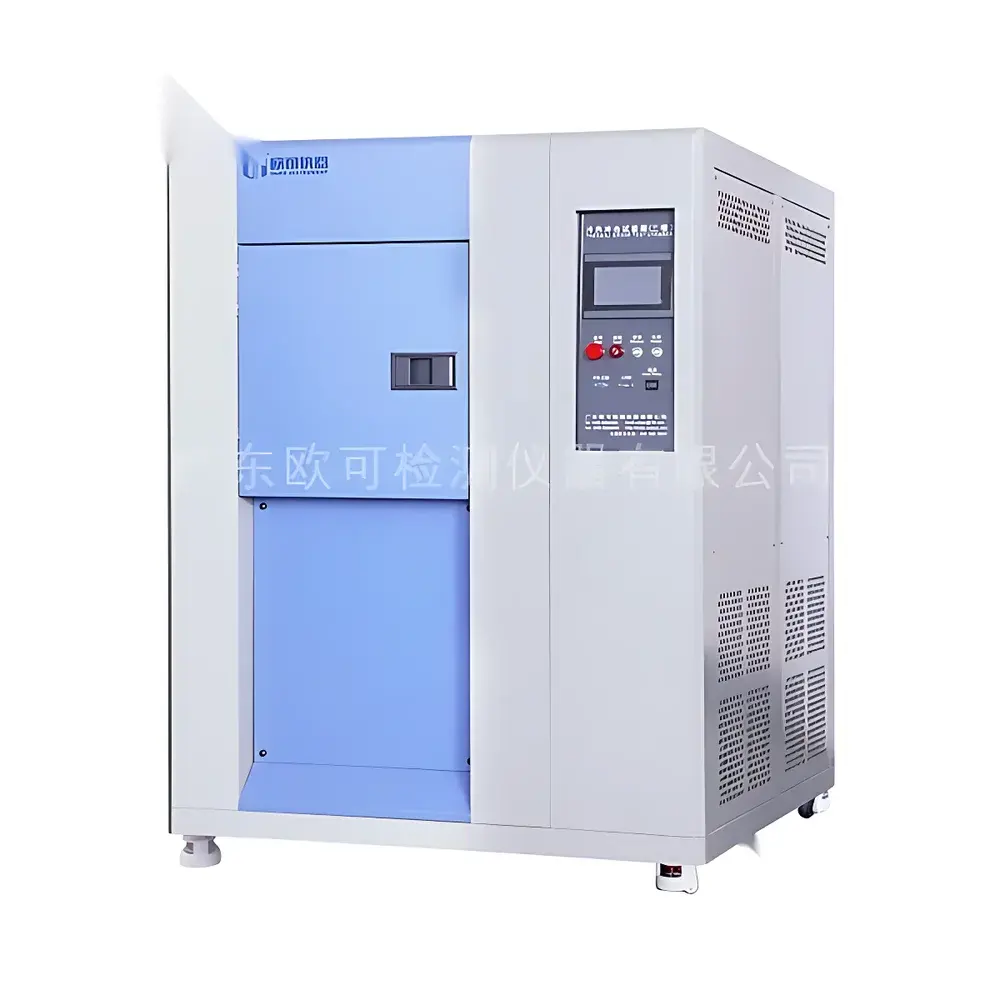
Thermal Shock Test Chamber – Standard Model with TEMI880 Controller
| Key | Temperature Range: −70 °C to +150 °C |
|---|---|
| Humidity Range | 20–98% RH |
| Temp. Uniformity | ±1.5 °C |
| Humidity Uniformity | ±3% RH |
| Temp. Stability | ±0.5 °C |
| Humidity Stability | ±2% RH |
| Internal Dimensions (W×H×D) | 600 × 850 × 800 mm |
| External Dimensions (W×H×D) | 1200 × 1700 × 1300 mm |
| Construction | Interior – SUS#304 stainless steel (1 mm thick) |
| Insulation | Rigid polyurethane foam + fiberglass wool |
| Refrigeration System | Hermetic compressor (Tecumseh or equivalent), eco-friendly refrigerant (R404A/R507), air-cooled condenser, fin-tube evaporator, solenoid valve, dryer filter, capillary tube |
| Heating System | U-shaped finned tubular heaters |
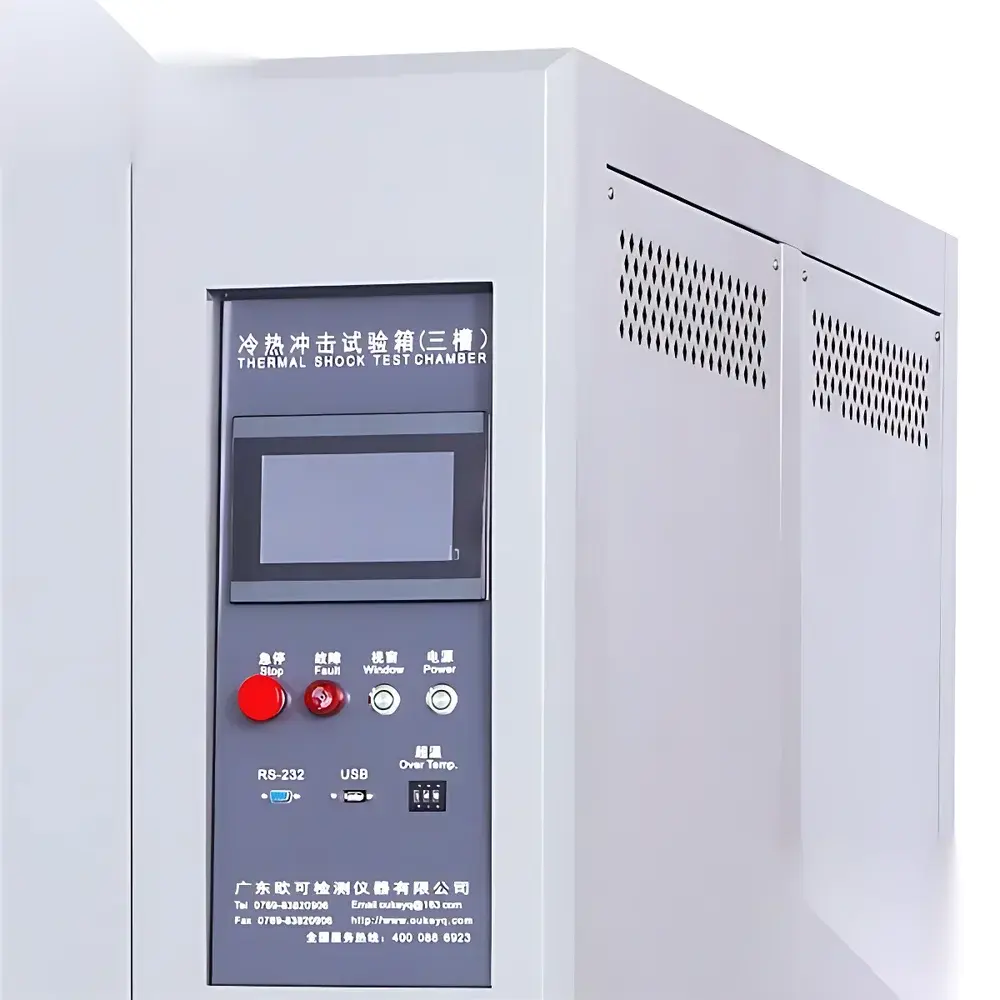
| Control System | TEMI880 color touchscreen programmable controller (LCD, bilingual English/Chinese interface, multi-segment PID control, real-time curve display, alarm logging, data export via USB) |
| Power Supply | 3-phase 5-wire 380 VAC ±10% or 2-phase 3-wire 220 VAC ±10% |
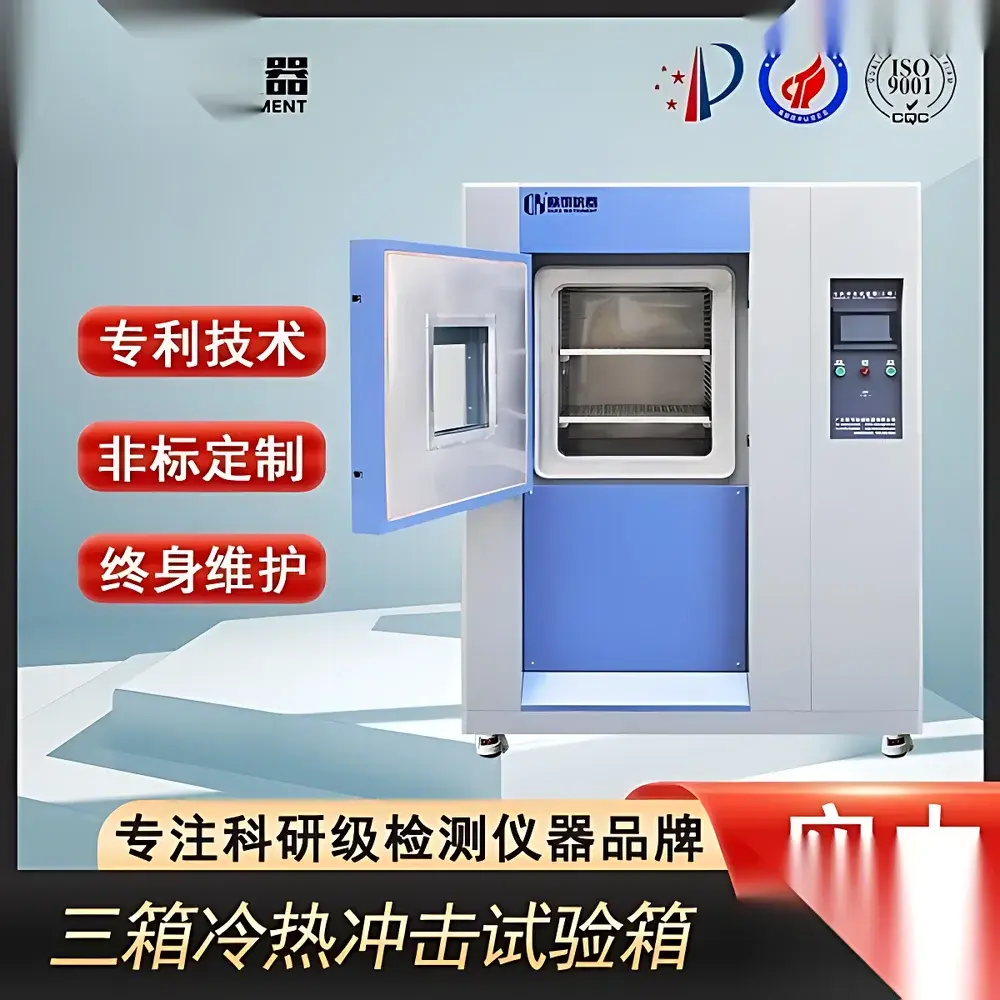
| Standard Accessories | Dual-pane tempered glass observation window, φ50 mm test port (left side), two adjustable sample racks, interior fluorescent lighting, four casters with brakes, built-in humidifier tank |
| Safety Protections | Compressor overheat/overcurrent/high-pressure protection, heater dry-run prevention, chamber overtemperature alarm, low-water level detection |
Overview
The Thermal Shock Test Chamber – Standard Model with TEMI880 Controller is an engineered environmental simulation system designed for accelerated reliability assessment of electronic components, automotive modules, aerospace assemblies, and polymer-based materials under rapid, repetitive thermal transitions. It operates on the principle of dual-chamber or single-chamber air-impingement thermal shock methodology—achieving high-rate temperature transitions by alternating airflow between independently conditioned hot and cold zones (or via forced convection within a single chamber with optimized ducting and high-capacity heating/cooling circuits). This design enables precise replication of field-induced thermal stresses encountered during operational cycling, storage, or transportation across extreme climatic zones. The chamber complies with core test standards including MIL-STD-810H Method 503.7 (Temperature Shock), IEC 60068-2-14 (Test N: Change of Temperature), and JESD22-A104D (Temperature Cycling), serving as a foundational tool in qualification testing workflows for QC labs, R&D centers, and third-party certification laboratories.
Key Features
- Triple selectable temperature ranges: −20 °C to +150 °C, −40 °C to +150 °C, and −70 °C to +150 °C—configured at time of order to match material validation requirements.
- Integrated humidity control (20–98% RH) with ±2% RH stability and ±3% RH uniformity—enabling combined temperature-humidity shock protocols per IEC 60068-2-30.
- Robust thermal architecture: High-efficiency U-type finned heaters, internal spiral K-type refrigerant copper tubing, and slope-optimized fin-tube evaporators ensure repeatable ramp rates—e.g., −70 °C to +100 °C in ≤60 minutes (typical, measured per ASTM E1545).
- TEMI880 intelligent controller with 7-inch color LCD touchscreen, supporting up to 99 programmable segments, real-time graphing of setpoint/actual curves, multi-zone PID tuning, and event-triggered data logging.
- Structural integrity: 1 mm SUS#304 stainless steel inner chamber with seamless welding; outer enclosure options include powder-coated mild steel or brushed #304 stainless—both corrosion-resistant and compatible with cleanroom-grade maintenance protocols.
- Comprehensive safety redundancy: Dual independent overtemperature cutouts, compressor discharge temperature monitoring, low-refrigerant pressure shutdown, heater dry-run interlock, and automatic water-level alarm for humidification system.
Sample Compatibility & Compliance
This thermal shock chamber accommodates samples up to 600 mm (W) × 850 mm (H) × 800 mm (D), with two height-adjustable stainless steel sample racks included as standard. Its interior layout supports DUTs ranging from PCB subassemblies and sensor housings to molded plastic enclosures and battery packs. All materials contacting the test environment—including gaskets, insulation, and internal fasteners—meet RoHS Directive 2011/65/EU and are halogen-free. The system is configured to support GLP/GMP-aligned validation: IQ/OQ documentation templates are available upon request, and controller audit trails comply with FDA 21 CFR Part 11 requirements when paired with optional password-protected user roles and electronic signature modules. Calibration traceability follows ISO/IEC 17025 guidelines via external accredited service providers.
Software & Data Management
The TEMI880 controller provides native data acquisition without external PC dependency: measurement values (temperature, humidity, time, alarms) are logged internally at user-defined intervals (1–600 seconds) and stored on removable USB flash drives in CSV format. Exported files are directly importable into Excel, MATLAB, or statistical process control (SPC) platforms. The interface supports bilingual operation (English/Chinese), configurable backlight intensity (17 levels), and on-screen alarm history with timestamped fault codes (e.g., “E07: Humidifier Low Water”, “E12: Compressor High Discharge Temp”). Optional RS485/RS232 or Ethernet communication modules enable integration into centralized lab management systems (LIMS) and SCADA networks, supporting Modbus RTU/TCP protocols for remote monitoring and automated report generation.
Applications
- Electronics: Solder joint fatigue evaluation in BGA packages, delamination detection in multilayer ceramic capacitors (MLCCs), and CTE mismatch analysis in hybrid modules.
- Automotive: Validation of ADAS camera housings, EV battery module sealing integrity, and connector performance under cyclic desert-to-alpine thermal profiles.
- Medical Devices: Accelerated aging of polymer-based disposable components per ISO 11607-1 and biocompatibility shelf-life modeling.
- Aerospace: Qualification of avionics enclosures to DO-160 Section 4 (Temperature Variation) and RTCA/DO-160G environmental stress screening (ESS) protocols.
- Materials Science: Study of phase transition hysteresis in shape-memory alloys, moisture diffusion kinetics in composite laminates, and crystallinity shifts in thermoplastic elastomers.
FAQ
What is the difference between a thermal shock chamber and a standard temperature-humidity chamber?
A thermal shock chamber is specifically engineered for rapid transitions between extreme temperature extremes (typically ≥10 °C/min), whereas standard environmental chambers prioritize steady-state stability and gradual ramping. Shock testing induces mechanical stress through differential expansion—making it critical for detecting latent defects not revealed by static exposure.
Can this chamber perform tests compliant with JEDEC JESD22-A104D?
Yes—the system’s achievable ramp rates, temperature stability, and programmable dwell times meet the minimum requirements of JESD22-A104D (including 15-minute dwell at extremes and ≤15-second transfer time for dual-chamber configurations; single-chamber variants require verification per Clause 5.2 using calibrated thermal probes).
Is calibration certificate included with delivery?
No—calibration is performed post-installation by an authorized service technician; a NIST-traceable certificate (per ISO/IEC 17025) is available as a billable option and must be specified prior to shipment.
What refrigerant is used, and is it compliant with current EU F-Gas regulations?
The system uses R404A or R507 refrigerant—both classified as HFCs under Regulation (EU) No 517/2014. While permitted for existing equipment, users planning long-term deployment in the EU should consult local regulatory updates regarding phase-down timelines and consider future retrofitting to low-GWP alternatives such as R449A or R452A.
Does the TEMI880 controller support 21 CFR Part 11 compliance out-of-the-box?
The base controller provides audit trail functionality and password protection; full 21 CFR Part 11 compliance—including electronic signatures, role-based access control, and immutable record retention—requires optional firmware upgrade and configuration by certified validation personnel.



