
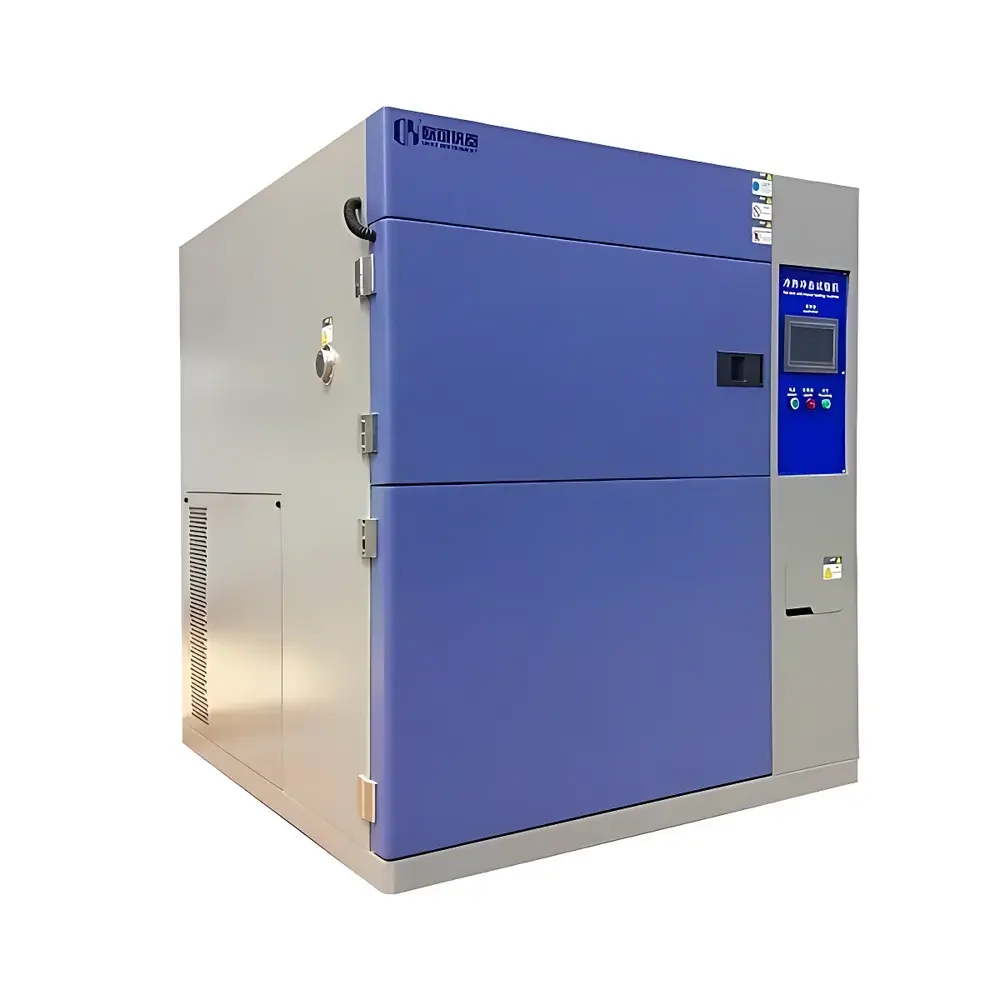
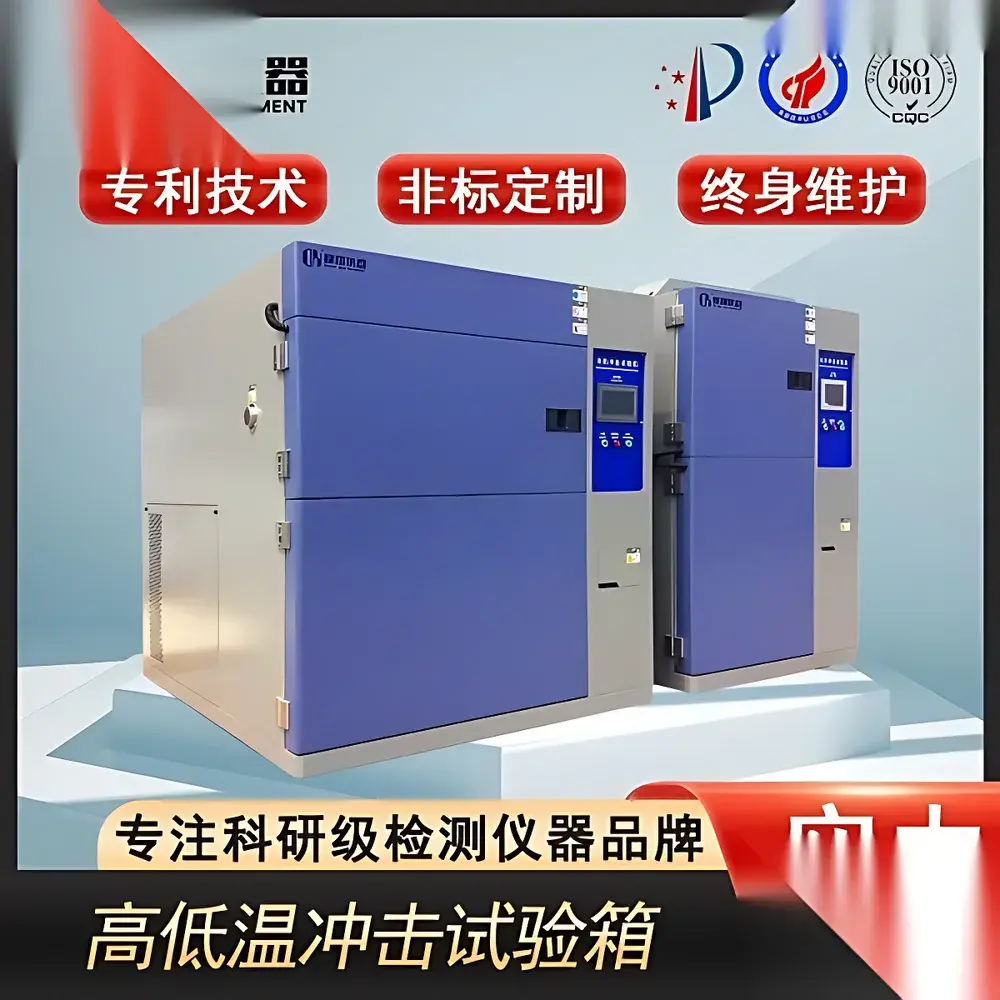
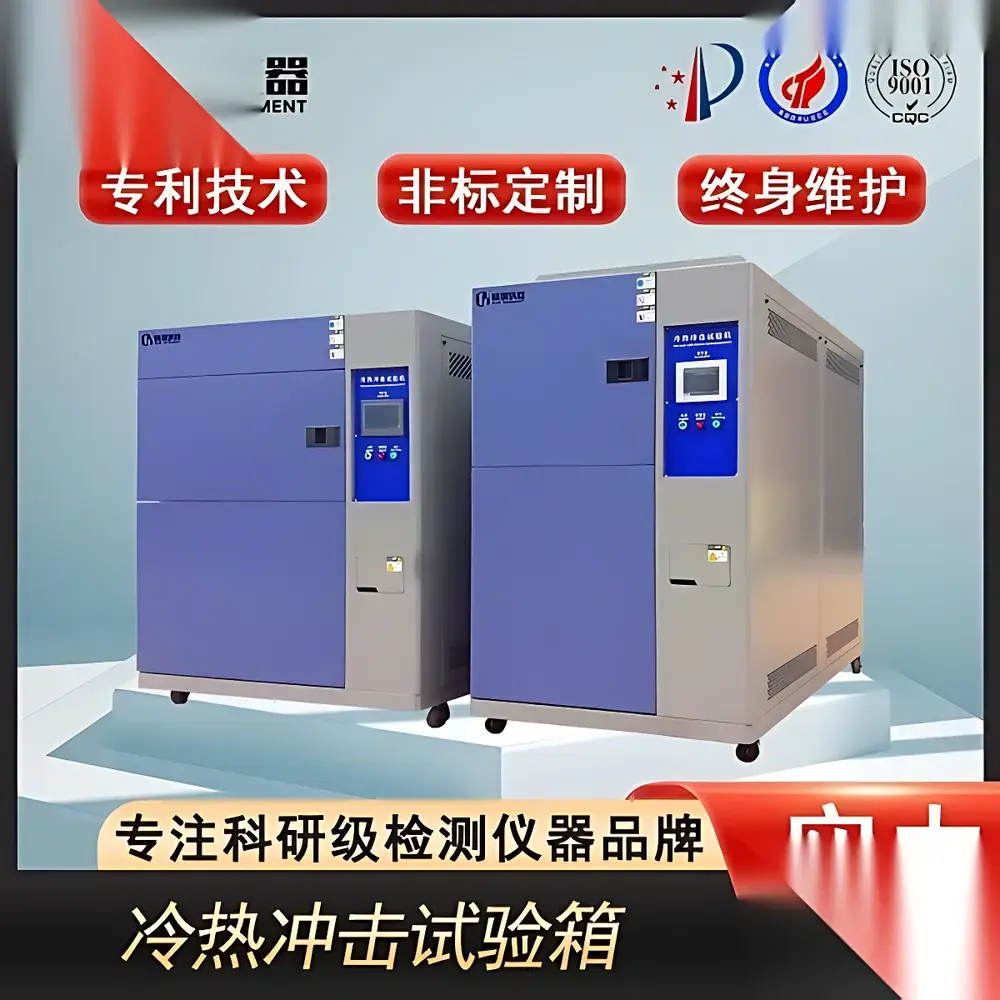
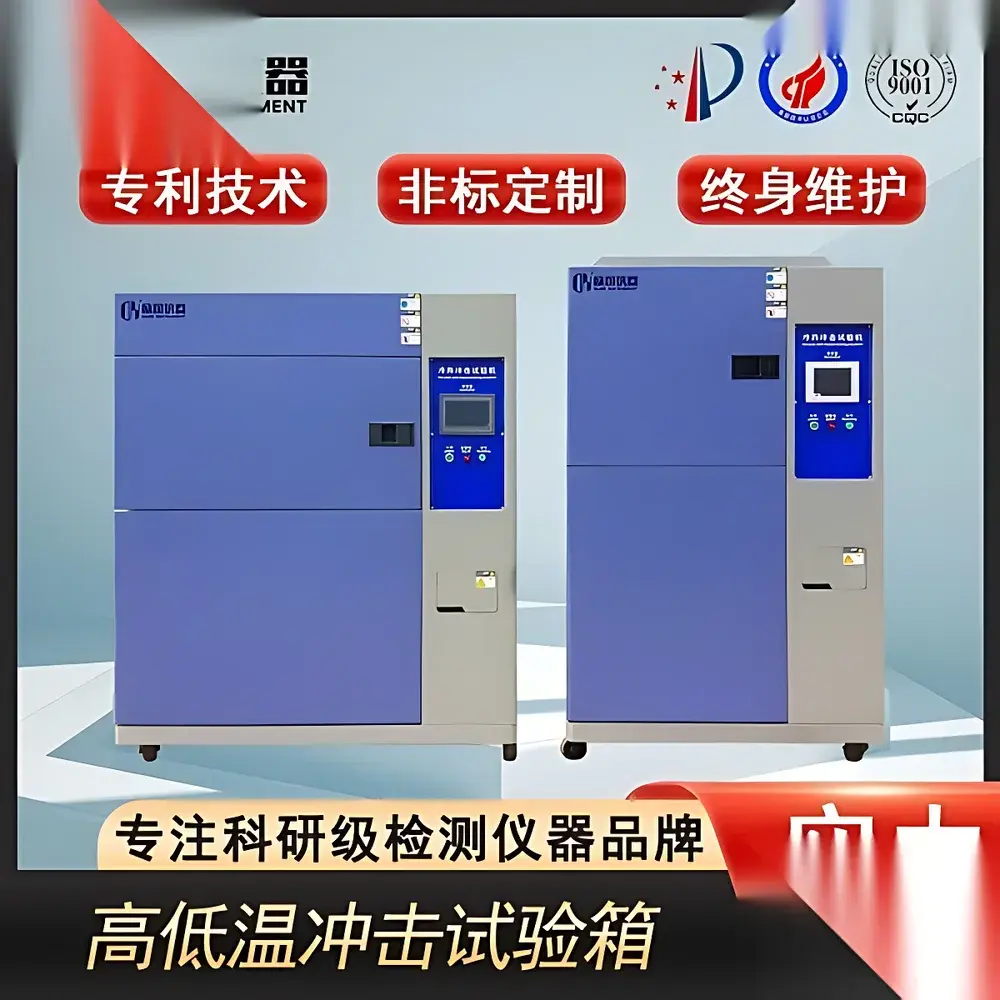
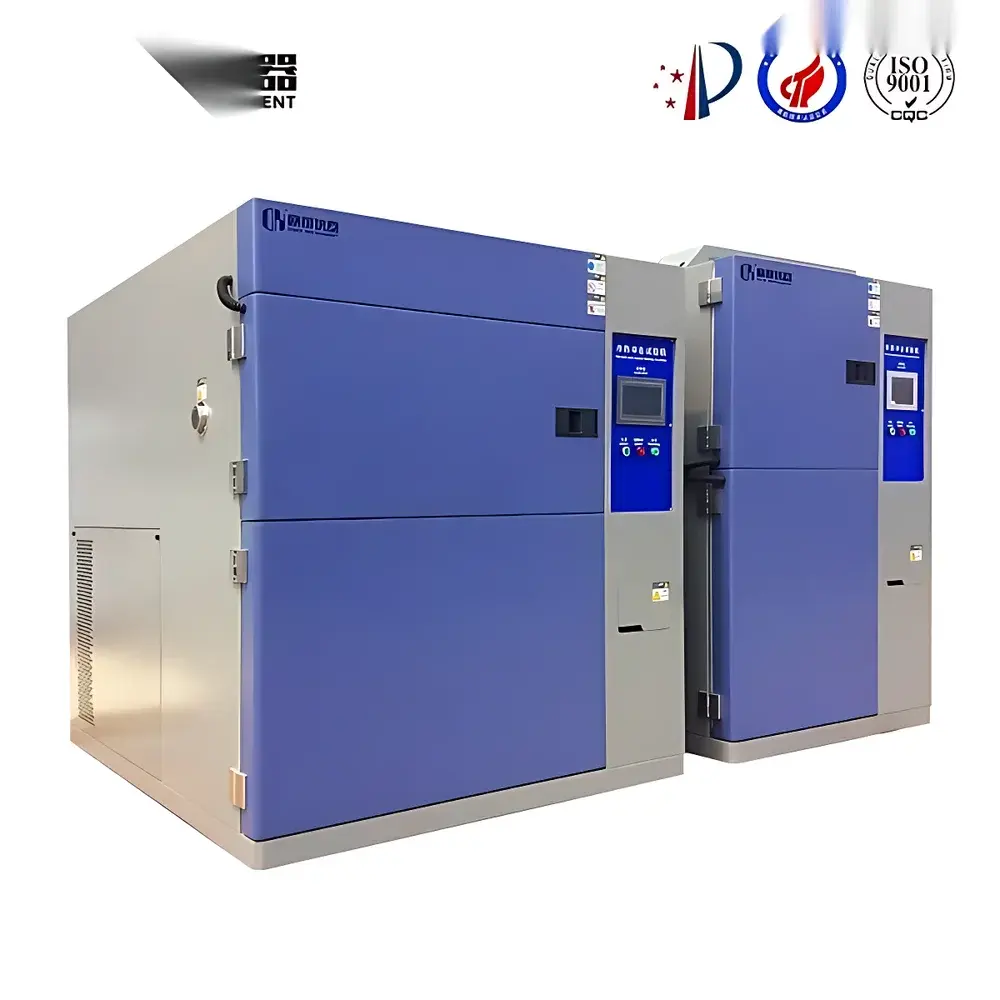
Thermal Shock Test Chamber – TEMI880-Controlled Dual-Compartment Rapid Temperature Transition System
| Key | Temperature Range: −70 °C to +150 °C |
|---|---|
| Heating Rate (−20 °C → +100 °C) | ≈35 min |
| Cooling Rate (20 °C → −70 °C) | ≈90 min |
| Inner Chamber Material | 1 mm SUS#304 Stainless Steel |
| Outer Chamber Material | Powder-Coated Cold-Rolled Steel or SUS#304 Brushed Stainless Steel |
| Insulation | Rigid Polyurethane Foam + Glass Wool |
| Refrigeration System | Hermetic Compressor (Tecumseh/France) with Eco-Friendly Refrigerant (R404A/R507) |
| Controller | TEMI880 Color Touchscreen Programmable Temperature/Humidity Controller (LCD, Bilingual English/Chinese Interface, Multi-PID, Curve Monitoring, Alarm Logging) |
| Power Supply | 3φ5W 380 VAC ±10% or 2φ3W 220 VAC ±10% |
| Standard Accessories | Double-Layer Tempered Glass Viewing Window, φ50 mm Cable Port (Left Side), Two Adjustable Sample Racks, Fluorescent Interior Lamp, Four Casters, Integrated Humidifier Tank |
| Safety Protections | Compressor Overheat/Overcurrent/High-Pressure Protection, Dry-Run Prevention for Heaters & Humidifiers, Chamber Over-Temperature Cut-off, Low-Water-Level Alarm |
| Compliance | Designed per IEC 60068-2-14 (Environmental Testing – Part 2-14: Tests – Test N: Change of Temperature) and ASTM D5229/D5229M (Standard Test Method for Moisture Absorption Properties of Polymer Matrix Composite Materials) — Structural and operational architecture supports GLP/GMP-aligned validation protocols. |
Overview
The Thermal Shock Test Chamber – TEMI880-Controlled Dual-Compartment Rapid Temperature Transition System is an engineered solution for evaluating material integrity and component reliability under extreme, rapid thermal cycling conditions. Based on the principle of two-zone (hot/cold) compartmentalized air circulation, this chamber subjects test specimens to abrupt transitions between pre-conditioned high- and low-temperature environments—enabling precise simulation of real-world thermal stress events such as solder joint fatigue, coating delamination, seal failure, and polymer embrittlement. Unlike single-chamber ramp-and-soak systems, its dual-compartment design achieves faster transition times (≤15 seconds typical transfer time between zones), minimizing dwell-induced thermal equilibration and delivering higher fidelity to field-relevant shock profiles. The system complies with core international standards including IEC 60068-2-14 (Test N) and supports traceable execution of qualification protocols required in aerospace, automotive electronics, medical device packaging, and advanced battery module development.
Key Features
- Dual independent temperature zones with segregated hot (+150 °C max) and cold (−70 °C min) chambers, enabling true thermal shock via mechanical basket transfer
- TEMI880 color touchscreen controller with bilingual (English/Chinese) interface, 17-level backlight adjustment, real-time curve plotting of setpoint vs. actual temperature, and multi-stage programmable profiles (up to 999 segments)
- Robust thermal insulation combining rigid polyurethane foam (≥100 mm thickness) and glass wool layers to minimize heat leakage and stabilize zone boundary conditions
- Certified refrigeration architecture featuring a hermetic Tecumseh compressor, eco-friendly R404A/R507 refrigerant blend, finned-tube evaporator, and water-cooled condenser option (via optional external chiller interface)
- Comprehensive safety interlock system: compressor overheat/overcurrent/high-pressure cut-offs; heater and humidifier dry-run prevention; chamber over-temperature lockout; low-water alarm with auto-shutdown
- Standard industrial-grade power configuration (3φ5W 380 VAC ±10%) with optional 220 VAC variant; integrated grounding and EMI filtering compliant with CE/UL general safety requirements
Sample Compatibility & Compliance
This chamber accommodates standard test specimens up to 500 mm × 500 mm × 500 mm (W×D×H) within its internal workspace. The SUS#304 stainless steel inner chamber (1 mm gauge) ensures corrosion resistance against humidity, condensate, and outgassed volatiles from electronic assemblies or composite laminates. External cladding options include powder-coated cold-rolled steel or brushed SUS#304 for cleanroom-compatible installations. All electrical and thermal subsystems are designed to meet IEC 61000-4 electromagnetic compatibility (EMC) immunity requirements. While not intrinsically rated for hazardous locations, the chamber’s structural integrity, pressure-relief venting, and non-sparking internal components support use in ISO Class 7–8 controlled environments. Documentation packages—including Factory Acceptance Test (FAT) reports, calibration certificates for integrated PT100 sensors, and IQ/OQ templates—are available upon request to facilitate 21 CFR Part 11-compliant validation workflows.
Software & Data Management
The TEMI880 controller provides embedded data logging at user-selectable intervals (1–600 seconds), storing up to 100,000 data points internally. Logged parameters include chamber zone temperatures, setpoints, alarm status, and PID output values. Data export is supported via USB flash drive (CSV format) or optional RS485/RS232 communication interface (Modbus RTU protocol). For enterprise integration, third-party SCADA systems can poll real-time process variables using standard Modbus register mapping. Audit trail functionality records all operator actions—including profile uploads, parameter edits, and alarm acknowledgments—with timestamp and user ID. When configured with optional Ethernet module, remote monitoring and secure web-based access (HTTPS) enable centralized fleet management across multi-site laboratories. All firmware versions are version-controlled and validated per IEC 62304 Software Lifecycle Requirements.
Applications
- Qualification testing of printed circuit board assemblies (PCBAs) per IPC-9701 and JEDEC JESD22-A104
- Accelerated aging of lithium-ion battery modules under thermal gradient cycling (UN 38.3 Section 5.4)
- Validation of adhesive bond strength in automotive trim components exposed to seasonal ambient extremes
- Evaluation of optical lens housing dimensional stability during rapid ambient transitions (ISO 10110-7)
- Reliability screening of MEMS sensors and RF front-end modules in 5G infrastructure equipment
- Moisture diffusion analysis in fiber-reinforced polymer composites (ASTM D5229/D5229M)
FAQ
What is the minimum achievable transfer time between hot and cold zones?
Typical basket transfer time is ≤15 seconds, verified per IEC 60068-2-14 Annex B. Actual performance depends on specimen mass, fixture geometry, and ambient lab conditions.
Can the chamber operate with humidity control enabled during thermal shock cycles?
No—this is a dedicated dry thermal shock system. Humidity capability is limited to standalone high/low-temperature soak modes and requires optional humidifier integration.
Is the TEMI880 controller validated for GxP environments?
The controller supports audit trail, electronic signatures (via optional password hierarchy), and configurable alarm suppression—all prerequisites for FDA 21 CFR Part 11 compliance. Full validation documentation must be generated by the end user per their internal SOPs.
What calibration standards are used for the internal PT100 sensors?
Sensors are calibrated traceably to NIST-certified reference standards prior to shipment. Certificate of Calibration (CoC) includes as-found/as-left data at three points per zone (−40 °C, 25 °C, +100 °C).
Does the system support custom profile sequencing with conditional branching?
Yes—the TEMI880 supports up to 999 program segments with jump-to-step, repeat-loop, and hold-until-stabilized logic. Conditional triggers (e.g., “hold until ΔT < 0.5 °C”) require firmware v3.2 or later.



