
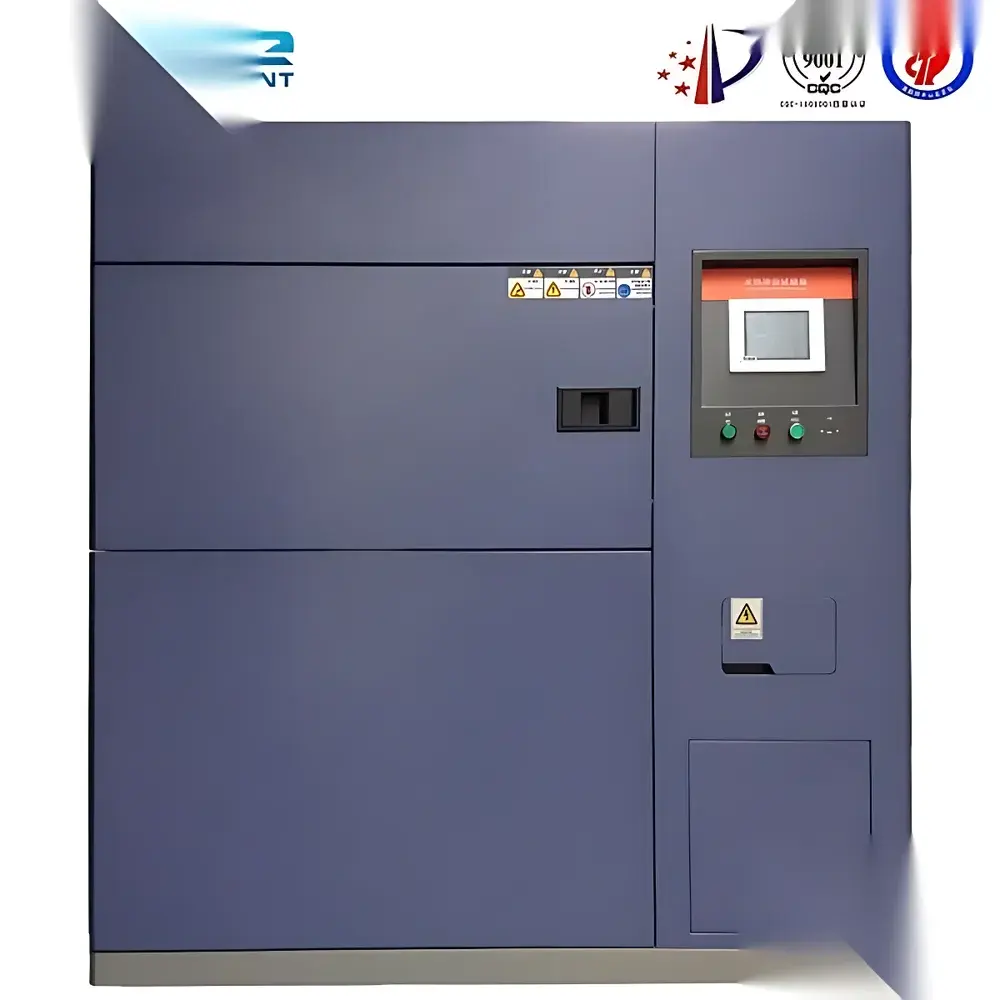
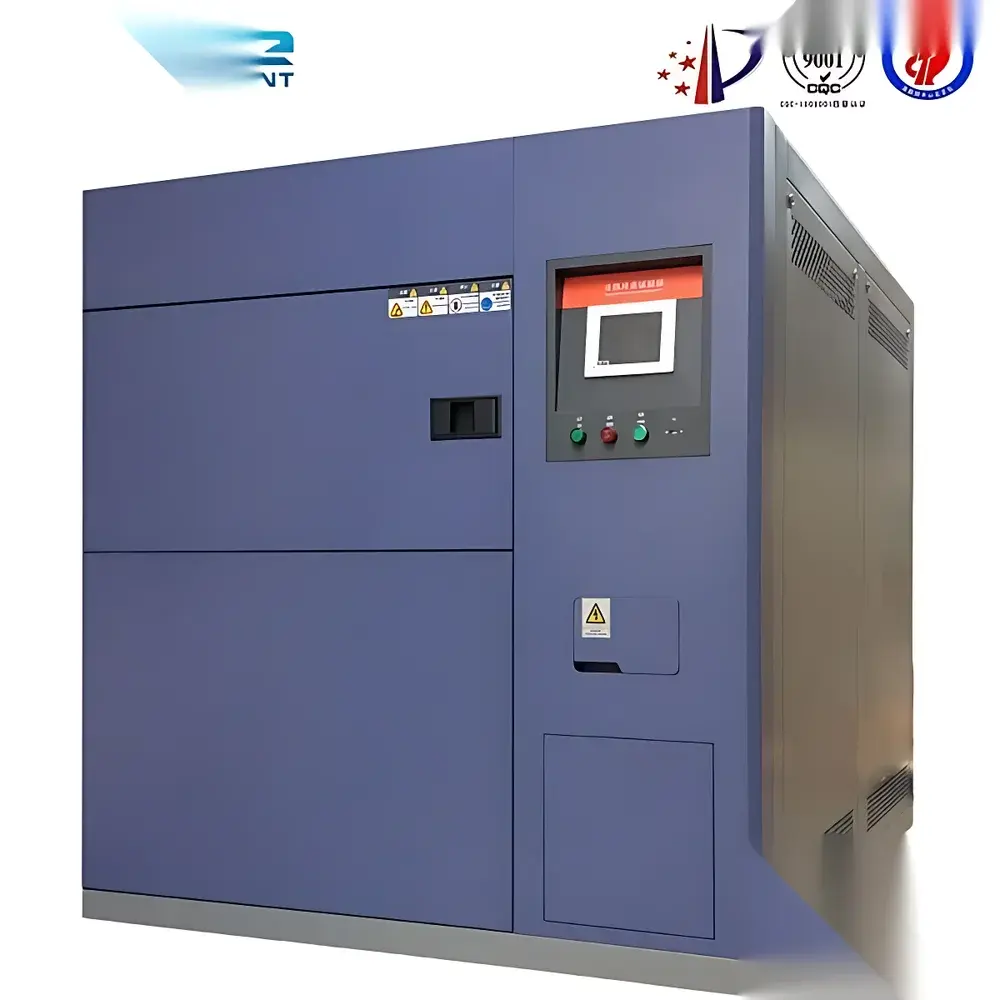
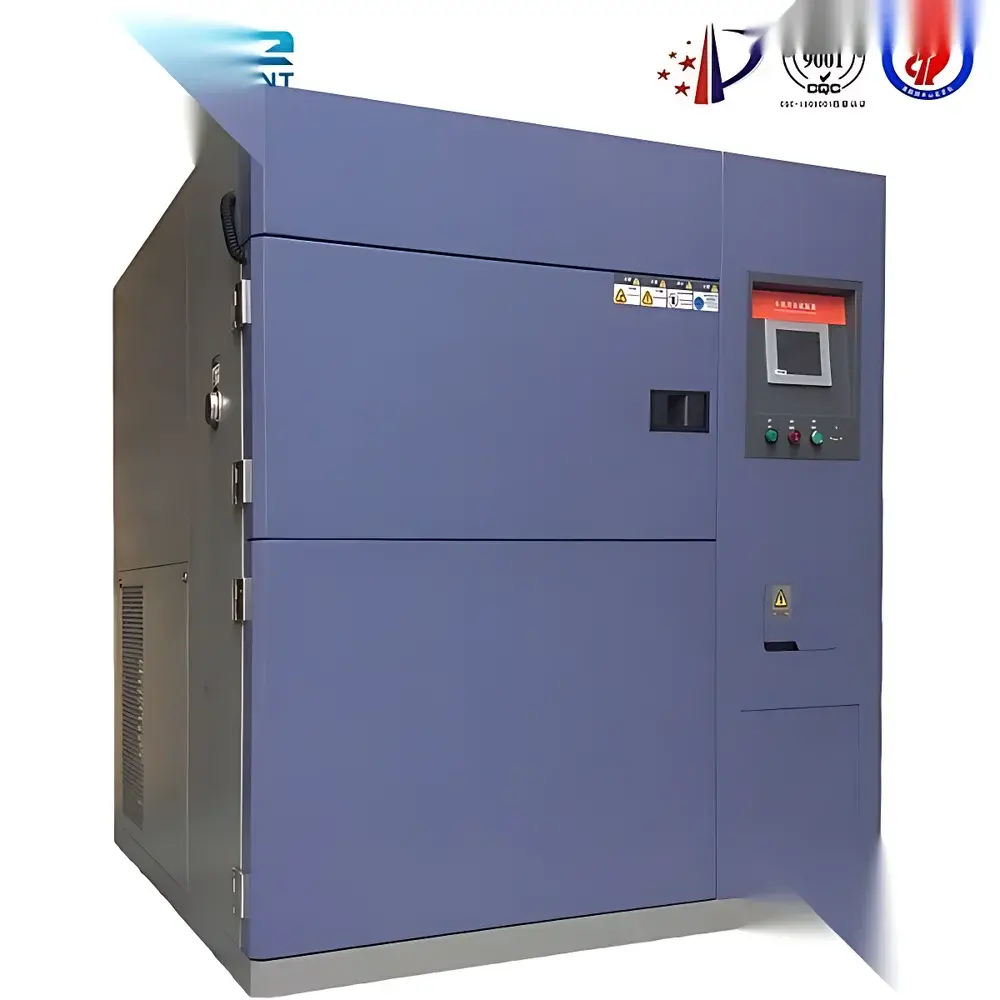
Thermal Shock Test Chamber OK-TS-100 / OK-TS-250 – Dual-Stage Cryogenic & High-Temperature Cycling Chamber
| Brand | Other Brands |
|---|---|
| Origin | Imported |
| Manufacturer Type | Authorized Distributor |
| Temperature Range | −70 °C to +150 °C (selectable) |
| Internal Chamber Dimensions | 400 × 500 × 500 mm (OK-TS-100) / 500 × 650 × 700 mm (OK-TS-250) |
| External Dimensions | 1030 × 1020 × 1470 mm / 1100 × 1170 × 1700 mm |
| Temperature Uniformity | ≤ ±2 °C |
| Temperature Fluctuation | ≤ ±0.5 °C |
| Heating Rate | ≥ 2–3 °C/min |
| Cooling Rate | ≤ 1 °C/min |
| Refrigeration System | Twin-stage cascade refrigeration with hermetic French Tecumseh compressors |
| Insulation | High-density ultra-fine glass fiber |
| Heating Element | Nickel-chromium alloy sheathed heaters |
| Evaporator | Finned multi-section evaporator |
| Air Circulation | Single-loop, extended-shaft low-noise stainless steel centrifugal blower |
| Door Seal | High-performance silicone rubber gasket rated for −70 °C to +150 °C |
| Control System | Imported precision digital PID controller with solid-state relays and industrial-grade I/O modules |
| Safety Protections | Over-temperature, compressor high-pressure, phase failure, motor overload, door interlock, and refrigerant leak detection |
Overview
The OK-TS-100 and OK-TS-250 Thermal Shock Test Chambers are engineered for rigorous evaluation of material integrity under rapid, repetitive transitions between extreme low- and high-temperature environments. Based on the principle of forced-air thermal cycling via dual-stage cascade refrigeration and precision resistive heating, these chambers simulate real-world operational stresses encountered by electronic assemblies, aerospace composites, automotive components, and polymer-based packaging. Unlike steady-state environmental chambers, thermal shock testing subjects specimens to abrupt temperature shifts—typically within seconds—inducing differential expansion/contraction across heterogeneous materials. This accelerates failure modes such as solder joint fatigue, delamination, seal leakage, and interfacial cracking. The OK-TS series employs BTC (Balance Temperature Control) methodology: a dynamic equilibrium algorithm that continuously modulates heater output and refrigerant flow rate in response to real-time chamber load, minimizing overshoot and stabilizing setpoint accuracy within ±0.5 °C. Constructed with SUS304 stainless steel inner walls and electrophoretically coated cold-rolled steel exteriors (Baosteel-sourced), the chambers ensure long-term corrosion resistance and structural rigidity under cyclic thermal stress.
Key Features
- Dual-stage cascade refrigeration system using hermetically sealed Tecumseh compressors—enabling stable operation down to −70 °C without liquid nitrogen dependency
- BTC (Balance Temperature Control) logic integrated into the imported digital PID controller, delivering high reproducibility across repeated thermal shock cycles
- High-efficiency insulation layer composed of ≥100 mm thick ultra-fine glass fiber, minimizing heat transfer and reducing energy consumption during prolonged dwell phases
- Observation window with tempered double-glazed quartz and internal LED lighting, permitting non-intrusive visual monitoring of sample behavior during transition phases
- Robust air circulation architecture: single-loop airflow path driven by an extended-shaft, low-vibration stainless steel centrifugal blower—ensuring uniform thermal distribution (≤ ±2 °C) across full working volume
- Multi-level safety architecture including compressor high-pressure cutoff, over-temperature cutout, phase-loss protection, motor thermal overload relay, and mechanical door interlock
- Temperature-rated silicone rubber gasket (−70 °C to +150 °C), tested per ASTM D1418, ensuring consistent sealing performance across the entire operational envelope
Sample Compatibility & Compliance
The OK-TS series accommodates standard test specimens up to 30 kg (OK-TS-100) or 50 kg (OK-TS-250), with configurable mounting fixtures compatible with MIL-STD-810H Method 503.7 (Temperature Shock), IEC 60068-2-14 (Change of Temperature), and JIS Z 8701-3. Designed for laboratory and QA/QC environments operating under GLP and ISO/IEC 17025 frameworks, the chambers support audit-ready documentation: temperature logging intervals are programmable from 1 s to 60 min, and all setpoints, alarms, and cycle events are timestamped with traceable system clock synchronization. While not pre-certified to FDA 21 CFR Part 11, the control system architecture permits integration with third-party validation packages for electronic record and signature compliance in regulated pharmaceutical or medical device testing.
Software & Data Management
The embedded controller provides local HMI operation with intuitive touch-enabled navigation, but full-cycle programming—including ramp-soak profiles, dwell times, number of cycles, and automatic data export—is managed via optional PC-based software (Windows 10/11 compatible). Raw temperature data is logged at user-defined intervals and exported in CSV format for post-processing in MATLAB, JMP, or Minitab. The system supports RS-485 Modbus RTU communication for integration into centralized lab monitoring networks (e.g., LabVantage, Siemens Desigo CC). All firmware updates are delivered via encrypted USB key; no cloud connectivity or remote access is implemented—preserving data sovereignty and network security in classified or ITAR-controlled facilities.
Applications
- Accelerated reliability screening of printed circuit board assemblies (PCBAs) per IPC-9701A
- Evaluation of thermal interface material (TIM) adhesion stability under cyclic loading
- Qualification testing of battery enclosures and cell housings for EV applications
- Validation of optical lens coatings subjected to diurnal temperature extremes
- Material compatibility assessment of elastomeric seals in cryogenic instrumentation
- Pre-release verification of MEMS sensor packaging integrity prior to field deployment
FAQ
What is the difference between thermal shock and thermal cycling?
Thermal shock involves rapid, discontinuous transitions between extreme temperature extremes (e.g., −65 °C ↔ +150 °C in < 15 s), inducing transient stress gradients. Thermal cycling applies slower, continuous ramps with defined dwell periods—used for fatigue life modeling rather than instantaneous failure induction.
Can the chamber perform single-sided temperature exposure (e.g., only low-temp shock)?
Yes. The controller supports standalone low-temperature soak, high-temperature soak, or asymmetric shock profiles—no requirement to execute full dual-temperature cycles.
Is calibration certification included with shipment?
A factory-as-built temperature uniformity report is provided. NIST-traceable calibration certificates (per ISO/IEC 17025) are available as a billable option, performed using calibrated PT100 probes at nine standardized chamber locations.
What maintenance intervals are recommended for the refrigeration system?
Compressor oil analysis and refrigerant purity testing are advised every 2,000 operational hours; condenser coil cleaning every 6 months; and door gasket inspection per quarterly preventive maintenance checklist.
Does the chamber meet CE or UKCA marking requirements?
The unit complies with EN 61000-6-2 (immunity) and EN 61000-6-4 (emissions), and carries CE marking for EMC and LVD directives. UKCA marking requires end-user responsibility for conformity assessment under UK legislation.



