
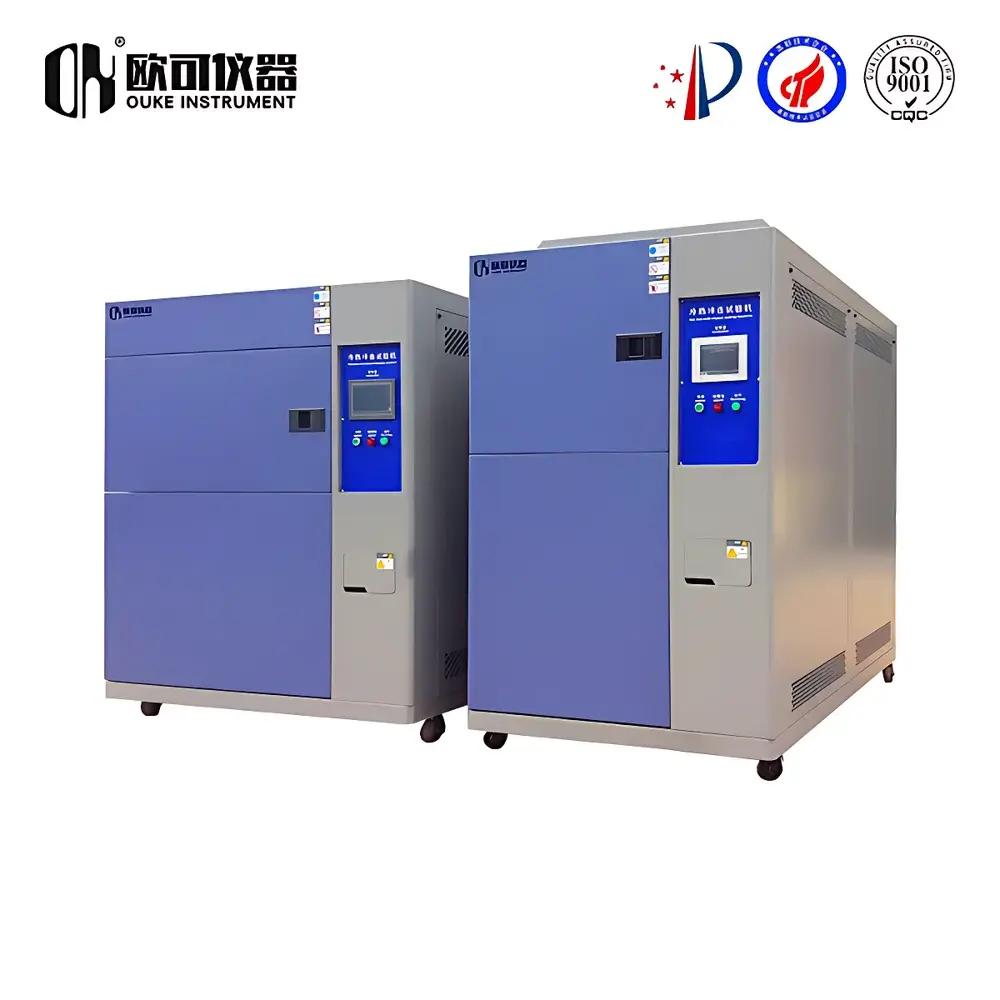
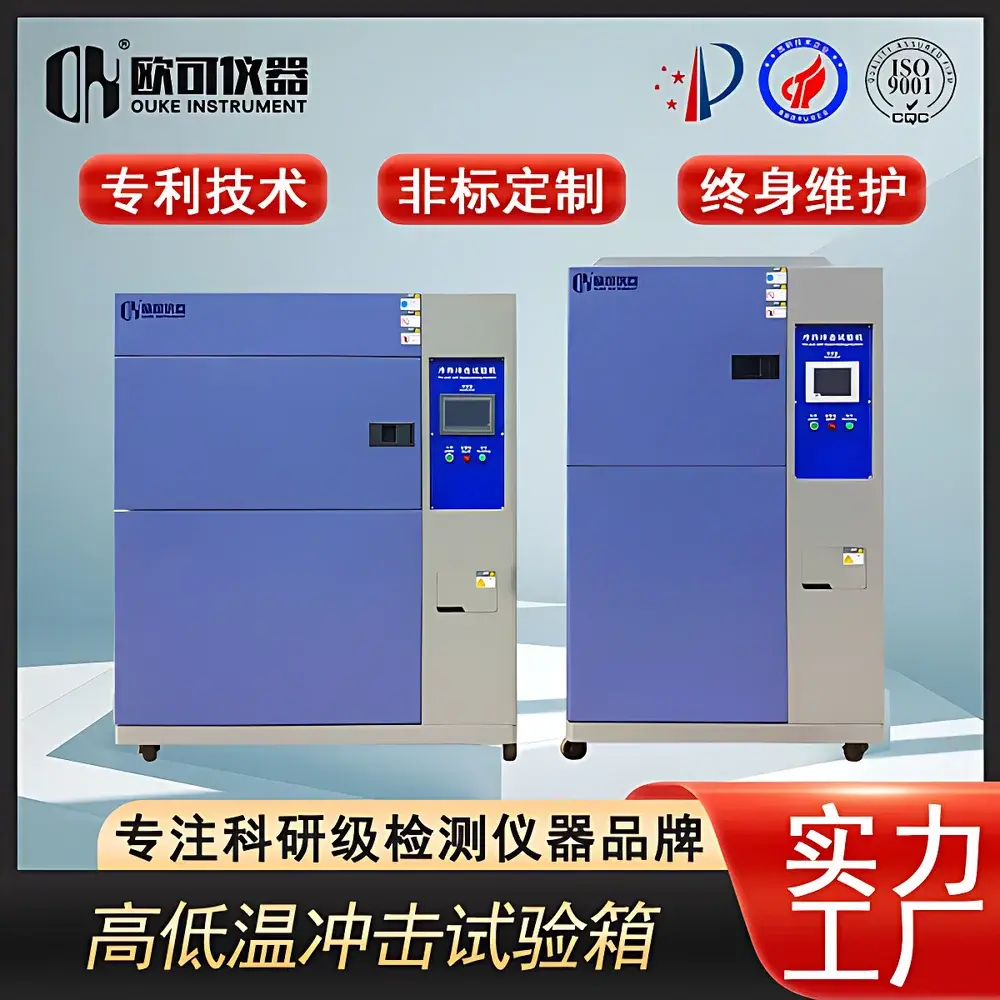
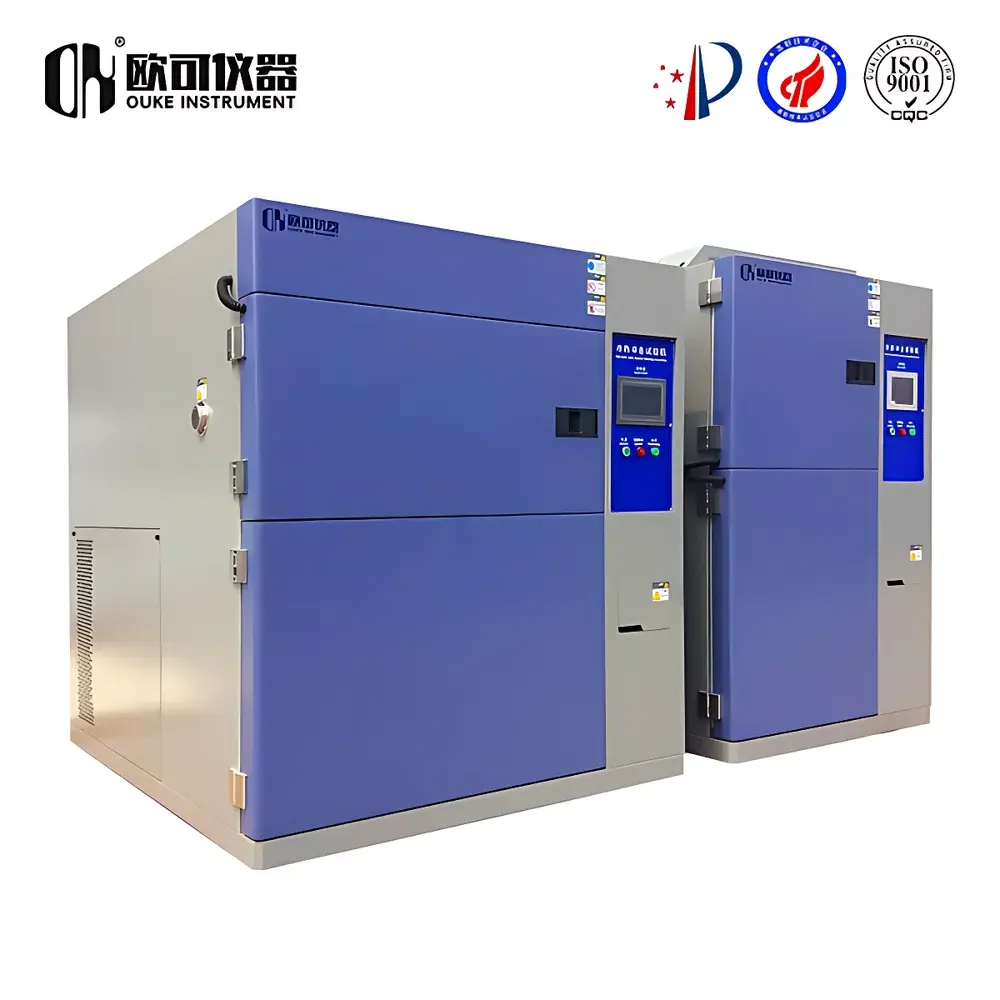
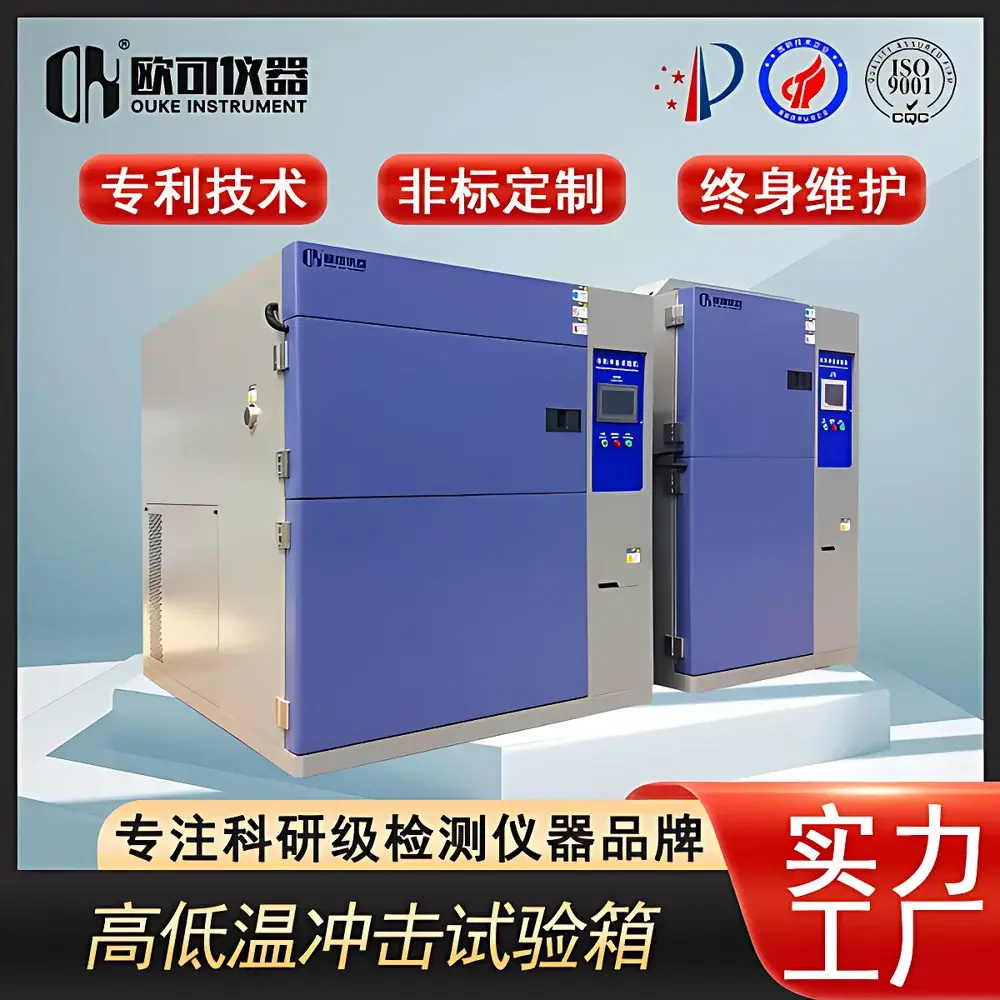
OK Thermal Shock Test Chamber OK-TS-5
| Brand | OK |
|---|---|
| Origin | Guangdong, China |
| Manufacturer Type | Manufacturer |
| Product Origin | Domestic |
| Model | OK-TS-5 |
| Price | ¥89,000 |
| High-Temperature Range (°C) | +150 |
| Low-Temperature Range (°C) | −50 |
| Thermal Shock Range (°C) | −50 to +150 |
| Temperature Stability (°C) | ±2 |
| Heating Rate (°C/min) | 10 |
| Cooling Rate (°C/min) | 10 |
Overview
The OK Thermal Shock Test Chamber OK-TS-5 is a high-performance, two-zone (hot/cold) thermal shock system engineered for accelerated environmental reliability testing of electronic components, automotive modules, aerospace hardware, and advanced materials. Unlike conventional temperature cycling chambers, this device implements rapid physical transfer of test specimens between thermally isolated zones—enabling true thermal shock conditions per IEC 60068-2-14, MIL-STD-883 Method 1010, and JESD22-A104. The chamber utilizes a pneumatically actuated lift basket mechanism to move samples from the high-temperature zone (+150 °C) to the low-temperature zone (−50 °C) in ≤10 seconds—meeting stringent industry-defined transition time requirements. Its dual-chamber architecture ensures minimal thermal inertia during transfer, delivering high-fidelity simulation of real-world thermal transients encountered during aircraft ascent/descent, automotive under-hood operation, or cold-start electronics deployment.
Key Features
- Two-zone configuration with independent PID-controlled hot and cold chambers, each equipped with redundant heating/cooling circuits for operational redundancy and long-term stability.
- Lift-basket transfer mechanism with pneumatic actuation, achieving ≤10-second zone-to-zone transition—validated per IEC 60068-2-14 Clause 6.2 and MIL-STD-883H 1010.8.
- Temperature stability maintained at ±2 °C across both zones under steady-state conditions, verified via NIST-traceable Class A PT100 sensors installed at multiple spatial locations.
- Uniform heating and cooling rates of 10 °C/min (typical), calibrated across full operational load conditions (up to 15 kg payload).
- Stainless steel 304 inner chamber construction with electrostatically applied epoxy coating on outer frame; insulated with 150 mm thick polyurethane foam (thermal conductivity <0.022 W/m·K).
- Integrated safety interlocks including over-temperature cut-off, door position monitoring, refrigerant pressure monitoring, and emergency stop circuit compliant with EN 61000-6-2 and EN 61000-6-4.
Sample Compatibility & Compliance
The OK-TS-5 accommodates test specimens up to 400 mm × 400 mm × 400 mm (W×D×H) within its lift basket, supporting standard IPC/JEDEC-compliant board fixtures and custom mounting plates. It is designed for non-powered and powered-in-situ testing configurations, with provision for external cable feedthroughs (optional). The system meets essential regulatory and industry-standard compliance requirements: IEC 60068-2-14 (Test Nb), MIL-STD-883 Method 1010.8 (Thermal Shock), MIL-STD-202G Method 107G, JESD22-A104D, GB/T 2423.22–2012, and ISO 16750-4 (Road vehicles – Environmental conditions). All thermal profiles are fully programmable and auditable, supporting GLP/GMP-aligned validation protocols when paired with optional IQ/OQ documentation packages.
Software & Data Management
Control and monitoring are executed via a dedicated 10.1-inch industrial touchscreen HMI running embedded Linux-based firmware. The interface supports multi-step profile programming—including dwell time, cycle count, ramp rate, and alarm thresholds—with real-time graphing of chamber temperatures, basket position status, and system fault logs. Data export is available in CSV format via USB 2.0 port or Ethernet (Modbus TCP). Optional PC-based software (OK-DataLink v3.2) enables remote supervision, automated report generation (PDF/Excel), and 21 CFR Part 11-compliant user access control with electronic signature capability—suitable for regulated quality assurance environments requiring audit-ready traceability.
Applications
- Qualification testing of semiconductor packages (QFN, BGA, CSP) per JEDEC J-STD-020 and J-STD-033.
- Reliability screening of automotive ECUs, ADAS sensors, and battery management systems under ISO 16750-4 thermal shock conditions.
- Material interface integrity assessment for solder joints, conformal coatings, and adhesive bonds subjected to repeated thermal expansion mismatch.
- Pre-qualification stress screening of avionics modules prior to formal DO-160 Section 4.5 environmental qualification.
- Failure mode analysis (FMA) of photovoltaic cell interconnects and encapsulant delamination under cyclic thermal extremes.
- Validation of hermetic seal integrity in MEMS devices and medical-grade electronic implants.
FAQ
What standards does the OK-TS-5 comply with?
The chamber is designed and validated to meet IEC 60068-2-14, MIL-STD-883 Method 1010.8, JESD22-A104D, GB/T 2423.22–2012, and ISO 16750-4. Full compliance documentation—including calibration certificates and test reports—is provided upon delivery.
Can the chamber perform powered-in-situ testing?
Yes. Optional cable feedthrough ports (with EMI shielding) and external power supply interfaces enable live electrical testing during thermal transitions, subject to customer-defined voltage/current limits and safety review.
Is third-party calibration supported?
The system includes six pre-installed Class A PT100 sensors (three per zone), all accessible for external verification. OK Instruments provides NIST-traceable calibration services and supports ISO/IEC 17025-accredited lab certification.
What maintenance intervals are recommended?
Compressor oil and refrigerant filter replacement every 24 months; heat exchanger cleaning every 12 months; full system performance verification annually—or after 500 operational cycles—per OK’s Preventive Maintenance Protocol (PMP-023).
Does the OK-TS-5 support custom test profiles beyond standard specifications?
Yes. The controller allows user-defined multi-segment profiles with variable dwell times, asymmetric ramp rates, and conditional branching logic—enabling replication of field-relevant thermal histories derived from vehicle telemetry or flight data recorders.



