
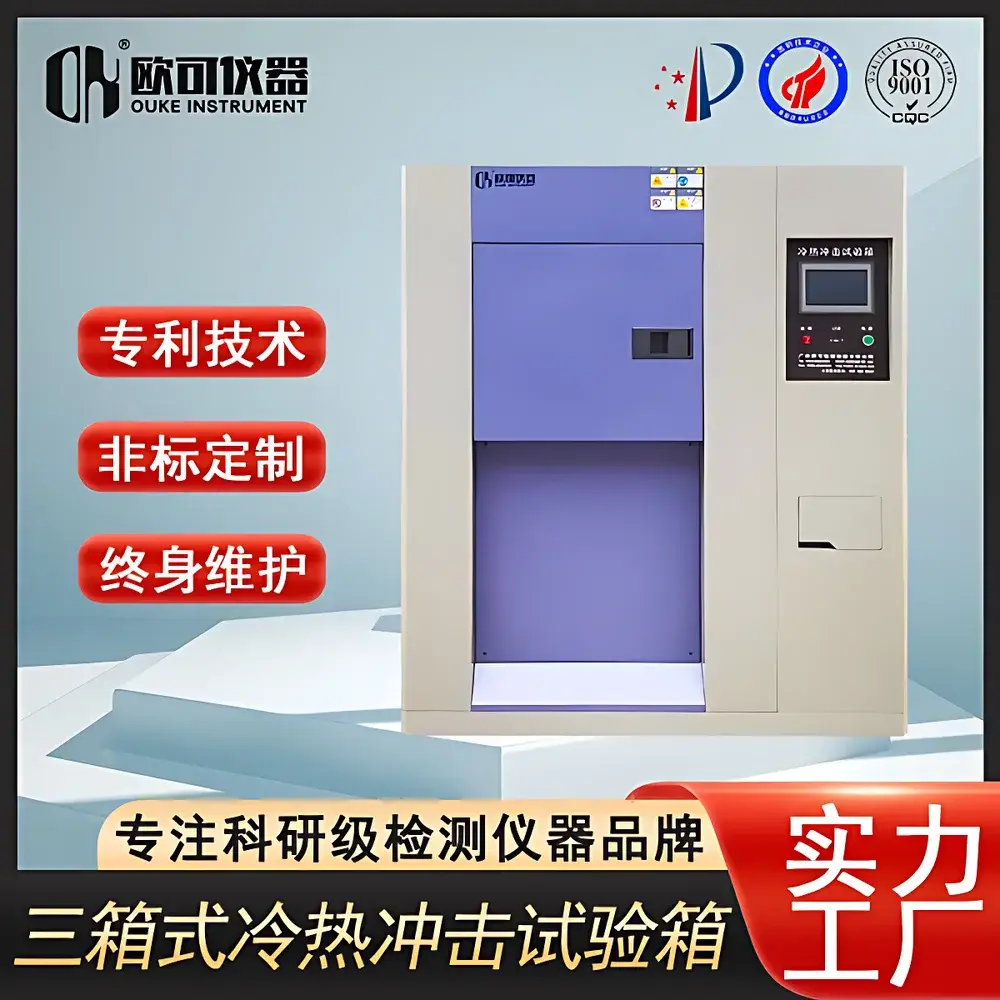
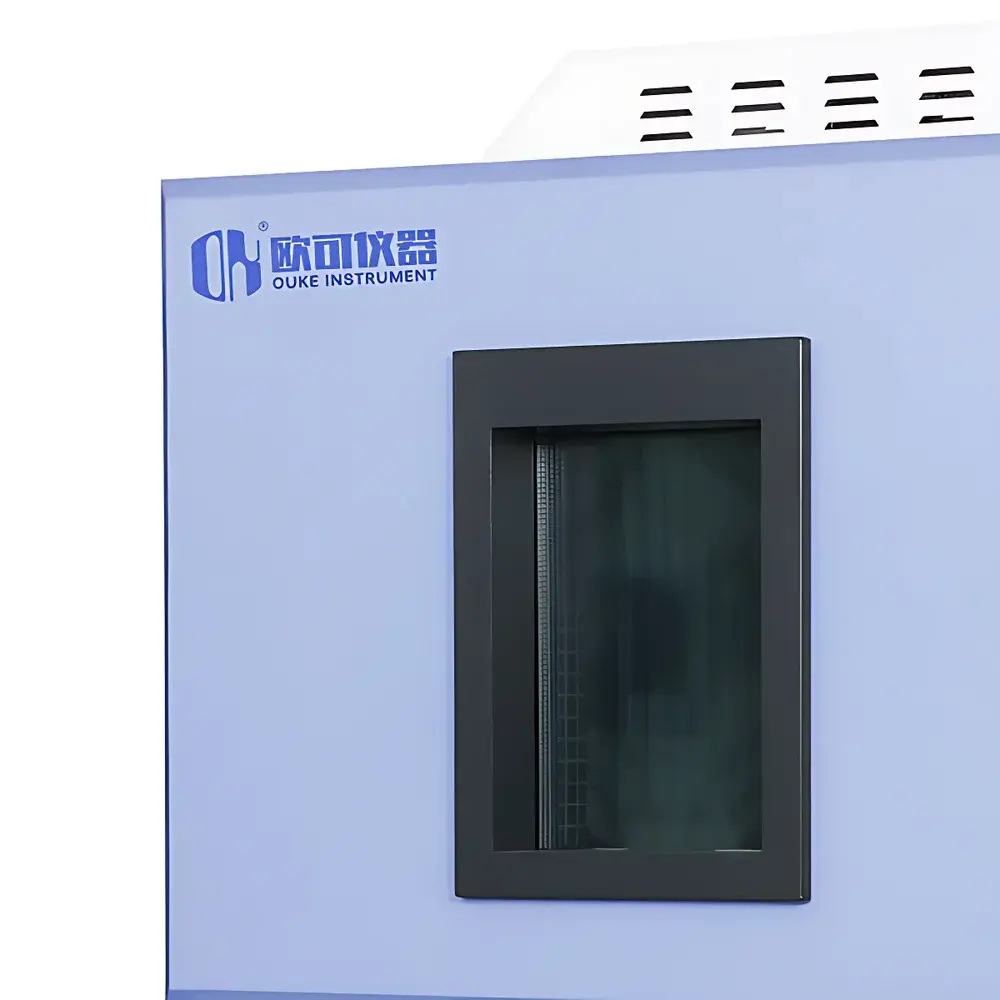
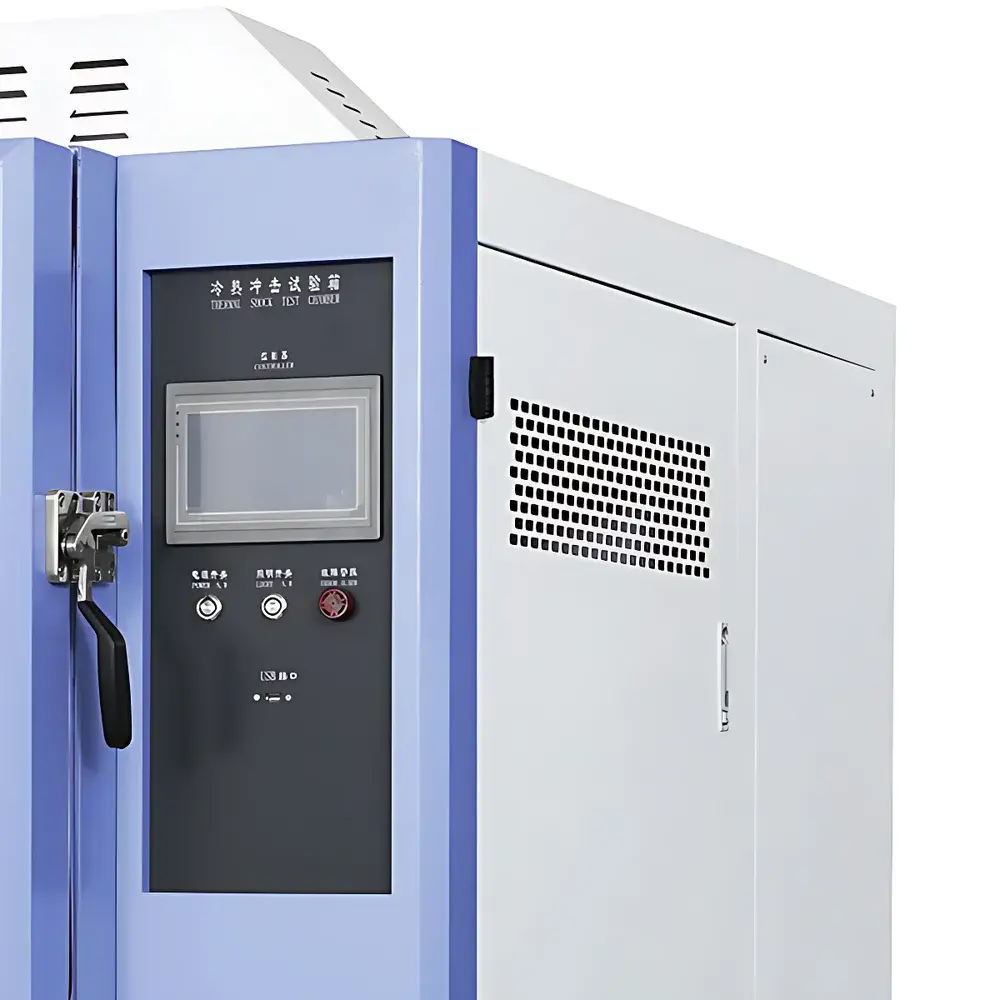
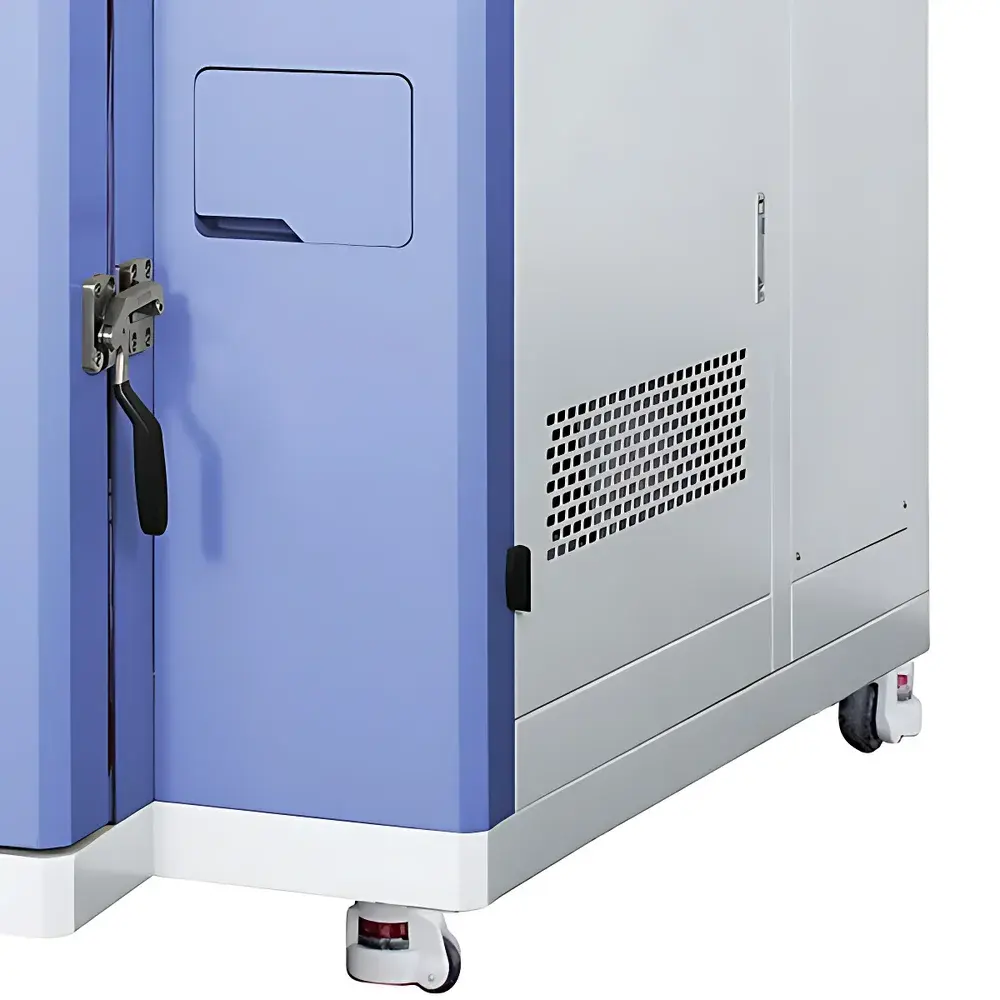
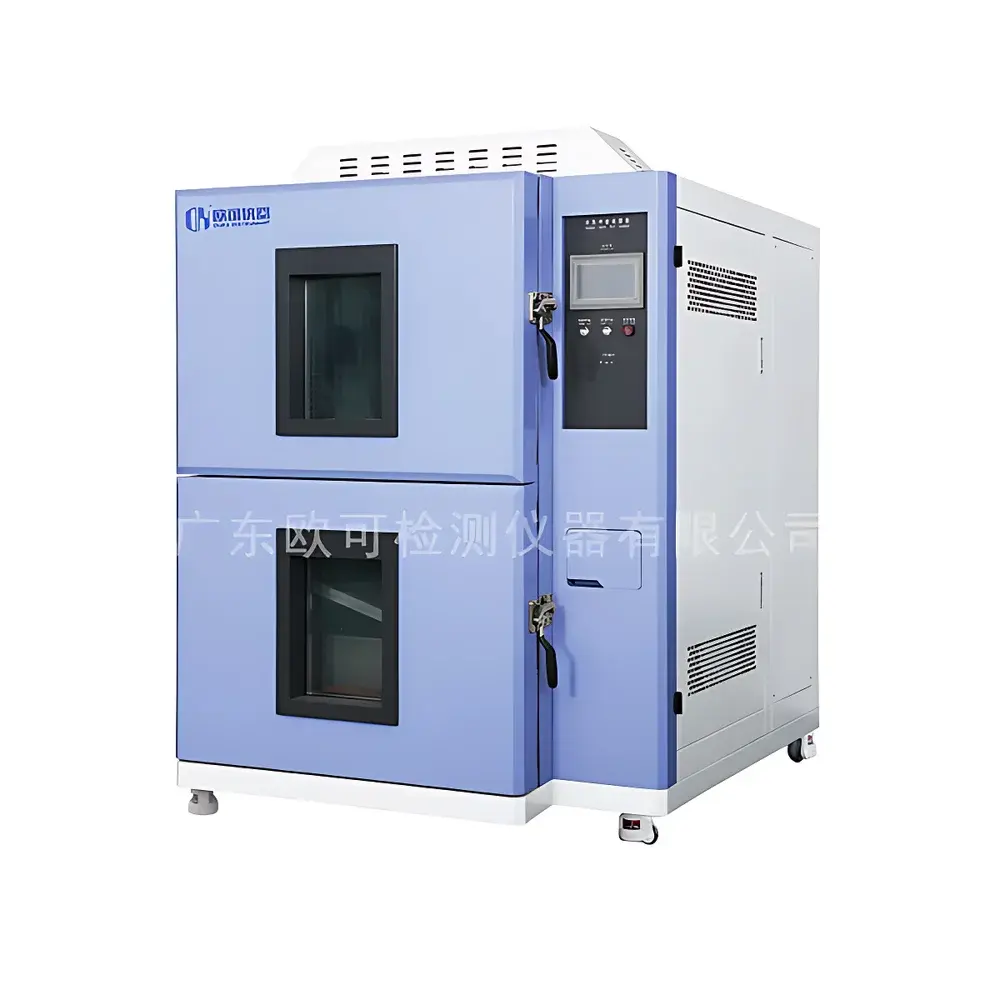
OK Thermal Shock Test Chamber OK-TS-80.3
| Brand | OK Instruments |
|---|---|
| Origin | Guangdong, China |
| Manufacturer Type | Direct Manufacturer |
| Product Origin | Domestic (China) |
| Model | OK-TS-80.3 |
| High-Temperature Range | +150 °C |
| Low-Temperature Range | −60 °C |
| Thermal Shock Range | −60 °C to +150 °C |
| Temperature Stability | ±2 °C |
| Temperature Transition Time | ≤10 s |
Overview
The OK Thermal Shock Test Chamber OK-TS-80.3 is an engineered environmental test system designed to subject electronic components, automotive modules, aerospace assemblies, and military-grade hardware to rapid, repeatable thermal transitions between extreme temperature extremes. Unlike conventional temperature cycling or fast thermal ramp chambers, this unit implements true thermal shock—a mechanical stress test governed by abrupt, step-change thermal exposure rather than linear ramping. It operates on the two-chamber (basket-transfer) principle: a high-temperature chamber (+150 °C) and a low-temperature chamber (−60 °C) are maintained in steady-state conditions; the test specimen, mounted on a pneumatically actuated transfer basket, is physically relocated between zones in ≤10 seconds. This methodology replicates real-world scenarios such as component deployment from arctic storage into heated avionics bays or rapid ingress from cryogenic ground environments into engine bay compartments. The resulting thermal gradients induce transient stresses driven by differential coefficients of thermal expansion (CTE), enabling detection of latent defects including interfacial delamination, solder joint fracture, hermetic seal failure, and microcrack propagation—failures often invisible under static thermal or functional testing.
Key Features
- Two-chamber basket-transfer architecture with independent PID-controlled high- and low-temperature zones
- Verified transition time of ≤10 seconds—compliant with MIL-STD-883 Method 1010.8, IEC 60068-2-14 (equivalent to GB/T 2423.22), and JESD22-A104
- Stable operating ranges: −60 °C to +150 °C with ±2 °C uniformity across the test volume
- Pneumatic basket drive system with position feedback and end-of-travel dampening for repeatable, low-vibration transfers
- Insulated stainless-steel interior, double-wall construction with vacuum-panel insulation, and forced-air circulation for minimized thermal lag
- Programmable test sequences supporting up to 999 cycles, dwell times per zone (1 min–999 h), and automatic safety interlocks
Sample Compatibility & Compliance
The OK-TS-80.3 accommodates specimens up to standard mid-size dimensions (interior chamber: W×D×H ≈ 400 × 400 × 400 mm; basket load capacity: 20 kg max). Its basket-transfer design is optimized for discrete, portable units—PCBs, IC packages, sensors, connectors, and small enclosures—that can be securely fixtured without external cabling constraints. The system meets structural and operational requirements for GLP-compliant reliability laboratories and supports audit-ready documentation per ISO/IEC 17025. All thermal profiles are traceable to NIST-calibrated reference sensors, and chamber validation follows ASTM E74 and IEC 60068-3-5 protocols. While not certified for Class 100 cleanroom integration, it complies with CE marking (EMC Directive 2014/30/EU and LVD Directive 2014/35/EU) and incorporates over-temperature, over-pressure, and door-safety cutoffs aligned with EN 61000-6-2 and EN 61000-6-4.
Software & Data Management
Control and monitoring are managed via the OK-TS Control Suite—a Windows-based application supporting local HMI operation and remote Ethernet connectivity. The software enables full sequence programming (including multi-step shock profiles with variable dwell, cycle count, and abort conditions), real-time graphing of chamber temperatures and basket position status, and timestamped CSV export of all thermocouple readings (T1–T6 configurable). Audit trails record operator logins, parameter modifications, and emergency stops—fully compliant with FDA 21 CFR Part 11 requirements when deployed with user authentication, electronic signatures, and immutable data archiving. Optional RS-485/Modbus TCP integration allows synchronization with external power supplies, DAQ systems, or functional testers during powered-in-situ shock testing.
Applications
- Qualification testing of semiconductor packages (QFN, BGA, CSP) per JESD22-A104 and A106
- Reliability screening of automotive ECUs, ADAS sensors, and battery management systems (BMS)
- Military hardware acceptance per MIL-STD-883, Method 1010.8 and MIL-STD-202, Method 107
- Validation of conformal coatings, potting compounds, and adhesive bonds under thermal gradient stress
- Failure analysis root-cause investigation for field returns attributed to thermal mismatch or solder fatigue
- Pre-compliance verification prior to third-party certification at accredited test houses
FAQ
What distinguishes thermal shock testing from temperature cycling or rapid thermal transition testing?
Thermal shock relies on instantaneous transfer between two stable thermal environments (step-change), inducing mechanical stress via CTE mismatch. Temperature cycling applies linear ramps across a single chamber, causing cumulative thermal fatigue—not sudden failure. Standards specify transition time (e.g., ≤10 s), not ramp rate.
Is the OK-TS-80.3 suitable for powered-in-situ testing?
Yes—provided external cabling is routed through dedicated feedthrough ports and the basket fixture accommodates cable strain relief. Electrical isolation and grounding continuity must be verified prior to energized operation.
Does this model support liquid nitrogen (LN₂) assist for extended low-temperature capability?
No—the OK-TS-80.3 uses dual-stage cascade refrigeration to achieve −60 °C. LN₂ injection is not integrated but may be retrofitted via optional auxiliary port kits (contact technical support for compatibility assessment).
How is temperature uniformity validated across the test volume?
Per IEC 60068-3-5, nine-point mapping is performed using calibrated PT100 probes at defined spatial coordinates during qualification. Uniformity is reported as ±2 °C at steady state, measured at center and corners after 30 minutes of stabilization.
Can test data be exported in formats compatible with LIMS or enterprise quality systems?
Yes—CSV and XML exports include metadata (test ID, operator, timestamps, chamber IDs, sensor IDs) and support direct ingestion into LabVantage, TrackWise, and ETQ Reliance via configurable ODBC drivers.



