
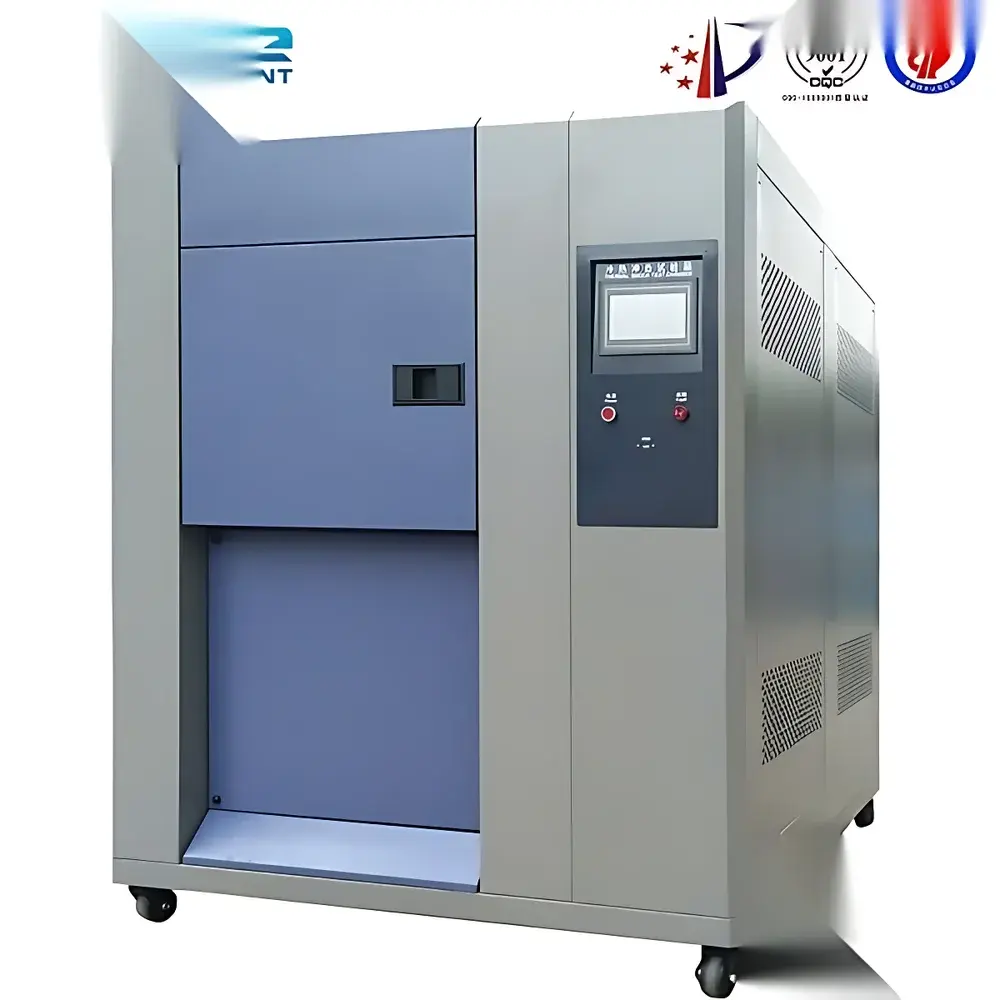
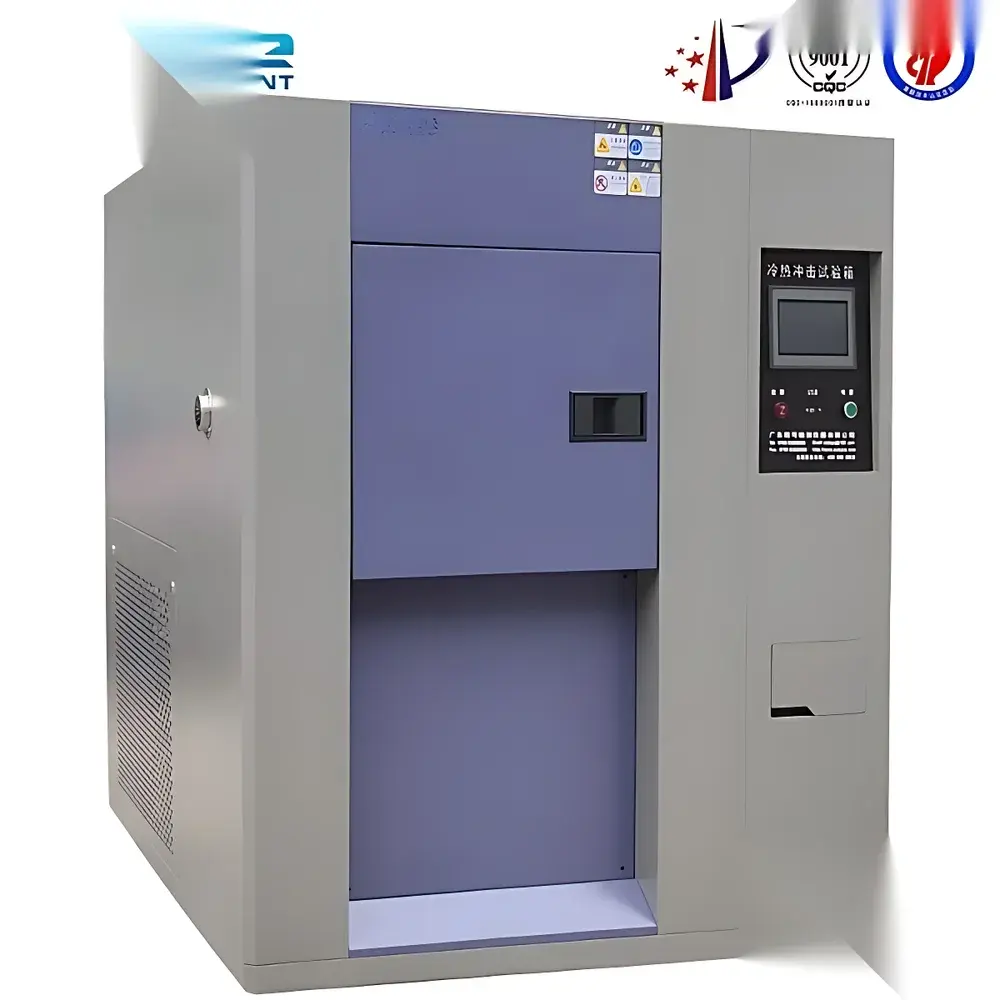
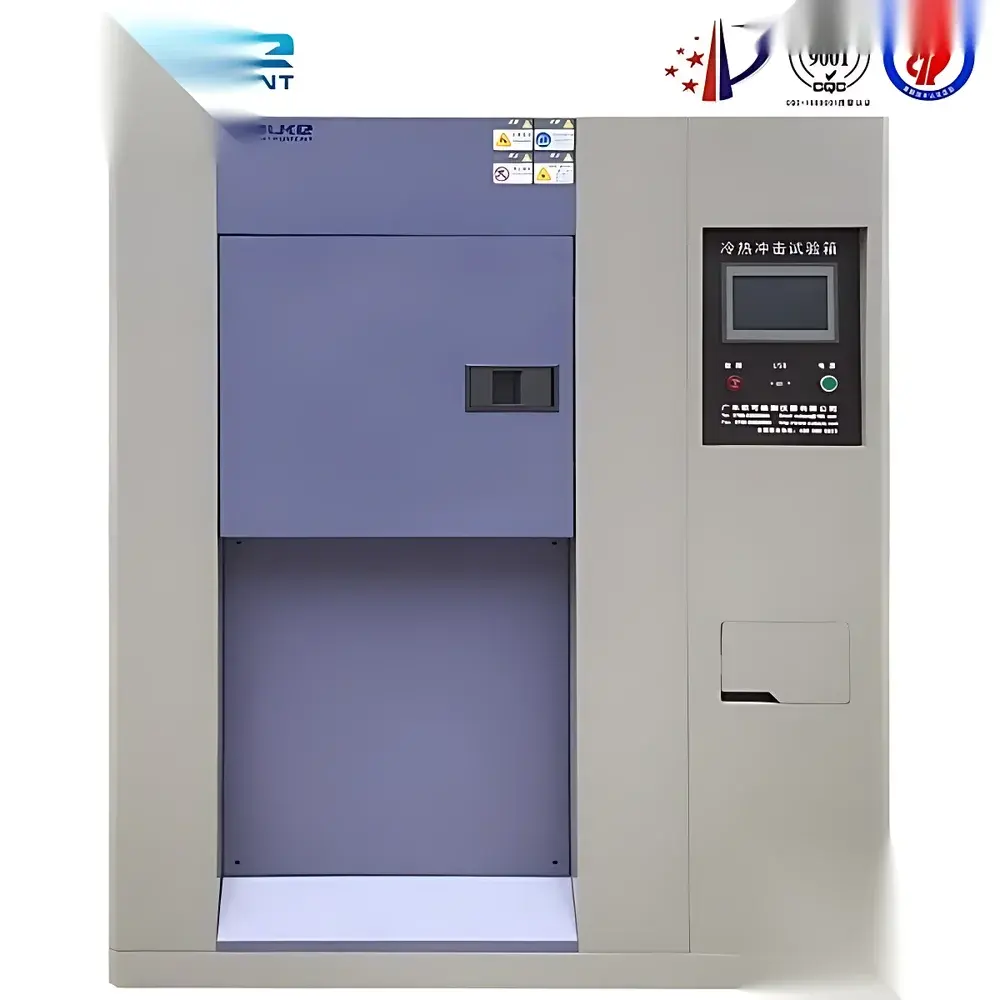
Thermal Shock Test Chamber OK-TS Series – Two-Zone or Three-Zone Configuration
| Brand | OK |
|---|---|
| Model Range | OK-TS-50 to OK-TS-1000 |
| Chamber Type | Dual-Zone or Tri-Zone Thermal Shock Test Chamber |
| Temperature Range (Test Zone) | -70 °C to +150 °C (configurable by model) |
| High-Temp Zone Range | 60 °C to 150 °C |
| Low-Temp Zone Range | -20 °C to -70 °C (selectable) |
| Temp. Fluctuation | ≤ ±0.5 °C |
| Temp. Uniformity | ≤ ±2 °C (high/low zones) |
| Temp. Recovery Time | ≤ 5 min |
| Transfer Time (specimen movement) | ≤ 10 s |
| Heating System | SSR-controlled U-shaped finned stainless-steel heaters |
| Cooling System | Twin-stage cascade refrigeration with Tecumseh/Tecumseh-derived hermetic compressors, Danfoss thermostatic expansion valves, R404A/R23/R14 refrigerant blend |
| Insulation | High-density fiberglass wool (≥100 mm thickness) |
| Interior Material | SUS304 stainless steel, precision TIG-welded |
| Door Seal | High-performance silicone gasket (low-temp flexibility & high-temp stability) |
| Controller | Programmable color LCD touchscreen PID controller with real-time logging |
| Compliance | GB/T 2423.1, GB/T 2423.2, GB/T 2423.22, IEC 60068-2-14, MIL-STD-810H Method 503.5, DIN EN 60068-2-14 |
Overview
The OK-TS Series Thermal Shock Test Chamber is an engineered environmental stress screening (ESS) system designed for rapid, repeatable, and highly controlled thermal cycling between extreme temperature extremes. Utilizing either a dual-zone (hot/cold chambers with specimen transfer mechanism) or tri-zone (hot/cold/ambient chambers with specimen positioning system) architecture, the chamber subjects test specimens to abrupt transitions—typically within 10 seconds—between predefined high- and low-temperature environments. This methodology replicates real-world thermal shock conditions encountered during operational deployment, transportation, or storage of electronic components, aerospace subsystems, automotive ECUs, military-grade connectors, and advanced composite materials. The system operates on the principle of accelerated failure mode induction: repeated thermal expansion and contraction generate interfacial stresses at material boundaries (e.g., solder joints, die attach, PCB laminate interfaces), thereby revealing latent defects not detectable under steady-state thermal exposure.
Key Features
- Dual- or tri-zone configuration selectable at order stage—enabling user-defined test logic: specimen movement (dual-zone) versus environment selection (tri-zone).
- Precision-engineered transfer mechanism with pneumatic actuation and position feedback, ensuring ≤10-second transition time between thermal zones with repeatability better than ±0.3 s.
- Cascade refrigeration system incorporating hermetically sealed reciprocating compressors (Tecumseh-derived architecture), Danfoss TXV valves, and environmentally compliant mixed-refrigerant blend (R404A/R23/R14) for stable operation down to –70 °C.
- High-efficiency insulation using ≥100 mm thick, low-conductivity fiberglass wool—minimizing thermal bridging and reducing energy consumption during prolonged cycling protocols.
- SUS304 stainless-steel interior with full TIG welding and passivation treatment—ensuring corrosion resistance, cleanroom compatibility, and long-term dimensional stability under cyclic thermal loading.
- Intelligent PID-based touchscreen controller with multi-segment programmability, real-time trend display, alarm history, and USB data export—supporting custom ramp-soak-shock profiles per IEC 60068-2-14 Annex A.
- Comprehensive safety architecture including independent overtemperature cutouts, phase-loss detection, refrigerant high-pressure shutdown, motor overload protection, and earth-leakage circuit interruption.
Sample Compatibility & Compliance
The OK-TS series accommodates test specimens up to 1000 × 1000 × 1000 mm (W × D × H) in the largest configuration (OK-TS-1000), with standardized internal fixtures supporting standard JEDEC trays, PCB racks, and MIL-STD mounting plates. All models are validated per GB/T 2423.1 (cold), GB/T 2423.2 (dry heat), and GB/T 2423.22 (temperature change) — equivalent to IEC 60068-2-1, IEC 60068-2-2, and IEC 60068-2-14 respectively. Additional compliance includes MIL-STD-810H Method 503.5 (temperature shock), DIN EN 60068-2-14, and JIS C 60068-2-14. For regulated industries, the controller supports audit-trail-enabled operation and can be configured to meet basic FDA 21 CFR Part 11 requirements (electronic signature, event logging, user access levels) when integrated with optional validation packages.
Software & Data Management
The embedded controller firmware provides native support for profile programming, real-time graphing of chamber zone temperatures and specimen surface readings (when equipped with optional thermocouple inputs), and automatic generation of test summary reports in PDF/CSV format. Data is timestamped with millisecond resolution and stored internally for ≥30 days. Optional Ethernet or RS485 interface enables integration into centralized lab management systems (LIMS) or MES platforms via Modbus TCP/RTU protocol. Raw data export supports post-test statistical analysis—including cycle-to-failure correlation, Weibull distribution fitting, and Arrhenius-based acceleration factor calculation—using third-party tools such as JMP or MATLAB.
Applications
- Qualification testing of avionics modules per DO-160 Section 4 (Temperature Shock).
- Reliability screening of automotive ADAS sensors prior to AEC-Q200 qualification.
- Failure analysis of lead-free solder interconnects in high-density BGA packages.
- Validation of thermal interface materials (TIMs) under aggressive cycling regimes.
- Accelerated aging studies of polymer encapsulants used in space-grade optoelectronics.
- Process capability assessment of reflow soldering lines through board-level thermal shock stress.
FAQ
What is the difference between two-zone and three-zone thermal shock configurations?
In a two-zone system, the test specimen physically moves between hot and cold chambers; in a three-zone system, the specimen remains stationary while ambient, hot, and cold environments are sequentially introduced via airflow control—reducing mechanical stress on delicate assemblies.
Can the OK-TS chamber be validated for GMP/GLP environments?
Yes—when ordered with IQ/OQ documentation package and calibrated sensor inputs, the system meets baseline GLP traceability requirements; full 21 CFR Part 11 compliance requires optional software add-ons and procedural controls.
Is nitrogen purge available as an option?
Yes—optional inert gas purge (N₂ or dry air) is available to suppress oxidation during high-temperature phases, particularly for metal fatigue or coating adhesion studies.
What maintenance intervals are recommended for the refrigeration system?
Compressor oil and filter-drier replacement every 24 months; refrigerant charge verification annually; calibration of chamber sensors per ISO/IEC 17025-accredited schedule.
Does the controller support remote monitoring and alarm notification?
Yes—via optional Ethernet module with SMTP email alerts, SNMP trap forwarding, and secure HTTPS web interface for real-time status and historical log access.



