
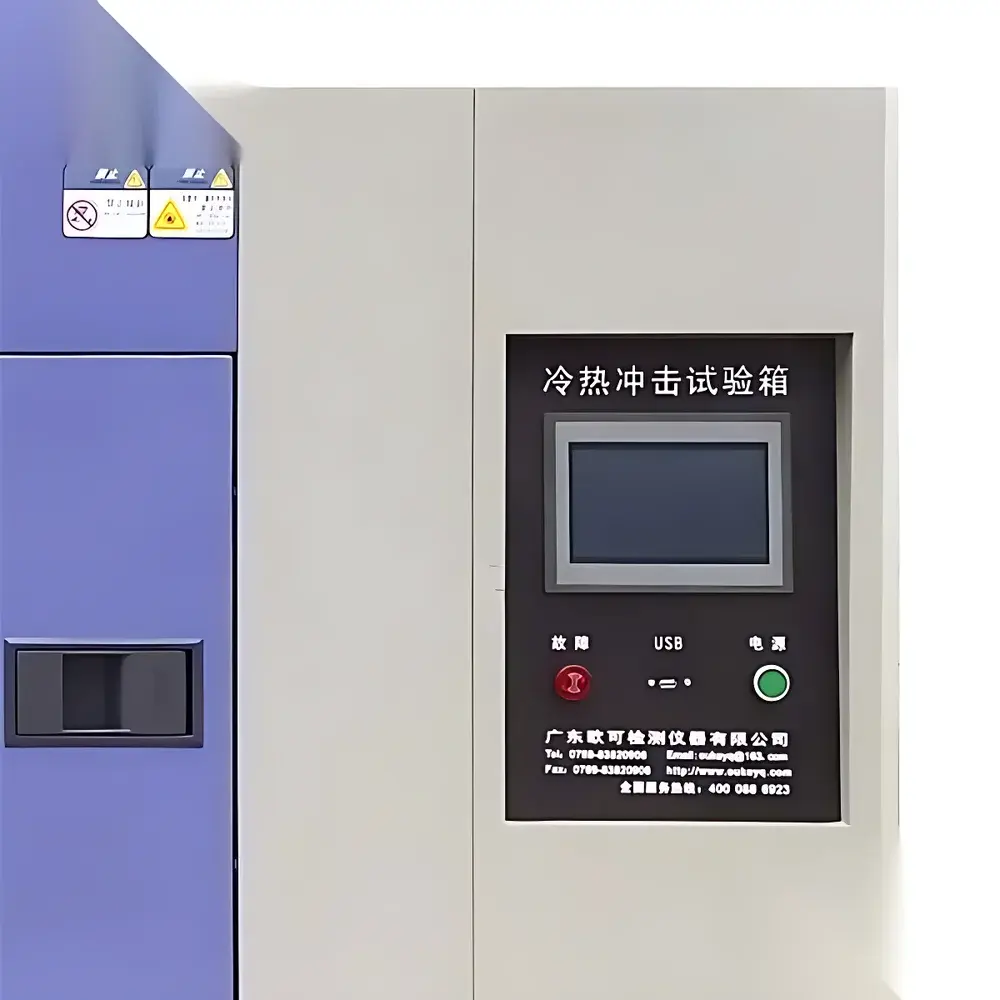
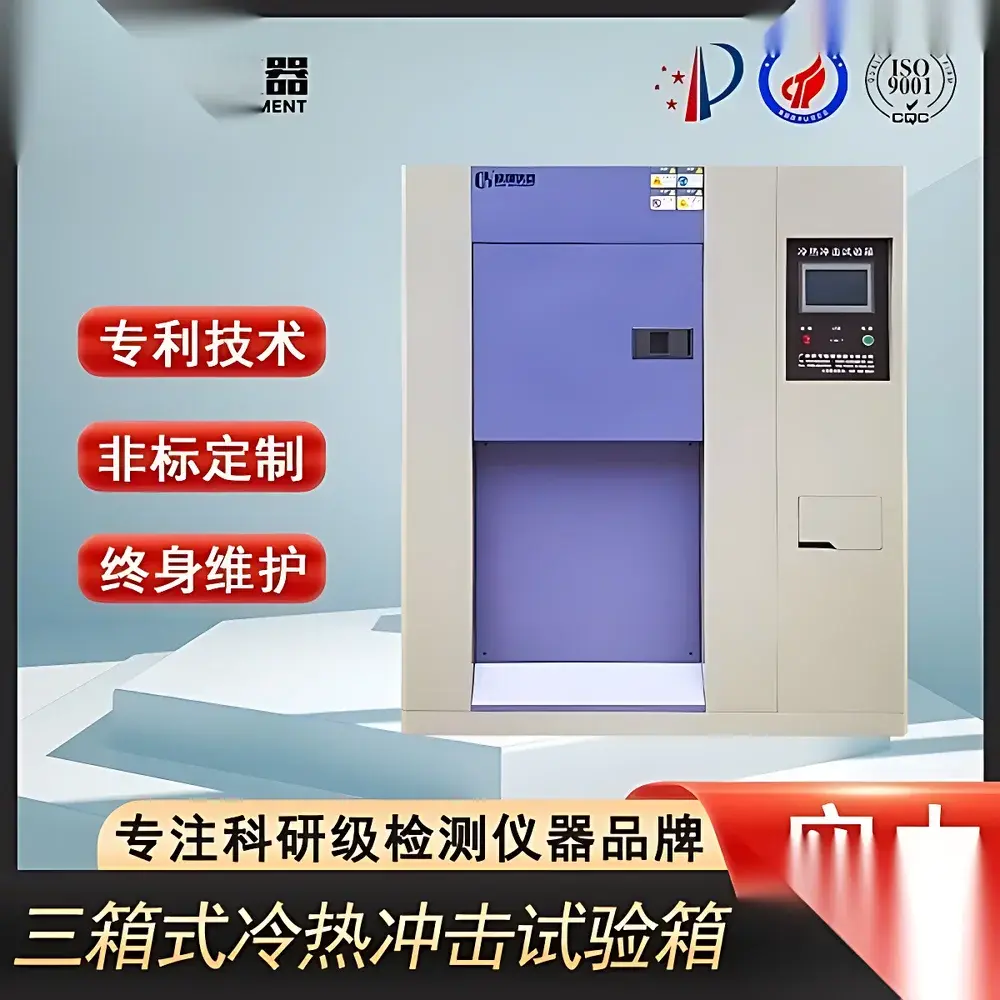
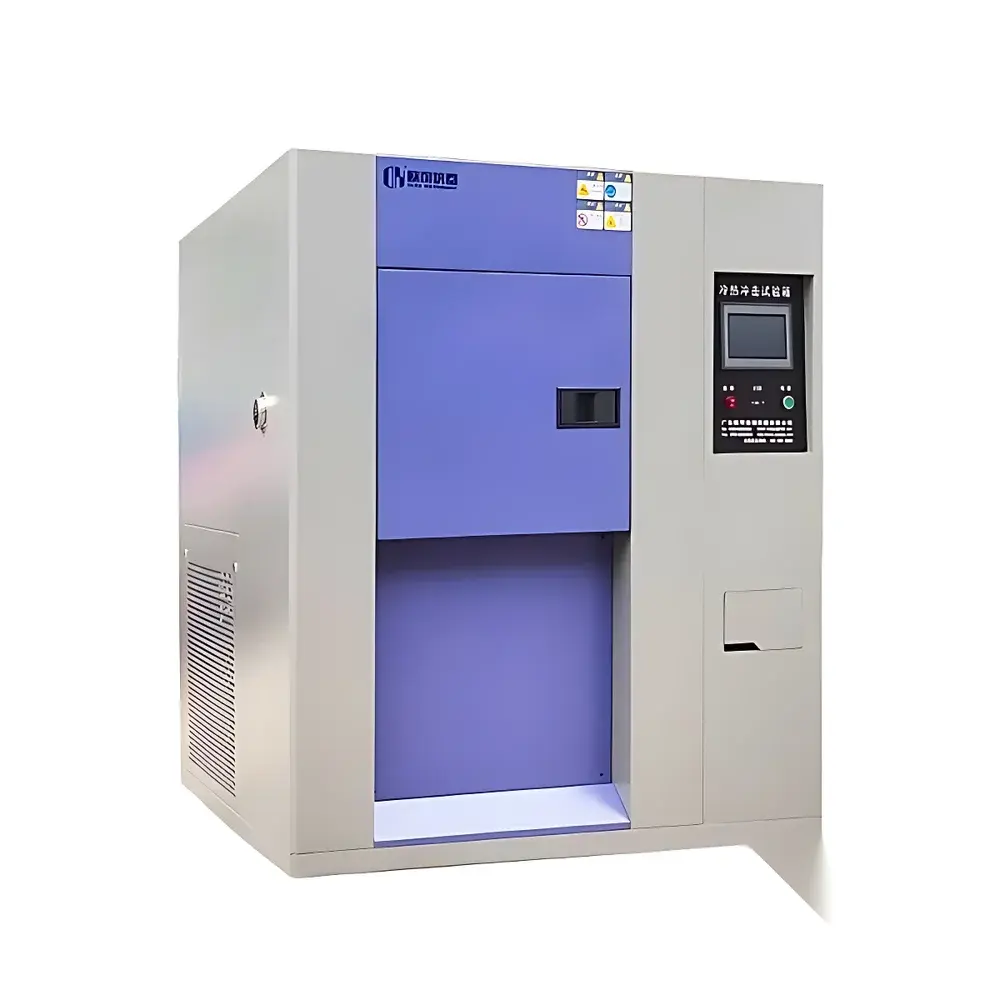
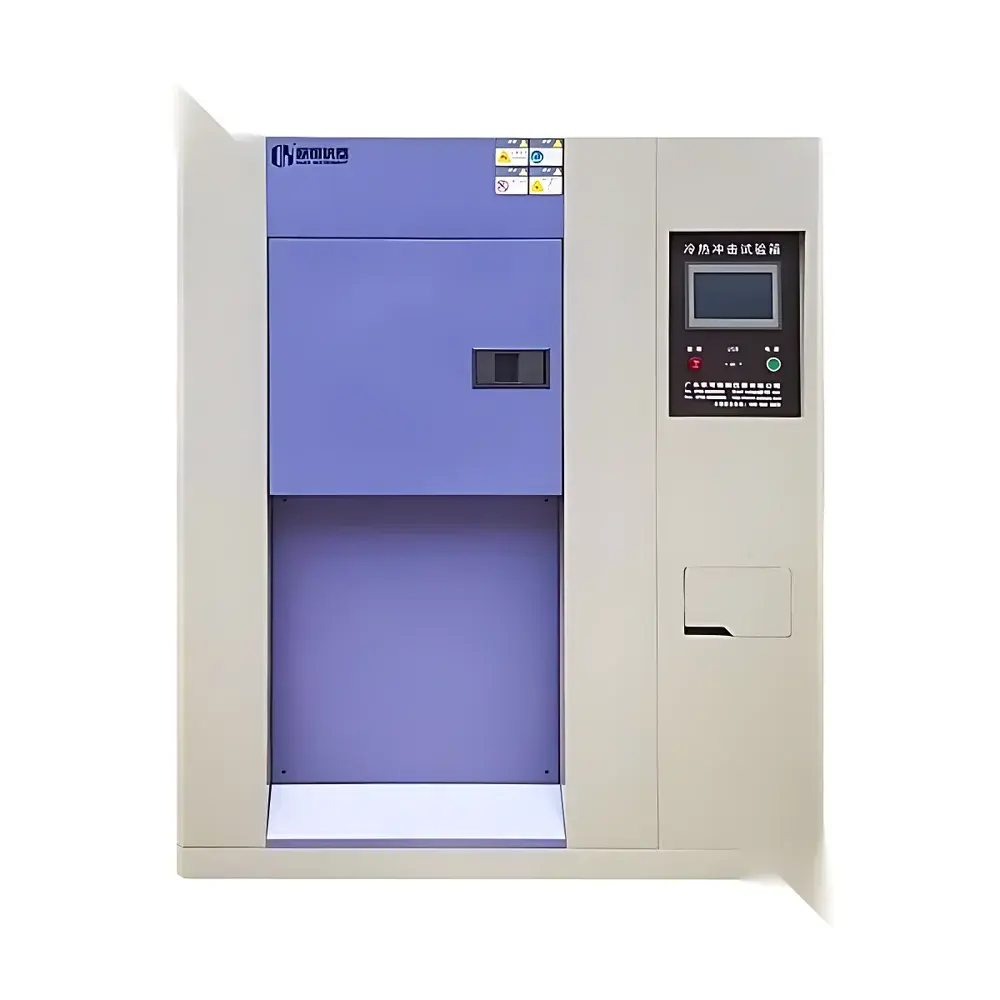
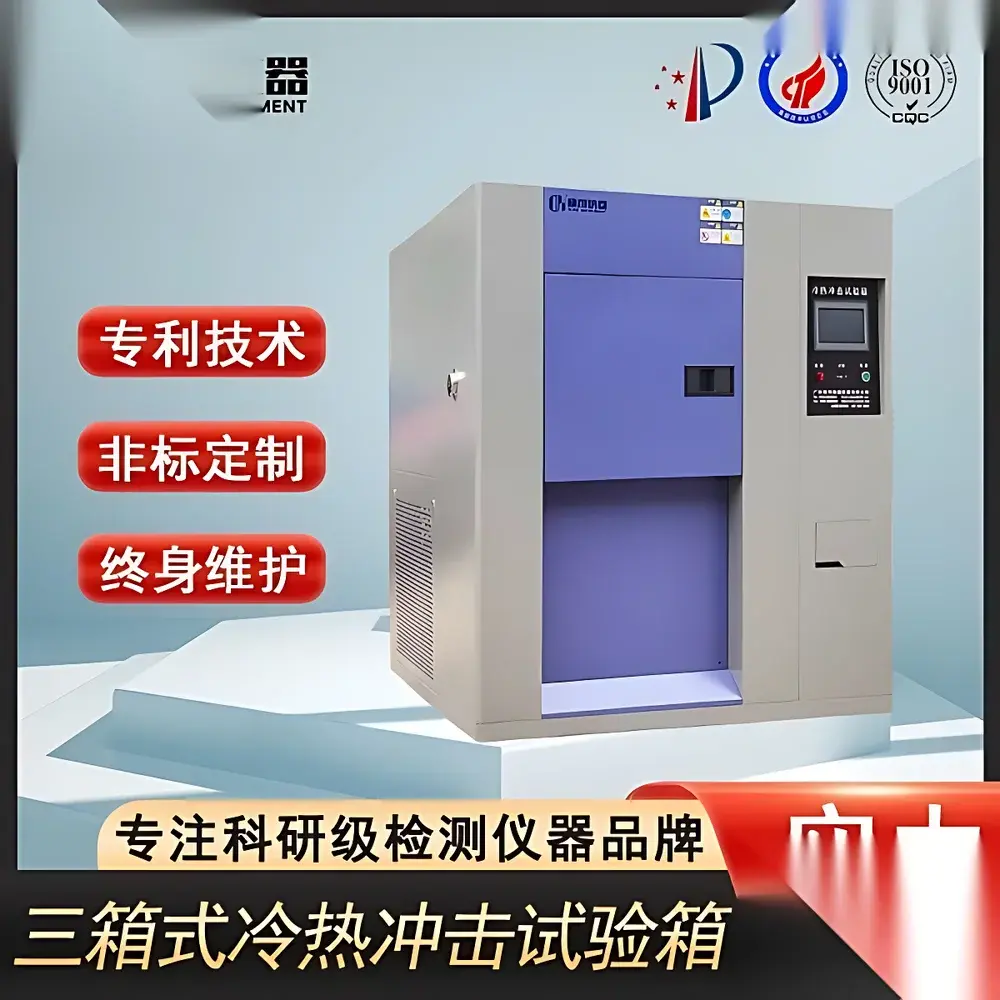
Thermal Shock Test Chamber – TSC Series (Customizable 2-Zone / 3-Zone Environmental Stress Screening System)
| Key | Internal Chamber Dimensions: 46×46×46 cm |
|---|---|
| High-Temperature Zone Range | Ambient to +150 °C |
| Low-Temperature Zone Range | Ambient to −60 °C |
| Average Ramp Rate | 1.5 °C/min |
| Temperature Uniformity | ±0.5 °C |
| Temperature Accuracy | ±2 °C |
| Transfer Time (Cold ↔ Hot) | <10 s |
| Temperature Recovery Time | <5 min |
| Actuation Method | Pneumatic Cylinder-Based Basket/Tray Transfer |
| Construction | Exterior & Interior Liner — SUS304 Stainless Steel |
| Refrigeration System | Dual-Stage Compound Compressor (Air-Cooled or Water-Cooled), Imported Tecumseh (France) Compressor Units, Eco-Friendly Refrigerant (R404A/R507) |
| Control System | Programmable LCD Controller (320 × 240 Dots), Bilingual (English/Chinese) Interface |
| Max. Program Storage | 100 Sets |
| Max. Cycles per Program | 9999 |
| Max. Segment Duration | 999 h 59 min |
| Communication | RS-232C Port for PC Integration, Data Logging & Remote Editing |
| Dynamic I/O | Two Time-Signal Relays |
| Power Rating | 7.5 kW / 12 kW / 15 kW / 26 kW |
| Electrical Supply | AC 380 V, 50 Hz, 3-Phase 4-Wire |
| Compliance | GB/T 2423.22, GJB 150.5A, IEC 60068-2-14, MIL-STD-810H Method 503.5 |
| Application Scope | Static (non-moving) specimen testing only |
Overview
The Thermal Shock Test Chamber – TSC Series is an engineered environmental stress screening (ESS) system designed to evaluate material and component reliability under rapid, repeated transitions between extreme high- and low-temperature conditions. Based on the two-zone (hot/cold) or optional three-zone (hot/ambient/cold) configuration, the chamber employs a pneumatically actuated transfer mechanism to move test specimens—mounted statically on a fixed basket or tray—between thermally isolated zones. This architecture eliminates mechanical vibration during transfer and ensures precise thermal shock exposure without specimen repositioning. The system operates on the principle of accelerated life testing (ALT), inducing thermal expansion/contraction stresses that reveal latent defects such as interfacial delamination, solder joint fatigue, seal integrity failure, and coefficient-of-thermal-expansion (CTE) mismatch in electronic assemblies, aerospace composites, automotive sensors, and polymer-based packaging materials.
Key Features
- Robust dual-stage compound refrigeration system with imported Tecumseh compressors and eco-friendly R404A/R507 refrigerants, enabling stable operation across −60 °C to +150 °C ranges.
- Pneumatic cylinder-driven transfer mechanism achieving ≤10 s zone-to-zone transition time and ≤5 min temperature recovery—critical for meeting stringent IEC 60068-2-14 and MIL-STD-810H Method 503.5 requirements.
- Microprocessor-based programmable controller with 320 × 240-dot backlit LCD display, supporting bilingual (English/Chinese) interface, 100 stored test programs, and up to 9999 cycles per program.
- SUS304 stainless steel construction for both exterior housing and interior chamber walls—ensuring corrosion resistance, structural rigidity, and long-term dimensional stability under thermal cycling.
- Integrated safety architecture: PLC-monitored fault detection, automatic emergency shutdown during voltage fluctuation or refrigerant pressure anomaly, and dual-channel time-signal relays for external process synchronization.
- Standard RS-232C serial interface compliant with SCPI command set, enabling bidirectional communication with LabVIEW, MATLAB, or custom LIMS platforms for automated data acquisition, audit trail generation, and remote parameter validation.
Sample Compatibility & Compliance
This chamber accommodates static (non-moving) specimens only—ideal for PCBAs, IC packages, LED modules, battery cells, optical housings, and molded plastic enclosures mounted on standardized test trays. Chamber internal dimensions are configurable across four standard footprints (46L × 46W × 46H cm to 80L × 80W × 76H cm), supporting batch testing of multiple units per cycle. All models comply with internationally recognized environmental test standards including GB/T 2423.22 (China), GJB 150.5A (PLA), IEC 60068-2-14 (Ed. 4.0, 2016), and MIL-STD-810H Method 503.5 (Thermal Shock). Calibration traceability follows ISO/IEC 17025 guidelines; temperature uniformity and accuracy are verified per ASTM E74 and IEC 60068-3-5 procedures prior to shipment.
Software & Data Management
The embedded controller supports real-time monitoring of zone temperatures, transfer timing, compressor status, and alarm history. Through the RS-232C port, users can deploy third-party software for full-cycle logging—including timestamped temperature profiles, event-triggered snapshots, and statistical summaries (min/max/mean/delta per segment). Audit-ready data export formats include CSV and XML. For regulated environments (e.g., automotive AEC-Q200 qualification or medical device IQ/OQ), optional firmware upgrade enables 21 CFR Part 11-compliant electronic signatures, user access levels, and immutable audit trails—fully aligned with GLP/GMP documentation frameworks.
Applications
- Qualification testing of semiconductor devices (BGA, QFN, CSP) per JEDEC JESD22-A104.
- Reliability validation of EV battery modules under thermal cycling stress (UN 38.3 Section 38.3.4).
- Material compatibility assessment of adhesives, conformal coatings, and potting compounds used in avionics enclosures.
- Failure mode analysis of MEMS sensors subjected to thermal hysteresis and creep deformation.
- Process capability studies for reflow soldering and underfill curing processes in high-mix electronics manufacturing.
FAQ
What is the difference between 2-zone and 3-zone thermal shock configurations?
The 2-zone system alternates specimens between hot and cold chambers only; the 3-zone variant adds a thermally neutral intermediate zone, reducing thermal gradient shock intensity and enabling gentler ramp profiles for sensitive optoelectronic components.
Can this chamber support dynamic loading during thermal cycling?
No—this model is explicitly designed for static specimen mounting only. Dynamic mechanical load application requires integration with external electrodynamic shakers or hydraulic actuators, which falls outside the scope of standard TSC Series compliance.
Is NIST-traceable calibration included with delivery?
Yes—each unit ships with a factory calibration certificate traceable to NIST standards (via accredited third-party lab), covering temperature uniformity, accuracy, and transfer timing verification per IEC 60068-3-5 Annex B.
What refrigerant options are available for regions with F-gas regulation restrictions?
R450A and R452A low-GWP alternatives are available upon request and subject to regional regulatory approval—consult technical sales for jurisdiction-specific compliance documentation.
How is electrical safety ensured during rapid thermal transients?
All power distribution circuits incorporate Class II insulation, reinforced grounding, and real-time RMS voltage monitoring with auto-cutoff at ±10% deviation from nominal 380 VAC supply—meeting IEC 61000-4-11 immunity requirements.



