
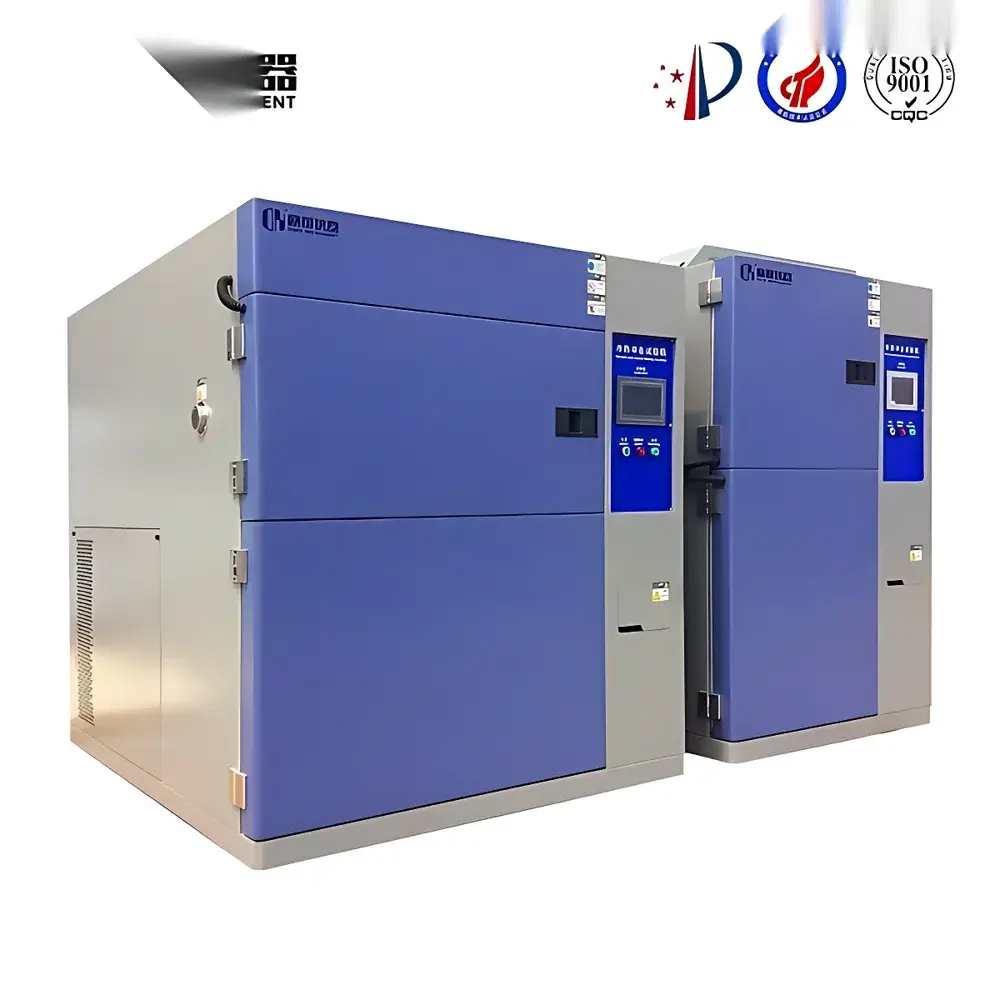
Thermal Shock Test Chamber – Three-Zone Air-Transfer Type
| Brand | OEM / Custom-Built |
|---|---|
| Origin | Imported |
| Manufacturer Type | Authorized Distributor |
| Pricing | USD 11,200 (FOB) |
Overview
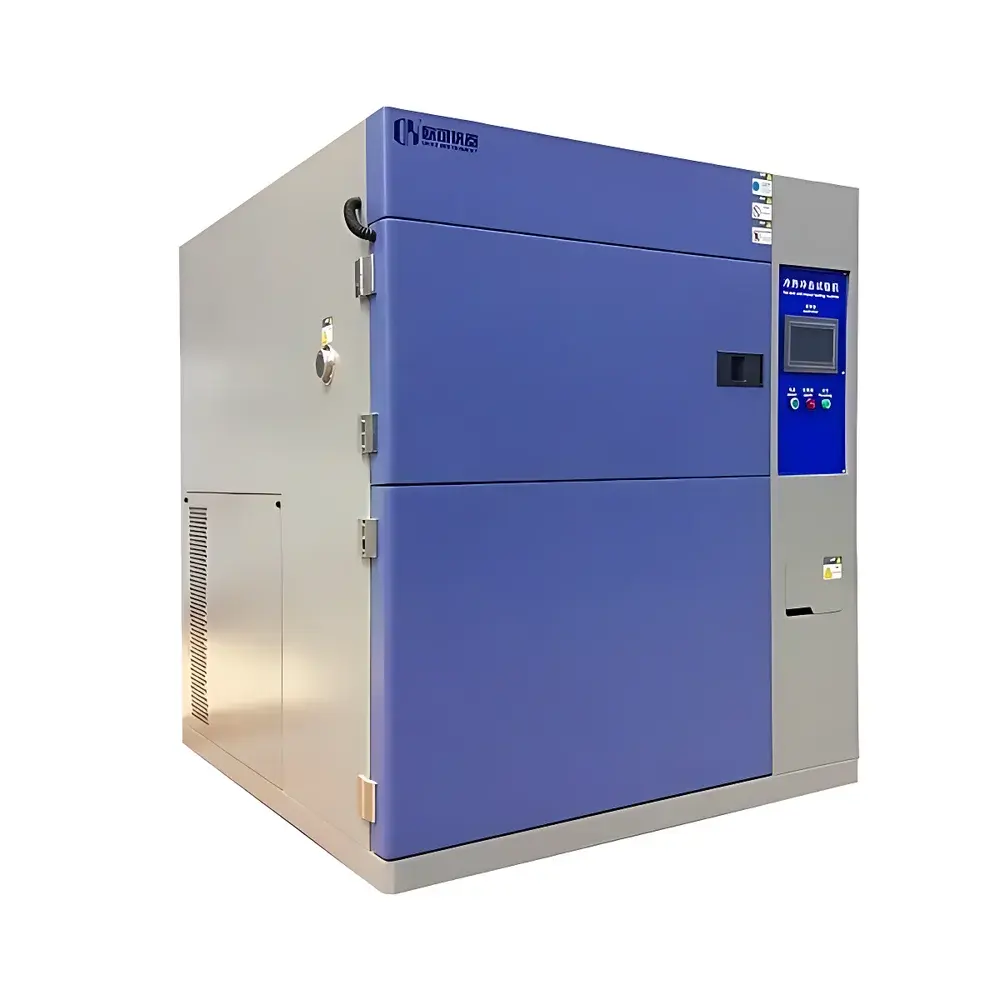
The Thermal Shock Test Chamber – Three-Zone Air-Transfer Type is an engineered environmental test system designed to evaluate material and component reliability under rapid, repetitive transitions between extreme high- and low-temperature conditions. It operates on the principle of physical thermal stress induction via controlled air transfer between three thermally isolated chambers: a high-temperature zone (+150 °C max), a low-temperature zone (−70 °C min), and a test specimen chamber positioned centrally. Unlike single- or dual-chamber configurations, this three-zone architecture eliminates thermal mass interference from the test space itself, enabling sub-15-second transfer times and precise dwell-time control—critical for assessing solder joint integrity, polymer embrittlement, coating adhesion loss, and intermetallic delamination in electronics, aerospace composites, and automotive powertrain modules. The system employs a BTC (Balance Temperature Control) methodology: continuous refrigeration operation combined with PID-regulated auxiliary heating, ensuring stable setpoint maintenance during dwell phases while minimizing compressor cycling and thermal overshoot.
Key Features
- Three-compartment design with independent temperature control: hot zone (up to +150 °C), cold zone (down to −70 °C), and neutral test chamber
- Air-transfer mechanism using pneumatically actuated isolation doors and high-efficiency centrifugal circulation fans (≥15 m/s airflow velocity at specimen location)
- BTC (Balance Temperature Control) system: simultaneous operation of refrigeration and resistive heating with real-time PID feedback for ±0.3 °C temperature stability during dwell
- Energy-regulated refrigeration circuit based on reverse Carnot cycle, incorporating electronic expansion valves and variable-speed compressors for optimized coefficient of performance (COP)
- PLC-based automation platform (Siemens S7-1200 series) with deterministic I/O response (<10 ms), full sequence logging, and hardware interlock for door position, pressure differential, and overtemperature cut-off
- Insulation: 150 mm thick polyurethane foam (λ ≤ 0.022 W/m·K) with vacuum-degassed core and stainless-steel vapor barrier
Sample Compatibility & Compliance
The chamber accommodates specimens up to 500 × 500 × 500 mm (W × D × H) and supports standardized mounting fixtures per MIL-STD-810H Method 503.7 and IEC 60068-2-14. It meets structural and operational requirements for ISO 17025-accredited laboratories performing thermal shock validation under GLP and GMP frameworks. All control firmware implements audit-trail functionality compliant with FDA 21 CFR Part 11 (electronic records and signatures), including user-level access control, timestamped parameter change logs, and non-erasable event history. Calibration traceability is maintained to NIST-traceable reference standards, with optional third-party certification available per ASTM E2293–22 (Standard Practice for Calibration of Thermal Shock Chambers).
Software & Data Management
Equipped with proprietary WinControl™ v4.2 software running on embedded industrial PC (Windows IoT Enterprise), the system provides synchronized multi-channel data acquisition at 10 Hz sampling rate across internal PT100 sensors (hot/cold/test zones), chamber pressure transducers, and door-cycle counters. Data export formats include CSV, XML, and PDF reports with embedded metadata (test ID, operator, calibration certificate number, environmental conditions). Remote monitoring is supported via TLS-encrypted HTTP/HTTPS interface; integration with LIMS platforms (e.g., LabVantage, Thermo Fisher SampleManager) is achieved through OPC UA 1.04 server compliance. All test sequences—including ramp rates (programmable 1–30 °C/min), dwell durations (1–9999 min), and cycle counts (1–9999)—are stored in encrypted project files with SHA-256 hash verification.
Applications
- Qualification testing of printed circuit board assemblies (PCBAs) per IPC-9701A for interconnect reliability
- Validation of adhesive bond strength in battery module enclosures under repeated −40 °C ↔ +85 °C cycling
- Accelerated life assessment of optical lens coatings subjected to thermal hysteresis-induced microcracking
- Material screening for electric vehicle traction inverters exposed to under-hood thermal transients
- Process validation of conformal coating cure stability in medical device housings (ISO 13485 context)
FAQ
What is the typical temperature transition time between extremes?
Transition from −70 °C to +150 °C (or vice versa) at specimen location is ≤15 seconds, verified per IEC 60068-2-14 Annex B.
Does the system support custom test profiles beyond standard MIL-STD or IEC cycles?
Yes—WinControl™ allows creation of multi-segment profiles with variable ramp rates, asymmetric dwell times, and conditional branching based on sensor thresholds.
Is remote diagnostics and preventive maintenance supported?
The embedded controller includes predictive analytics for refrigerant charge level estimation, compressor bearing health scoring, and heat exchanger fouling index calculation—all accessible via secure web dashboard.
Can the chamber be integrated into an automated test cell with robotic sample handling?
Yes—digital I/O expansion modules (8-in/8-out opto-isolated) and EtherNet/IP slave interface are factory-configurable for synchronized operation with SCARA or Cartesian robots.
What documentation is provided for regulatory submissions?
Standard delivery includes IQ/OQ protocols, FAT/SAT reports, uncertainty budgets per ISO/IEC 17025, and a Declaration of Conformity referencing EN 61000-6-2 (EMC) and EN 61000-6-4 (emissions).



