
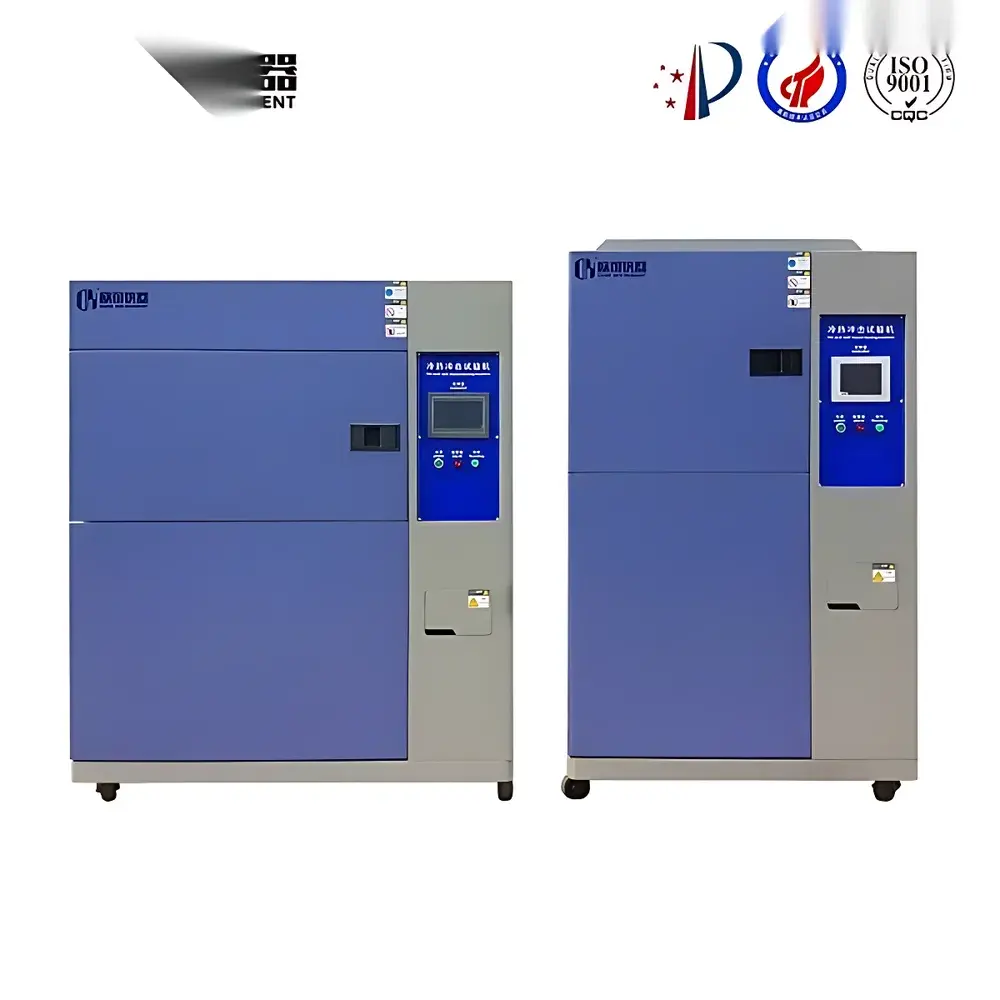
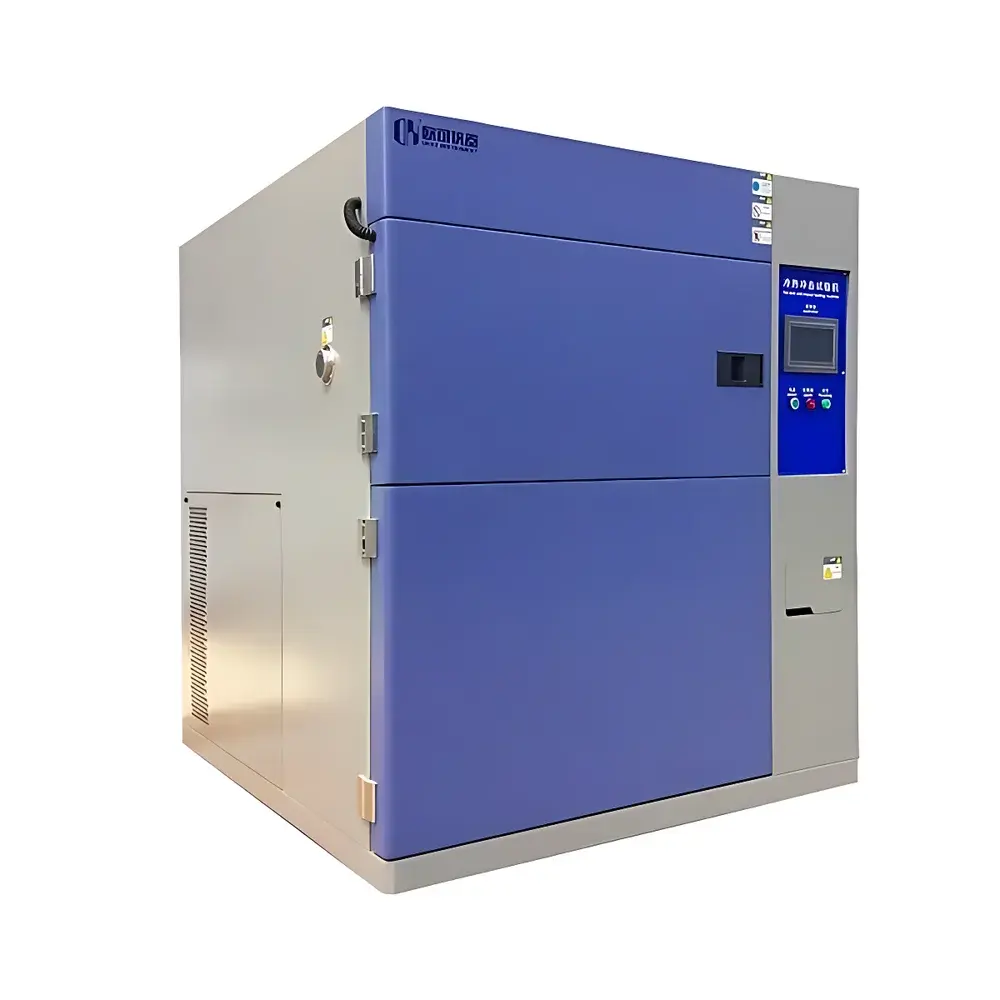
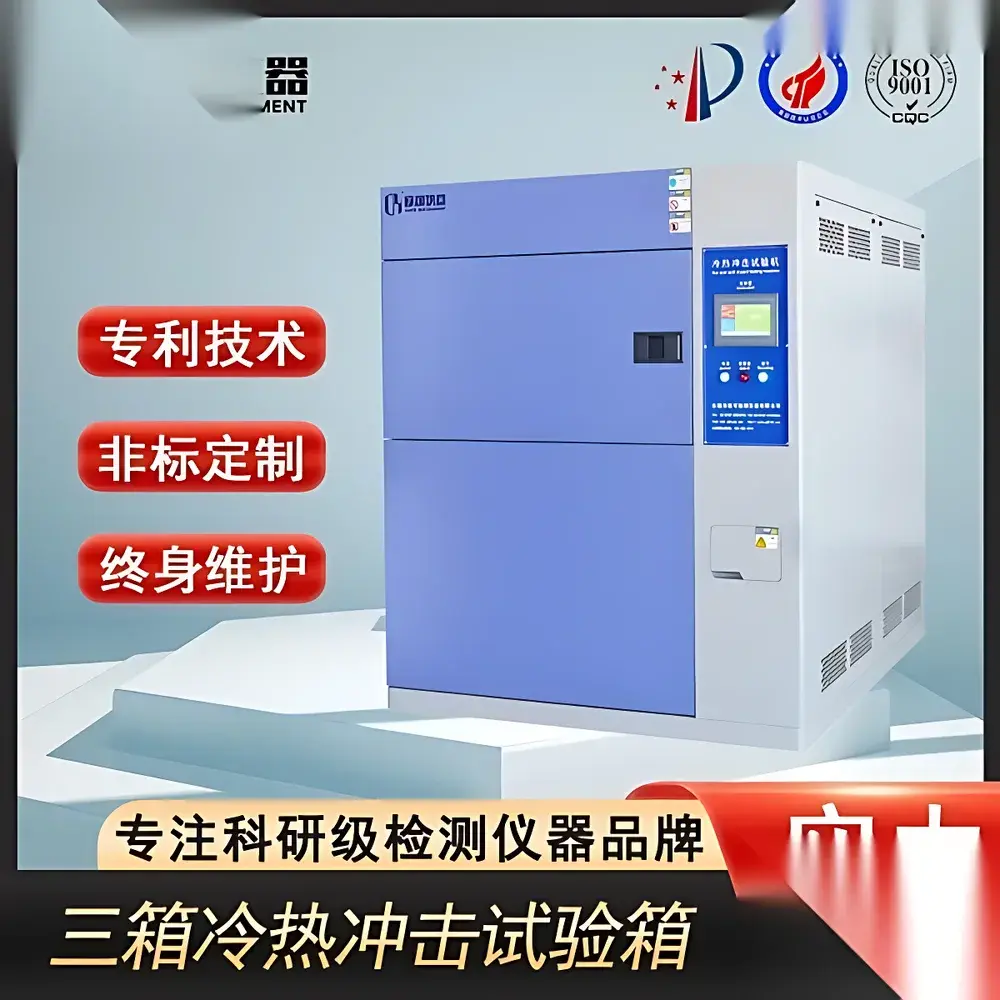
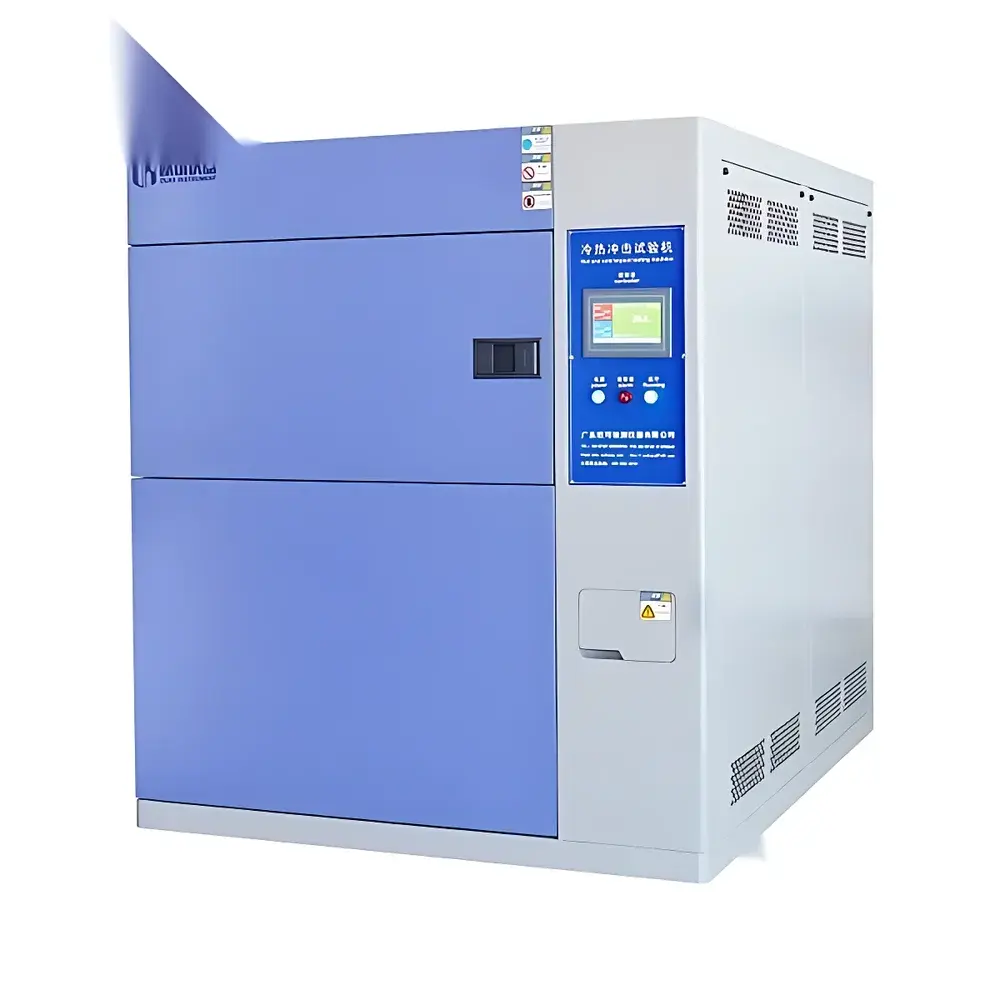
Thermal Shock Test Chamber – Three-Zone Rapid Temperature Transition Chamber
| Key | Brand: Other Brands |
|---|---|
| Origin | Imported |
| Manufacturer Type | Authorized Distributor |
| Price | USD 11,200 (FOB) |
| Display | 7″ TFT True-Color LCD Touchscreen Controller |
| Door Viewport | Multi-Layer Tempered Glass with Conductive Film Defrosting & Internal LED Illumination |
| Air Circulation | Low-Noise High-Efficiency AC Motor with Multi-Blade Centrifugal Impeller |
| Mobility | Lockable PU Casters |
| Test Port | One Φ50 mm Access Port (Left Side, Sealed Gland) |
| Safety Systems | Over-Temperature Protection, Compressor Overload/High-Pressure Cutout, Leakage Current Detection, Water Shortage Alarm, Real-Time Fault Logging & Auto Shutdown |
| Refrigeration Architecture | Modular Hermetic Compressor Units |
| Evaporator Integrity | Water-Immersion Leak Testing Certified |
| Airflow Design | Positive-Pressure Uniformity Optimized Duct System |
| Defrost Method | Adaptive Scheduled Defrost with Reduced Cycle Duration |
| Control Algorithm | Proprietary Fuzzy Logic Thermal Load Compensation Engine |
Overview
The Three-Zone Rapid Temperature Transition Chamber is an industrial-grade thermal shock test system engineered for accelerated reliability validation of electronic components, automotive modules, aerospace hardware, and polymer-based assemblies subjected to extreme ambient transitions. Operating on the principle of rapid, repeatable thermal displacement between discrete high-temperature, low-temperature, and ambient soak zones, the chamber enables precise simulation of real-world thermal cycling stress without mechanical sample transfer—eliminating thermal lag and positional error inherent in single- or dual-chamber designs. Its core architecture integrates a tripartite insulated enclosure with independent refrigeration and heating circuits, enabling transition rates exceeding 60 °C/min between −65 °C and +150 °C (typical operational range), with temperature stability maintained within ±0.5 °C during steady-state soak phases. Designed for compliance-driven testing environments, the system supports traceable execution of ASTM D5229, MIL-STD-810H Method 503.7, IEC 60068-2-14, and JESD22-A104 qualification protocols.
Key Features
- Tri-Zone Isolation Architecture: Physically separated hot, cold, and transfer chambers minimize cross-contamination of thermal mass and ensure reproducible dwell-to-transition timing per IEC 60068-2-14 Annex B.
- Fuzzy Logic Adaptive Control: Proprietary controller dynamically modulates refrigerant flow rate and heater duty cycle based on real-time thermal load profiling—reducing energy consumption by up to 20% versus fixed-setpoint PID systems while maintaining ±0.3 °C uniformity across 1 m³ working volume.
- Defrost Optimization: Scheduled defrost cycles are triggered only when evaporator frost accumulation exceeds empirically calibrated thresholds, minimizing unnecessary downtime and extending compressor service intervals.
- Human-Centric Interface: 7″ TFT true-color touchscreen provides intuitive navigation, multi-language support (English, German, Japanese, Simplified Chinese), graphical trend logging, and password-protected parameter locking for GLP/GMP audit readiness.
- Mechanical Robustness: Structural frame fabricated from 2.0 mm cold-rolled steel with electrophoretic coating; inner chamber constructed from SUS304 stainless steel; observation viewport comprises triple-layer tempered glass with embedded conductive film and adjustable LED illumination for unobstructed process monitoring under condensation-prone conditions.
- Modular Refrigeration: Hermetically sealed compressors mounted on vibration-dampened subframes allow field replacement of individual units without system evacuation—reducing mean time to repair (MTTR) by >40% compared to monolithic systems.
Sample Compatibility & Compliance
The chamber accommodates standard test specimens up to 500 mm × 500 mm × 500 mm (W×D×H) with unrestricted access via a double-gasketed vertical lift door. The Φ50 mm left-side test port features a silicone-sealed gland fitting compatible with thermocouple wires (Type K/T/J), voltage-rated signal cables (up to 300 VAC), and pneumatic tubing—enabling in-situ electrical performance monitoring during thermal transients. All safety interlocks comply with EN 61000-6-2 (immunity) and EN 61000-6-4 (emissions). Thermal mapping reports per ISO/IEC 17025-accredited procedures are available upon request. The system meets CE marking requirements and conforms to UL 61010-1 for laboratory equipment safety.
Software & Data Management
Built-in data logger records timestamped values for chamber setpoint, actual temperature (hot/cold/transfer zones), compressor discharge pressure, evaporator superheat, and fault event codes at user-selectable intervals (1–60 seconds). Export formats include CSV and PDF with embedded digital signatures. Optional Ethernet/Wi-Fi connectivity enables remote supervision via secure HTTPS interface and integration into enterprise MES/QMS platforms (e.g., Siemens Opcenter, ETQ Reliance) using Modbus TCP or OPC UA protocols. Audit trail functionality satisfies FDA 21 CFR Part 11 requirements—including operator ID tagging, electronic signature capture, and immutable record retention for ≥12 months.
Applications
- Qualification testing of PCBAs, solder joints, and conformal coatings per IPC-J-STD-004 and IPC-A-610.
- Validation of battery pack thermal interface materials (TIMs) and cell-level expansion behavior under cyclic ΔT stress.
- Reliability screening of MEMS sensors, optical encoders, and ceramic capacitors prior to AEC-Q200 certification.
- Accelerated aging studies of elastomeric seals, adhesives, and composite laminates used in avionics enclosures.
- Process window definition for reflow soldering profile development and lead-free alloy compatibility assessment.
FAQ
What is the typical temperature transition time between extremes?
Transition from −65 °C to +150 °C (or vice versa) is achievable in ≤15 seconds for empty chamber; loaded times depend on specimen thermal mass and are validated per IEC 60068-2-14 Clause 6.2.
Does the system support automated test sequencing?
Yes—the controller supports up to 99 programmable steps per test profile, including variable dwell durations, ramp rates, loop counts, and conditional branching based on real-time sensor feedback.
Is calibration documentation included with shipment?
A factory-as-built temperature uniformity report (per ISO 17025) and NIST-traceable sensor calibration certificates are provided; annual recalibration services are available under extended warranty contracts.
Can the chamber be integrated into an existing environmental test lab network?
Standard RS-485, Ethernet, and optional analog 4–20 mA outputs enable seamless integration with centralized monitoring SCADA systems and LIMS databases.
What maintenance intervals are recommended?
Compressor oil analysis every 2,000 operating hours; condenser coil cleaning quarterly; refrigerant leak verification semiannually; full system performance verification annually per ASTM E744 guidelines.



