
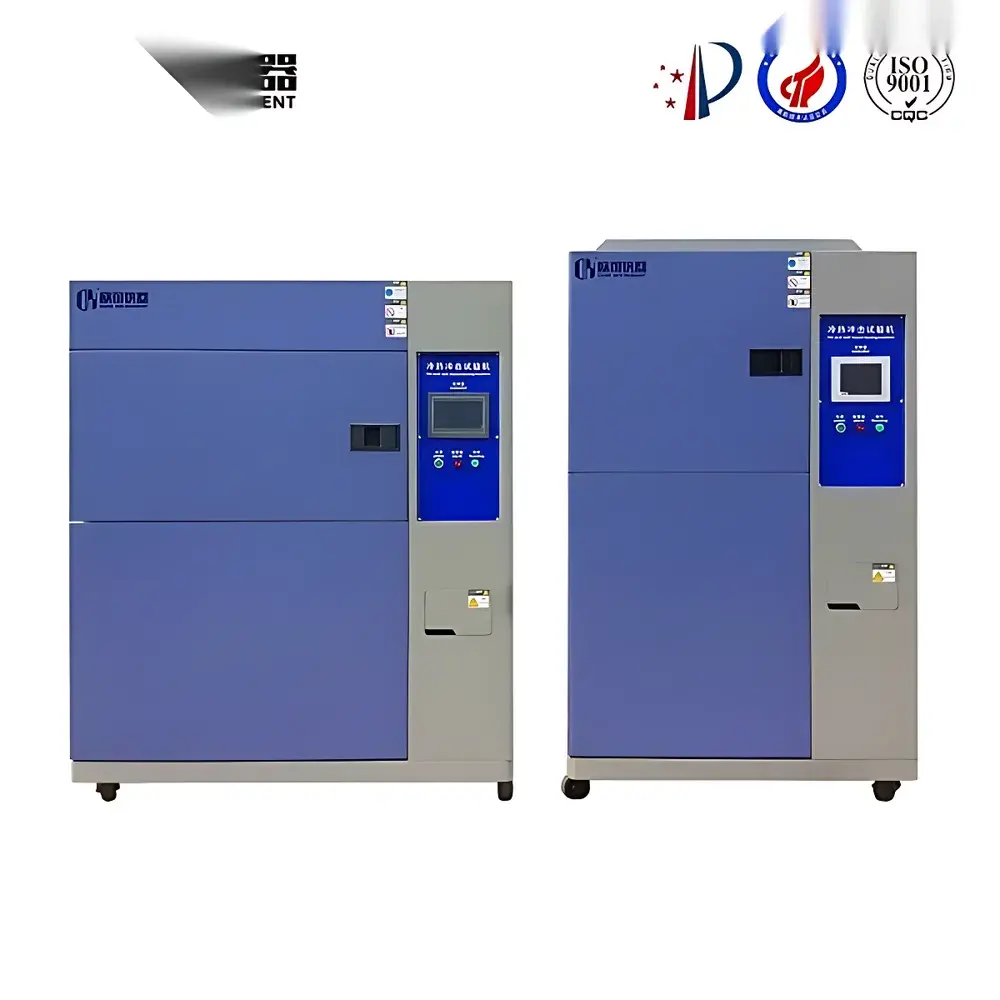
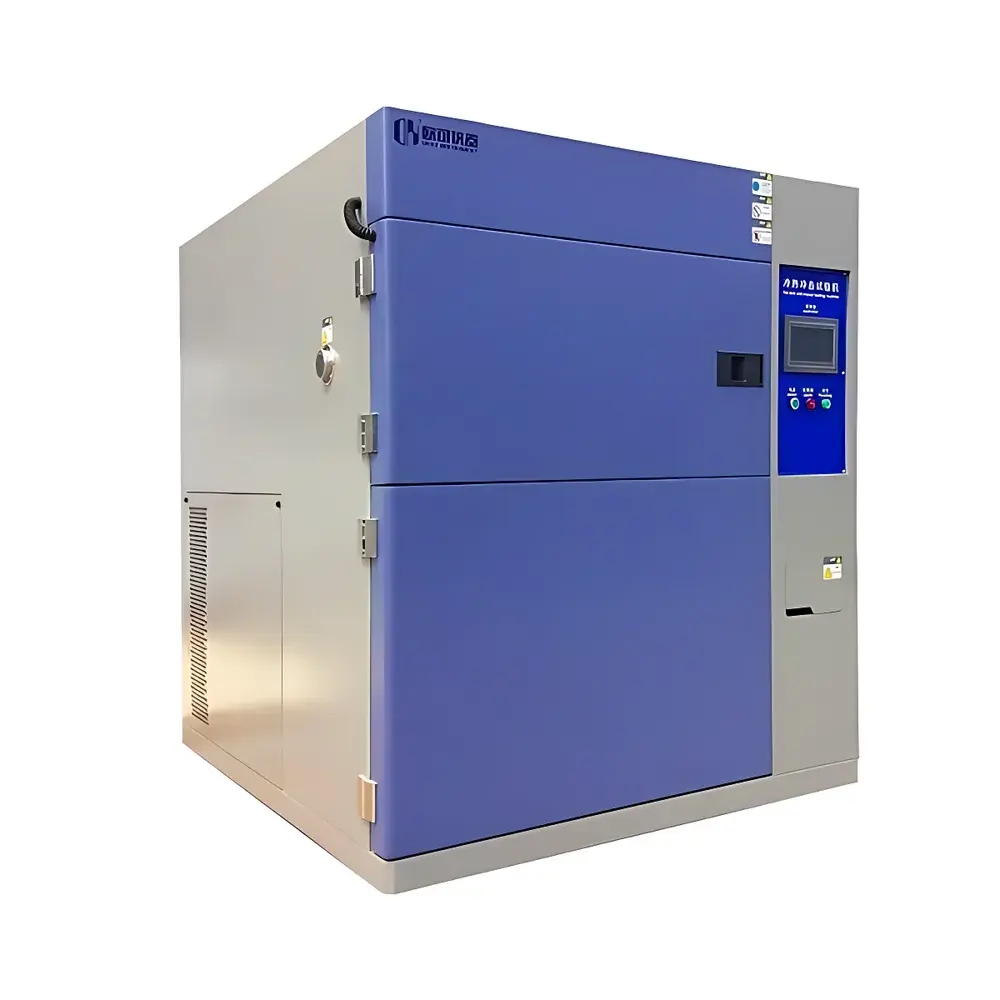
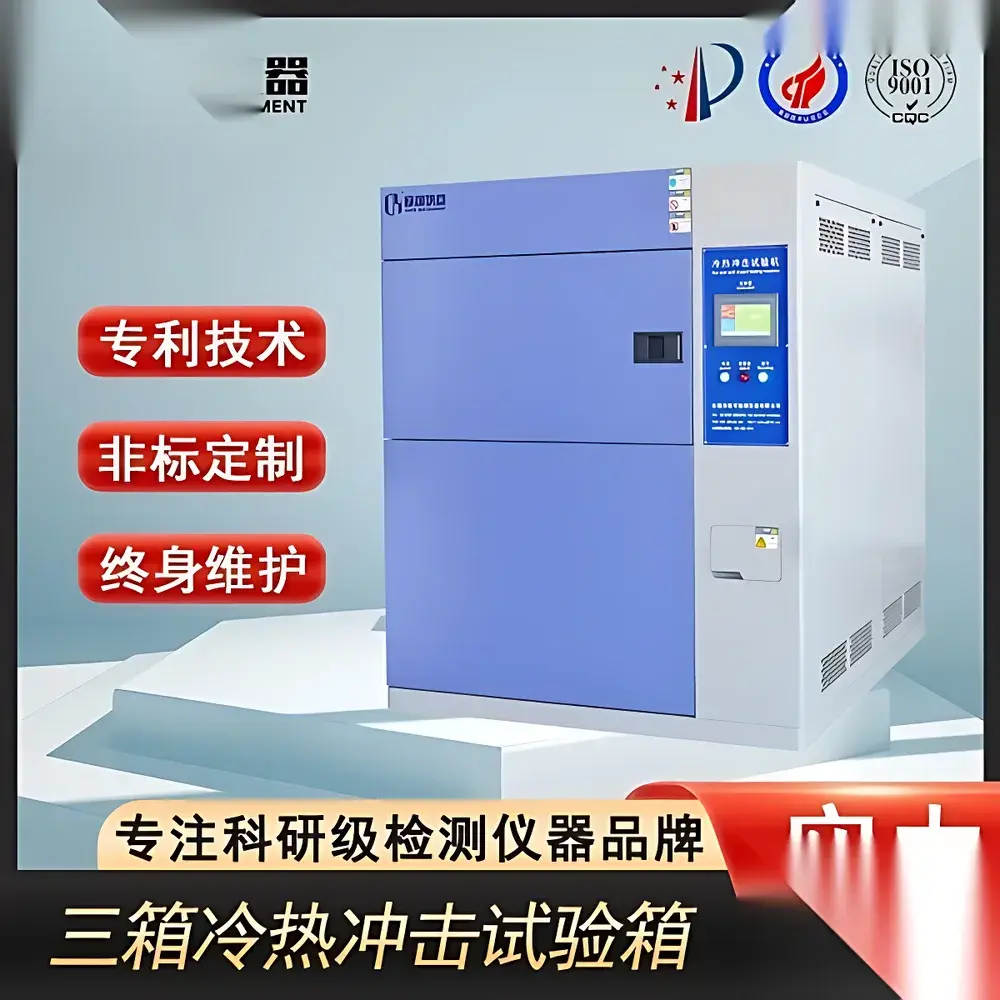
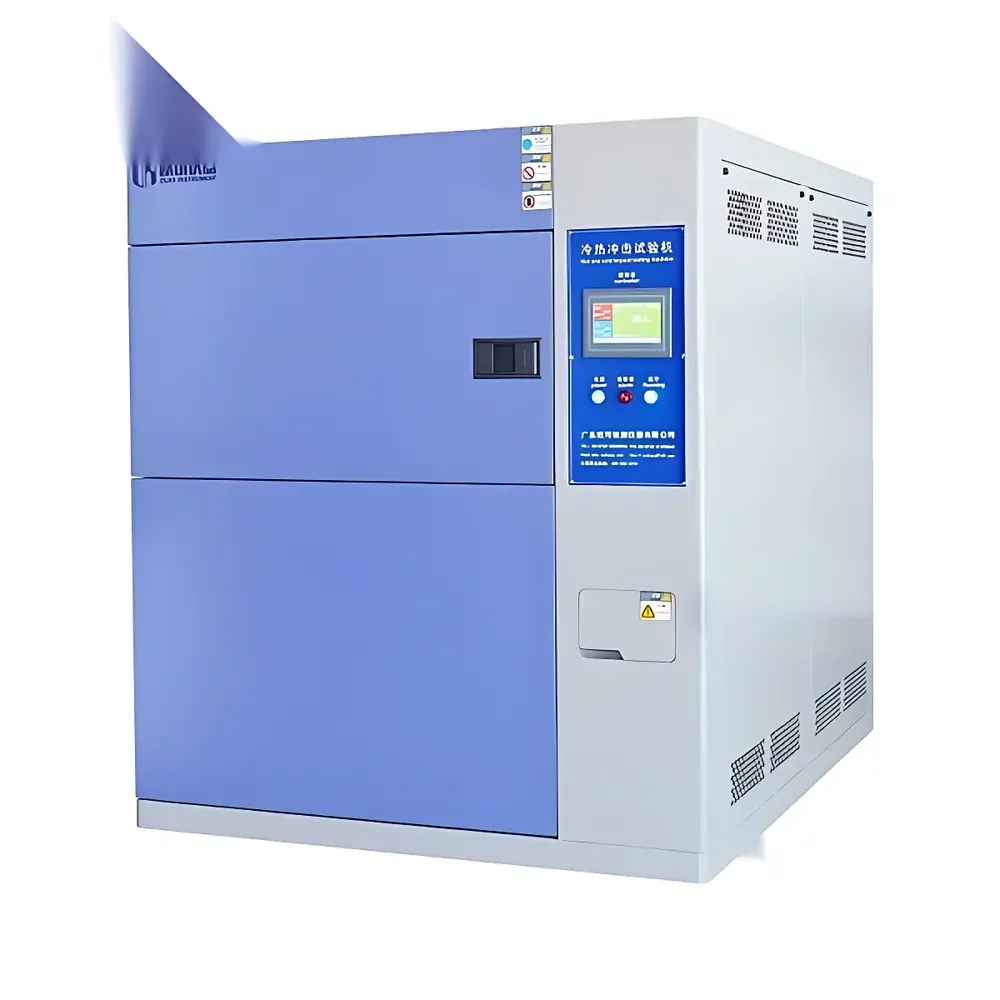
Thermal Shock Test Chamber – Three-Zone Static Specimen Configuration
| Key | Temperature Range (High Zone): +150°C to +200°C |
|---|---|
| Temperature Range (Low Zone) | -70°C to -40°C |
| Transition Time (Typical) | ≤15 s (5℃ to -40℃) |
| Test Zone Stability | ±0.5°C |
| Control System | PLC-based with 302×240-dot LCD HMI (Bilingual English/Chinese) |
| Program Storage | 100 user-defined profiles, up to 9999 cycles per profile |
| Timing Resolution | 1 min (adjustable to 1 sec) |
| Communication Interface | RS-232C, optional RS-485/Ethernet |
| Compliance | GB/T 2423.1–2001, GB/T 2423.2–2001, GB/T 2423.22–1989, GJB 150.5–1986, GJB 360.7–1987, IEC 60068-2-14 (Test N) |
Overview
The Thermal Shock Test Chamber – Three-Zone Static Specimen Configuration is an engineered environmental stress screening (ESS) system designed for accelerated reliability assessment of electronic components, aerospace hardware, automotive modules, and polymer-based assemblies. It operates on the principle of rapid, controlled thermal transients—subjecting stationary test specimens to abrupt transitions between extreme high- and low-temperature environments without physical movement of the sample. This eliminates mechanical vibration artifacts and ensures that observed failures are attributable solely to thermally induced stresses—including interfacial delamination, solder joint fatigue, coefficient-of-thermal-expansion (CTE) mismatch strain, and microcrack propagation. The chamber employs a three-zone architecture (high-temperature soak zone, low-temperature soak zone, and neutral test zone), coupled with dual independent refrigeration circuits based on the reverse Carnot cycle. Each circuit utilizes hermetic compressors, copper-aluminum finned condensers, expansion valves, and optimized refrigerant charge (R404A/R23 cascade or R507) to achieve stable thermal plateaus and repeatable shock profiles.
Key Features
- Three-zone static configuration: Eliminates specimen handling during cycling, ensuring positional repeatability and eliminating transport-induced anomalies.
- Independent dual-refrigeration system: High- and low-temperature zones operate simultaneously, enabling precise dwell control and minimizing transition latency (typical transfer time <15 seconds between +150°C and −40°C).
- PLC-integrated control architecture: Equipped with industrial-grade programmable logic controller (PLC) and 302×240-dot backlit LCD human-machine interface (HMI) supporting bilingual (English/Chinese) operation, real-time parameter monitoring, and alarm logging.
- Extended program capacity: Stores up to 100 multi-step thermal profiles; each profile supports up to 9999 cycles with individual segment timing resolution down to 1 second.
- Digital communication & traceability: Standard RS-232C interface enables remote command execution, data streaming, and automated report generation; optional RS-485 or Ethernet modules support integration into centralized lab management systems compliant with ISO/IEC 17025 requirements.
- Fault-resilient safety design: Includes over-temperature/over-pressure cutoffs, phase-loss detection, compressor discharge temperature monitoring, emergency power-off relay, and automatic system recovery protocols upon grid voltage fluctuation.
Sample Compatibility & Compliance
This chamber accommodates rigid and semi-rigid specimens up to 500 mm × 500 mm × 500 mm (W×D×H) with maximum mass loading of 30 kg. It supports standardized mounting fixtures (e.g., PCB carriers, component trays, and MIL-STD-810G-compliant test racks). All operational parameters adhere to internationally recognized environmental testing standards including IEC 60068-2-14 (Test N: Change of Temperature), MIL-STD-810H Method 503.5, and GJB 150.5A–2009 (Chinese military standard for temperature shock). For regulated industries, the system supports audit-ready data integrity via configurable event logs, operator ID tagging, and timestamped cycle records—fully compatible with GLP and GMP documentation workflows under FDA 21 CFR Part 11 when paired with validated software extensions.
Software & Data Management
The embedded control firmware provides deterministic real-time scheduling and closed-loop PID regulation of both thermal zones. Optional PC-based software (sold separately) delivers full-cycle visualization, statistical process control (SPC) charting, deviation alerting, and PDF/CSV export. All logged data—including chamber setpoints, actual temperatures, cycle counters, fault codes, and operator actions—are stored in non-volatile memory with cyclic overwrite protection. Audit trails include digital signatures for critical operations (e.g., profile activation, calibration verification, and emergency stop initiation), satisfying traceability requirements per ISO/IEC 17025 Clause 7.7 and ANSI Z540.3.
Applications
- Qualification testing of avionics modules per DO-160 Section 4 (Temperature Shock).
- Solder joint reliability validation for lead-free BGA packages under JEDEC JESD22-A106B.
- Accelerated aging studies of encapsulated optoelectronic devices (LEDs, laser diodes) subjected to repeated thermal excursions.
- Material compatibility screening for adhesive bonds in multi-layer composites used in electric vehicle battery housings.
- Failure mode identification in MEMS sensors exposed to automotive under-hood thermal gradients.
- Pre-screening of medical device PCBs prior to sterilization validation (ISO 13485 Annex C).
FAQ
What is the difference between two-zone and three-zone thermal shock configurations?
In a two-zone system, the test specimen moves mechanically between hot and cold chambers—introducing inertial stress and positional variability. The three-zone static design maintains the specimen in a fixed location while redirecting conditioned air via high-speed pneumatic dampers, ensuring purely thermal stress exposure.
Can this chamber perform ramp-and-soak profiles in addition to shock cycles?
Yes—the controller supports hybrid profiles combining linear ramps (0.5–10°C/min), dwell periods (1 min to 999 hrs), and instantaneous shock transitions, enabling simulation of real-world thermal duty cycles such as engine start-stop or solar loading events.
Is calibration certification included with shipment?
A factory-as-found calibration report (traceable to NIST or equivalent national metrology institute) is provided. On-site IQ/OQ/PQ validation services and annual recalibration contracts are available upon request.
What refrigerants are used, and are they compliant with current environmental regulations?
The system uses either R404A/R23 cascade or R507 refrigerant blends—both classified as transitional HFCs under the Kigali Amendment. Units shipped post-2025 may be configured with low-GWP alternatives (e.g., R450A or R454B) upon customer specification and regional regulatory alignment.
How is data integrity ensured during long-duration tests spanning multiple days?
Internal flash memory buffers all sensor readings at 1 Hz sampling rate; redundant storage prevents data loss during brief power interruptions. External logging via RS-232C or Ethernet provides synchronized backup and enables integration with LIMS or MES platforms.



