
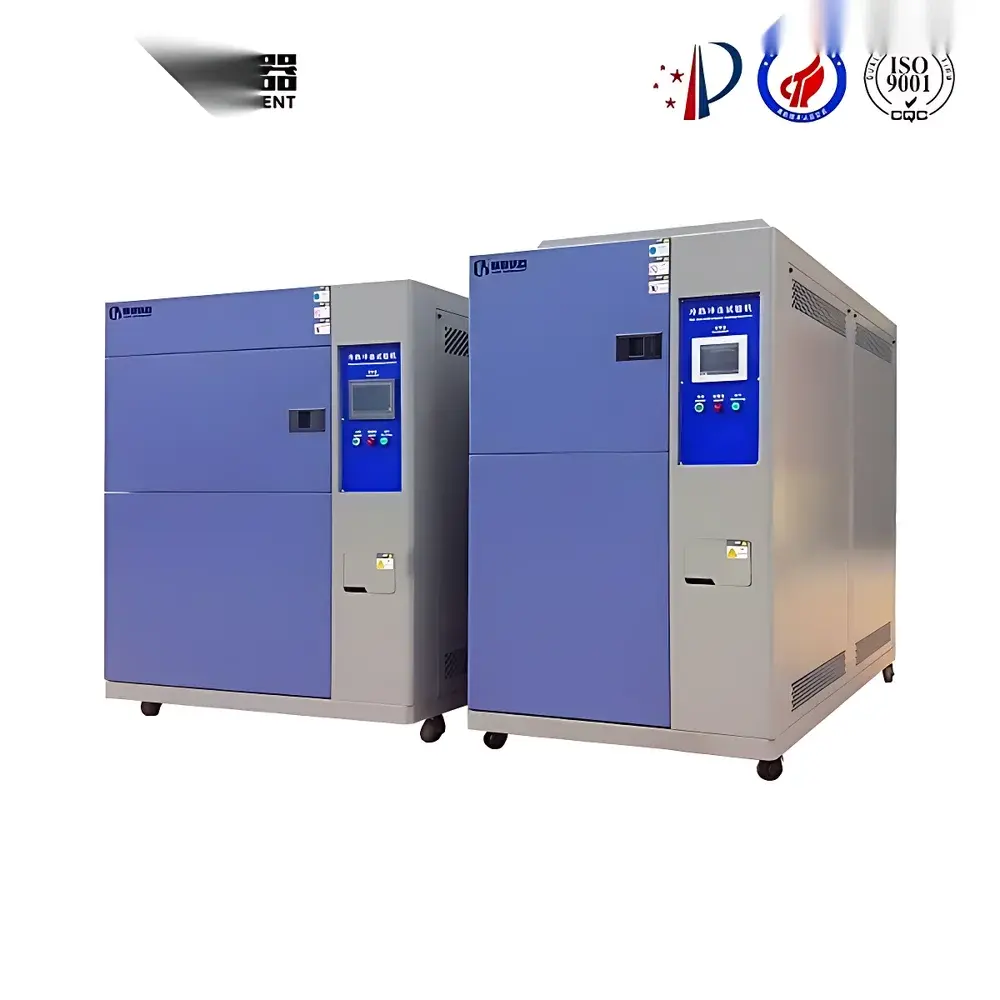
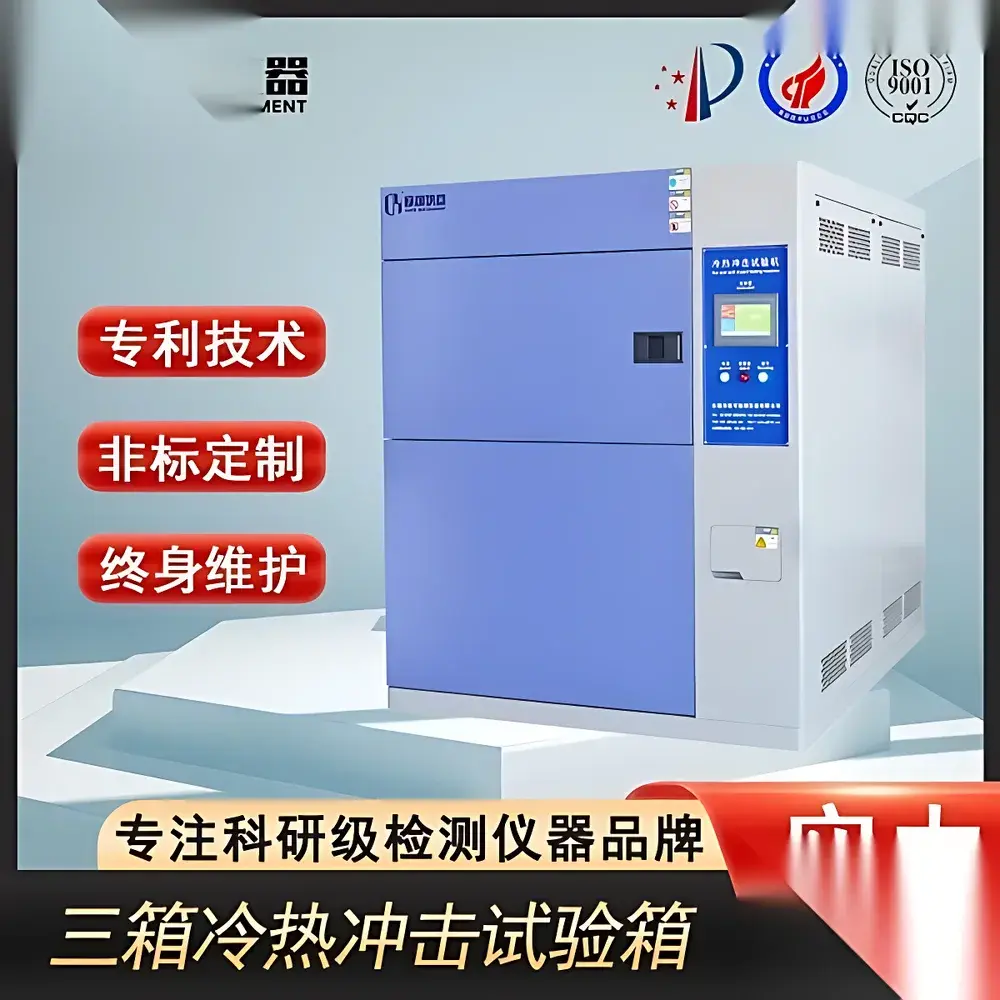
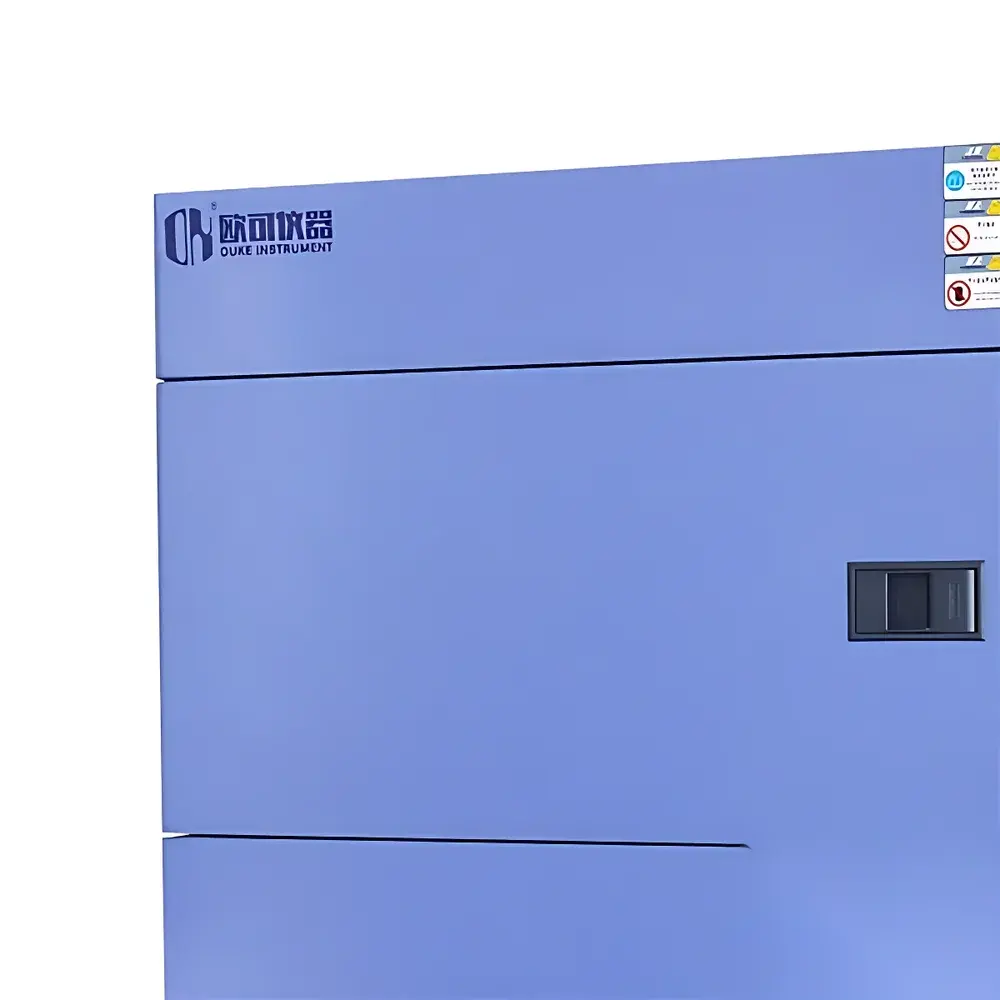
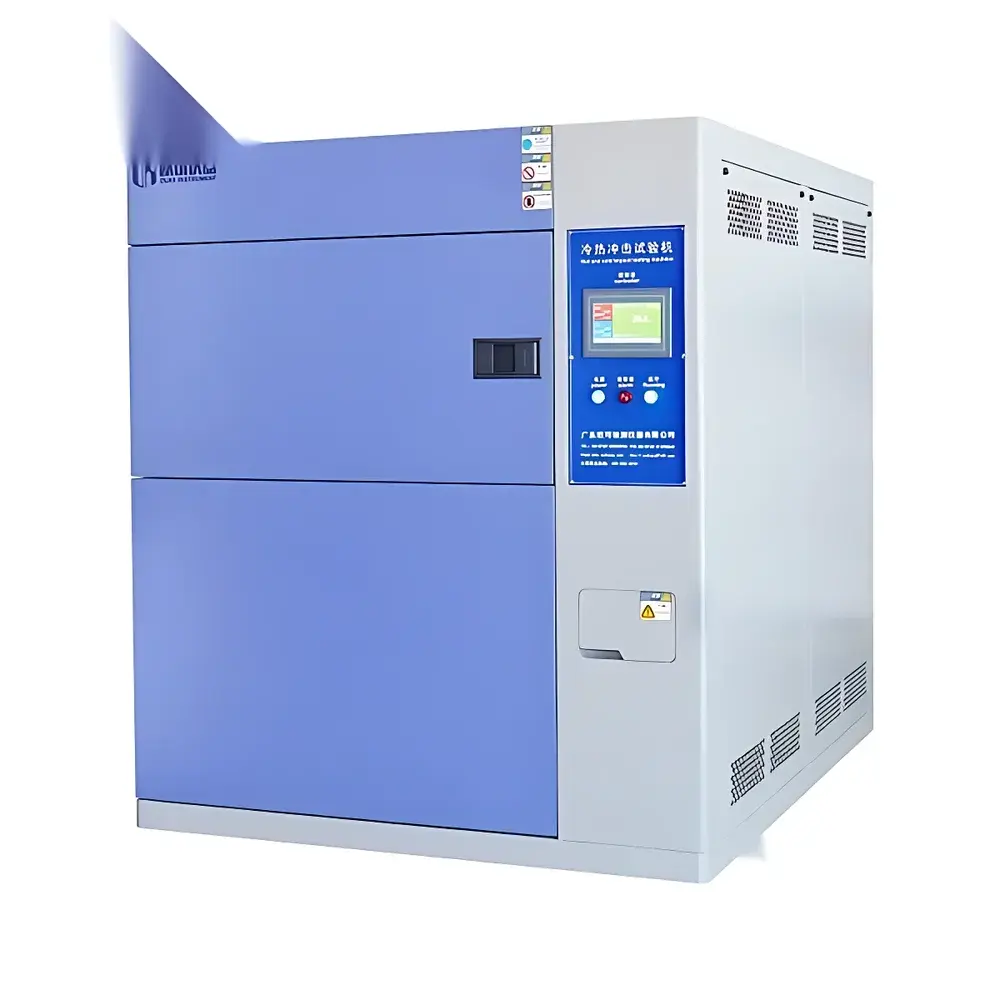
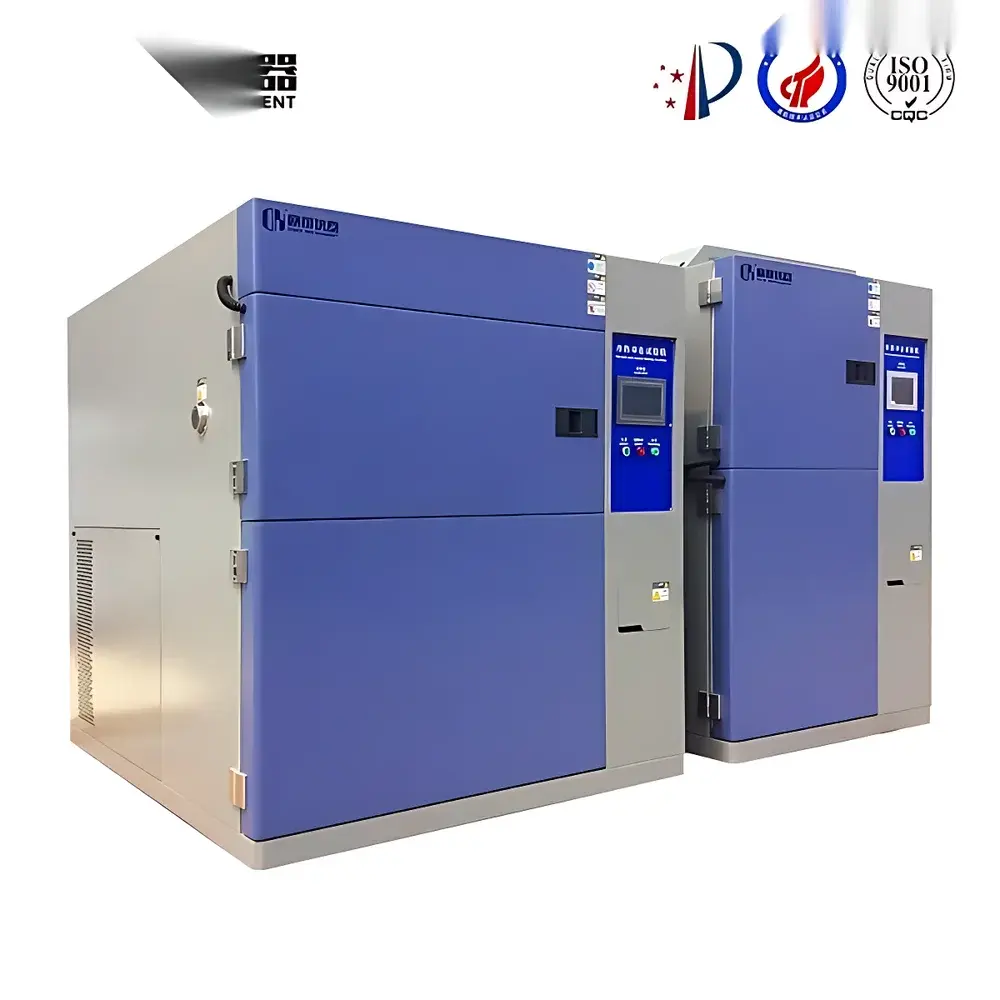
Thermal Shock Test Chamber – Three-Zone Vertical Configuration with PLC Control and Dual-Mode Operation (2-Zone / 3-Zone)
| [Brand | OEM |
|---|---|
| Origin | Imported |
| Manufacturer Type | Authorized Distributor |
| Temperature Transition Time | ≤10 s |
| Temperature Recovery Time | ≤5 min |
| Compliance | IEC 60068-2-14, JIS C 60068-2-14, MIL-STD-810H Method 503.5, GJB 150.5A-2009 |
| Control System | 320×240-dot Color LCD Touchscreen Controller (Bilingual English/Chinese), Programmable Logic Controller (PLC) Integration |
| Safety Features | Overtemperature, Overpressure, Phase Imbalance, Low Refrigerant Flow, Compressor Oil Pressure Loss, Cooling Water Failure, Leakage Protection |
| Interface | RS-232C Serial Communication Port |
| Data Logging | Optional Integrated Temperature Recorder |
| Optional Upgrade | LN₂-Assisted Rapid Cooling System |
| Internal Construction | Stainless Steel 304 Chamber Liner |
| Chamber Configuration | Three-Separate-Zone (High-Temp / Low-Temp / Test) with Thermal Isolation Structure] |
Overview
The Thermal Shock Test Chamber – Three-Zone Vertical Configuration is an engineered environmental stress screening system designed to evaluate material and component reliability under rapid, repeated transitions between extreme high and low temperature extremes. Based on the principle of accelerated thermal cycling, this chamber subjects test specimens to abrupt thermal gradients—typically ranging from −65 °C to +150 °C—within a controlled, repeatable sequence. Unlike single-chamber or two-zone designs, its dedicated three-zone architecture (separate high-temperature soak zone, low-temperature soak zone, and neutral test zone) eliminates thermal mass interference and enables precise dwell time control in each environment before transfer. This configuration ensures high reproducibility of thermal shock profiles required for qualification testing per international standards including IEC 60068-2-14, JIS C 60068-2-14, MIL-STD-810H Method 503.5, and GJB 150.5A-2009. The system operates on a dual-mode logic: users may select either 2-zone operation (direct transfer between hot and cold chambers) or full 3-zone sequencing (soak–transfer–soak–return), supporting both accelerated failure analysis and long-term reliability validation.
Key Features
- Three-zone vertical chamber layout with thermally isolated stainless steel 304 interiors, minimizing cross-contamination and enabling independent temperature stabilization
- Programmable Logic Controller (PLC)-based motion and safety interlock system ensuring sub-10-second transfer time between zones and ≤5-minute temperature recovery post-transfer
- 320 × 240-dot full-color touchscreen controller with bilingual (English/Chinese) interface, supporting up to 100 stored test programs and 9999 cycles per program
- Comprehensive fault diagnostics: real-time display of alarm conditions—including refrigerant pressure anomalies, compressor oil pressure loss, cooling water interruption, phase imbalance, and chamber overtemperature—with step-by-step remediation guidance
- Integrated emergency shutdown circuitry activated upon detection of unstable input voltage or critical safety threshold breaches
- RS-232C serial communication port for remote monitoring, parameter editing, and data export; compatible with standard SCADA and LabVIEW environments
- Optional LN₂-assisted rapid cooling module for achieving ultra-low temperatures (<−70 °C) with enhanced ramp rate control
Sample Compatibility & Compliance
This chamber accommodates a broad spectrum of physical samples—including metallic alloys, polymer composites, elastomers, printed circuit boards (PCBs), semiconductor packages, and automotive electronic modules—without requiring sample-specific fixtures. Specimens are placed directly into the test zone, where standardized airflow patterns ensure uniform thermal exposure across surfaces. All operational parameters—including dwell duration, transition timing, and temperature setpoints—are fully configurable to align with application-specific test plans. The system supports traceable execution of qualification protocols mandated by ISO/IEC 17025-accredited laboratories and complies with GLP/GMP documentation requirements when paired with validated data logging systems. Its mechanical design conforms to CE machinery directive (2006/42/EC) and electromagnetic compatibility (EMC) standards EN 61326-1.
Software & Data Management
While the embedded microcontroller handles real-time execution, optional PC-based software extends functionality for audit-ready data management. The RS-232C interface enables bidirectional communication for automated test initiation, live parameter readback, and timestamped event logging—including door open/close events, alarm triggers, and controller mode changes. When integrated with third-party data acquisition platforms, the chamber supports 21 CFR Part 11-compliant electronic signatures and audit trails. Temperature recorder add-ons provide continuous analog/digital output with NIST-traceable calibration certificates, satisfying regulatory submission requirements for aerospace, medical device, and defense applications.
Applications
- Qualification testing of avionics components per DO-160 Section 24 (Temperature Shock)
- Failure mode identification in solder joint integrity for surface-mount technology (SMT) assemblies
- Material coefficient of thermal expansion (CTE) validation for multi-layer ceramic capacitors (MLCCs) and power modules
- Accelerated life testing of battery enclosures and thermal interface materials (TIMs)
- Pre-screening of automotive ECUs prior to climatic endurance campaigns
- Verification of hermetic seal integrity in MEMS devices and optoelectronic housings
FAQ
What is the maximum allowable specimen volume for standard operation?
The standard test zone accommodates specimens up to 500 mm × 500 mm × 500 mm (L×W×H); custom configurations support larger footprints upon structural reinforcement verification.
Can the chamber operate unattended for extended cycles?
Yes—equipped with redundant safety circuits, automatic restart after power recovery, and non-volatile program memory, it supports fully autonomous 72-hour+ test sequences under monitored facility conditions.
Is calibration certification included with delivery?
A factory-assembled calibration report covering temperature uniformity and transition performance is provided; ISO/IEC 17025-accredited field calibration services are available as an optional add-on.
Does the system support custom thermal shock profiles beyond standard norms?
Absolutely—the controller accepts user-defined ramp rates, asymmetric dwell times, and conditional branching logic (e.g., pause on sensor deviation), enabling proprietary stress profiles for R&D use cases.
How is maintenance access structured for refrigeration subsystems?
Front-access service panels and modular refrigerant circuit design allow full compressor, condenser, and expansion valve inspection without chamber disassembly or insulation removal.
Related Products



