
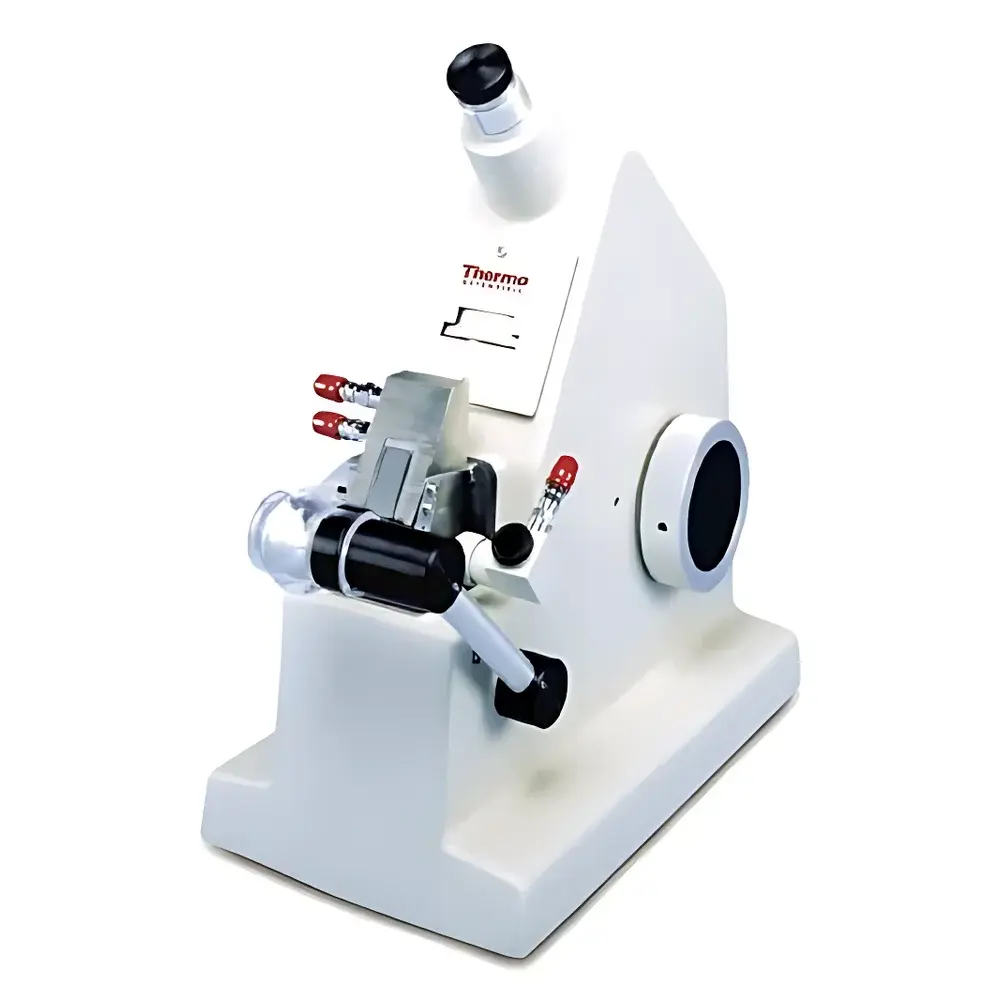
Thermo Fisher ABBE-3L Abbe Refractometer
| Brand | Thermo Fisher |
|---|---|
| Origin | USA |
| Manufacturer | Thermo Fisher Scientific |
| Type | Imported Instrument |
| Model | ABBE-3L |
| Pricing | Upon Request |
Overview
The Thermo Fisher ABBE-3L Abbe Refractometer is a precision optical instrument engineered for the accurate, repeatable measurement of refractive index (nD) and related optical properties—including Brix concentration—based on the principle of total internal reflection at the prism-sample interface. Operating at the sodium D-line (589.3 nm), it utilizes a high-stability Amici compensator system to eliminate chromatic aberration and deliver monochromatic illumination essential for metrological-grade measurements. Designed for long-term stability in demanding environments, the ABBE-3L integrates a robust all-metal housing, temperature-controlled sample stage compatibility (via external water bath circulation), and dual-scale direct-read optics—enabling simultaneous nD and %Brix determination without software dependency. Its fundamental design adheres to ISO 21148:2018 (Optics and photonics — Refractometers — Vocabulary and performance requirements) and supports traceable calibration per ASTM D1218 and USP .
Key Features
- Refractive index range: 1.3000–1.7100 nD, with resolution of 0.0001 and accuracy ±0.0005 nD
- Brix measurement range: 0–85.0%, accuracy ±0.2% Brix (calibrated against certified sucrose standards)
- Integrated Amici double-prism compensator for precise achromatic adjustment and D-line isolation
- Direct-view optical system with illuminated scale plate (AC 6.3 V), eliminating need for external light sources or darkroom conditions
- Temperature-sensitive measurement capability: compatible with external thermostatic baths (e.g., Thermo Fisher TC-100) for ISO-compliant thermal control (±0.1 °C typical)
- Minimal sample volume requirement: as low as 0.03 mL for liquids; accommodates solids and powders via contact prism technique
- Chemically resistant aluminum alloy chassis with sealed optical pathways—designed for GLP/GMP lab, production floor, and academic teaching use
Sample Compatibility & Compliance
The ABBE-3L accepts transparent, translucent, and semi-opaque samples—including aqueous solutions, organic solvents, edible oils, polymer melts, pharmaceutical excipients, and ground solid matrices—provided surface contact with the main sapphire-coated measuring prism is achievable. For non-liquid samples, standardized preparation protocols (e.g., thin-section mounting, solvent-assisted wetting) ensure reproducible interfacial contact. The instrument complies with key regulatory frameworks governing analytical instrumentation: its mechanical stability and calibration traceability support audit readiness under FDA 21 CFR Part 11 (when paired with validated manual recording procedures), ISO/IEC 17025 (for accredited testing labs), and EU GMP Annex 11 principles for non-automated systems. Routine verification follows manufacturer-recommended check standards (e.g., distilled water, certified Brix reference fluids).
Software & Data Management
As a manually operated optical bench instrument, the ABBE-3L does not incorporate embedded firmware or digital data output. All measurements are recorded visually via calibrated analog scales, ensuring full transparency, zero electronic drift, and independence from cybersecurity or software validation requirements. This architecture aligns with laboratories prioritizing simplicity, long-term serviceability, and compliance in resource-constrained or regulated settings where paper-based records remain primary. Optional accessories—including calibrated reference slides, prism cleaning kits, and NIST-traceable Brix standard sets—enable documented calibration verification per ISO/IEC 17025 clause 6.6. For digital archiving, users may integrate the ABBE-3L into LIMS workflows via manual entry or barcode-linked logbooks, maintaining full ALCOA+ (Attributable, Legible, Contemporaneous, Original, Accurate, Complete, Consistent, Enduring, Available) data integrity.
Applications
- Food & Beverage QC: Soluble solids (°Brix) in fruit juices, honey, syrups; fat content estimation in dairy and avocado oil; moisture analysis in meats and dried fruits
- Petrochemical Analysis: Hydrocarbon classification (olefins vs. paraffins), glycol contamination in lubricants, bitumen cut-point verification
- Agricultural Research: Oil content screening in oilseed crops (soybean, rapeseed), corn syrup purity assessment
- Pharmaceutical Manufacturing: Excipient identity confirmation (e.g., glycerin, propylene glycol), syrup concentration monitoring
- Electroplating & Battery Industries: Electrolyte density control (H2SO4, NiSO4 baths), salinity verification in rinse tanks
- Academic Instruction: Undergraduate optics labs—demonstrating Snell’s law, dispersion, critical angle, and empirical correlation between nD and composition
FAQ
What is the minimum sample volume required for liquid measurement?
Approximately 0.03 mL is sufficient to fully cover the measuring prism surface when applied with a dropper or micro-syringe.
Can the ABBE-3L measure opaque or highly viscous samples?
Yes—opaque solids and pastes may be measured using the “contact method” with appropriate surface preparation and pressure application to ensure optical coupling.
Is temperature control mandatory for accurate results?
While ambient measurements are possible, ISO 21148 mandates temperature specification for reporting nD; external water bath integration is strongly recommended for quantitative work.
How is calibration verified on this instrument?
Using certified reference materials such as distilled water (nD = 1.3330 at 20 °C) or NIST-traceable sucrose solutions, following documented SOPs per laboratory quality system requirements.
Does the ABBE-3L comply with pharmacopeial methods?
Yes—it satisfies USP and EP 2.2.6 refractometry requirements for manual instruments used in compendial testing of liquids and semi-solids.




