
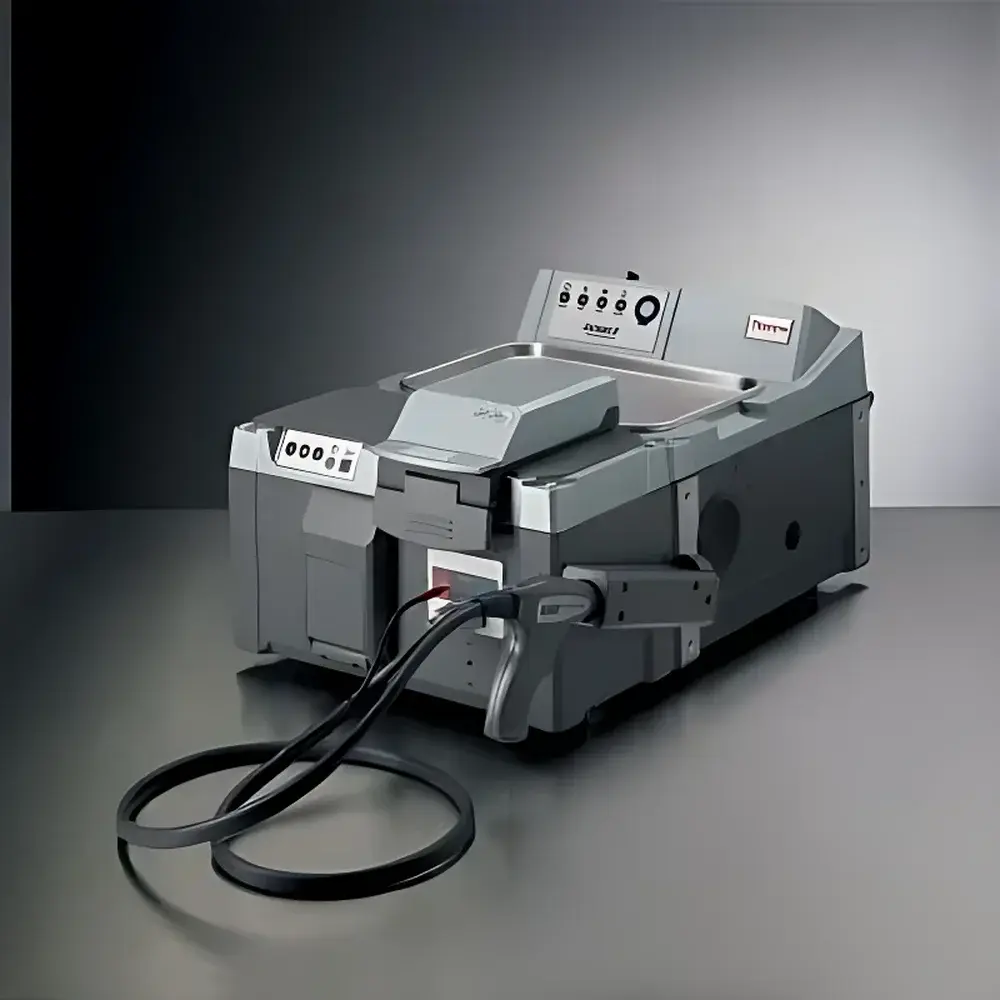
Thermo Fisher Antaris II Fourier Transform Near-Infrared (FT-NIR) Spectrometer
| Brand | Thermo Fisher |
|---|---|
| Origin | USA |
| Manufacturer Type | Original Equipment Manufacturer (OEM) |
| Product Category | Imported |
| Model | Antaris II |
| Instrument Type | Laboratory |
| Operating Principle | Fourier Transform (FT) |
| Wavelength Range | 3800–12000 cm⁻¹ |
| Scan Speed | 5 scans/sec |
| Data Sampling Interval | 2 cm⁻¹ |
| Measurement Modes | Transmission, Diffuse Reflectance, Transflectance, Transdiffuse |
| Chemometrics Software | TQ Analyst |
Overview
The Thermo Fisher Antaris II Fourier Transform Near-Infrared (FT-NIR) Spectrometer is a high-performance, research-grade analytical platform engineered for precision, stability, and operational robustness in both laboratory R&D and regulated industrial environments. Based on Michelson interferometry with dynamic alignment control, the system acquires interferograms at up to 5 scans per second and converts them into high-fidelity spectra via fast Fourier transform (FFT) algorithms. Its spectral coverage spans 3800–12000 cm⁻¹ (i.e., ~2.6–1.0 µm), fully encompassing the first and second overtones of C–H, N–H, and O–H bonds—enabling quantitative and qualitative analysis of organic compounds, polymers, pharmaceuticals, agricultural feedstocks, and food matrices. Designed for long-term reproducibility, the Antaris II integrates optical, thermal, and mechanical stabilization features—including temperature-compensated CaF₂ beam splitters and real-time laser-referenced path-length correction—to ensure spectral fidelity across extended acquisition sessions and variable ambient conditions.
Key Features
- Patented high-throughput electromagnetic dynamic alignment interferometer (Nicolet technology), delivering superior optical throughput and long-term alignment stability without manual recalibration.
- CaF₂ beam splitter optimized for the NIR region (3800–12000 cm⁻¹), providing enhanced energy throughput and signal-to-noise ratio compared to standard KBr or quartz alternatives.
- InGaAs photodiode array detector with thermoelectric cooling, offering high quantum efficiency (>80%) and low dark current across the full spectral range—critical for high-precision quantitation in low-absorbance samples.
- Modular sampling architecture supporting simultaneous integration of transmission cells, integrating spheres (for diffuse reflectance), transflectance accessories, and fiber-optic probes—enabling method transfer across solid, liquid, semi-solid, and granular sample formats without hardware reconfiguration.
- USB 2.0 interface compliant with Windows-based host systems; no proprietary data acquisition cards or external controllers required—reducing system footprint and simplifying IT infrastructure integration.
- Low total cost of ownership: minimal consumables, no moving mirrors requiring periodic replacement, and field-serviceable optics modules designed for >10-year operational life under continuous use.
Sample Compatibility & Compliance
The Antaris II accommodates diverse physical states—including powders, tablets, pellets, slurries, solutions, films, and bulk solids—via interchangeable, application-optimized sampling interfaces. All optical paths are sealed and purged-capable to mitigate atmospheric CO₂ and H₂O vapor interference, ensuring compliance with ASTM E1655 (standard practices for NIR quantitative analysis) and ISO 12099 (animal feeding stuffs—determination of moisture, crude protein, crude fat, and crude fiber). The system supports 21 CFR Part 11-compliant operation when paired with TQ Analyst software configured for electronic signatures, audit trails, and user-access controls—meeting GLP and GMP requirements for pharmaceutical raw material identification (USP ) and blend uniformity monitoring.
Software & Data Management
TQ Analyst is the embedded chemometrics platform, providing full-spectrum preprocessing (Savitzky-Golay smoothing, multiplicative scatter correction, derivatives), multivariate calibration (PLS, PCR, PCA), validation (cross-validation, prediction residuals), and automated model deployment. All calibrations are stored as encrypted, version-controlled objects with metadata logging (operator, date, instrument ID, spectral acquisition parameters). Raw interferograms and processed spectra are saved in standardized JCAMP-DX format, enabling interoperability with third-party statistical tools (e.g., MATLAB, Python scikit-learn) and enterprise LIMS systems via configurable ODBC or REST API connectors. Audit trail records capture every parameter change, model update, and result export—fully traceable for regulatory inspection.
Applications
- Pharmaceutical: Active pharmaceutical ingredient (API) assay, excipient identity verification, tablet coating thickness estimation, and real-time blend homogeneity monitoring during continuous manufacturing.
- Food & Agriculture: Moisture, protein, fat, starch, and sugar content in grains, dairy products, meat, and beverages—validated against AOAC reference methods.
- Polymer Science: Copolymer composition analysis, crystallinity index determination, and degradation monitoring in PE, PP, PET, and bioplastics.
- Fuel & Lubricants: Hydrocarbon type distribution (paraffinic vs. naphthenic), biodiesel blend ratio (B0–B100), and oxidation stability assessment.
- Chemical Manufacturing: Reaction endpoint detection, catalyst activity tracking, and in-line QC of intermediates in batch and continuous processes.
FAQ
Is the Antaris II suitable for regulated pharmaceutical environments?
Yes—when operated with validated TQ Analyst configurations, it meets 21 CFR Part 11, EU Annex 11, and ICH Q2(R2) guidelines for analytical procedure validation.
Can existing PLS models developed on older FT-NIR instruments be migrated to the Antaris II?
Yes—TQ Analyst supports import of legacy .qcal and .cal files; spectral resampling and preprocessing harmonization tools ensure cross-platform model portability.
What maintenance is required beyond routine cleaning of optical windows?
None beyond annual verification of laser wavelength accuracy and detector dark current; the interferometer contains no wear-prone mechanical components.
Does the system support remote diagnostics and firmware updates?
Yes—via secure HTTPS-enabled instrument web interface and Thermo Fisher’s Connect Remote Support portal, with role-based access and TLS 1.2 encryption.
Is fiber-optic probe integration limited to specific wavelengths or lengths?
No—standard SMA-905 interfaces accept commercial NIR fibers (up to 5 m length); spectral cutoff is determined by fiber material (silica/fluoride), not instrument electronics.





