
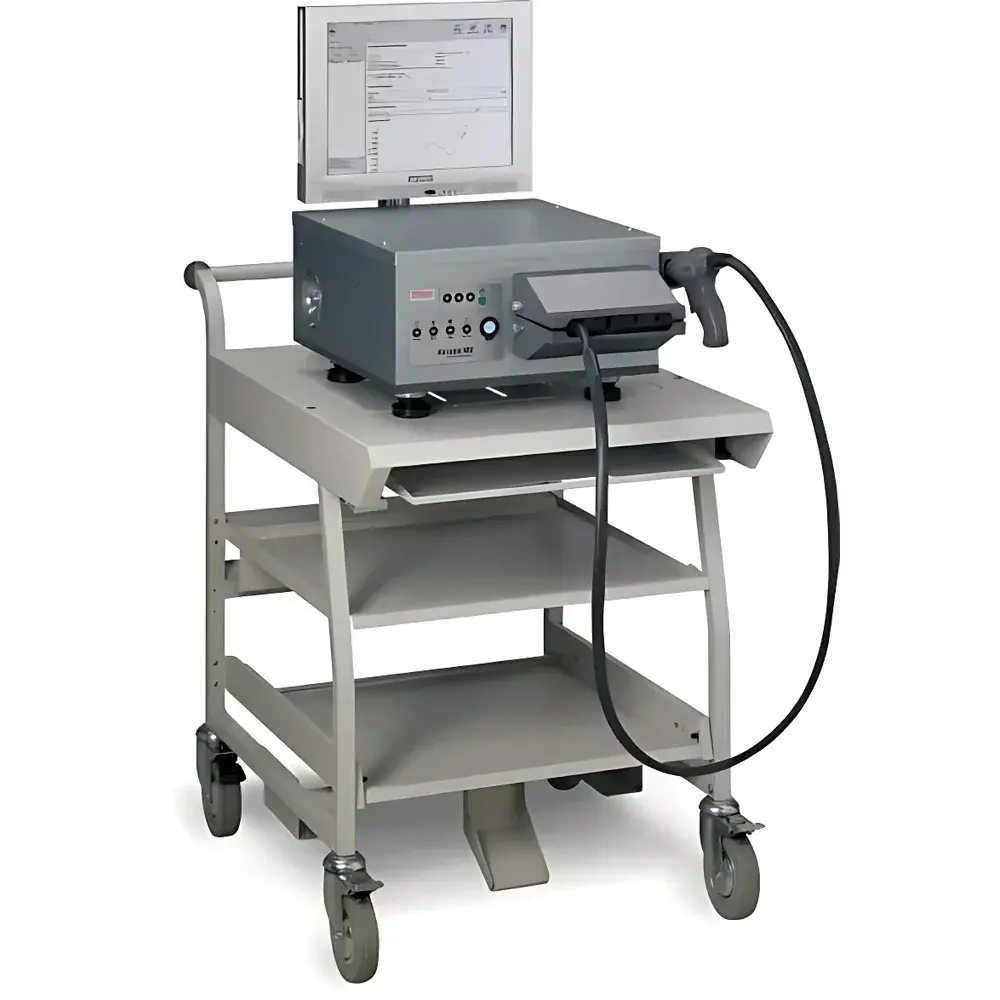
Thermo Fisher Antaris MX Fourier Transform Near-Infrared Process Analyzer
| Brand | Thermo Fisher |
|---|---|
| Origin | USA |
| Manufacturer Type | Original Equipment Manufacturer (OEM) |
| Product Category | Imported Instrument |
| Model | Antaris MX |
| Instrument Type | Online/At-line Portable FT-NIR Analyzer |
| Principle | Fourier Transform Near-Infrared Spectroscopy (FT-NIR) with Real-time Process Integration |
| Wavelength Range | 4000–12000 cm⁻¹ |
| Scan Speed | 5 scans per second |
| Spectral Resolution | 2 cm⁻¹ (data sampling interval) |
| Measurement Modes | Transmission, Transflection, Diffuse Reflectance |
| Chemometrics Software | TQ Analyst v9+ and RESULT v3.x |
Overview
The Thermo Fisher Antaris MX Fourier Transform Near-Infrared Process Analyzer is a high-performance, industrial-grade FT-NIR spectrometer engineered for real-time, non-destructive chemical analysis in manufacturing environments. Built upon Thermo Fisher’s legacy of precision molecular spectroscopy, the Antaris MX implements a robust Michelson interferometer architecture with electromagnetic dynamic alignment—eliminating mechanical drift and ensuring long-term optical stability. Its core measurement principle relies on Fourier-transformed near-infrared absorption spectroscopy, where molecular overtones and combination bands (primarily C–H, O–H, and N–H vibrations) are quantified across the 4000–12000 cm⁻¹ spectral range. Unlike dispersive NIR systems, the Antaris MX delivers inherent wavelength accuracy, high photometric reproducibility, and superior signal-to-noise ratio (>10,000:1 at 5 scans/sec), making it suitable for regulated pharmaceutical, food & beverage, chemical, and agricultural process applications. Designed explicitly for at-line and online deployment, the system interfaces directly with industrial control infrastructure via OPC UA or PLC protocols—enabling closed-loop process monitoring, automated batch release, and PAT (Process Analytical Technology) compliance per ICH Q8/Q9/Q10 frameworks.
Key Features
- True multi-channel synchronous detection: Utilizes Thermo Fisher’s proprietary ParaLux™ NIR Illumination System—no moving parts, no mechanical channel switching, and simultaneous background acquisition during sample measurement.
- High-throughput optical design: Features a patented high-throughput electromagnetic dynamic alignment interferometer, CaF₂ beamsplitter optimized for NIR energy distribution, and discrete InGaAs detectors per channel (including dedicated internal reference channel).
- Flexible fiber-optic integration: Equipped with multiple SMA 905-compliant fiber ports compatible with industry-standard transmission, transflectance, and diffuse reflectance probes—including immersion, flow cell, and conveyor-mounted configurations.
- Regulatory-ready software architecture: RESULT v3.x provides structured electronic SOP workflows, real-time trend visualization, automatic spectral correction (e.g., pathlength normalization, scatter correction), and one-click pass/fail decision logic with visual LED feedback on probe hardware.
- USB 2.0 host interface: Enables direct connection to industrial PCs without proprietary cabling or driver dependencies; supports deterministic data transfer timing for time-critical process synchronization.
- Low total cost of ownership: Solid-state design eliminates consumables; maintenance intervals exceed 10,000 hours; calibration stability validated per ASTM E1655 and ISO 12099.
Sample Compatibility & Compliance
The Antaris MX accommodates heterogeneous, opaque, granular, viscous, and flowing samples without sample preparation—ideal for raw material identification (RMI), blend uniformity assessment, moisture quantification, active pharmaceutical ingredient (API) concentration, and endpoint determination in drying or granulation. It complies with global regulatory expectations for analytical instrumentation in GMP environments: RESULT software is fully 21 CFR Part 11 compliant (electronic signatures, audit trail, role-based access control); ValPro validation toolkit supports documented DQ/IQ/OQ/PQ execution aligned with USP , Ph. Eur. 2.2.40, and JP 17; all firmware and software revisions undergo formal change control per ISO 9001 and ICH Q5A.
Software & Data Management
TQ Analyst v9+ serves as the chemometrics engine—supporting CLS, SMLR, PCR, linear and nonlinear PLS (including weighted PLS), Mahalanobis distance, SIMCA classification, and correlation-based outlier detection. Method development is guided by intelligent wizards that auto-select preprocessing steps (SNV, MSC, derivatives) and validate model robustness using cross-validation and test-set prediction metrics (RMSEP, R², bias). RESULT v3.x integrates natively with LIMS, MES, and DCS via OPC UA; optional PLC communication modules support Siemens S7, Rockwell ControlLogix, and Beckhoff TwinCAT protocols. All spectral acquisitions, processed results, and metadata are stored in ACID-compliant SQLite databases with configurable retention policies and encrypted export (CSV, XML, HDF5).
Applications
- Pharmaceutical: Real-time API assay in wet granules, tablet coating thickness, excipient identity verification per USP monographs.
- Food & Agriculture: Protein/fat/moisture in grains, dairy powders, and meat products; authenticity screening of olive oil, honey, and spices.
- Chemicals: Solvent purity, polymer composition (e.g., ethylene/propylene ratio in copolymers), catalyst activity monitoring.
- Biomanufacturing: Cell culture nutrient depletion (glucose, glutamine), viability estimation, and harvest timing optimization.
- Materials Science: Carbon black dispersion in rubber compounds, filler content in composites, curing degree in thermosets.
FAQ
Is the Antaris MX suitable for FDA-regulated pharmaceutical manufacturing?
Yes—the system includes ValPro validation documentation, 21 CFR Part 11-compliant RESULT software, and full traceability for audit readiness.
Can existing Antaris II calibration models be reused on the Antaris MX?
Yes—both platforms share identical optical path length, beam geometry, and detector response characteristics, enabling seamless model migration without revalidation.
What fiber optic probe types are supported?
All standard SMA 905-compatible probes: immersion, flow-through, contact reflectance, and remote sensing configurations with customizable pathlengths (0.1–50 mm) and window materials (quartz, sapphire, CaF₂).
Does the system require external background referencing?
No—ParaLux™ enables concurrent background acquisition within the same scan cycle, eliminating manual background collection and reducing operator dependency.
How is instrument performance verified over time?
Built-in NIST-traceable polystyrene and water vapor reference standards enable automated daily performance qualification (PQ) per ASTM E1421 and ISO/IEC 17025 requirements.
Related Products





