
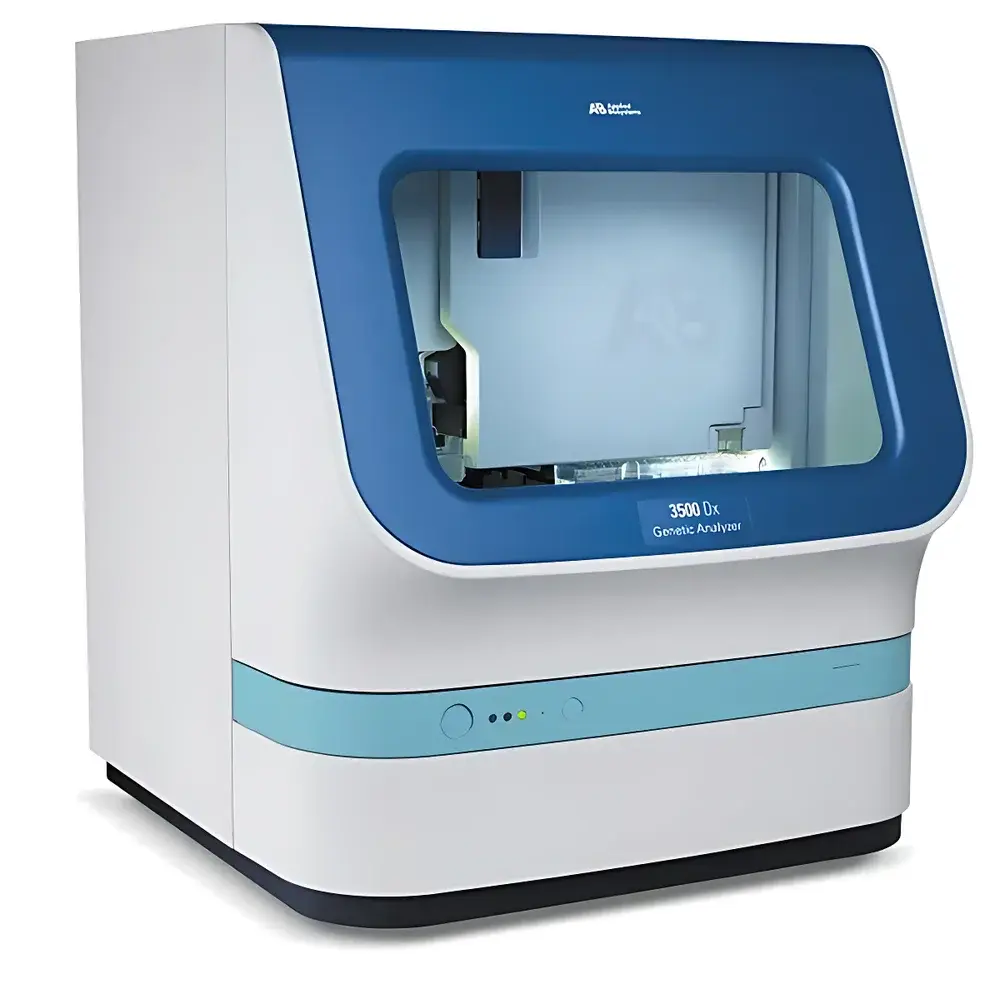
Thermo Fisher Applied Biosystems 3500 Dx / 3500xL Dx Genetic Analyzer
| Brand | Thermo Fisher |
|---|---|
| Origin | Japan |
| Manufacturer Type | Manufacturer |
| Origin Category | Imported |
| Model | 3500 Dx / 3500xL Dx |
| Instrument Type | First-Generation (Sanger) Sequencer |
| Throughput | 1104 samples/day |
| Read Length Range | 30–1000 bp |
| Detection Accuracy | 99.99% |
| Detection Reproducibility | 90% |
| Run Time | 1000 reads per 120 min |
| Data Format | Capillary Electrophoresis-Based Sequencing |
| Software | Data Collection Software v3, Sequencing Analysis v6, KB Basecaller v1.4.1, Variant Reporter™, SeqScape®, GeneMapper®, GeneMapper ID-x®, MicroSEQ ID® |
Overview
The Thermo Fisher Applied Biosystems 3500 Dx and 3500xL Dx Genetic Analyzers are CE-IVD and FDA-cleared capillary electrophoresis-based instruments engineered for clinical diagnostic laboratories requiring high-fidelity Sanger sequencing and fragment analysis under regulated environments. These systems implement the gold-standard dideoxy chain-termination method—widely recognized for its single-base resolution, exceptional accuracy, and robustness in validating variants identified by next-generation sequencing (NGS) platforms. Designed for compliance with ISO 13485, CLIA, CAP, and FDA 21 CFR Part 11 requirements, the 3500 Dx series supports dual-mode operation: diagnostic mode (locked configuration for IVD use) and research mode (configurable for exploratory applications), enabling seamless transition between regulated and non-regulated workflows without hardware modification.
Key Features
- Dual-capacity platform: 8-capillary 3500 Dx system for low-throughput clinical validation; 24-capillary 3500xL Dx system for medium-throughput diagnostic labs—both share identical optical, thermal, and fluidic architecture to ensure cross-platform data comparability.
- Advanced thermal management system: Precision Peltier-controlled heating/cooling maintains ±0.1 °C uniformity across all capillaries during electrophoretic separation—critical for reproducible DNA fragment sizing and base-calling fidelity in heterozygous SNP detection and microsatellite instability (MSI) assays.
- 505 nm solid-state laser source: Long-lifetime, air-cooled excitation with stable output intensity over >20,000 hours—eliminates water-chiller dependency and reduces maintenance intervals while maintaining consistent signal-to-noise ratios across runs.
- GeneScan™ 600 LIZ™ Size Standard v2 integration: Enables inter-run, inter-capillary, and inter-instrument normalization of electrophoretic mobility—significantly improving size-call consistency in STR, LOH, and AFLP applications per ASTM D7566 Annex A1 guidelines.
- Real-time data quality monitoring: Embedded algorithms assess peak shape, signal intensity, baseline noise, and dye balance during electrophoresis—flagging suboptimal injections or capillary fouling before run completion.
- RFID-enabled consumables tracking: All capillaries, polymer kits, and buffer cartridges embed passive RFID tags storing lot-specific calibration parameters, expiration dates, and usage history—automatically loaded into audit trails compliant with GLP/GMP documentation standards.
- Regulatory-ready software stack: Data Collection Software v3 includes electronic signatures, role-based access control, automated backup, and immutable audit logs—validated for use in FDA-submitted IVD assay dossiers and EU IVDR technical files.
Sample Compatibility & Compliance
The 3500 Dx platform accepts standard Sanger sequencing reaction products (e.g., BigDye™ Terminator v3.1, v1.1) and fragment analysis samples (e.g., PCR-amplified microsatellites, SNP genotyping panels). It supports both purified and unpurified post-PCR products, with optimized injection protocols minimizing salt-induced migration artifacts. All reagents and consumables—including POP-7™ polymer, GS600 LIZ™ size standard, and 3500 Dx-certified capillaries—are manufactured under ISO 13485-certified quality systems and supplied with full traceability documentation. The instrument meets IEC 61010-1 safety standards and EMC Directive 2014/30/EU. Diagnostic mode enforces pre-validated run methods, prevents unauthorized parameter changes, and auto-generates 21 CFR Part 11-compliant reports including raw data (.fsa), base-called sequences (.seq), and QC summaries.
Software & Data Management
Data Collection Software v3 serves as the primary acquisition and preliminary analysis interface, supporting real-time visualization of electropherograms, automatic base-calling, and integrated QC metrics (QV ≥ 20 thresholding, peak width filtering, and stutter ratio calculation). Secondary analysis is performed using a validated suite: Sequencing Analysis v6 and KB Basecaller v1.4.1 for high-confidence de novo and comparative sequencing; Variant Reporter™ for allele frequency quantification and somatic variant calling in tumor-normal pairs; SeqScape® for targeted resequencing library QC and consensus generation; GeneMapper® ID-x® for forensic STR profiling aligned with SWGDAM guidelines; and MicroSEQ® ID for microbial strain typing via 16S rRNA or tuf gene sequencing. All software modules support export to LIMS via ASTM E1384-compliant HL7 ADT/ORU messages and generate PDF reports with embedded digital signatures and timestamped audit trails.
Applications
- Clinical variant confirmation: Orthogonal validation of NGS-identified SNVs, indels, and splice-site mutations in hereditary cancer panels (e.g., BRCA1/2), pharmacogenomic markers (CYP2C19, VKORC1), and inherited metabolic disorders.
- Forensic human identification: STR profiling using AmpFlSTR® Identifiler® Plus and GlobalFiler™ PCR amplification kits—fully compatible with FBI’s CODIS database submission requirements.
- Infectious disease diagnostics: Direct sequencing of viral quasi-species (HIV, HCV), antimicrobial resistance determinants (e.g., mecA, vanA), and fungal ITS regions for species-level identification.
- Quality control in biomanufacturing: Plasmid insert verification, clone screening, and vector backbone integrity assessment in cell line development workflows.
- Academic core facility support: High-reliability Sanger sequencing for CRISPR editing validation, site-directed mutagenesis checks, and small-scale amplicon resequencing where read-length and accuracy outweigh throughput demands.
FAQ
Is the 3500 Dx series compliant with FDA 21 CFR Part 11 and EU IVDR?
Yes—the diagnostic mode enforces electronic signature workflows, audit trail retention (>10 years), and system validation protocols required for IVD use in the U.S. and EU.
Can the same capillaries be used interchangeably between 3500 Dx and 3500xL Dx systems?
Yes—both models utilize identical 3500-series capillaries (50 µm ID × 36 cm effective length) and polymer formulations, ensuring method portability and cross-platform data equivalence.
What level of training is required to operate the system in diagnostic mode?
Operators must complete Thermo Fisher’s certified IVD Operator Training Program, covering method validation, daily QC execution, troubleshooting, and audit-readiness documentation practices.
Does the system support third-party reagents or only Thermo Fisher–branded kits?
Only Thermo Fisher–validated reagents and consumables are supported in diagnostic mode; research mode permits limited third-party compatibility subject to user validation per ISO 15189 Clause 5.5.2.
How is data integrity maintained during long-term archival?
Raw .fsa files, processed .seq outputs, and audit logs are stored in encrypted, tamper-evident formats with SHA-256 checksums; LTO-7 tape backups follow NIST SP 800-88 Rev. 1 media sanitization guidelines.
Related Products




