
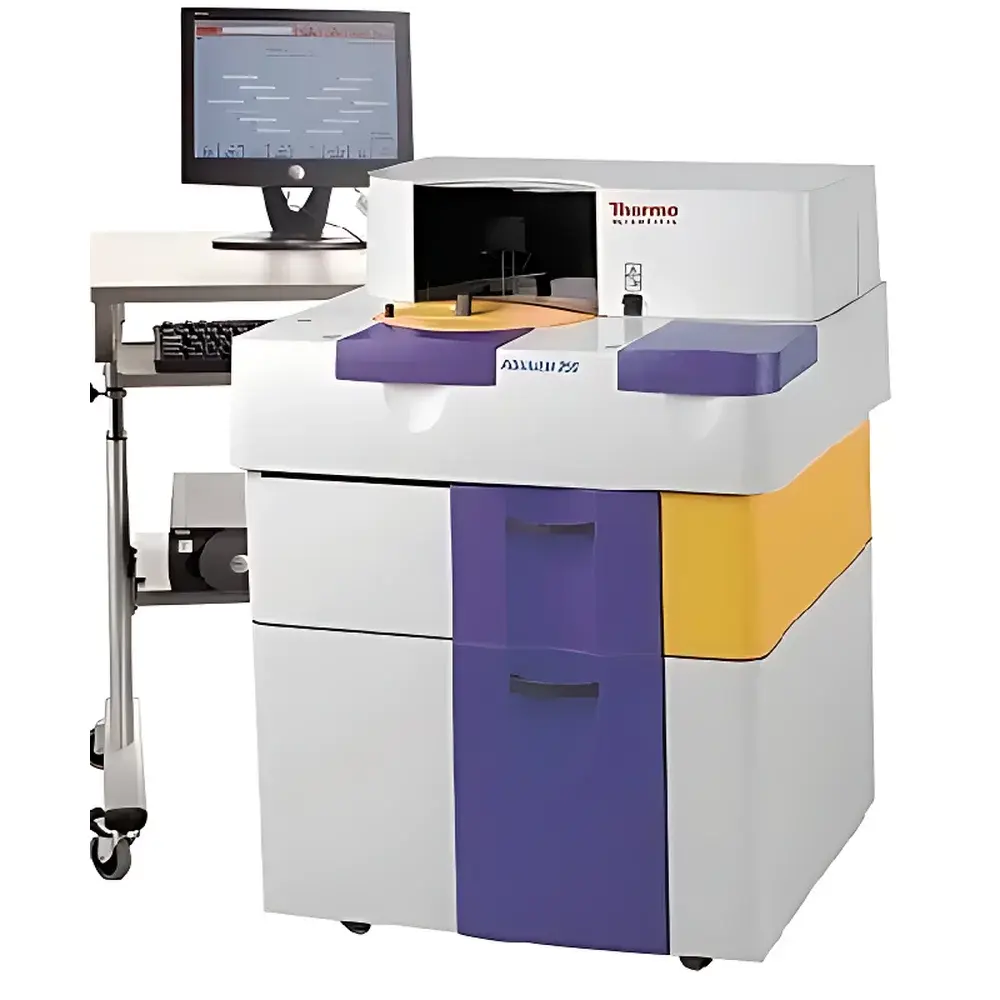
Thermo Fisher Aquakem200 Automated Water Quality Analyzer
| Brand | Thermo Fisher |
|---|---|
| Origin | Finland |
| Manufacturer | Thermo Fisher Scientific |
| Product Type | Imported |
| Model | Aquakem200 |
| Instrument Category | Laboratory Water Quality Analyzer |
| Detection Speed | Up to 180 tests/hour |
| Sample Positions | 84 |
| Refrigerated Reagent Positions | 35 |
| Maximum Reagents per Test | 4 |
| Wavelength Range | 340–880 nm |
| Barcode Reader | Integrated |
| Sample Dilution | Auto pre-dilution and auto re-dilution |
| Cadmium Reduction Module | Optional (for nitrate analysis) |
| System Architecture | Open-platform, user-definable methods, reagents, and protocols |
| Probe Function | Dual-purpose pipetting probe with integrated mixing capability |
| Wash System | Automatic internal/external probe washing |
Overview
The Thermo Fisher Aquakem200 Automated Water Quality Analyzer is a high-throughput, open-architecture discrete analyzer engineered for precision, flexibility, and regulatory compliance in environmental and municipal water laboratories. Based on discrete photometric analysis—where each sample and reagent are processed in individual reaction cuvettes—the Aquakem200 eliminates cross-contamination risks inherent in continuous-flow or segmented-flow systems. This architecture enables true method independence: multiple analytes (e.g., nitrate, phosphate, ammonia, silica, COD, alkalinity) can be measured simultaneously across different samples using distinct chemistries, wavelengths, and incubation times—all under unified software control. Developed from the legacy Konelab platform (first deployed in environmental labs in 1984), the Aquakem200 integrates decades of refinement in environmental assay robustness, low-volume reagent handling, and long-term calibration stability. Its design reflects core operational requirements of modern accredited labs: minimal hands-on time, traceable calibration history, low waste generation (<1.5 mL waste/test average), and full auditability of all analytical steps.
Key Features
- Discrete cuvette-based analysis ensures high reproducibility and eliminates carryover between samples or methods.
- Throughput of up to 180 determinations per hour, scalable via parallel processing of heterogeneous assays.
- 84-position sample carousel with optional barcoded tube recognition and automated sample identification.
- 35-position refrigerated reagent carousel (4–12 °C), supporting real-time reagent level monitoring and low-volume dispensing (as low as 5 µL).
- Dual-function pipetting probe performs precise aspiration, dispensing, and in-cuvette mixing—eliminating need for separate stirrers.
- Photometric detection across 340–880 nm with high-stability tungsten-halogen source and thermoelectrically stabilized CCD array detector.
- Integrated auto-dilution module supports programmable pre-dilution and conditional re-dilution based on initial result thresholds.
- Optional cadmium reduction column module enables selective, interference-resistant nitrate quantification via conversion to nitrite followed by diazotization, fully synchronized with other on-board assays.
- Open-system architecture allows full customization of assay protocols—including reagent composition, reaction timing, curve fitting algorithms (linear, quadratic, log-log), and QC flagging logic.
Sample Compatibility & Compliance
The Aquakem200 accommodates a broad range of aqueous matrices: raw and treated drinking water, wastewater influent/effluent, surface and groundwater, seawater (with matrix-matched calibration), and industrial process streams. It complies with method requirements aligned with EPA Methods 353.2, 365.2, 350.1, ISO 15681-1/-2 (phosphate), ISO 7890-3 (ammonia), and ASTM D3867 (nitrate). The system supports GLP/GMP workflows through configurable electronic signatures, full audit trail (per 21 CFR Part 11 Annex 11), and instrument qualification documentation packages (IQ/OQ/PQ). All calibrations and QC checks are timestamped, user-attributed, and exportable in CSV or PDF format. Reusable cadmium columns undergo validated regeneration cycles (up to 2,000 injections per column), with performance verified daily via certified reference material (CRM) challenge.
Software & Data Management
Controlled by Thermo Fisher’s Aquaview™ Software v5.x, the Aquakem200 provides role-based access, method versioning, and automated report generation compliant with LIMS interfaces (via ASTM E1384, HL7, or direct SQL export). The software maintains persistent calibration curves—up to 256 stored per parameter—with automatic expiration alerts and drift compensation algorithms. All data points include metadata: ambient temperature, cuvette ID, reagent lot numbers, operator ID, and maintenance logs. Raw absorbance traces, kinetic reaction profiles, and dilution histories are retained for retrospective review. Backup and restore functions adhere to ISO/IEC 27001-aligned encryption standards; local database archiving supports ≥10 years of continuous operation without performance degradation.
Applications
The Aquakem200 is routinely deployed in national reference laboratories (e.g., UK EA, German LAWA network), municipal water utilities, contract environmental testing labs, and academic research centers conducting nutrient cycling studies. Typical use cases include: routine compliance monitoring for WHO/EU Drinking Water Directive parameters; wastewater treatment plant performance evaluation (N/P removal efficiency); eutrophication risk assessment in lakes and reservoirs; method validation studies requiring multi-parameter correlation; and development of novel colorimetric assays for emerging contaminants (e.g., microplastic digestion byproducts, perfluoroalkyl substances via indirect detection). Its open platform has enabled over 120 peer-reviewed method adaptations published since 2010.
FAQ
Does the Aquakem200 support EPA-approved methods out of the box?
Yes—pre-configured methods for 22 EPA-compliant parameters are included, with full validation documentation and CRM traceability.
Can custom reagents be used without vendor lock-in?
Absolutely. The system accepts third-party or in-house prepared reagents; concentration, stability, and lot-specific corrections are fully configurable.
Is remote diagnostics and software update supported?
Yes, via secure HTTPS-enabled remote access with IT-administrative approval workflow and encrypted firmware signing.
What is the typical mean time between failures (MTBF) for the optical system?
Based on field data from >1,200 installed units, MTBF exceeds 12,500 operating hours under standard environmental lab conditions (20–25 °C, <60% RH).
How is cadmium column performance monitored during routine operation?
Automated daily verification using nitrate CRM at 1.0 mg/L N; deviation >±3% triggers alert and optional column regeneration sequence.
Related Products







