
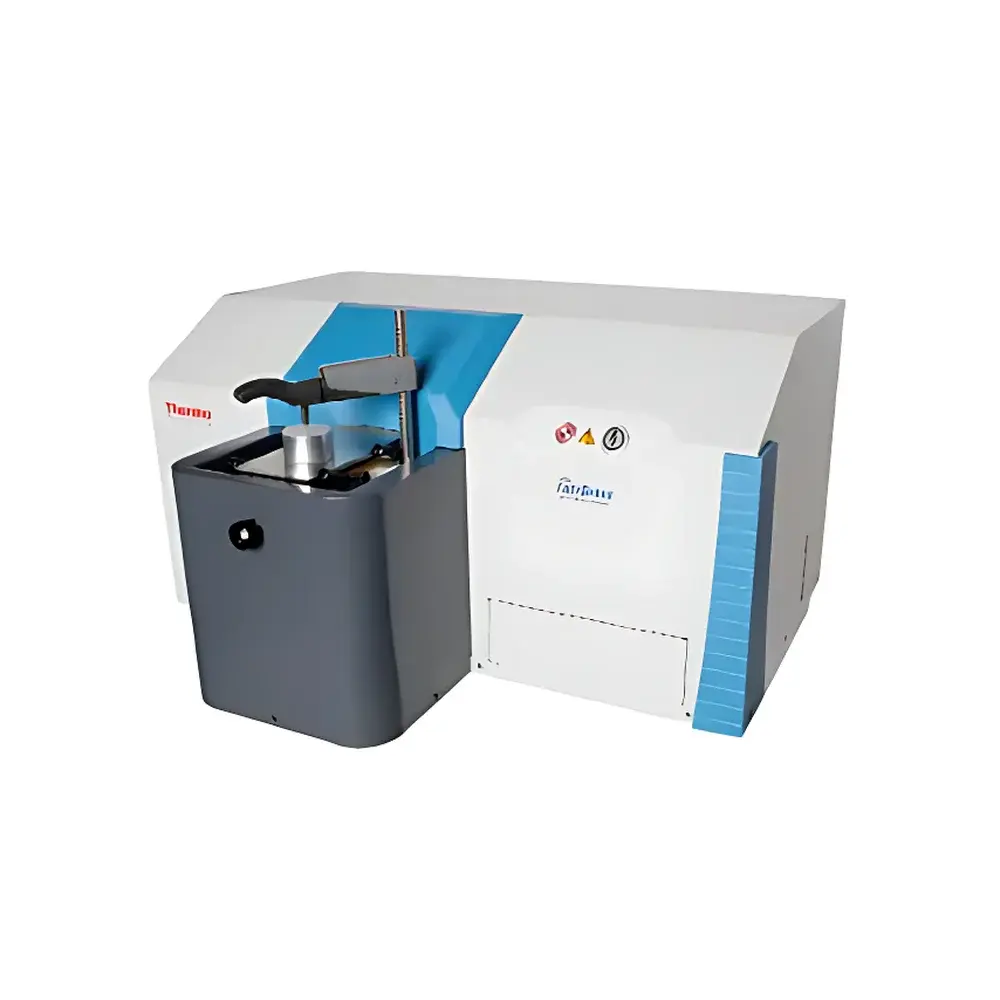
Thermo Fisher ARL easySpark 1160 Full-Spectrum Direct-Reading Spark Optical Emission Spectrometer
| Brand | Thermo Fisher |
|---|---|
| Origin | Switzerland |
| Manufacturer Type | Original Equipment Manufacturer (OEM) |
| Origin Category | Imported Instrument |
| Model | easySpark 1160 |
| Pricing | Upon Request |
Overview
The Thermo Fisher ARL easySpark 1160 is a full-spectrum direct-reading spark optical emission spectrometer (OES) engineered for precision elemental analysis of solid metallic samples in production and quality control environments. It operates on the fundamental principle of spark-induced plasma excitation: when a high-voltage spark is discharged across the surface of a conductive metal sample, atoms are vaporized and excited into higher electronic energy states; upon relaxation, they emit characteristic wavelengths of ultraviolet–visible light. These emissions are dispersed via a high-efficiency multi-grating optical system and simultaneously detected by a thermoelectrically cooled CCD array, enabling true full-spectrum acquisition from ~130 nm to ~800 nm with sub-nanometer spectral resolution. Designed specifically for small-to-medium enterprises (SMEs), contract laboratories, and academic metallurgy facilities, the easySpark 1160 delivers laboratory-grade quantitative performance—covering trace-level impurities (e.g., As, Pb, Sn at sub-ppm levels) through major alloying elements (e.g., Fe, Al, Cu, Ni at wt% levels)—without requiring cryogenic cooling or complex vacuum purging systems.
Key Features
- Multi-grating Paschen–Runge optical layout with optimized focal curve and aberration correction for high linearity and peak shape fidelity across the entire UV–VIS range
- Robust, sealed argon-purged optical chamber eliminating need for continuous gas flow during analysis—reducing operational cost and complexity
- Integrated spark source with adjustable discharge parameters (energy, frequency, pre-spark duration) for optimal excitation across diverse matrix types (e.g., low-alloy steels, aluminum alloys, copper-based bronzes)
- Self-aligning electrode system with automatic gap calibration and wear compensation to maintain long-term measurement stability
- Modular hardware architecture supporting field-upgradable detectors, lamps, and firmware—ensuring technology longevity beyond typical instrument lifecycles
- IP54-rated enclosure with integrated vibration-damping feet and electromagnetic interference (EMI) shielding compliant with IEC 61326-1 for industrial floor deployment
Sample Compatibility & Compliance
The ARL easySpark 1160 accepts standard 32 mm diameter solid metal samples (flat or slightly curved), including castings, forgings, rolled plates, and machined coupons. Sample preparation follows ISO 11577 and ASTM E415 guidelines for surface conditioning (grinding or milling). The system complies with CE marking requirements under the EU Machinery Directive 2006/42/EC and Electromagnetic Compatibility Directive 2014/30/EU. Its analytical methodology adheres to ISO 11577 (spark OES for metals), ASTM E1086 (analysis of stainless steels), and ASTM E1479 (multi-element analysis of aluminum alloys). Full audit trails, user access controls, and electronic signature support align with FDA 21 CFR Part 11 readiness for regulated QA/QC workflows.
Software & Data Management
Controlled by Thermo Scientific OXSAS v5.x software, the platform provides intuitive workflow-driven operation—from sample registration and method selection to calibration validation and report generation. All spectra are stored in vendor-neutral HDF5 format with embedded metadata (instrument configuration, operator ID, timestamp, environmental conditions). Calibration models are built using certified reference materials (CRMs) traceable to NIST SRMs and include matrix-matched standards for steel, aluminum, copper, and nickel families. Data export supports CSV, XML, and LIMS-compatible ASTM E1382 formats. Optional integration with Thermo Fisher’s QMS Connect enables centralized fleet monitoring, predictive maintenance alerts, and remote diagnostics.
Applications
- Routine grade identification and scrap sorting in metal recycling facilities
- In-process verification of alloy composition during casting, forging, and heat treatment operations
- Supplier qualification and incoming material inspection per ISO/TS 16949 and AS9100 requirements
- Failure analysis support in R&D labs investigating segregation, contamination, or heat-affected zone chemistry
- Teaching and method development in university metallurgy and materials science programs
- Backup or secondary analyzer in high-throughput foundries where redundancy ensures uninterrupted QC coverage
FAQ
What sample types can be analyzed without dilution or dissolution?
Solid conductive metals only—including ferrous and non-ferrous alloys such as carbon steels, stainless steels, tool steels, aluminum alloys, copper alloys, titanium alloys, and nickel superalloys.
Is vacuum pumping required for UV spectral lines (e.g., C, P, S, N)?
No—the sealed argon-purged optical path maintains stable transmission down to 130 nm, enabling reliable quantification of critical interstitial elements without mechanical vacuum pumps or associated maintenance.
How often does the system require recalibration?
Typical recalibration intervals range from 8–12 hours of continuous operation or after 50–100 samples, depending on matrix variability and CRM usage frequency; automated drift correction algorithms minimize manual intervention.
Can the instrument be integrated into an existing MES or ERP system?
Yes—via OPC UA or RESTful API interfaces, supporting bidirectional data exchange for sample routing, result logging, and certificate-of-analysis generation.
What safety certifications does the easySpark 1160 hold?
It meets IEC 61010-1 (electrical safety), IEC 60825-1 (laser product classification—Class 1 LED illumination), and EN 61326-1 (EMC for industrial environments).






