
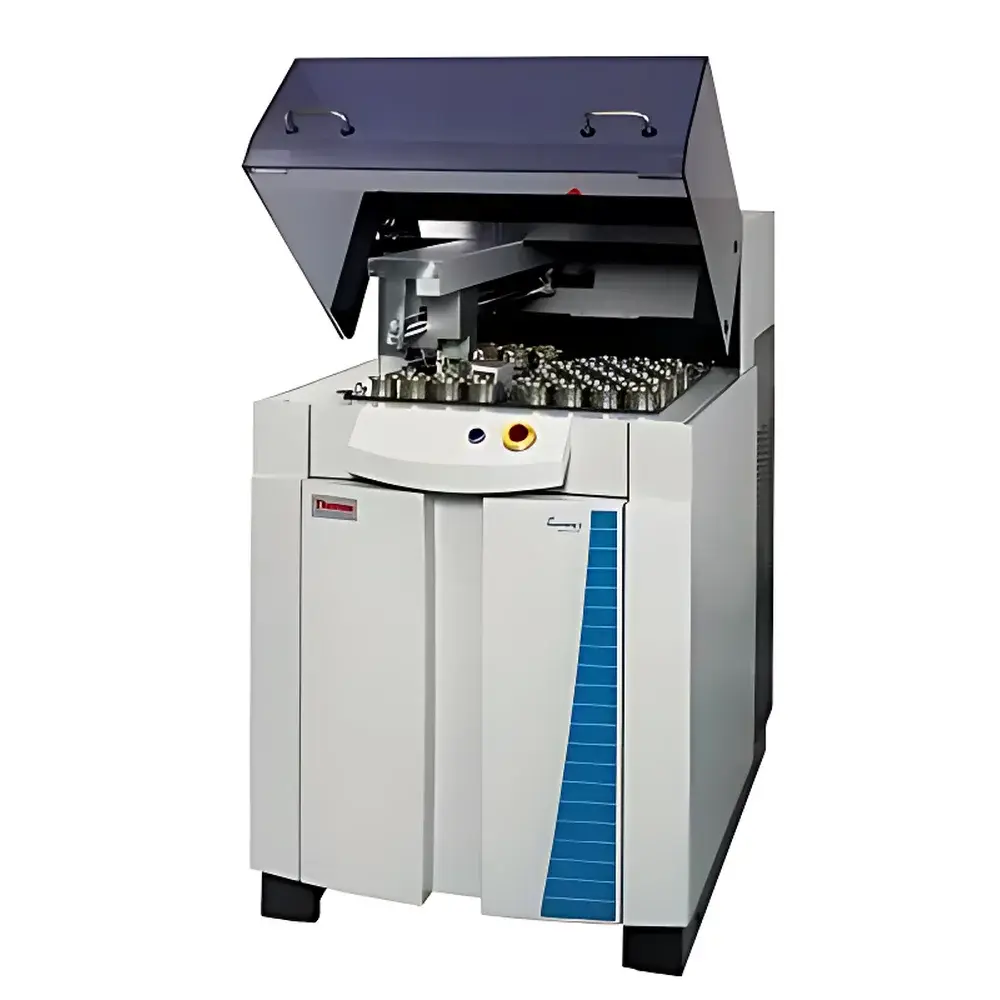
Thermo Fisher ARL Perform’X Wavelength Dispersive X-Ray Fluorescence Spectrometer
| Brand | Thermo Fisher |
|---|---|
| Origin | Switzerland |
| Manufacturer | Yes |
| Origin Category | Imported |
| Model | ARL Perform’X |
| Instrument Type | Floor-standing |
| Instrument Class | Scanning-type |
| X-ray Tube Power Options | 1500 W / 2500 W / 4200 W |
| Elemental Range | Be to U (Atomic Number 4 to 92) |
Overview
The Thermo Fisher ARL Perform’X is a high-performance, floor-standing wavelength dispersive X-ray fluorescence (WDXRF) spectrometer engineered for precision elemental analysis across diverse sample matrices and concentration ranges. Based on Bragg diffraction principles, it utilizes crystalline analyzers to separate characteristic X-ray emissions by wavelength, enabling superior spectral resolution and peak-to-background ratios compared to energy-dispersive systems. Designed for routine and research-grade applications in industrial QC, regulatory compliance, and academic laboratories, the ARL Perform’X delivers trace-level detection (sub-ppm), quantitative accuracy from major constituents to ultra-trace elements, and robust reproducibility across extended measurement campaigns. Its modular architecture supports configurable tube power (1500 W, 2500 W, or 4200 W), allowing optimization for sensitivity, throughput, or light-element performance — particularly critical for Be–F analysis in demanding applications such as catalyst characterization or low-Z impurity screening.
Key Features
- Digital Moiré-based goniometer with gearless angular positioning: Ensures long-term mechanical stability, sub-arcsecond repeatability, and minimal drift during multi-hour analyses.
- UCCO (Ultra-Short Coupling Optics) technology: Optimizes X-ray photon transfer efficiency between crystal analyzer and detector, enhancing sensitivity for light elements (Be–Na) while maintaining high count rates for heavy elements (e.g., U, Pb).
- Integrated temperature-controlled spectrometer chamber and crystal mounts: Maintains thermal equilibrium ±0.05 °C, minimizing spectral shift and preserving calibration integrity over time.
- Automated XY sample stage with programmable mapping: Enables micro-spot analysis (down to 200 µm diameter), compositional profiling, and defect-localized quantification without manual repositioning.
- Full-automation-ready design: Compatible with optional high-capacity sample changers (up to 168 positions), robotic loaders, and integrated liquid-handling modules for unattended operation.
- Leak-proof liquid cell interface with automatic recognition: Prevents accidental exposure of optics to volatile solvents or corrosive samples; includes pressure-sensing interlocks and sealed optical path isolation.
Sample Compatibility & Compliance
The ARL Perform’X accommodates solid discs, fused beads, pressed pellets, thin films, coatings, and sealed liquid cells — supporting ISO 21043, ASTM E1621, ASTM E2472, and USP method validation requirements. Its Be–U coverage satisfies elemental screening mandates under RoHS 2 (Directive 2011/65/EU), ELV (2000/53/EC), and REACH SVHC reporting. Factory-provided calibration sets comply with ISO 18223 for metals, ISO 12677 for cement, and ASTM D6443 for petroleum products. System validation documentation (IQ/OQ protocols) is provided in accordance with GMP Annex 15 and FDA 21 CFR Part 11 guidelines, including audit trails for calibration updates, parameter changes, and user access logs.
Software & Data Management
Controlled by Thermo Scientific OXSAS™ software, the platform supports fully automated acquisition, real-time spectral evaluation, and multivariate quantification. QuantAS™ enables fundamental parameter (FP)-based analysis without standards, suitable for unknown geological or forensic samples. UniQuant™ extends FP methodology to heterogeneous materials using matrix correction algorithms validated against NIST SRMs. PetroilQuant™ delivers pre-validated, ASTM-aligned calibrations for >30 elements in crude oil, distillates, lubricants, and additives — with built-in viscosity and sulfur speciation correlation models. All software modules generate ALCOA+ compliant reports (Attributable, Legible, Contemporaneous, Original, Accurate), support electronic signatures, and export data to LIMS via ASTM E1482-compliant XML or CSV formats.
Applications
- Geology & Environmental: Quantitative analysis of soil, sediment, fly ash, and mining tailings for As, Cd, Cr, Hg, Pb, and rare earth elements (REEs) at regulatory detection limits.
- Petroleum & Polymers: Sulfur, chlorine, and metal additive profiling (Ca, Zn, P, Mg) in fuels and lubricants per ASTM D2622 and D4294; halogen screening in flame-retardant polymers.
- Materials Science: Phase-specific composition mapping of Ni-based superalloys, Al–Li aerospace alloys, and sintered ceramics; inclusion analysis in steel billets.
- Construction & Refractories: Major oxide (SiO₂, Al₂O₃, CaO, MgO) and trace contaminant (B, Na, K, Cl) quantification in cement clinker, refractory bricks, and glass batches.
- Forensics & Recycling: Discrimination of paint layers, gunshot residue (Sb/Ba/Pb), and e-waste fractions (Cu/Sn/Pb/Br) using stratified spot analysis and statistical clustering.
FAQ
What is the minimum detectable limit for boron (B) in a fused glass bead?
Typical MDL for B in optimized conditions (4200 W tube, LiF(200) crystal, flow proportional counter) is 1.2 ppm at 1000 s counting time, per ISO 12885 Annex C validation.
Can the ARL Perform’X be integrated into an existing LIMS environment?
Yes — OXSAS supports ASTM E1482-compliant data export, OPC UA connectivity, and custom API integration for bidirectional workflow synchronization.
Is remote diagnostics supported out-of-the-box?
Standard firmware includes secure TLS-encrypted remote access for Thermo Fisher Field Service Engineers, with configurable firewall policies and session logging per ISO/IEC 27001 requirements.
Does the system meet GLP/GMP documentation requirements for pharmaceutical excipient testing?
Yes — full 21 CFR Part 11 compliance is enabled via electronic signature workflows, immutable audit trails, and IQ/OQ documentation packages aligned with ICH Q2(R2) analytical procedure validation guidance.
Related Products






