
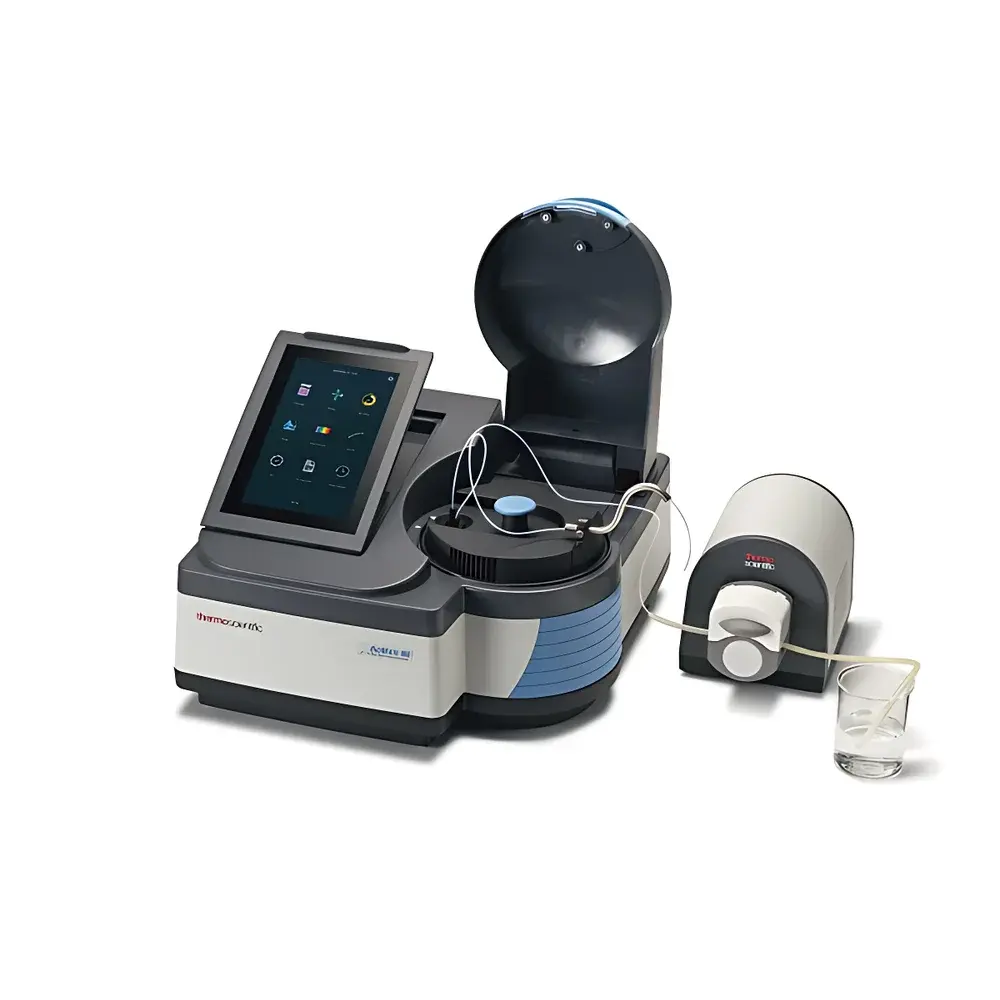
Thermo Fisher Biomate 160 UV-Vis Spectrophotometer
| Brand | Thermo Fisher |
|---|---|
| Origin | USA |
| Manufacturer Type | Original Equipment Manufacturer (OEM) |
| Product Origin | Imported |
| Model | Biomate 160 |
| Instrument Architecture | Double-Beam |
| Detector Type | Photodiode Array (PDA) |
| Wavelength Range | 190–1100 nm |
| Wavelength Selection | Manual |
| Spectral Bandwidth | 2 nm |
| Wavelength Accuracy | ±0.5 nm |
| Stray Light | <1.0%T at 198 nm (KCl), <0.05%T at 220 nm (NaI), <0.03%T at 340 nm (NaNO₂) |
Overview
The Thermo Fisher Biomate 160 UV-Vis Spectrophotometer is a double-beam, fixed-slit spectrophotometric platform engineered for routine quantitative and qualitative analysis in academic, pharmaceutical, and industrial quality control laboratories. Built upon the robust optical architecture of the GENESYS 150 series, it delivers high photometric stability and spectral reproducibility across the full ultraviolet to near-infrared range (190–1100 nm). Its double-beam design continuously compensates for lamp intensity drift and environmental fluctuations by simultaneously measuring sample and reference beam intensities—ensuring baseline stability over extended acquisition periods. The instrument employs a high-efficiency holographic grating and a thermally stabilized photodiode array detector, enabling rapid spectral acquisition without mechanical scanning. This configuration supports both single-wavelength absorbance measurements and full-spectrum scanning with consistent linearity and low noise performance.
Key Features
- Double-beam optical system with real-time reference correction for enhanced photometric accuracy and long-term stability
- Photodiode array (PDA) detector enabling simultaneous multi-wavelength detection and fast spectral acquisition (≤1 s per full scan)
- Fixed 2 nm spectral bandwidth optimized for resolution–sensitivity balance in biological and chemical applications
- Wavelength accuracy of ±0.5 nm traceable to NIST-certified holmium oxide and didymium filters
- Low stray light performance: <0.03%T at 340 nm (NaNO₂), critical for high-absorbance measurements in nucleic acid quantification
- Pre-installed Life Science Software Suite supporting standardized protocols including A260, A260/A280, A260/A230, protein A280/A205, and kinetic assay templates
- Compatibility with microvolume measurement accessories—including disposable plastic cuvettes with pathlengths as low as 0.2 mm—enabling direct analysis of ≤2 µL samples without dilution
Sample Compatibility & Compliance
The Biomate 160 accommodates standard 10-mm square quartz or UV-grade plastic cuvettes, as well as specialized microvolume cells for low-volume biological samples. Its optical design ensures compatibility with common solvents (water, buffers, ethanol, acetonitrile) and sample matrices encountered in molecular biology, biochemistry, and pharmaceutical QC workflows. The instrument meets key international performance standards including ASTM E275 (spectrophotometer terminology), ISO 6425 (performance verification of UV-Vis instruments), and USP (Spectrophotometry and Light-Scattering). While not inherently 21 CFR Part 11 compliant out-of-the-box, its software architecture supports audit-trail-enabled configurations when deployed with validated networked data management systems under GLP/GMP environments.
Software & Data Management
The integrated Life Science Software provides intuitive, menu-driven operation with preconfigured methods aligned with widely accepted biochemical assay guidelines (e.g., Bradford, Lowry, BCA for protein; hyperchromicity-based DNA/RNA quantitation). All methods include built-in concentration calculations, ratio reporting, and automatic dilution factor application. Data export is supported in CSV, TXT, and XML formats for integration with LIMS or statistical analysis platforms (e.g., JMP, GraphPad Prism). Raw spectral data are stored with metadata including date/time stamp, operator ID (if configured), instrument serial number, and calibration history. Software updates are delivered via Thermo Fisher’s secure support portal and undergo version-controlled validation documentation per internal QA procedures.
Applications
- Quantification and purity assessment of nucleic acids (DNA, RNA, oligonucleotides) using A260, A260/A280, and A260/A230 ratios per established literature protocols
- Determination of protein concentration via direct A280 (Trp/Tyr) or A205 (peptide bond) absorbance, including correction for nucleic acid contamination
- Kinetic monitoring of enzyme-catalyzed reactions (e.g., NADH/NADPH oxidation/reduction) at user-defined time intervals
- Colorimetric assays including ELISA endpoint reading, dye-binding methods (e.g., Coomassie, BCA), and metal ion complexation studies
- Verification of solvent transparency and blank correction in method development for HPLC and dissolution testing
- Educational use in undergraduate analytical chemistry and biochemistry laboratories due to its operational simplicity and method transparency
FAQ
Is the Biomate 160 compatible with third-party cuvette holders or microvolume adapters?
Yes—mechanical and optical interfaces conform to ANSI/SCTE standard dimensions, allowing integration with commercially available adjustable holders, temperature-controlled cells, and fiber-optic sampling accessories.
Can wavelength calibration be performed in-house?
Yes—calibration is supported using NIST-traceable holmium oxide (241, 279, 333, 360, 418, 480, 536 nm) and didymium (322, 355, 373, 381, 419, 438, 454, 460, 475, 483, 492, 502, 514, 525, 536, 547, 559, 572, 585, 602, 616, 630, 644, 657, 671, 686, 702, 717, 732, 747, 762, 777, 792, 807, 822, 837, 852, 867, 882, 897, 912, 927, 942, 957, 972, 987 nm) filters.
Does the instrument support automated data archiving to network drives?
Data export functions support UNC paths and mapped network locations; however, scheduled auto-backup requires external scripting or integration with enterprise file synchronization tools.
What is the recommended maintenance interval for lamp replacement?
The xenon flash lamp has a rated lifetime of ≥2 × 10⁹ flashes; typical replacement occurs every 18–24 months under average usage (≤200 scans/day).





