
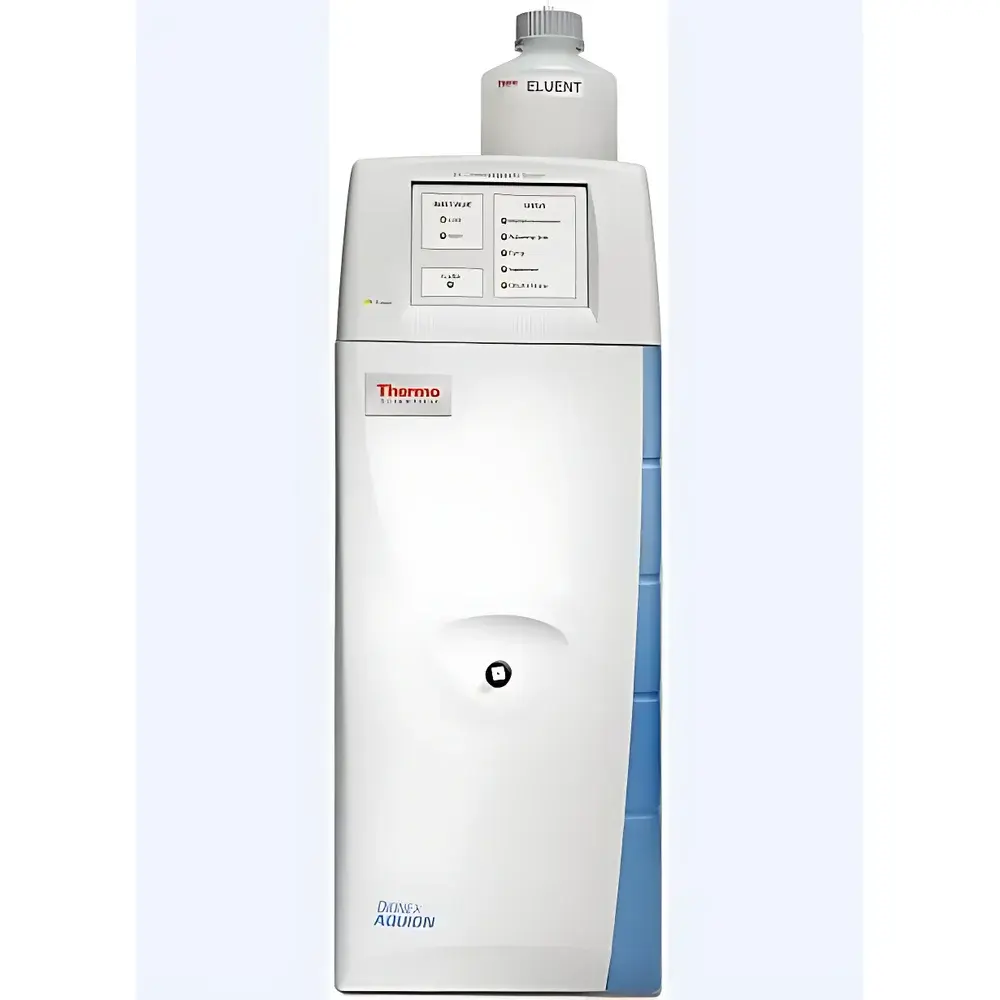
Thermo Fisher Dionex Aquion IC Ion Chromatograph
| Brand | Thermo Fisher |
|---|---|
| Origin | Mexico |
| Manufacturer | Thermo Fisher Scientific |
| Product Type | Imported Laboratory Instrument |
| Model | Aquion |
| Pump Pressure Rating | 5000 psi |
| Flow Rate Range | 0.00–5.00 mL/min |
| Eluent Flow Rate | 0.00–5.00 mL/min |
| Maximum Operating Pressure | 5000 psi |
| Column Oven Temperature Range | 30–60 °C |
| Temperature Reproducibility | ±0.5 °C |
| Eluent Concentration Range | 0.1–100 mM (dependent on eluent chemistry) |
Overview
The Thermo Fisher Dionex Aquion IC Ion Chromatograph is a robust, entry-level high-performance ion chromatography system engineered for routine anion and cation analysis in environmental, food safety, pharmaceutical, and academic research laboratories. It operates on the fundamental principle of suppressed conductivity detection following ion-exchange separation—where analyte ions are resolved on high-capacity, chemically stable anion- or cation-exchange columns under precisely controlled eluent composition and flow conditions. The system integrates core Thermo Fisher proprietary technologies—including electrolytic eluent generation (RFC-30), automatic electrolytic regeneration micro-membrane suppression (ERS), and PEEK-based fluidic architecture—to deliver trace-level sensitivity (sub-ppb detection limits), exceptional baseline stability, and long-term operational reliability without chemical regeneration reagents. Designed for regulatory-compliant workflows, the Aquion supports GLP/GMP-aligned data integrity practices through secure, audit-trail-enabled software control.
Key Features
- High-precision dual-piston high-pressure pump delivering pulse-free, low-drift eluent flow (0.00–5.00 mL/min) with <±0.1% RSD over extended runs
- Full-PEEK fluidic path—chemically inert across pH 0–14 and fully compatible with 0–100% organic solvents (e.g., methanol, acetonitrile)
- Integrated column oven with active temperature control (30–60 °C, ±0.5 °C reproducibility) to minimize retention time drift and backpressure variation
- Digital conductivity detector featuring 100 Hz acquisition rate, 0.00238 nS/cm resolution, and 10 MPa pressure tolerance
- Auto-ranging digital detection circuitry enabling simultaneous quantification of major and trace ionic species in a single injection
- Electrolytic eluent generator (RFC-30) enabling potassium hydroxide or methanesulfonic acid gradients without external gradient pumps or manual eluent preparation
- ERS 500 electrolytic suppressor—eliminates need for concentrated H2SO4 or other hazardous regenerants; reduces background conductivity and improves S/N ratio
- Optional online degassing module and eluent shut-off valve for unattended operation and method robustness
Sample Compatibility & Compliance
The Aquion IC system accommodates diverse sample matrices—including drinking water, wastewater, soil extracts, food digests, biological fluids, and pharmaceutical excipients—via optional Thermo Fisher SpectraPore™ and Valve-Switched Online Sample Preparation modules. These integrate electrolytic water splitting and selective trapping to remove interfering cations/anions, eliminate particulates, and concentrate target analytes prior to separation. All hardware and firmware comply with IEC 61000-6-3 (EMC), UL/CSA 61010-1 (safety), and support 21 CFR Part 11–compliant electronic records when operated with Chromeleon 7.2 or later. Column chemistries—including Dionex IonPac AS23, CS19, and ICE-AS6—are manufactured under ISO 9001-certified processes and validated per ASTM D4327 (anions in water) and USP (conductivity of purified water).
Software & Data Management
Controlled exclusively via Thermo Fisher Chromeleon Chromatography Data System (CDS) v7.2+, the Aquion enables method development, instrument sequencing, real-time monitoring, and automated report generation. Chromeleon provides role-based user access, electronic signatures, full audit trail (including parameter changes, sequence edits, and data reprocessing), and raw data archiving compliant with ALCOA+ principles. Integration with LIMS is supported via ODBC and direct API interfaces. Sequence templates, calibration curve management, and peak integration algorithms (e.g., valley-to-valley, tangent skim) are pre-validated for routine QC/QA applications. Data files (.cdf) retain full metadata—including instrument configuration, column history, and detector settings—for forensic traceability.
Applications
- Environmental: Quantification of F−, Cl−, NO2−, Br−, NO3−, PO43−, SO42−, and AsO43− in surface water per EPA Method 300.1 and ISO 10304-1
- Food & Beverage: Determination of lactate, acetate, citrate, and preservatives (e.g., benzoate, sorbate) in dairy, soft drinks, and sauces
- Pharmaceutical: Counter-ion profiling (Na+, K+, Ca2+) in APIs and excipients; residual chloride/sulfate in parenteral formulations per USP
- Power Generation: Trace chloride and sulfate monitoring in ultrapure boiler feedwater (ASTM D4582)
- Research: Separation of carbohydrates, amino acids, nucleotides, and peptides using specialized hydrophilic interaction (HILIC) and ligand-exchange columns
FAQ
Does the Aquion IC system support gradient elution?
Yes—when equipped with the RFC-30 Reagent-Free Eluent Generation system, the Aquion enables potassium hydroxide or methanesulfonic acid gradients without mechanical gradient pumps.
Is Chromeleon software included with the system purchase?
Yes—each Aquion IC system ships with a perpetual license for Chromeleon CDS v7.2+, including full instrument control, data processing, and 21 CFR Part 11 compliance modules.
Can the system analyze both anions and cations without hardware modification?
Yes—the same pump, detector, and autosampler support both modes; only the column, eluent, and suppressor require swapping between anion and cation configurations.
What is the expected lifetime of the ERS 500 suppressor?
Under normal operating conditions (≤5000 psi, ≤60 °C, recommended eluent concentration range), the ERS 500 typically exceeds 2,000 hours of continuous operation before performance decline warrants replacement.
Does the Aquion meet ISO/IEC 17025 requirements for accredited testing labs?
Yes—when deployed with validated methods, calibrated standards, documented maintenance logs, and Chromeleon’s audit-trail functionality, the system fulfills technical competence criteria outlined in ISO/IEC 17025:2017 clause 7.2–7.7.





