
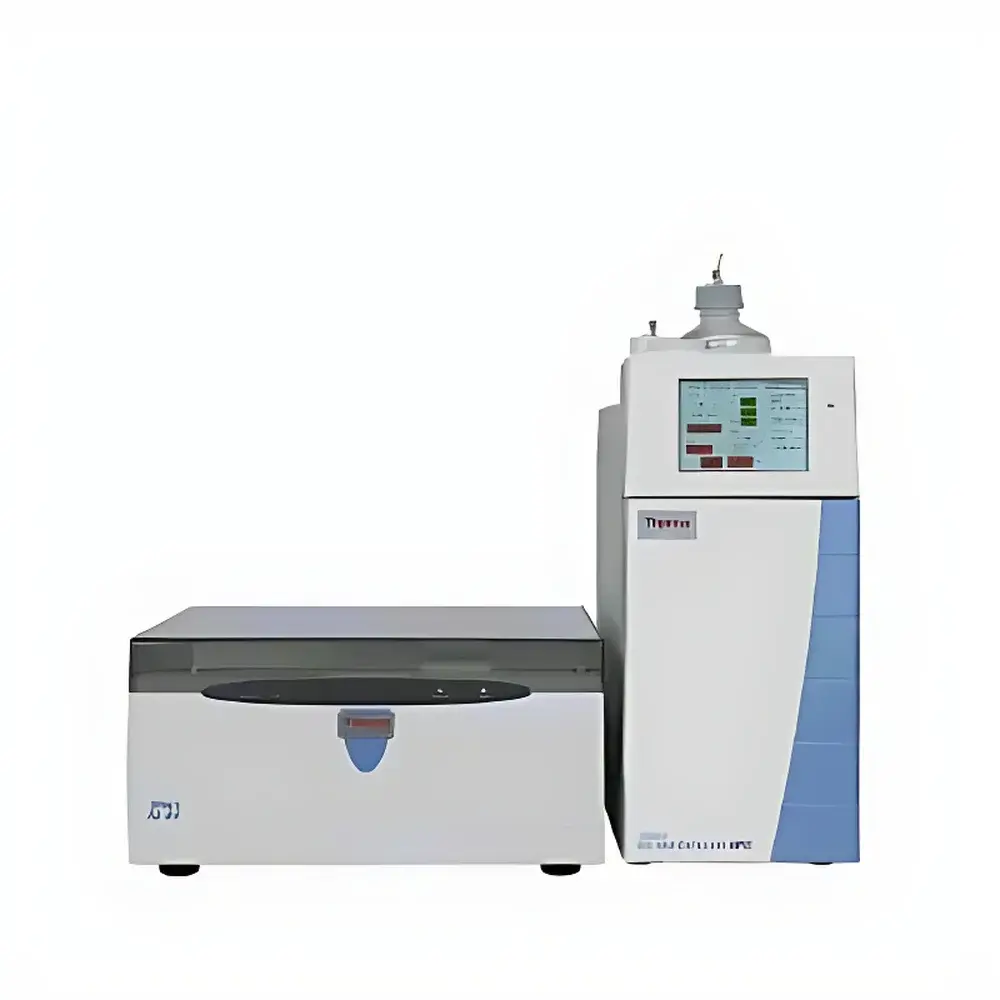
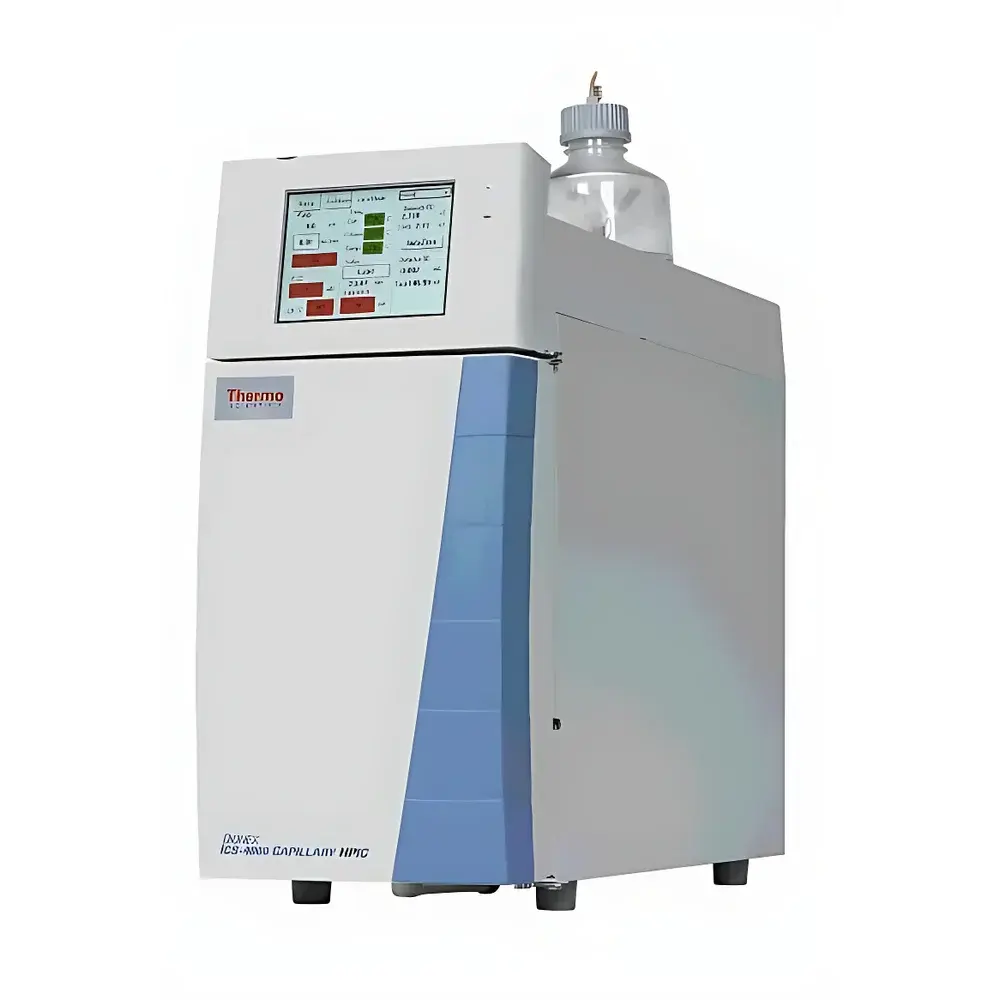
Thermo Fisher Dionex ICS-4000 Capillary High-Pressure Ion Chromatography System
| Brand | Thermo Fisher |
|---|---|
| Origin | USA |
| Manufacturer | Thermo Fisher Scientific |
| Product Type | Imported Laboratory Instrument |
| Model | ICS-4000 |
| Pump Pressure Rating | 6000 psi |
| Flow Rate Range | 0.001–0.100 mL/min |
| Eluent Flow Rate | 0.001–0.100 mL/min |
| Maximum Operating Pressure | 6000 psi |
| Operating Temperature Range | 10°C–40°C |
| Temperature Reproducibility | ±0.2°C |
| Eluent Concentration Range | 0–100 mM (KOH), dependent on eluent chemistry |
Overview
The Thermo Fisher Dionex ICS-4000 Capillary High-Pressure Ion Chromatography (HPIC™) System represents a foundational advancement in analytical ion chromatography, engineered specifically for capillary-scale separations under high-pressure conditions. Unlike conventional analytical-scale IC systems, the ICS-4000 operates with 0.4 mm internal diameter capillary columns and leverages ultra-low flow rates (down to 0.001 mL/min) to achieve exceptional resolution, sensitivity, and reagent economy. Its core measurement principle is based on suppressed conductivity detection following anion- or cation-exchange separation—enabled by high-pressure gradient-capable dual-piston pumps, thermally stabilized column compartments, and electrochemical suppression technology. Designed for unattended, continuous operation in regulated environments—including pharmaceutical QC labs, environmental testing facilities, and semiconductor-grade water analysis suites—the system supports 24/7 operation without equilibration delays, owing to its zero-dead-volume fluidic architecture and chemically inert, non-metallic wetted path (PEEK, PTFE, and ceramic components).
Key Features
- Capillary-scale HPIC platform optimized for 0.4 mm ID columns, enabling high-efficiency separations at pressures up to 6000 psi
- Ultra-low flow precision: stable delivery from 0.001 to 0.100 mL/min with <±0.1% RSD over extended runs
- Thermostatically controlled column oven (10–40°C) with ±0.2°C temperature reproducibility for retention time stability
- RFIC™ (Reagent-Free Ion Chromatography) capability: on-demand KOH eluent generation (0–100 mM) eliminates manual eluent preparation and improves inter-day reproducibility
- Modular “Spectrum Cube” design with color-coded fittings and minimized connection points to reduce installation errors and maintenance downtime
- Full compatibility with multiple detection modalities: suppressed conductivity, pulsed amperometric detection (PAD), and charged aerosol detection (CAD)
- Non-metallic fluid path ensures compatibility with trace-level metal analysis and prevents catalytic degradation of labile analytes (e.g., perchlorate, iodide, organic acids)
Sample Compatibility & Compliance
The ICS-4000 accommodates a broad spectrum of aqueous matrices—including ultrapure water, wastewater, biological fluids, food extracts, and high-purity chemical reagents—without requiring extensive pre-treatment. Its low-flow, low-volume design minimizes sample consumption (as low as 5 µL injection volume) and reduces matrix overload risk. All wetted materials comply with USP Class VI and ISO 10993 biocompatibility standards. The system meets critical regulatory requirements for data integrity: full audit trail support, electronic signature capability, and configurable user access levels align with FDA 21 CFR Part 11, EU Annex 11, and GLP/GMP laboratory practices. Method validation documentation adheres to ICH Q2(R2) and ASTM D4327/D6919 guidelines for ion analysis.
Software & Data Management
Chromelon™ 7 Chromatography Data System (CDS) provides native integration with the ICS-4000, offering method development tools, automated peak integration, customizable reporting templates, and real-time system suitability monitoring. The software supports multi-user workflows with role-based permissions and full electronic record retention. Raw data files are stored in vendor-neutral formats (e.g., .cdf) compliant with long-term archival standards. Optional Chromelon Secure Mode enables 21 CFR Part 11-compliant electronic signatures, audit trails with immutable timestamps, and change control logs—essential for regulated QC laboratories undergoing routine FDA or EMA inspections.
Applications
- Environmental monitoring: quantification of anions (F⁻, Cl⁻, NO₂⁻, Br⁻, NO₃⁻, PO₄³⁻, SO₄²⁻) and cations (Li⁺, Na⁺, NH₄⁺, K⁺, Mg²⁺, Ca²⁺) in drinking water, surface water, and leachates per EPA Methods 300.0, 300.1, and 317.0
- Pharmaceutical quality control: residual counterion analysis in APIs and excipients; chloride and sulfate testing in parenteral formulations per USP and
- Electronics industry: sub-ppb-level anion profiling in ultrapure water used in wafer cleaning processes (SEMI F63/F58 compliance)
- Food & beverage: organic acid profiling (acetate, citrate, lactate, malate) and preservative quantitation (benzoate, sorbate) in soft drinks and dairy products
- Academic and industrial research: speciation studies of redox-active ions (e.g., Cr(III)/Cr(VI), As(III)/As(V)) using coupled post-column reaction modules
FAQ
What distinguishes the ICS-4000 from conventional analytical-scale ion chromatographs?
The ICS-4000 utilizes capillary-scale columns and ultra-low flow rates, resulting in ~10× lower eluent consumption, reduced waste generation, and higher mass sensitivity compared to standard 4 mm ID systems—while maintaining equivalent or superior resolution through high-pressure operation.
Can the ICS-4000 be integrated into existing LIMS or ELN infrastructures?
Yes. Chromelon CDS supports ASTM E1578-compliant instrument interfacing via OPC UA and offers direct API-driven data export to common LIMS platforms (e.g., LabVantage, STARLIMS) and electronic lab notebooks.
Is RFIC eluent generation compatible with all common anion and cation exchange columns?
RFIC-generated KOH is fully compatible with Thermo’s CarboPac, IonPac AS/CS series, and most third-party high-capacity columns rated for pH 0–14 and ≤6000 psi. Methanesulfonic acid (MSA) generation is available via optional RFIC-ESP module for cation analysis.
Does the system support gradient elution with capillary columns?
Yes. The dual-pump configuration enables precise binary or ternary gradient formation at capillary flow rates, supporting complex multi-analyte separations such as simultaneous determination of haloacetic acids and inorganic anions in disinfection byproduct studies.
What level of training and service support is provided with installation?
Thermo Fisher offers factory-certified on-site installation, IQ/OQ documentation, application-specific method transfer assistance, and annual preventive maintenance contracts with guaranteed 4-hour remote diagnostics response and 24–72 hour onsite engineer dispatch for critical failures.





