
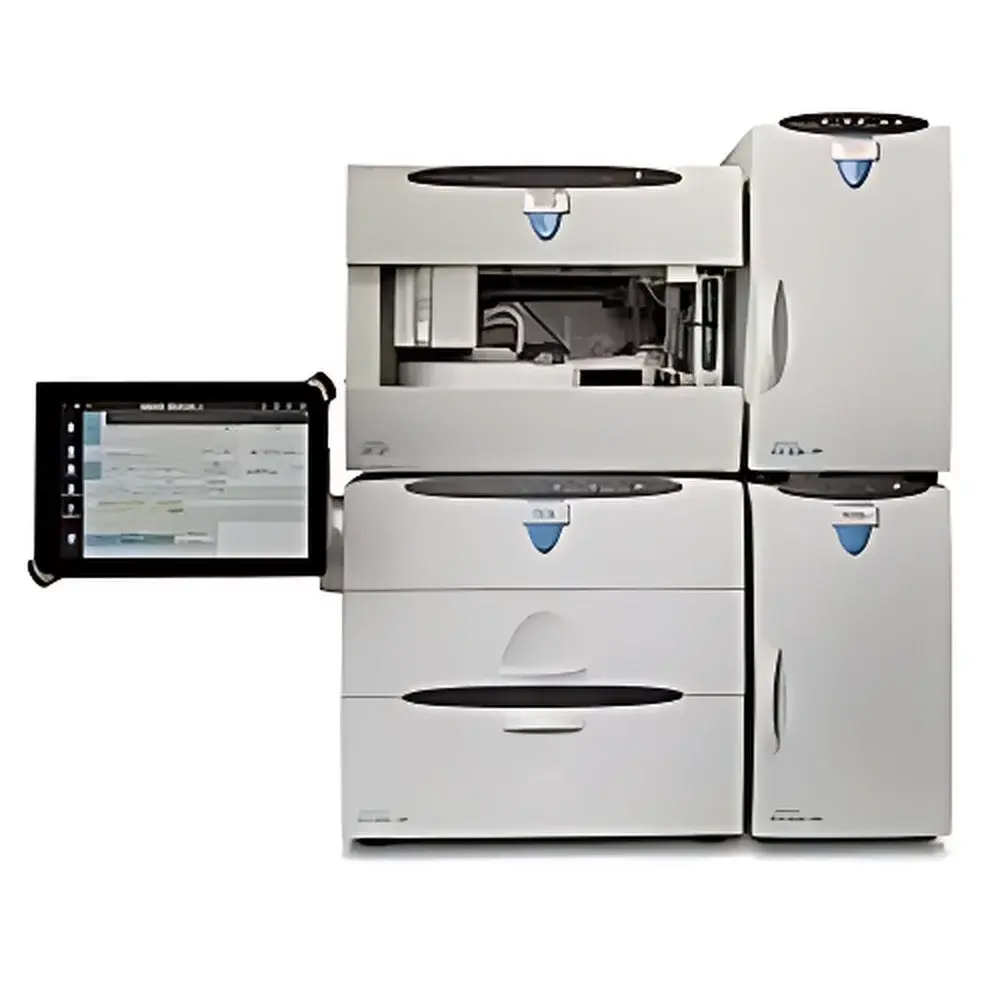
Thermo Fisher Dionex ICS-5000+ Electrochemical Detector
| Brand | Thermo Fisher |
|---|---|
| Origin | USA |
| Manufacturer Type | Original Equipment Manufacturer (OEM) |
| Product Category | Imported Instrument |
| Model | ICS-5000+ ED |
| Application | Laboratory-Based Ion Chromatography |
| Detection Principle | Pulsed Amperometric Detection (PAD), DC Amperometry, Integrated Amperometry, and Cyclic Voltammetry |
Overview
The Thermo Fisher Dionex ICS-5000+ Electrochemical Detector (ED) is a high-performance, microprocessor-controlled amperometric detection module engineered for integration with the ICS-5000+ and ICS-6000 Reagent-Free™ Ion Chromatography (RFIC™) systems. Designed specifically for trace-level quantification of electroactive analytes—including carbohydrates, amino acids, organic acids, and inorganic anions/cations—the detector operates on well-established electrochemical principles including direct current (DC) amperometry, pulsed amperometric detection (PAD), and integrated amperometry. Its core architecture minimizes band broadening through optimized flow cell geometry, reduced dead volume, and precise thermal management—ensuring high resolution, low baseline noise, and exceptional signal-to-noise ratios across wide dynamic concentration ranges (sub-nanomolar to millimolar). The detector’s fully integrated electronics are co-located within the flow cell housing, eliminating external cabling and minimizing electromagnetic interference—a critical design feature for reproducible, long-term stability in regulated laboratory environments.
Key Features
- Modular, snap-in installation compatible with ICS-5000+/ICS-6000 chassis—no tools or cables required; automatic recognition by Chromeleon CDS software
- Optimized electrochemical flow cell with ultra-low dead volume (< 1 µL) and thermally stabilized electrode assembly for minimal peak dispersion
- Dual reference electrode options: standard pH/Ag/AgCl or optional palladium-hydrogen (Pd/H₂) reference electrode—reducing calibration frequency and extending operational lifetime
- Digitally controlled waveform generation supporting DC amperometry, PAD, cyclic voltammetry, and user-defined integrated amperometry with adjustable pulse timing, voltage steps, and integration windows
- Onboard diagnostics and self-calibration routines accessible via Chromeleon CDS or local TTL trigger inputs
- Side-access rotary knob mechanism ensures repeatable, torque-consistent electrode and gasket seating—critical for inter-run precision and method transferability
Sample Compatibility & Compliance
The ICS-5000+ ED is validated for use with aqueous eluents across pH 3–12 and compatible with both suppressed and non-suppressed ion chromatography configurations. It supports analysis of labile species such as monosaccharides (e.g., glucose, fructose), disaccharides (e.g., sucrose, lactose), alditols, and low-molecular-weight organic acids without derivatization. Method development adheres to ASTM D6919 (carbohydrate analysis in biomass hydrolysates), ISO 16614-2 (water quality—carbohydrate determination), and USP / elemental impurity guidance where electrochemical detection serves as orthogonal verification. The detector’s firmware and hardware architecture support audit trail, electronic signature, and data integrity requirements per FDA 21 CFR Part 11 when deployed with Chromeleon CDS 7.3 or later under GLP/GMP-compliant workflows.
Software & Data Management
Fully integrated with Thermo Scientific™ Chromeleon™ Chromatography Data System (CDS) v6.8+, the detector enables real-time waveform parameter control, automated sequence-based method switching, and synchronized data acquisition with conductivity or UV/VIS detectors. Raw integrated amperometric data is rendered in native 3D visualization (current vs. voltage vs. retention time), analogous to photodiode array (PDA) output—facilitating peak purity assessment and co-elution diagnosis. All detector settings, calibration logs, and diagnostic reports are stored within the secure, relational Chromeleon database with full versioning, user access controls, and export compliance to CSV, PDF, and XML formats. Remote operation via Ethernet or USB is supported without additional middleware.
Applications
The ICS-5000+ ED delivers robust performance in pharmaceutical QC (e.g., excipient profiling in injectables), food safety (sugar-to-acid ratios in fruit juices, lactose in dairy), environmental monitoring (cyanide, sulfide, iodide in wastewater), and bioprocess analytics (glucose/glutamine monitoring in cell culture media). Its flexibility in waveform configuration allows method optimization for challenging matrices—such as high-salinity brines or viscous fermentation broths—without hardware modification. When coupled with dual-detection configurations (e.g., ED + conductivity), it enables simultaneous quantification of electroactive and non-electroactive ions in a single run—reducing analytical cycle time and improving throughput in high-volume labs.
FAQ
Is the ICS-5000+ ED compatible with legacy Dionex IC systems?
Yes—when used with Chromeleon CDS v6.8+ and appropriate interface modules, it supports backward compatibility with ICS-3000 and ICS-2100 platforms, though optimal performance is achieved on ICS-5000+/ICS-6000 RFIC architectures.
What maintenance intervals are recommended for the Pd/H₂ reference electrode?
Under continuous operation at 25 °C and neutral pH eluents, recalibration is typically required every 7–10 days; electrode replacement is recommended after 6–12 months depending on usage frequency and sample matrix complexity.
Can the detector operate in standalone mode without Chromeleon CDS?
No—the detector requires Chromeleon CDS for initialization, waveform definition, and data acquisition; however, basic diagnostic functions and status reporting are accessible via front-panel LED indicators and TTL-triggered self-tests.
Does the ED support gradient elution in carbohydrate analysis?
Yes—its fast response time (< 100 ms) and digital signal processing enable stable baseline retention during NaOH/NaOAc gradients commonly used in high-pH anion-exchange chromatography of carbohydrates.
How is data integrity ensured during long-duration runs (e.g., >24 h)?
Chromeleon CDS enforces continuous audit trail logging, real-time checksum validation of raw detector buffers, and automatic recovery from transient communication loss—meeting ALCOA+ (Attributable, Legible, Contemporaneous, Original, Accurate, Complete, Consistent, Enduring, Available) data governance criteria.





