
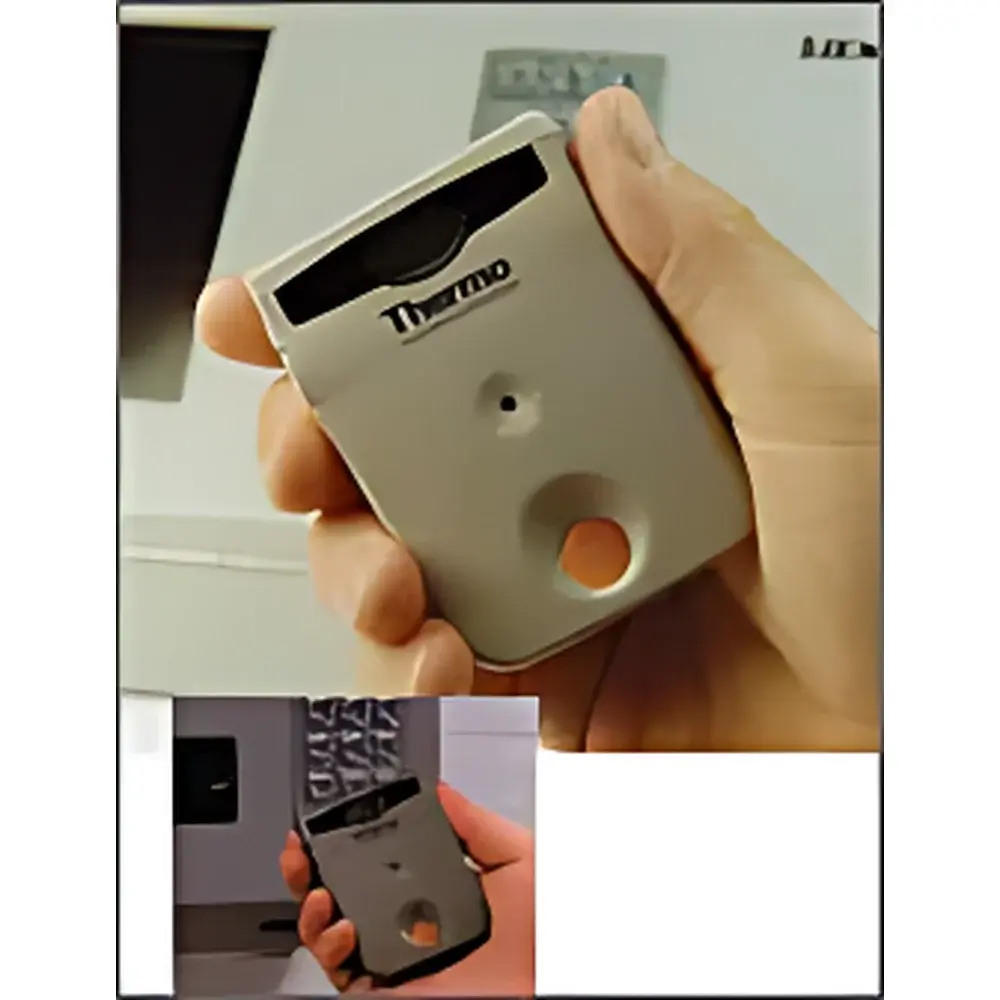
Thermo Fisher EPD MK2 Electronic Personal Dosimeter
| Brand | Thermo Fisher |
|---|---|
| Origin | USA |
| Manufacturer | Thermo Fisher Scientific |
| Product Type | Imported |
| Model | EPD MK2 |
| Instrument Category | Dose/Dose Rate Meter |
| Form Factor | Portable |
| Measured Radiation Types | X-ray, γ-ray, and β-particle radiation |
| Detector Type | Multi-stage solid-state detector |
| Measurement Quantities | Ambient dose equivalent H*(10), personal dose equivalent Hp(10) (deep/body), and Hp(0.07) (shallow/skin) |
| Compliance Standards | IEC 61283, IEC 61526, ANSI N13.11, ANSI N13.27, ANSI N42.20 |
| Data Retention | 10 years without battery power |
| Power Supply | Two AA 1.5 V alkaline batteries (8 weeks continuous operation) or one 3.6 V lithium battery (5 months continuous operation) |
| Communication Interface | High-speed infrared (IR) port |
| Alarm Capability | Configurable dose and dose rate thresholds with audible alert |
| Memory Security | Password-protected dose log storage |
| Certification Status | Only electronic personal dosimeter to pass all IAEA 2007 performance tests |
Overview
The Thermo Fisher EPD MK2 Electronic Personal Dosimeter is a rigorously engineered, CE-marked and IAEA-validated instrument designed for real-time monitoring of occupational radiation exposure in nuclear facilities, medical radiology departments, industrial radiography, and emergency response environments. Operating on the principle of solid-state multi-stage detection, the EPD MK2 simultaneously measures personal dose equivalent Hp(10) — representing deep-dose penetration relevant to whole-body exposure — and Hp(0.07), which quantifies shallow-dose deposition at the skin surface. Its dual-energy response architecture enables accurate discrimination and quantification of mixed-field radiation environments containing X-rays, gamma photons, and beta particles across a broad energy range (typically 15 keV to 7 MeV for photons; 0.15 MeV to 3.5 MeV for beta emitters). Unlike passive dosimeters (e.g., TLDs or OSL badges), the EPD MK2 delivers immediate, on-device readout with no post-processing delay — a critical capability for ALARA (As Low As Reasonably Achievable) compliance and dynamic work-permit management.
Key Features
- Multi-stage silicon diode detector optimized for flat energy response across X, γ, and β radiation spectra
- Simultaneous real-time display of Hp(10) and Hp(0.07) with configurable averaging intervals (1 s to 60 s)
- Programmable dose and dose rate alarm thresholds with user-selectable audible and visual alerts
- High-speed infrared (IR) interface compliant with ISO/IEC 15693 for secure, contactless data transfer to base stations or PCs
- Non-volatile flash memory storing ≥10,000 dose records, alarm logs, and event timestamps — retained for up to 10 years without battery power
- Password-protected memory partitioning ensures audit-trail integrity and prevents unauthorized data modification
- Robust IP67-rated housing resistant to dust, moisture, and mechanical shock (MIL-STD-810G compliant)
- Two power options: standard AA alkaline batteries (8-week typical service life) or extended-life 3.6 V lithium primary cell (5-month operational duration)
Sample Compatibility & Compliance
The EPD MK2 is certified for use in regulated environments requiring traceable, auditable radiation protection programs. It conforms to international performance standards including IEC 61283 (functional requirements for electronic personal dosimeters), IEC 61526 (type testing methodology), ANSI N13.11 (performance criteria for personnel dosimetry), ANSI N13.27 (radiation protection instrumentation classification), and ANSI N42.20 (performance criteria for portable radiation detection instruments). Its calibration is traceable to national metrology institutes (NMI) such as NIST and PTB. The device supports GLP/GMP-aligned workflows through time-stamped, tamper-evident logging and is compatible with Thermo Fisher’s RadEye™ Dose Management Software for integration into enterprise-wide radiation safety information systems (RSIS). It meets IAEA Safety Guide RS-G-1.2 requirements for individual monitoring in planned exposure situations.
Software & Data Management
Data exchange occurs via bidirectional IR communication using Thermo Fisher’s proprietary protocol, ensuring encrypted transmission and preventing accidental overwrites. The included RadEye Dose Manager software (Windows-based) provides full lifecycle management: automatic dose record import, customizable reporting (daily/weekly/monthly summaries, cumulative dose trending, alarm incident analysis), and export to CSV, PDF, or XML formats for regulatory submission. All logged entries include embedded metadata: unique device ID, operator ID (if assigned), timestamp (with UTC synchronization support), measurement mode, and alarm status flags. Audit trails comply with FDA 21 CFR Part 11 requirements when configured with electronic signatures and role-based access control. Data archives are structured to support ISO/IEC 17025-accredited laboratory documentation practices.
Applications
- Nuclear power plant maintenance and refueling operations
- Interventional radiology, PET/CT, and brachytherapy suites
- Industrial non-destructive testing (NDT) using Ir-192 or Se-75 sources
- Decommissioning and remediation of legacy nuclear sites
- First responder deployment during radiological dispersal device (RDD) incidents
- Research reactor and accelerator facility personnel monitoring
- Regulatory inspection and third-party verification audits
FAQ
What radiation types does the EPD MK2 measure?
It measures X-ray, gamma-ray, and beta-particle radiation — with independent quantification of Hp(10) and Hp(0.07) dose equivalents.
Is the EPD MK2 suitable for neutron fields?
No — it is not designed for neutron detection; neutron monitoring requires dedicated rem meters or TLD-albedo systems.
How is calibration maintained over time?
Calibration is performed annually against reference sources at accredited laboratories; built-in self-test routines verify detector stability before each use.
Can multiple EPD MK2 units be managed centrally?
Yes — via RadEye Dose Manager and optional docking stations supporting batch download and firmware updates.
Does the device meet IAEA TRS-468 requirements for emergency response dosimetry?
Yes — its IAEA 2007 test certification confirms compliance with TRS-468 Annex II performance benchmarks for field-deployable dosimeters.







