
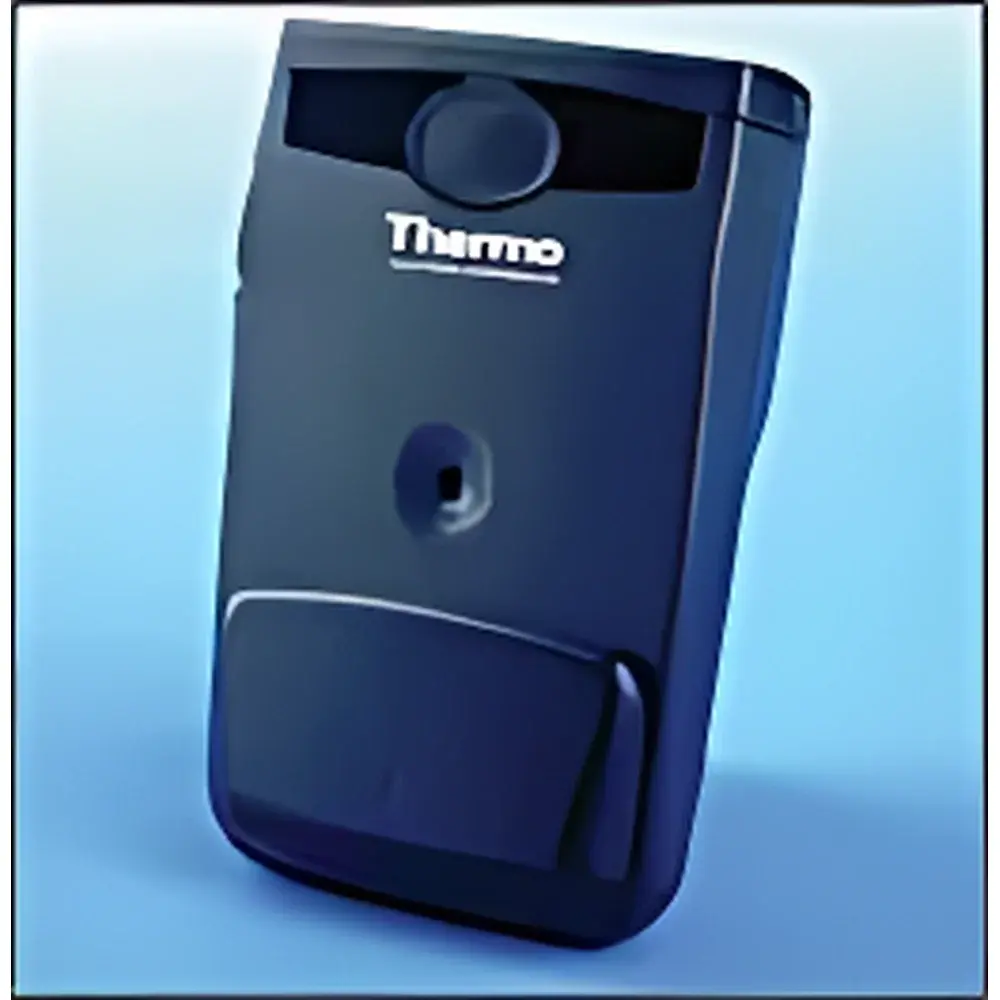
Thermo Fisher EPD-N2 Electronic Personal Neutron Dosimeter
| Brand | Thermo Fisher |
|---|---|
| Origin | USA |
| Manufacturer | Thermo Fisher Scientific |
| Product Type | Imported |
| Model | EPD-N2 |
| Instrument Category | Dose Rate Meter / Personal Dosimeter |
| Form Factor | Portable |
| Radiation Types Measured | Gamma and Neutron |
| Detector Technology | Multi-stage Solid-State Detector |
| Energy Range | 25 keV – 10 MeV (photons), Thermal neutrons – 15 MeV (neutrons) |
| Dose Quantity Displayed | Ambient and Personal Dose Equivalent Hp(10) |
| Compliance | IEC 61526 Ed. 4.0 (2018), ANSI N42.20, ISO 15265:2022 |
Overview
The Thermo Fisher EPD-N2 Electronic Personal Neutron Dosimeter is a compact, rugged, and field-deployable radiation monitoring instrument engineered for real-time measurement of personal dose equivalent Hp(10) in mixed gamma–neutron radiation fields. Unlike conventional single-detector dosimeters, the EPD-N2 integrates a multi-stage solid-state detector architecture—comprising optimized thermal neutron converters, fast-neutron moderators, and high-Z photon-sensitive layers—to deliver simultaneous, energy-compensated detection of both photons and neutrons across an extended energy range (25 keV–10 MeV for photons; thermal neutrons to 15 MeV for neutrons). Its core measurement principle relies on pulse-height discrimination and spectral unfolding algorithms embedded in firmware, enabling accurate separation of neutron and gamma contributions without requiring external calibration adjustments during routine use. Designed for nuclear power plant personnel, accelerator facility operators, radiopharmaceutical production staff, and emergency response teams, the EPD-N2 meets stringent operational requirements for occupational radiation protection under fluctuating field conditions.
Key Features
- Multi-stage solid-state detector system with integrated neutron moderation and photon absorption layers for independent signal generation from gamma and neutron interactions
- Real-time, dual-channel display of Hp(10) for photons and neutrons—no post-processing or manual subtraction required
- Energy-compensated response compliant with IEC 61526 Ed. 4.0 (2018) for personal dosimeters used in mixed fields
- Ruggedized IP67-rated housing with shock-absorbing polymer casing, suitable for continuous wear in industrial, outdoor, and emergency environments
- Low-power CMOS electronics supporting >2,000 hours of continuous operation on a single CR2032 battery
- Auto-ranging analog-to-digital conversion with 16-bit resolution and built-in temperature compensation for stable performance across −10 °C to +50 °C
- Vibration-resistant OLED display with backlighting for legibility in low-light or smoke-impacted scenarios
Sample Compatibility & Compliance
The EPD-N2 is calibrated and verified against traceable reference sources at accredited laboratories (NIST-traceable neutron fields at PTB Braunschweig and gamma beams at IRSN Fontenay-aux-Roses). It satisfies regulatory requirements for personal dosimetry in accordance with IEC 61526, ISO 15265:2022, and ANSI N42.20. Its Hp(10) reporting format aligns with ICRP Publication 116 recommendations and supports compliance with national regulations including 10 CFR Part 20 (U.S. NRC), EURATOM Directive 2013/59, and China’s GBZ 128–2019. The device does not require user-selectable radiation type modes—its firmware automatically identifies dominant radiation components via pulse shape analysis and applies appropriate fluence-to-dose conversion coefficients per ICRU Report 57 and ICRP 74.
Software & Data Management
Data retrieval is performed via bidirectional infrared (IrDA) interface or optional USB-C cradle, compatible with Thermo Fisher’s DoseManager Pro v4.2 software suite. The software provides audit-trail-enabled dose record management, supports 21 CFR Part 11-compliant electronic signatures, and generates GLP/GMP-ready reports including daily exposure summaries, alarm event logs, and cumulative dose trend analysis. All stored dose records include timestamp, detector status flags, battery voltage, and environmental temperature metadata. Firmware updates are delivered through digitally signed packages to ensure integrity and traceability in regulated environments.
Applications
- Continuous personal monitoring for reactor maintenance technicians working near spent fuel pools or primary coolant loops
- Dose assessment for medical physicists and cyclotron engineers exposed to prompt neutrons during PET isotope production
- Field deployment by nuclear emergency response units operating in post-accident environments with unknown radiation composition
- Validation of shielding effectiveness in neutron-rich facilities such as spallation sources and fusion test stands
- Compliance auditing and ALARA program implementation in defense-related nuclear material handling facilities
FAQ
Does the EPD-N2 require periodic recalibration?
Yes—annual calibration against certified neutron and gamma reference fields is recommended per IEC 61526 Clause 8.3 and national regulatory guidance. Calibration certificates include uncertainty budgets traceable to national metrology institutes.
Can the EPD-N2 distinguish between thermal and fast neutrons?
No—it reports total neutron Hp(10) across the full thermal-to-15-MeV range. Spectral differentiation is not performed; however, its multi-stage design ensures flat energy response within ±30% over the specified neutron energy span.
Is the device suitable for use in high-humidity or saline environments?
Yes—the IP67 ingress protection rating guarantees functionality after immersion in 1 m of water for 30 minutes and resistance to salt fog per ISO 9227, making it suitable for marine nuclear platforms and coastal research reactors.
How is dose data archived and protected from tampering?
All dose records are cryptographically hashed and stored in write-once memory sectors. DoseManager Pro enforces role-based access control and maintains immutable audit logs for all read/write/delete actions in alignment with FDA 21 CFR Part 11 Subpart B.
Does the EPD-N2 support wireless data transfer?
Not natively—data exchange occurs via IrDA or USB-C. Bluetooth or Wi-Fi modules are omitted to prevent electromagnetic interference with sensitive detector electronics and to maintain compliance with IEC 61000-4-3 immunity requirements.







