
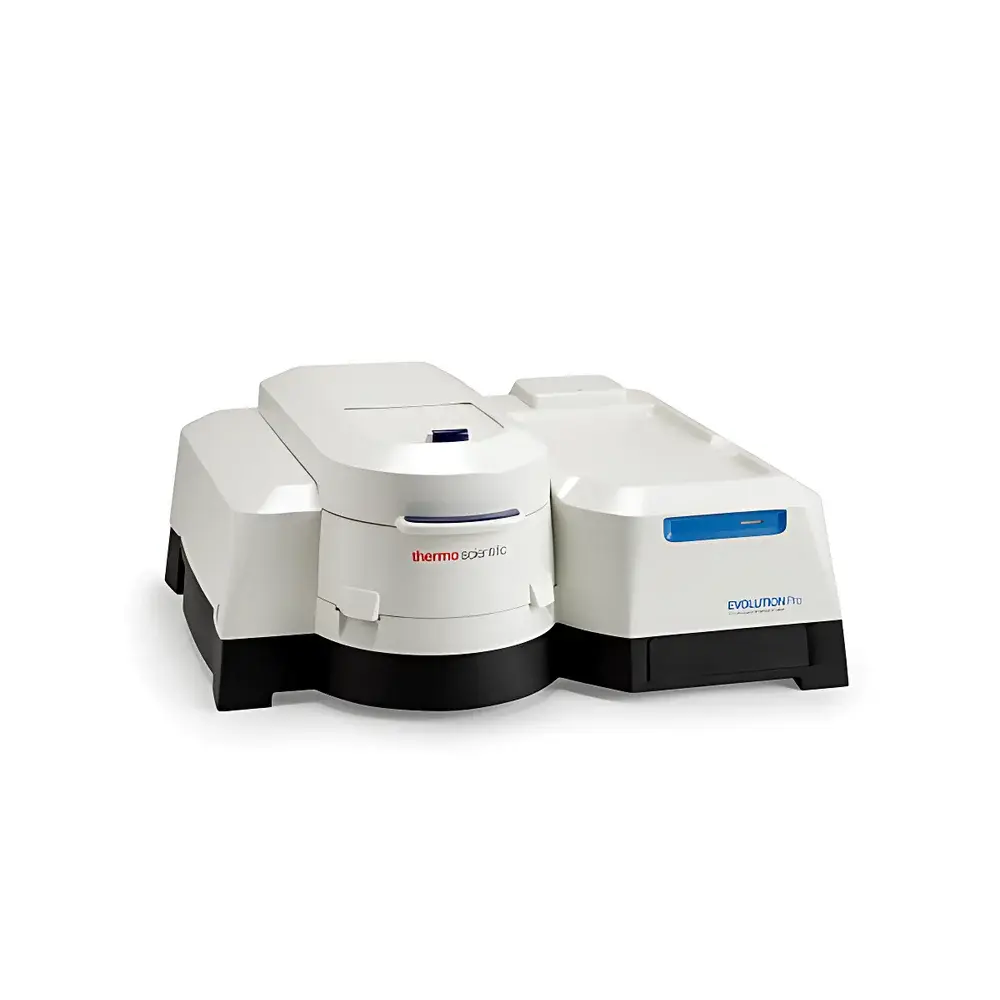
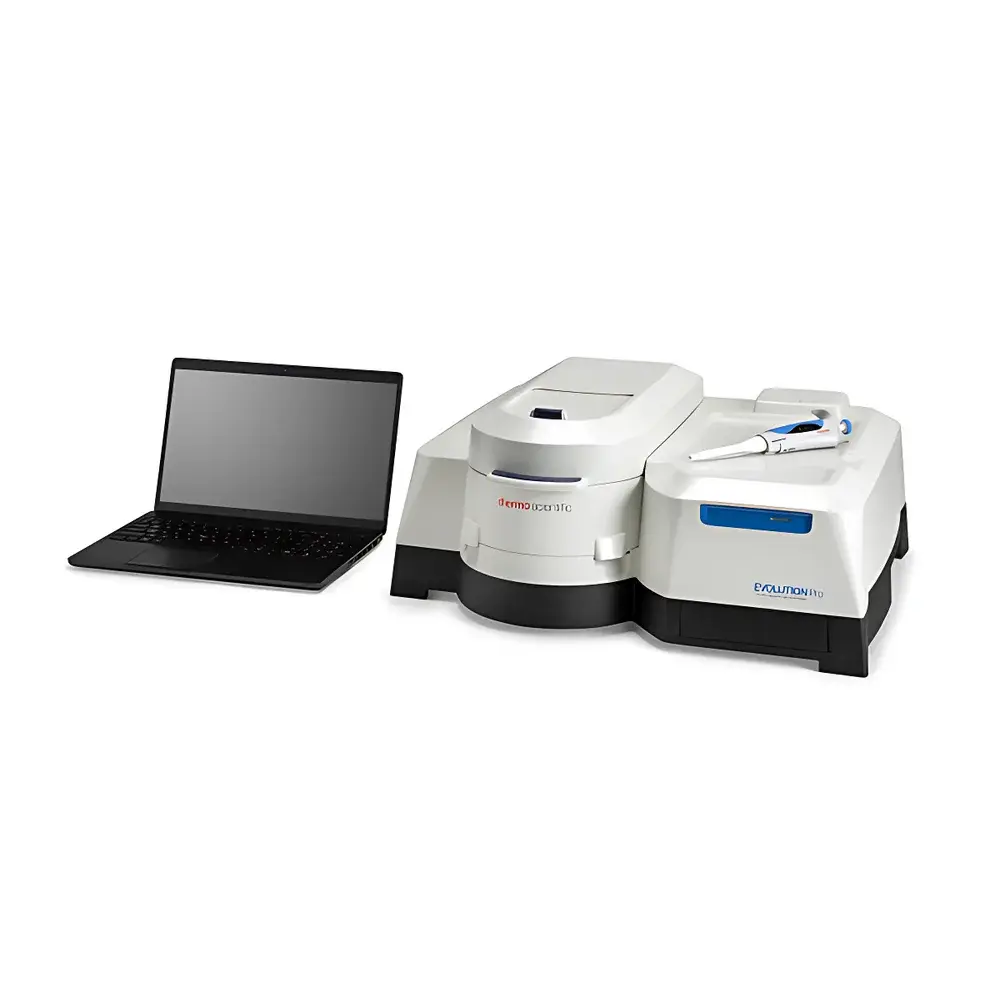
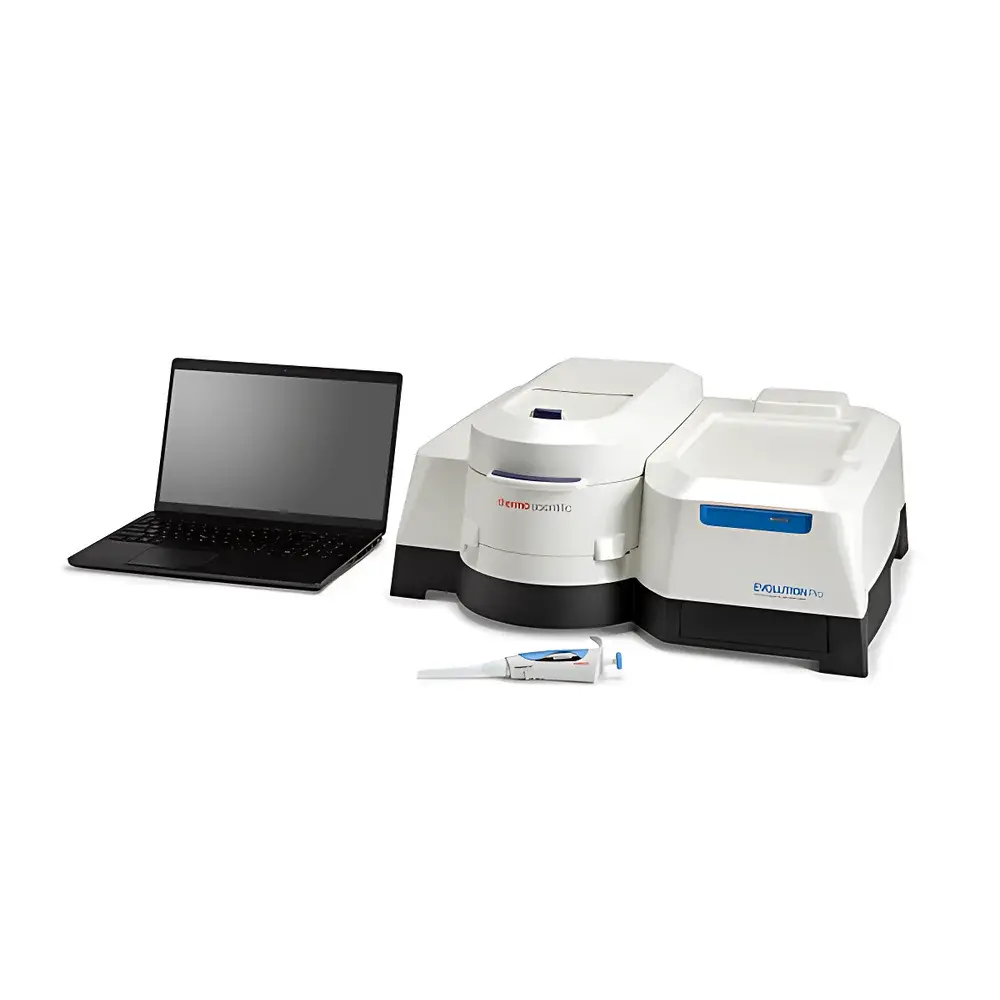
Thermo Fisher Evolution Pro UV-Vis Spectrophotometer
| Brand | Thermo Fisher |
|---|---|
| Origin | USA |
| Manufacturer Type | Original Equipment Manufacturer (OEM) |
| Product Origin | Imported |
| Model | Evolution Pro |
| Instrument Configuration | Double-beam |
| Detector Type | Photodiode Array (PDA) |
| Wavelength Range | 190–1100 nm |
| Wavelength Scanning | Motorized Auto-Scanning |
| Spectral Bandwidth | Selectable 0.5, 1.0, 1.5, 2.0, or 4.0 nm |
| Wavelength Accuracy | ±0.20 nm at 546.07 nm (Hg emission line) |
| Wavelength Repeatability | Standard deviation <0.05 nm over 10 consecutive measurements |
| Stray Light | ≤0.4% T at 198 nm (KCl), ≤0.032% T at 220 nm (NaI), <0.01% T at 340 nm (NaNO₂) |
Overview
The Thermo Fisher Evolution Pro UV-Vis Spectrophotometer is a high-performance double-beam instrument engineered for precision absorbance, transmittance, and reflectance measurements across the ultraviolet, visible, and near-infrared spectral regions (190–1100 nm). Built upon a robust optical architecture featuring a photodiode array (PDA) detector and motorized wavelength scanning, it delivers rapid full-spectrum acquisition with high photometric stability and low noise. Its double-beam design continuously compensates for source drift and environmental fluctuations—critical for long-duration kinetic studies or regulated QC workflows. The system’s wide spectral coverage, selectable spectral bandwidths (0.5–4.0 nm), and exceptional stray light suppression (<0.01% T at 340 nm) enable reliable quantification of highly absorbing or turbid samples, including biological macromolecules, pharmaceutical actives, and colored dyes in complex matrices.
Key Features
- Double-beam optical path with real-time reference beam correction for enhanced baseline stability and measurement reproducibility
- Photodiode array (PDA) detector enabling simultaneous multi-wavelength detection and sub-second full-spectrum acquisition (190–1100 nm)
- Selectably adjustable spectral bandwidth (0.5, 1.0, 1.5, 2.0, or 4.0 nm) to optimize resolution vs. signal-to-noise ratio per application requirement
- Wavelength accuracy of ±0.20 nm at the mercury 546.07 nm line and ±0.30 nm across 190–900 nm, verified per ASTM E275 and ISO 9001 calibration protocols
- Stray light performance compliant with USP and Ph. Eur. 2.2.25 specifications: <0.01% T at 340 nm (NaNO₂), ≤0.032% T at 220 nm (NaI)
- Large sample compartment accommodating custom accessories—including fiber-optic probes, integrating spheres, temperature-controlled cuvette holders, and solid-sample reflectance stages
- Smart accessory recognition via embedded RFID tags; automatic configuration loading for autosamplers, syringe pumps, and cell changers
Sample Compatibility & Compliance
The Evolution Pro supports liquid, suspension, film, and solid-state samples using standard 10-mm quartz or glass cuvettes, microvolume platforms, or optional accessories such as the Thermo Scientific™ SmartPath™ microvolume stand or the 8-cell Peltier-controlled changer. It meets key regulatory requirements for GxP environments: when paired with INSIGHT Pro Security software, the system supports audit trail generation, electronic signatures, role-based user access control, and data integrity features aligned with FDA 21 CFR Part 11, EU Annex 11, and ICH GCP/GLP guidelines. Routine performance qualification (PQ) and operational qualification (OQ) protocols are available through Thermo Fisher’s certified service network, ensuring ongoing compliance with ISO/IEC 17025 and ASTM E1655 standards.
Software & Data Management
INSIGHT Pro software provides an intuitive, workflow-driven interface for method development, data acquisition, processing, and reporting. Preconfigured application modules streamline common tasks—including quantitative analysis (single/multi-point calibration, Beer-Lambert modeling), spectral scanning (kinetic, time-resolved, variable temperature), and purity assessment (peak purity, spectral overlay, derivative spectroscopy). All raw spectral data are stored in vendor-neutral formats (e.g., .jdx, .csv) with embedded metadata (instrument ID, operator, timestamp, calibration history). Data export supports LIMS integration via ASTM E1384-compliant interfaces, and secure archiving complies with ALCOA+ principles (Attributable, Legible, Contemporaneous, Original, Accurate, Complete, Consistent, Enduring, Available).
Applications
- Pharmaceutical quality control: assay determination of APIs per USP monographs, excipient compatibility testing, dissolution profile analysis
- Life sciences: nucleic acid quantification (A260/A280 ratios), protein concentration (BCA/Lowry assays), enzyme kinetics (NADH/NADPH monitoring at 340 nm)
- Environmental analysis: nitrate/nitrite detection in water, heavy metal chelation studies, humic substance characterization
- Materials science: thin-film thickness estimation via interference fringes, bandgap determination of semiconductors, pigment dispersion stability
- Food & beverage: colorimetric evaluation (CIELAB), antioxidant capacity (FRAP/DPPH assays), adulterant screening
FAQ
What regulatory standards does the Evolution Pro support out-of-the-box?
It complies with ASTM E275 (spectrophotometer performance verification), ISO 9001 (calibration traceability), and USP (stray light and wavelength accuracy). With INSIGHT Pro Security software enabled, it satisfies 21 CFR Part 11 and EU Annex 11 requirements for electronic records and signatures.
Can the instrument be integrated into an automated lab environment?
Yes—via RS-232, USB, or Ethernet connectivity, it supports remote control through LabVIEW, Python (PyVISA), or Thermo Fisher’s OpenLab CDS platform. Autosamplers and liquid handlers can be synchronized using standardized SCPI commands.
Is routine maintenance documented and traceable?
All hardware calibrations, lamp replacements, and alignment checks generate timestamped entries in the system audit log. Service reports include metrological traceability to NIST standards and are exportable as PDF or XML.
How is spectral resolution defined and validated on this instrument?
Spectral resolution is determined by the selected slit width (corresponding to 0.5–4.0 nm bandwidth) and verified using the half-width of the mercury 253.65 nm line per ISO 6326-1. Resolution validation is part of annual OQ and included in IQ/OQ/PQ documentation packages.
Does the system support multi-user environments with differentiated permissions?
Yes—INSIGHT Pro Security implements hierarchical user roles (Administrator, Analyst, Reviewer) with configurable permissions for method editing, data deletion, report approval, and audit trail viewing, fully auditable per ALCOA+ principles.
Related Products




