
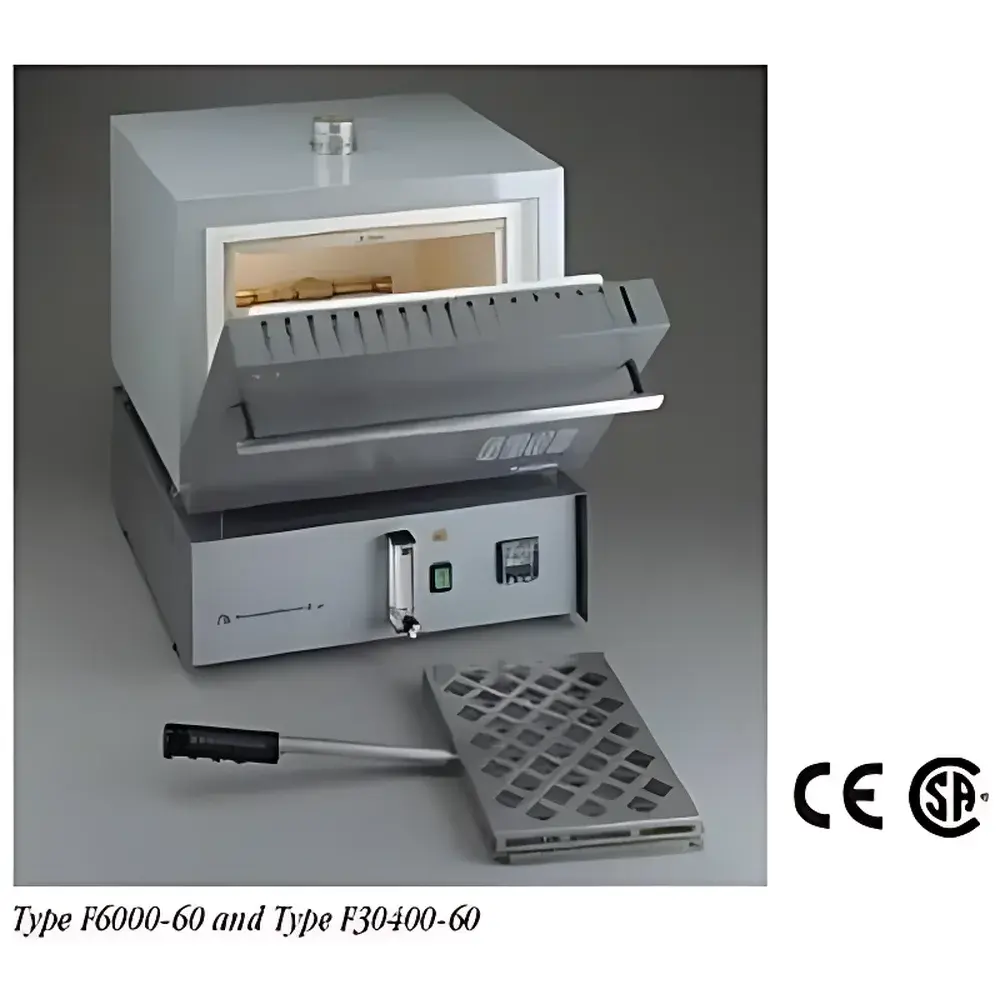
Thermo Fisher F6000-60 / F30400-60 Atmosphere-Controlled Ashing Furnace
| Brand | Thermo Fisher |
|---|---|
| Origin | USA |
| Model | F6000-60 / F30400-60 |
| Temperature Range | 100–975 °C |
| Chamber Volume | 15 L or 45 L |
| Air Flow Control | 0–80 L/min (adjustable via front-mounted flowmeter) |
| Temperature Stability at 750 °C | ±3 °C |
| Heating Rate | 8 °C/min (≤500 °C), 6 °C/min (500–750 °C) |
| Compliance | ASTM D3174 |
| Gas Inlet Ports | 1 × 0.95 cm thermocouple port, 1 × 0.635 cm or 0.876 cm soft-hose barb for inert gas supply |
| Control Options | B1 (single-setpoint), C1 (8-segment single program), D1 (16-segment × 4 programs, RS232 interface) |
Overview
The Thermo Fisher F6000-60 and F30400-60 Atmosphere-Controlled Ashing Furnaces are engineered for precise, repeatable, and standards-compliant ash content determination in solid fuels—primarily coal and coke—according to ASTM D3174. These muffle furnaces operate on a forced-air convection principle with active atmosphere management, enabling controlled oxidative combustion under defined air exchange rates (3–4 air changes per minute) and strictly regulated thermal ramping profiles. Unlike conventional box furnaces, the F6000 series integrates an integrated preheated air inlet manifold located at the rear chamber wall, ensuring uniform thermal distribution and minimizing cold-spot formation during extended isothermal holds (e.g., 2-hour dwell at 750 °C). The design eliminates uncontrolled draft effects while maintaining strict adherence to standardized heating kinetics, making it suitable for accredited laboratories operating under ISO/IEC 17025, ASTM, and internal QA/QC protocols.
Key Features
- Two chamber volumes available: 15 L (F6000-60) and 45 L (F30400-60), optimized for batch throughput and spatial uniformity in routine ash testing.
- Front-mounted, calibrated gas flowmeter (0–80 L/min range) with fine-adjustment valve for real-time control of ambient air ingress—critical for reproducible oxidation kinetics and residue morphology.
- Rear-mounted preheated air manifold ensures incoming air reaches near-chamber temperature before entering the working zone, reducing thermal shock and improving temperature homogeneity (±3 °C max deviation at 750 °C).
- Dual stainless-steel hearth plates included as standard—rated for continuous operation up to 975 °C; optional Inconel® alloy manifolds extend compatibility to 1093 °C for specialized applications requiring higher thermal stability.
- Three programmable control tiers (B1, C1, D1) support escalating process automation needs—from basic setpoint operation to multi-stage thermal profiles with audit-ready parameter logging.
- Dedicated 0.95 cm thermocouple port enables independent verification of chamber temperature using external calibrated sensors, supporting GLP traceability and method validation requirements.
Sample Compatibility & Compliance
The furnace accommodates standard crucible formats used in coal analysis: thirty 30 mL ceramic crucibles or ten 10 mL quartz crucibles per hearth plate. Crucible placement follows ASTM D3174 spacing guidelines to ensure consistent heat transfer and prevent cross-contamination. All models comply fully with ASTM D3174 for proximate analysis of coal and coke, including specified ramp rates, dwell conditions, and ventilation parameters. The system supports integration into GMP-regulated environments when paired with D1 controllers featuring RS232 output and mechanical overtemperature cut-off relays—facilitating data capture, electronic signature workflows, and 21 CFR Part 11–compliant audit trails when interfaced with validated LIMS or ELN platforms.
Software & Data Management
While the F6000 series operates independently of proprietary software, the D1 controller provides native RS232 serial communication for bidirectional data exchange with laboratory informatics systems. Users may log time-stamped temperature readings, setpoint transitions, and alarm events—including overtemperature cutoff activation—for inclusion in analytical reports. Firmware-level mechanical safety interlocks remain active regardless of communication status, ensuring fail-safe operation. For laboratories requiring electronic record retention, third-party SCADA or LabVIEW-based acquisition modules can be deployed to capture real-time thermal profiles and correlate them with sample metadata, satisfying FDA and ISO 17025 documentation requirements.
Applications
- Routine ash content determination in coal, coke, biomass, and mineral feedstocks per ASTM D3174, ISO 1171, and GB/T 212.
- Residue analysis following controlled oxidative decomposition of organic matrices in environmental and geochemical laboratories.
- Preparation of ash reference materials for XRF and ICP-OES calibration where compositional fidelity and particle size consistency depend on uniform calcination conditions.
- Method development for alternative fuels (e.g., RDF, SRF) where ash melting behavior and elemental partitioning must be characterized under standardized thermal histories.
- Quality assurance in metallurgical coke production, where ash content directly correlates with blast furnace efficiency and slag volume.
FAQ
Does the F6000-60 require external ventilation or fume extraction?
Yes—continuous exhaust is mandatory during operation to remove combustion byproducts and maintain safe workplace exposure limits. A dedicated ducted hood or lab-scale fume extraction system must be installed per OSHA and local industrial hygiene regulations.
Can inert gas purging be performed without modifying the furnace hardware?
Yes—the rear-mounted 0.635 cm or 0.876 cm hose barb accepts standard inert gas tubing (e.g., nitrogen or argon) without adapters. Purge flow rate must be manually balanced against the forced-air intake to avoid pressure differentials that compromise temperature uniformity.
Is the D1 controller compatible with modern laboratory network infrastructure?
The D1 unit outputs ASCII-formatted serial data via RS232. Integration with Ethernet-based networks requires an RS232-to-TCP/IP converter or middleware such as Modbus TCP gateways—no native Ethernet or Wi-Fi capability is built in.
What maintenance intervals are recommended for the airflow system?
The flowmeter and inlet manifold should be inspected quarterly for particulate buildup; stainless-steel components may be cleaned ultrasonically in mild detergent. Air filters (if added upstream) require monthly replacement in high-dust environments.
How is temperature uniformity validated across the chamber volume?
ASTM D3174 recommends mapping using at least nine NIST-traceable thermocouples placed at defined grid positions. Thermo Fisher provides optional calibration kits and SOP templates aligned with ISO/IEC 17025 clause 6.4.2 for thermal validation.



