
Thermo Fisher FHT 1377 PackEye Backpack-Style Radiation Source Search System
| Brand | Thermo Fisher |
|---|---|
| Origin | USA |
| Manufacturer | Thermo Fisher Scientific |
| Product Type | Imported |
| Model | FHT 1377 PackEye |
| Instrument Category | Dose Rate Meter |
| Portability | Portable |
| Measured Radiation Types | Gamma and Neutron |
| Detector Configuration | Dual Plastic Scintillator + Two He-3 Proportional Counters |
| Dose Rate Range | 50 nSv/h – 2 mSv/h |
| Sensitivity | 50 nSv/h |
| Power Consumption | 350 mW |
| Battery Life | ~70 h (7.2 V, 3600 mAh rechargeable Li-ion) |
| Dimensions | 58 cm (H) × 30 cm (W) × 18 cm (D) |
| Weight | 6 kg |
| Data Update Interval | 100 ms |
| LED Indication | 10-level gamma / 10-level neutron |
| Communication | Bluetooth + GPS interface |
| Compliance | IAEA-recommended system for orphan source search |
| Key Technology | Patented Natural Background Rejection (NBR), Digital Filtering, Low-Power Embedded Electronics |
Overview
The Thermo Fisher FHT 1377 PackEye is a purpose-engineered, backpack-mounted radiation detection system designed for covert, mobile, and real-time identification of orphaned or illicit radioactive sources in open environments. Unlike conventional handheld survey meters or fixed portal monitors, the PackEye integrates dual-mode detection—gamma and thermal neutron—into a wearable platform that maintains operational discretion without compromising measurement fidelity. Its core architecture leverages the physical principles of scintillation (for gamma photons) and neutron-induced nuclear reaction in 3He gas (for thermal neutrons), enabling simultaneous, independent quantification of both radiation components. The system’s operational paradigm centers on rapid spatial mapping: as the operator walks through urban infrastructure, transport hubs, or post-disaster zones, the instrument continuously acquires dose rate data, applies real-time natural background subtraction (NBR), and delivers immediate visual feedback via segmented LED arrays—enabling hands-free situational awareness. This makes it especially suited for first responders, nuclear security teams, and regulatory inspectors conducting wide-area radiological surveys under time-critical or low-visibility conditions.
Key Features
- Dual-Mode Detection Architecture: Combines a large-volume plastic scintillator (optimized for 50 keV–3 MeV gamma energy response) with two parallel 3He proportional counters (5 cm × 36 cm active length each), providing orthogonal sensitivity to gamma-emitting isotopes (e.g., 137Cs, 60Co) and neutron-emitting materials (e.g., 252Cf, plutonium-bearing assemblies).
- Patented Natural Background Rejection (NBR): Dynamically models and subtracts local terrestrial and cosmic background fluctuations using multi-parameter correlation algorithms, significantly reducing false positives during pedestrian-based scanning in variable terrain or building proximity.
- Real-Time Embedded Processing: Integrated digital signal processing updates dose rate values every 100 ms, applying adaptive filtering to suppress electronic noise and pulse pile-up artifacts—ensuring stable readings even during rapid motion or vibration.
- Hands-Free Operational Interface: Ten-segment LED indicators (separate gamma and neutron scales) provide intuitive, glance-readable status without requiring screen interaction; audible alerts and Bluetooth-linked smartphone notifications further enhance usability in high-stress scenarios.
- Low-Power Robust Design: Consumes only 350 mW during continuous operation, supporting up to 70 hours of field deployment on a single charge of its 7.2 V / 3600 mAh lithium-ion battery pack—validated under ISO 9001-certified environmental stress testing (−10°C to +50°C, 95% RH non-condensing).
Sample Compatibility & Compliance
The FHT 1377 PackEye is not sample-based in the traditional analytical sense; rather, it performs in-situ, non-contact environmental monitoring of ambient ionizing radiation fields. It complies with IAEA Nuclear Security Series No. 11-G (2021) for radiation detection equipment used in nuclear security applications and meets the functional requirements outlined in ANSI N42.33-2022 for portable radiation detection instruments. Its gamma energy response has been calibrated traceably to NIST SRM-2002 (Cs-137 reference source), and neutron efficiency was verified per ISO 8529-1:2001 using a 252Cf neutron source at 2 m distance. The system supports GLP-compliant data logging when paired with Thermo Fisher’s RadEye Connect software, including time-stamped GPS coordinates, dose rate history, and audit-trail metadata—fully compatible with FDA 21 CFR Part 11 electronic record requirements when configured with user authentication and electronic signature modules.
Software & Data Management
Data acquisition, visualization, and reporting are managed via RadEye Connect—a Windows-based desktop application and companion Android/iOS mobile app. Raw pulse count streams, processed dose rates, GPS trajectories, and LED alarm states are stored in encrypted SQLite databases with configurable export options (CSV, XML, PDF). The software implements automatic spectral drift correction, supports overlay of radiation hotspots onto Google Earth KML files, and enables post-mission replay with synchronized video annotation (via optional external camera integration). All firmware updates and configuration parameters—including NBR threshold tuning, LED brightness control, and Bluetooth pairing profiles—are administered remotely through the same interface. Audit logs record every configuration change, user login, and data export event, satisfying ISO/IEC 17025 clause 7.10.2 for data integrity assurance.
Applications
- Radiological search operations in urban environments following suspected illicit trafficking or lost source incidents
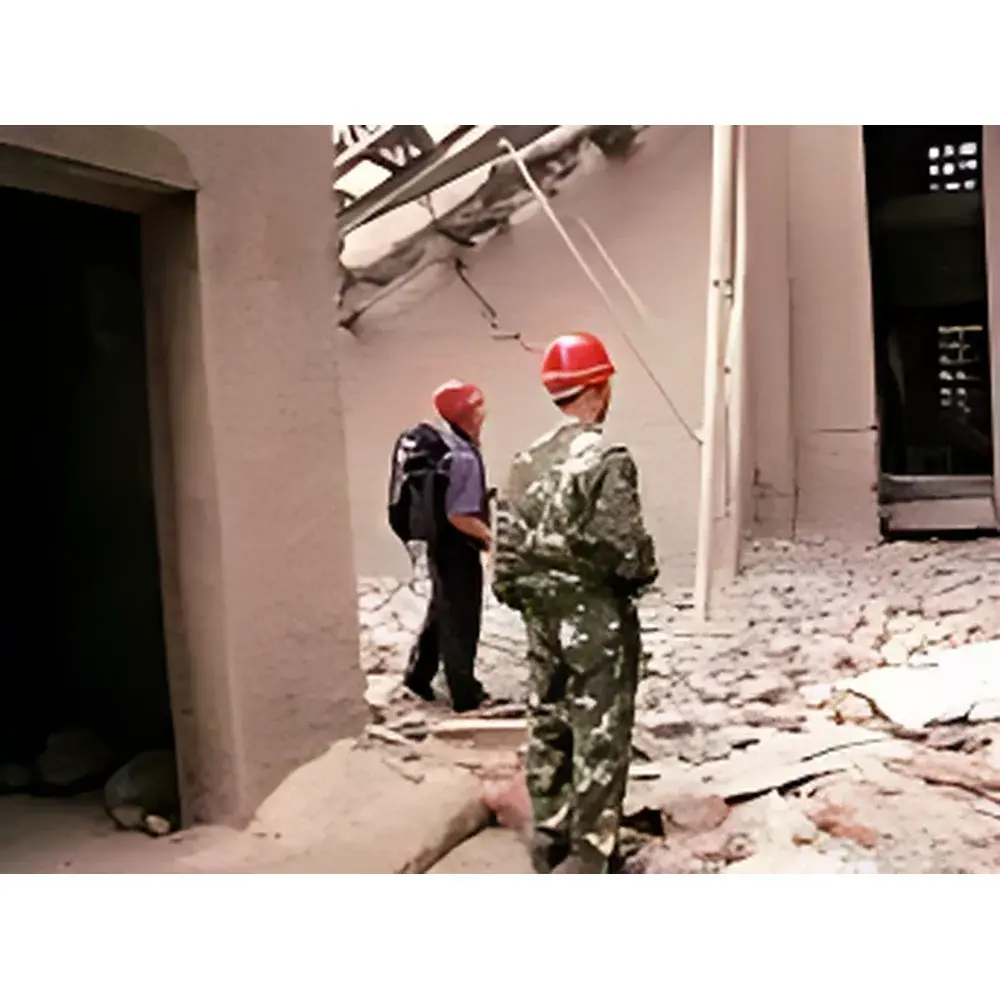
- Post-disaster radiological assessment (e.g., earthquake rubble, flood-damaged facilities) where conventional access is limited
- Perimeter screening and route surveillance during high-profile international events (e.g., Olympic Games, G20 summits)
- Regulatory verification of decommissioned sites, scrap metal yards, and recycling facilities for orphan source contamination
- Training exercises for nuclear emergency response units under realistic mobility constraints
FAQ
Does the PackEye require annual calibration by an accredited laboratory?
Yes. Thermo Fisher recommends traceable calibration against primary standards every 12 months—or after any mechanical shock exceeding 50 g—to maintain compliance with ISO/IEC 17025 and national regulatory frameworks.
Can the system distinguish between medical isotopes and industrial sources?
No. The PackEye is a dose-rate meter, not a spectrometer. It reports total gamma/neutron flux but does not perform nuclide identification. For isotopic analysis, coupling with a gamma spectrometer (e.g., RadEye B20-ER) is required.
Is GPS positioning accurate enough for source localization?
The integrated GPS module provides ≤3 m CEP (Circular Error Probable) under open-sky conditions; accuracy degrades in urban canyons or indoors. For precise source triangulation, multiple overlapping PackEye transects combined with inverse-square modeling are recommended.
What is the minimum detectable activity (MDA) for Cs-137 at 1 m?
Based on ANSI N42.33-2022 methodology and the stated 50 nSv/h sensitivity, the MDA for point-source 137Cs at 1 m is approximately 3.7 kBq (0.1 µCi), assuming 10-second integration and background-subtracted counting statistics.
How does the NBR algorithm handle elevated background near granite buildings or phosphate fertilizers?
NBR continuously adapts its baseline model using moving-window statistical analysis across both detector channels. Field tests confirm sustained specificity (>99.5%) even in regions with naturally enhanced gamma backgrounds up to 200 nSv/h above average.
Related Products







