
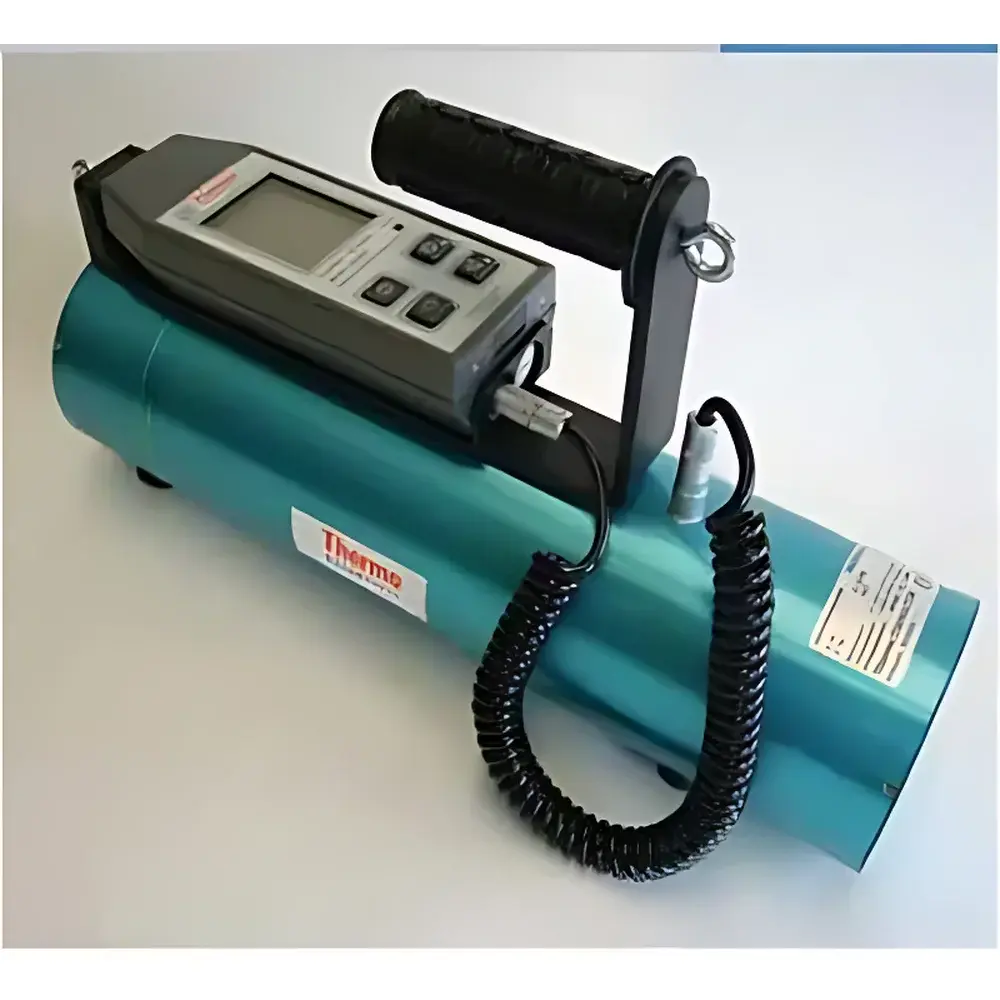
Thermo Fisher FHT 40NBR Gamma Dose Rate Meter
| Brand | Thermo Fisher |
|---|---|
| Origin | Germany |
| Manufacturer | Thermo Fisher Scientific |
| Product Type | Portable Dose Rate Meter |
| Model | FHT 40NBR |
| Detector Configuration | Dual-detector (NaI(Tl) scintillation crystal + plastic scintillator) |
| Measurement Principle | Gamma photon energy discrimination via pulse-height analysis and NBR (Natural Background Rejection) algorithm |
| Compliance | Designed for field-deployable radiological survey per IEC 60846-1:2014, ANSI N42.33, and EURATOM Directive 2013/59/Euratom |
| Data Interface | USB and Bluetooth® 4.0 |
| Storage Capacity | Up to 10,000 timestamped dose rate records |
| Operating Temperature | –10 °C to +50 °C |
| IP Rating | IP67 |
| Battery Life | >100 hours (alkaline) or >200 hours (rechargeable Li-ion) |
Overview
The Thermo Fisher FHT 40NBR Gamma Dose Rate Meter is a field-deployable, dual-scintillator radiation survey instrument engineered for high-fidelity gamma dose rate quantification in mixed-radiation environments. It employs a coupled detector architecture—comprising a thallium-doped sodium iodide [NaI(Tl)] crystal for high-resolution gamma spectroscopy and a fast-response plastic scintillator for high-count-rate capability and neutron-insensitive gamma detection. The system integrates Thermo Fisher’s proprietary Natural Background Rejection (NBR) algorithm, which performs real-time spectral subtraction of terrestrial and cosmic background contributions using adaptive energy-windowing and statistical baseline modeling. This enables robust discrimination between naturally occurring radioactive material (NORM) and anthropogenic radionuclides—such as 137Cs, 60Co, or 192Ir—without requiring pre-survey calibration against local background. The instrument operates on the principle of energy-compensated dose rate estimation derived from pulse-height distribution analysis, conforming to the fluence-to-dose conversion formalism defined in ICRP Publication 116 and implemented per IEC 60846-1:2014 requirements for portable ambient dose equivalent rate meters.
Key Features
- Dual-detector architecture: NaI(Tl) for energy-resolved identification and plastic scintillator for high-efficiency, low-energy-threshold gamma detection (≥30 keV)
- NBR (Natural Background Rejection) technology: Patented real-time background subtraction enabling artificial radionuclide detection at levels ≤1.5× natural background fluctuation
- Digital pulse processing with adaptive filtering: Automatically adjusts shaping time constants based on count rate and detector decay characteristics to maintain linearity up to 100,000 cps
- Full spectral logging capability: Stores full 1024-channel spectra with timestamps, GPS coordinates (optional), and environmental metadata (temperature, pressure)
- Ruggedized field design: IP67 ingress protection, MIL-STD-810G shock/vibration compliance, and extended operating temperature range (–10 °C to +50 °C)
- Regulatory-ready data management: Audit-trail-enabled firmware with user-access-level controls, electronic signature support, and 21 CFR Part 11–compatible export protocols
Sample Compatibility & Compliance
The FHT 40NBR is validated for direct measurement of ambient dose equivalent rate H*(10) in air across a wide energy range (30 keV to 3 MeV), with energy response deviation <±15% relative to Cs-137 reference field. It complies with international standards for portable radiation monitoring equipment including IEC 60846-1:2014 (Class II performance), ANSI N42.33-2022 (radiation portal monitor interoperability), and EU Council Directive 2013/59/Euratom Annex VIII requirements for environmental monitoring instrumentation. Its dual-detector configuration ensures reliable operation in heterogeneous fields—e.g., mixed gamma–beta contamination zones or neutron-gamma environments where plastic scintillator response remains predominantly gamma-selective. No sample preparation is required; measurements are performed in situ with no consumables or gas supply.
Software & Data Management
Data acquisition and post-processing are supported by Thermo Fisher’s RadPro Suite v4.x—a Windows-based application certified for GLP/GMP-aligned laboratories. The software enables spectral deconvolution, nuclide library matching (using IAEA NuDat 3.0 and ORTEC GammaVision libraries), dose rate trend visualization, and automated report generation compliant with ISO/IEC 17025 documentation requirements. All stored spectra and dose rate logs include cryptographic hash signatures, immutable timestamps, and operator ID tagging. Export formats include CSV (for LIMS integration), IAEA RADAR-compliant XML, and PDF reports with embedded digital signatures. Firmware updates are delivered via secure HTTPS with SHA-256 verification, and device configuration parameters are version-controlled with rollback capability.
Applications
- Environmental radiation monitoring: Long-term surveillance of nuclear facility perimeters, river sediment screening, and airborne particulate deposition studies
- Emergency response & civil protection: Rapid assessment during radiological dispersal device (RDD) incidents, nuclear power plant anomalies, or transportation accidents involving radioactive sources
- Border and port security: Mobile scanning of cargo containers, vehicles, and personnel for illicit radioactive materials under EURATOM and IAEA Code of Conduct guidelines
- Nuclear decommissioning & waste characterization: On-site verification of clearance levels, hot spot localization, and residual activity mapping in legacy facilities
- Research & education: Field-based teaching of radiation physics principles, intercomparison studies with HPGe systems, and validation of Monte Carlo simulation models (e.g., MCNP6, GEANT4)
FAQ
Does the FHT 40NBR require annual recalibration?
Yes—traceable calibration against national standards (e.g., PTB, NPL, or NIST-traceable sources) is recommended annually or after any physical impact, detector replacement, or firmware update affecting spectral processing algorithms.
Can it distinguish between 40K and 137Cs in soil samples?
Yes—the NaI(Tl) detector resolves the 1461 keV peak of 40K and the 662 keV photopeak of 137Cs with sufficient separation for quantitative deconvolution when combined with RadPro spectral fitting tools.
Is Bluetooth connectivity compatible with iOS mobile devices?
No—Bluetooth communication is limited to Windows-based PCs and Android tablets running RadPro Mobile v2.1+; iOS support is not implemented due to Apple’s CoreBluetooth restrictions on raw HID data streams.
What is the minimum detectable dose rate increment under natural background conditions?
Using NBR mode with 60-second integration, the instrument achieves a lower limit of detection (LLD) of 5 nSv/h above local background with 95% confidence (k = 2), verified per ISO 11929:2019.
Does it meet FDA 21 CFR Part 11 requirements for electronic records?
Yes—RadPro Suite implements role-based access control, electronic signatures with biometric or PKI options, audit trail archiving, and data integrity validation per FDA guidance for computerized systems in regulated environments.
Related Products







