
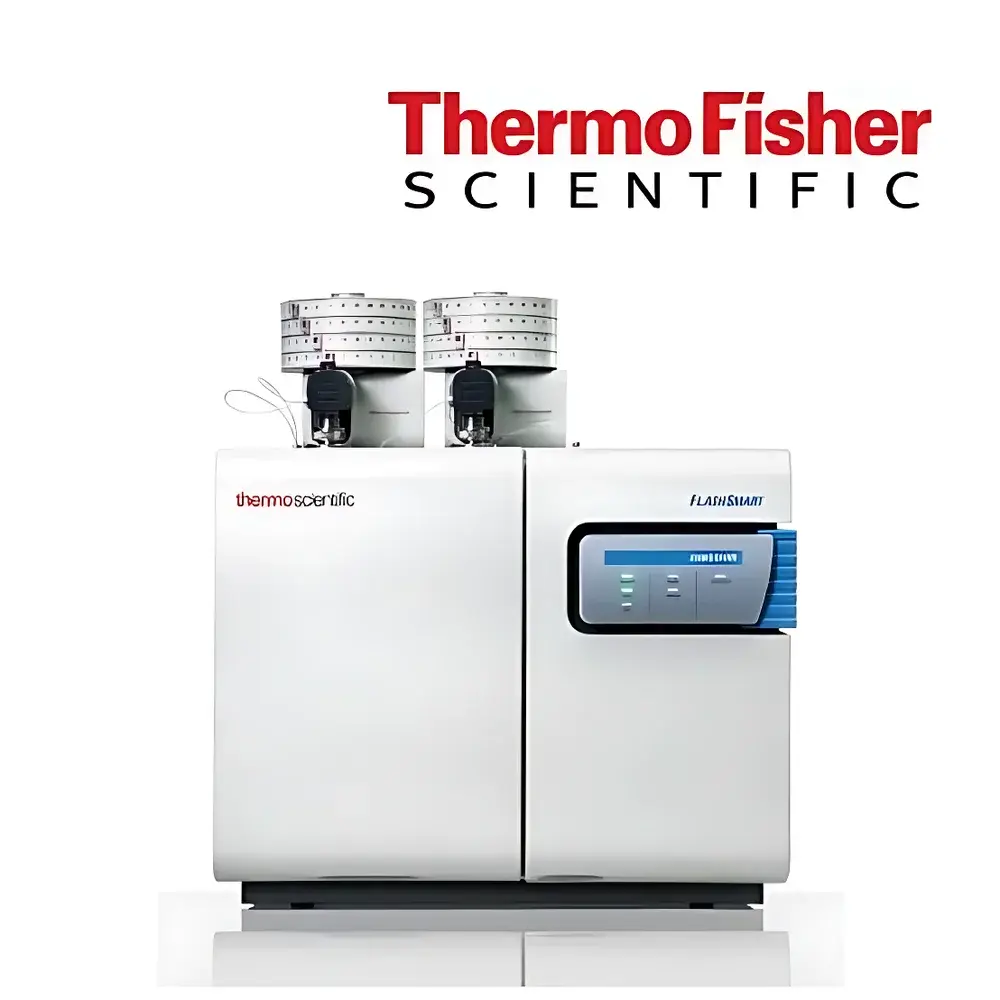
Thermo Fisher FlashSmart CHN Organic Elemental Analyzer
| Brand | Thermo Fisher |
|---|---|
| Origin | Italy |
| Model | FlashSmart CHN |
| Measurement Elements | C, H, N (expandable to CHNSO, CHNS, NCS, NC, N, S, O) |
| Analysis Time | 5–10 min (sample-weight and matrix dependent) |
| Detection Limit | <40 ppm |
| Accuracy | ≤0.05% |
| Sample Volume | up to 500 µL |
| Detectors | Thermal Conductivity Detector (TCD), Flame Photometric Detector (FPD), Infrared Detector (IR), Isotope Ratio Mass Spectrometer (IRMS) interface |
| Combustion Temperature | up to 1800 °C |
Overview
The Thermo Fisher FlashSmart CHN Organic Elemental Analyzer is a high-precision, fully automated combustion-based elemental analyzer engineered for quantitative determination of carbon (C), hydrogen (H), and nitrogen (N) in organic and organometallic samples. Building upon the legacy of Carlo Erba—pioneer of commercial elemental analysis since 1948—the FlashSmart platform integrates 80 years of thermal decomposition methodology with modern gas chromatographic separation and robust thermal conductivity detection. Unlike wet-chemical or XRF-based approaches, this instrument employs high-temperature flash combustion (up to 1800 °C) in an oxygen-rich environment, followed by catalytic reduction and selective gas-phase separation via dedicated GC columns. The resulting gaseous products—CO2, H2O, and N2—are quantified in real time using a high-stability TCD, ensuring trace-level sensitivity (<40 ppm detection limit) and analytical reproducibility (≤0.05% accuracy). Its modular architecture supports seamless expansion to CHNS, CHNSO, NCS, or single-element configurations, making it suitable for R&D, QC, and regulatory-compliant laboratories across pharmaceuticals, polymers, fuels, and environmental research.
Key Features
- True real-time analysis enabled by dedicated gas chromatography columns—no moving valves, no consumable columns, and continuous baseline stability
- “ViewPort” optical monitoring window for direct visual verification of combustion tube integrity and catalyst bed condition
- OxyTune™ intelligent oxygen dosing system: automatically adjusts oxygen injection volume based on sample mass, matrix composition, and target elements
- Integrated auto-sampler interfaced with analytical balance—automatically imports sample weight metadata into acquisition software
- Multi-detector compatibility: standard TCD; optional FPD (for sulfur), IR (for oxygen), IRMS (for isotopic ratio analysis), and chemiluminescence (CL) modules
- Full automation cycle: auto-start, auto-standby, auto-shutdown, and integrated leak detection with pressure decay validation
Sample Compatibility & Compliance
The FlashSmart CHN accommodates solid powders, pellets, films, and liquids—including viscous fuels, pharmaceutical actives, and polymer additives—with sample introduction volumes up to 500 µL. Solid samples are loaded into pre-weighed tin or silver capsules; liquid samples are introduced via micro-syringe or autosampler vial. Moisture content (for solids) and density (for liquids) are programmatically incorporated into final stoichiometric calculations. The system complies with ASTM D5291, ISO 17249, USP , and EP 2.4.12 for elemental impurity testing. Data integrity meets FDA 21 CFR Part 11 requirements through EagerSmart’s audit-trail-enabled user authentication, electronic signatures, and immutable method/version logging—fully aligned with GLP and GMP laboratory practices.
Software & Data Management
EagerSmart data acquisition and analysis software provides end-to-end workflow automation. It controls all hardware parameters—including furnace temperature ramp profiles, carrier gas flow rates (He, O2), detector settings, and autosampler sequencing—while offering context-aware method recommendation based on sample type and target elements. Users define custom report templates with embedded calculations (e.g., gross/net calorific value for fuels, CO2 emission equivalents, empirical formula derivation). Raw and processed data export seamlessly to Excel, LIMS, and Thermo Fisher’s Chromeleon CDS without manual reformatting. IRMS coupling enables dual-inlet or continuous-flow stable isotope ratio measurements (δ13C, δ15N, δ18O), with synchronized timing and metadata synchronization.
Applications
- Pharmaceutical development: API purity assessment, residual solvent screening, and elemental impurity profiling per ICH Q3D guidelines
- Fuel and lubricant characterization: carbon/hydrogen ratios, net/gross calorific value calculation, and sulfur content verification per ASTM D7169
- Academic and industrial polymer research: monomer composition, crosslink density estimation, and degradation product quantification
- Environmental analysis: TOC/TN determination in soils and sediments, carbon sequestration studies, and biochar elemental profiling
- Food and feed safety: protein content (via nitrogen-to-protein conversion), adulteration detection, and nutritional labeling compliance
FAQ
What sample types can be analyzed on the FlashSmart CHN?
Solid organic materials (e.g., pharmaceuticals, polymers, soils), liquids (e.g., fuels, solvents, oils), and volatile compounds—provided they are thermally stable below 1800 °C and do not produce corrosive halogenated gases.
Is IRMS coupling possible without hardware modification?
Yes—the FlashSmart CHN features a standardized interface port and synchronized timing electronics to integrate directly with Thermo Fisher Delta V or similar IRMS systems for compound-specific isotope analysis.
How often does the combustion catalyst require replacement?
Under routine operation with clean organic matrices, the platinum- and cobalt-based catalysts typically last >10,000 analyses; lifetime is extended by OxyTune optimization and optional quartz wool pre-filters.
Does the system support unattended overnight operation?
Yes—EagerSmart supports full batch scheduling, automatic error recovery, and email/SNMP alerts for completion or fault conditions, enabling lights-out operation for multi-day campaigns.
Can calibration be performed using certified reference materials only?
Yes—calibration is traceable to NIST SRMs (e.g., BBOT, sulfanilamide, acetanilide); multi-point linear regression and drift correction algorithms ensure long-term measurement stability across instrument lifetime.




