
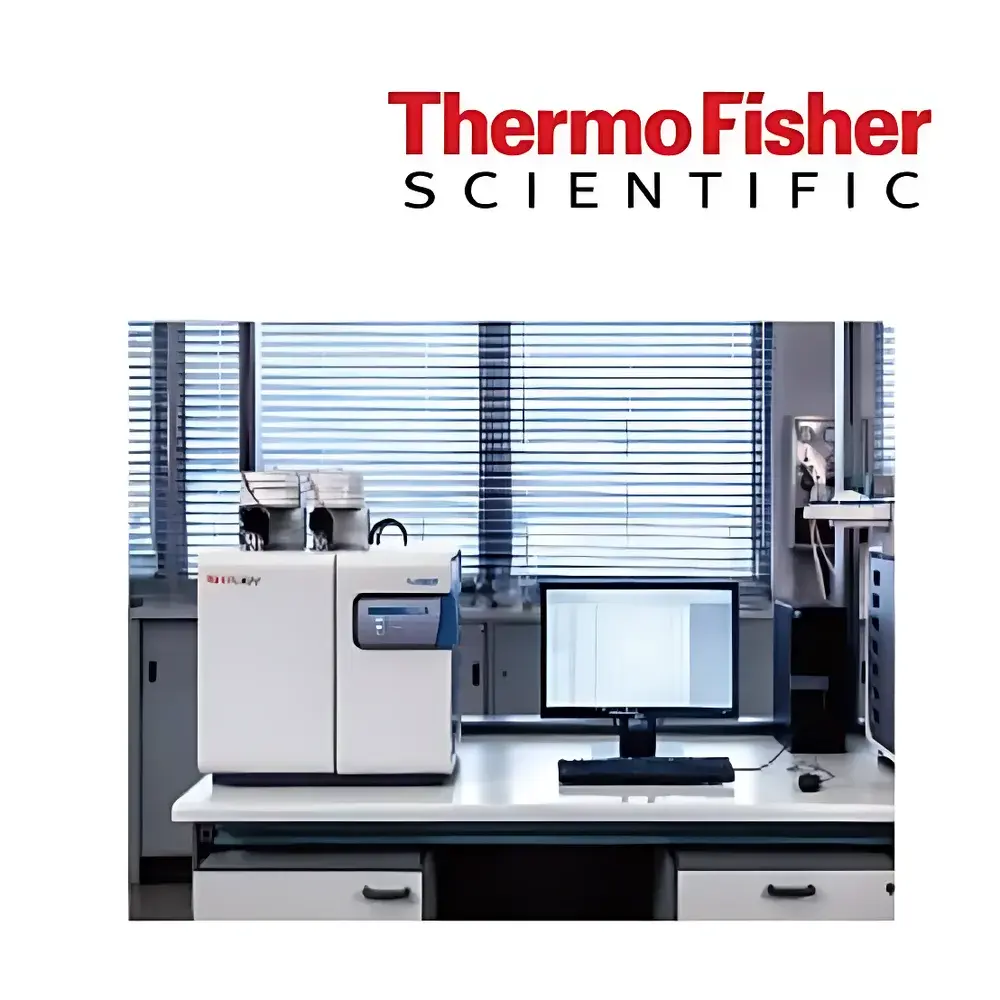
Thermo Fisher FlashSmart CN/CNS Elemental Analyzer
| Brand | Thermo Fisher |
|---|---|
| Origin | Italy |
| Model | FlashSmart CN/CNS |
| Detection Principle | Dynamic Flash Combustion coupled with Gas Chromatographic Separation |
| Detector Options | TCD (standard), optional chemiluminescence or IR detectors |
| Combustion Temperature | up to 1800 °C (Sn capsule mode) |
| Warranty | 15 years on combustion furnace and TCD detector |
| Automation | Fully software-controlled oxygen injection, sample weighing, and combustion timing |
| Compliance | Designed for GLP/GMP environments |
| Carrier Gas Options | Helium (standard), Argon (cost-optimized alternative) |
| Modular Configurations | Upgradable to CHNS, CHN, NC, NCS, N, S, O modes |
| Sample Types | Solids (soils, sediments, biomass, coal, polymers), liquids (oils, extracts, aqueous solutions), and heterogeneous matrices |
| Throughput | Up to 120 samples/day with dual autosamplers (solid + liquid) |
| Software Platform | EagerQ™ v3.2 with method templates, calibration wizards, and raw data export (CSV, XML, PDF) |
Overview
The Thermo Fisher FlashSmart CN/CNS Elemental Analyzer is a high-precision, research-grade combustion-based instrument engineered for quantitative determination of carbon (C), nitrogen (N), and sulfur (S) in organic and inorganic solid and liquid matrices. It implements Thermo Fisher’s proprietary Flash Combustion technology—originating from the legacy Carlo Erba platform first commercialized in 1948—combined with real-time gas chromatographic separation and thermal conductivity detection (TCD). This architecture ensures complete oxidation of refractory samples (e.g., lignin-rich plant tissues, charred sediments, or high-sulfur coals) under dynamically optimized oxygen flow conditions. The system operates at peak combustion temperatures up to 1800 °C using tin (Sn) capsules, enabling stoichiometric conversion of C → CO₂, N → N₂, and S → SO₂ without catalyst poisoning or incomplete decomposition. Its design adheres to fundamental principles of quantitative elemental analysis as defined in ASTM D5291, ISO 14852, and USP , supporting trace-level accuracy (RSD < 0.5% for homogeneous standards) and long-term measurement stability.
Key Features
- Dynamic Flash Combustion Engine: Real-time optimization of oxygen dosage based on sample mass, composition, and ignition profile—minimizing residual carbon and ensuring full oxidation even for thermally stable materials.
- Modular Detection Architecture: Standard TCD detector with 15-year warranty; optional upgrade paths to chemiluminescence (for ultra-trace N/S) or infrared (for selective SO₂ quantification) detection modules.
- Dual-Autosampler Compatibility: Simultaneous integration of solid-sample carousel (up to 112 positions) and liquid autosampler (up to 60 vials), enabling unattended analysis of heterogeneous sample sets across environmental, agricultural, and petrochemical workflows.
- High-Temperature Combustion Furnace: Ceramic-heated furnace with Sn-capsule capability up to 1800 °C, backed by a 15-year limited warranty—reflecting robust thermal design and material longevity.
- Carrier Gas Flexibility: Supports helium (primary carrier) and argon (low-cost alternative) without performance compromise, reducing operational cost per analysis by up to 40%.
- Software-Controlled Method Development: EagerQ™ v3.2 provides guided calibration routines, multi-point standardization, drift correction algorithms, and compliance-ready reporting templates aligned with ISO/IEC 17025 documentation requirements.
Sample Compatibility & Compliance
The FlashSmart CN/CNS accommodates a broad spectrum of environmentally and industrially relevant matrices—including soils, sediments, sludges, biochars, fertilizers, tobacco leaves, algae, wood chips, wastewater solids, and polymer additives—without derivatization or pre-treatment. Its combustion efficiency exceeds 99.9% for certified reference materials (CRMs) such as NIST SRM 1646a (estuarine sediment) and LECO 502–304 (coal). The system complies with international regulatory frameworks: it meets ASTM D5291 (C/N in petroleum products), ISO 14852 (biodegradability testing), and EPA Method 525.3 (organic carbon in drinking water). Full 21 CFR Part 11 readiness is enabled via user role management, electronic signature capture, and immutable audit trails—ensuring suitability for GLP-certified labs and pharmaceutical QC environments.
Software & Data Management
EagerQ™ v3.2 serves as the central analytical interface, integrating instrument control, data acquisition, and post-processing within a single validated environment. It features automated peak integration with baseline correction, internal standard normalization (e.g., benzoic acid for C calibration), and batch-wise report generation compliant with ISO/IEC 17025 clause 7.8. Raw chromatograms, calibration curves, and metadata (operator ID, timestamp, instrument state) are stored in encrypted SQLite databases with configurable backup intervals. Export options include CSV (for LIMS ingestion), XML (for ELN integration), and PDF (for audit submission). All software updates undergo version-controlled validation packages per GAMP 5 guidelines.
Applications
This analyzer is routinely deployed in environmental monitoring laboratories assessing total organic carbon (TOC) and total Kjeldahl nitrogen (TKN) equivalence in soils and sediments; in agricultural R&D quantifying nitrogen use efficiency in crop residues; in energy research evaluating sulfur content in biofuels and coal derivatives; and in materials science characterizing heteroatom doping in carbon nanomaterials. Its ability to handle complex, variable-composition samples—such as municipal solid waste leachates or algal bloom biomass—makes it indispensable for circular economy studies and regulatory compliance testing.
FAQ
What sample forms can be analyzed on the FlashSmart CN/CNS?
Solid powders, granules, filter papers, and homogenized biological tissues (via Sn or Ag capsules); liquids including oils, aqueous extracts, and digested samples (using quartz boats or liquid autosampler vials).
Is method validation support available?
Yes—Thermo Fisher provides IQ/OQ/PQ protocols, CRM compatibility reports, and application notes aligned with ASTM, ISO, and EPA methods.
Can the system be upgraded from CN to CNS or CHNS configuration later?
Yes—the hardware platform is natively modular; adding sulfur detection or oxygen modules requires only field-installable components and software license activation.
How does the system ensure long-term calibration stability?
Through continuous baseline monitoring, automatic zero-point correction, and scheduled recalibration triggers based on cumulative run time and peak area deviation thresholds.
What maintenance intervals are recommended?
Combustion tube replacement every 2,000–3,000 injections; CO₂/H₂O scrubber cartridges every 100–150 runs; annual preventive maintenance by certified service engineers.





