
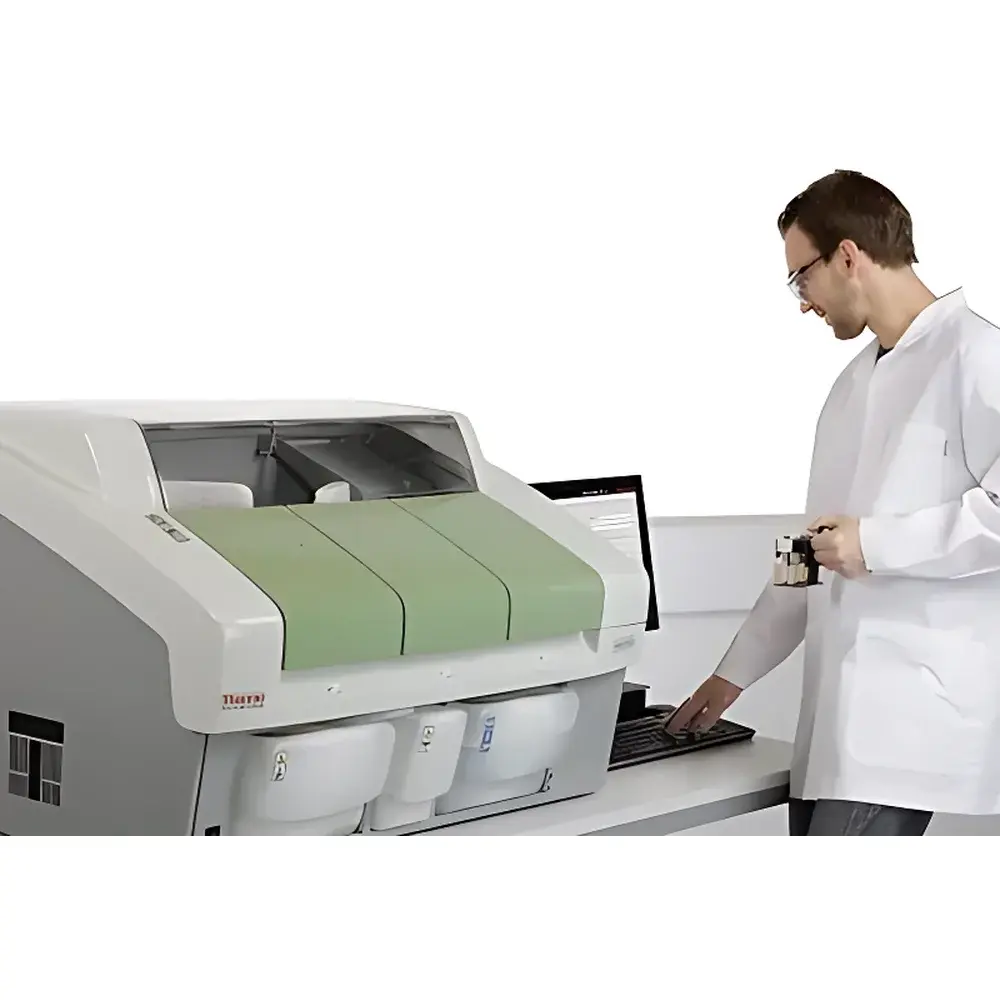
Thermo Fisher Gallery Plus Automated Discrete Analyzer
| Brand | Thermo Fisher |
|---|---|
| Origin | Finland |
| Manufacturer | Thermo Fisher Scientific |
| Product Type | Imported Laboratory Water Quality Analyzer |
| Model | Gallery Plus |
| Instrument Category | Benchtop Discrete Analyzer |
| Detection Principles | Photometric (Colorimetric), Enzymatic, and Electrochemical (ISE-based) |
| Sample Throughput | Up to 350 tests/hour |
| Wavelength Range | 275–880 nm (12 fixed-position interference filters) |
| Sample Capacity | 54 positions |
| Refrigerated Reagent Capacity | 42 positions |
| Reaction Vessel Format | 10-cell cuvette strips (up to 18 × 2 strips = 360 tests) |
| Incubation | Adjustable temperature incubation block (9 lanes × 10 positions = 90 test slots) |
| Electrochemical Module (ECM) | Integrated ISE-based pH and conductivity measurement |
| Sample Handling | Dual independent probes (sample + reagent), dedicated wash station, barcode reader |
| Dilution Capability | Onboard primary and secondary auto-dilution |
| Power & Utility | <2.5 L/h water consumption |
| Software Compliance | Audit-trail enabled, user-access control, electronic signature support per FDA 21 CFR Part 11 |
| Regulatory Alignment | Designed to support ISO/IEC 17025, ASTM D1293 (pH), ASTM D1125 (conductivity), EPA 365.3 (phosphate), USP <731>, and GLP/GMP workflows |
Overview
The Thermo Fisher Gallery Plus Automated Discrete Analyzer is a benchtop, modular discrete analyzer engineered for high-precision, multi-chemistry quantification in environmental, food, beverage, and industrial quality control laboratories. It operates on the discrete analysis principle—where individual samples and reagents are precisely metered into dedicated reaction vessels, thermally incubated under controlled conditions, and optically or electrochemically measured—ensuring superior reproducibility, minimal cross-contamination, and full traceability compared to continuous-flow systems. Unlike segmented-flow or flow-injection analyzers, the Gallery Plus isolates each test within physically separate cuvettes, enabling simultaneous heterogeneous assay types (e.g., colorimetric nitrate, enzymatic glucose, and ISE-based pH) without method interference. Its architecture supports routine compliance testing across regulated environments, including wastewater discharge monitoring (EPA Method 365.3), drinking water quality assessment (ISO 10523, ISO 7888), and environmental matrix analysis (soil leachates, surface water, groundwater).
Key Features
- Triple-detection platform integrating photometric (275–880 nm, 12 fixed filters), enzymatic, and electrochemical (ISE-based) measurement modalities in a single instrument
- Modular electrochemical module (ECM) for concurrent, real-time pH and conductivity determination—eliminating need for standalone meters and reducing sample handling errors
- High-throughput capacity: up to 350 tests per hour with 54-sample carousel and 42-position refrigerated reagent deck
- Flexible incubation system: 9-lane heated incubation block with programmable temperature (ambient to 50 °C) and customizable reaction timing (0–99 minutes)
- Dual independent liquid handling: separate sample and reagent probes with integrated wash station and tip rinsing protocol to prevent carryover
- Onboard dilution engine supporting both primary and secondary automated dilutions—critical for out-of-range environmental samples requiring linear range extension
- Barcode-enabled sample tracking with built-in reader; supports LIMS integration via ASTM E1384-compliant data export
- Open-system design: users define custom methods, reagent formulations, calibration curves, and QC rules via intuitive software interface
- Self-contained utility operation: internal 5-L water reservoir; total consumptive water usage <2.5 L/h—ideal for labs lacking permanent plumbing infrastructure
Sample Compatibility & Compliance
The Gallery Plus accommodates aqueous matrices including raw and treated drinking water, wastewater effluents, surface and groundwater, soil extracts, digested sludge supernatants, and industrial process streams. Its discrete cuvette format ensures compatibility with turbid, particulate-laden, or viscous samples that would clog capillary-based systems. The analyzer meets performance criteria outlined in ISO 17025-accredited testing protocols and supports regulatory reporting under EU Directive 2000/60/EC (Water Framework Directive), US EPA Clean Water Act methods (e.g., 365.3 for orthophosphate, 353.2 for nitrate/nitrite), and ASTM standards for conductivity (D1125) and pH (D1293). All electrochemical measurements comply with ISE performance guidelines per IUPAC recommendations. Data integrity safeguards—including electronic signatures, audit trails, and role-based access control—align with FDA 21 CFR Part 11 and EU Annex 11 requirements for regulated laboratories.
Software & Data Management
The Gallery Plus runs on Thermo Fisher’s proprietary Gallery Software Suite, a Windows-based application designed for method development, instrument control, and result validation. It provides full method lifecycle management: from assay configuration (wavelength selection, incubation profile, reagent addition sequence) to calibration curve fitting (linear, quadratic, log-log), QC flagging (Westgard rules), and outlier detection. Raw absorbance, mV, and conductivity values are stored with timestamp, operator ID, and environmental metadata (e.g., incubation temperature, dilution factor). Export formats include CSV, PDF reports, and XML compliant with ASTM E1384 and HL7 standards. The software maintains a tamper-evident audit trail recording all user actions, parameter changes, and calibration events—essential for GLP audits and ISO/IEC 17025 documentation.
Applications
- Environmental monitoring: nutrient profiling (NH₄⁺, NO₃⁻, PO₄³⁻, SiO₂), hardness (Ca²⁺/Mg²⁺), alkalinity, chloride, sulfate, fluoride, cyanide, phenol, and COD surrogates
- Drinking water compliance: residual chlorine (DPD), total organic carbon (TOC) surrogates, iron/manganese speciation, and disinfection by-product precursors
- Wastewater treatment: influent/effluent nutrient load tracking, nitrification/denitrification process control, and sludge digestion monitoring
- Soil and sediment analysis: extractable anions/cations, salinity index, and leachate toxicity screening
- Industrial QA/QC: boiler feedwater chemistry, cooling tower biocide residuals, and process rinse water purity verification
FAQ
Does the Gallery Plus require permanent plumbing or drain connection?
No—it operates using an internal 5-liter water reservoir and consumes less than 2.5 L/h, making it suitable for mobile labs or facilities with limited utility infrastructure.
Can I run non-Thermo reagents or develop in-house methods?
Yes—the system is fully open; users may import custom reagent definitions, configure multi-step protocols, and validate alternative chemistries without vendor lock-in.
How is calibration and QC managed across multiple assays?
Each method stores its own calibration curve and QC acceptance criteria; the software enforces scheduled recalibration, drift correction, and automatic retesting of flagged samples.
Is the electrochemical module (ECM) validated for regulatory reporting?
Yes—ISE-based pH and conductivity measurements follow IUPAC-recommended electrode calibration procedures and meet ASTM D1293/D1125 accuracy specifications for environmental reporting.
What level of IT security and data governance does the software provide?
Gallery Software supports 21 CFR Part 11 compliance: electronic signatures, password policies, session timeouts, and immutable audit logs with cryptographic hashing of critical events.







