
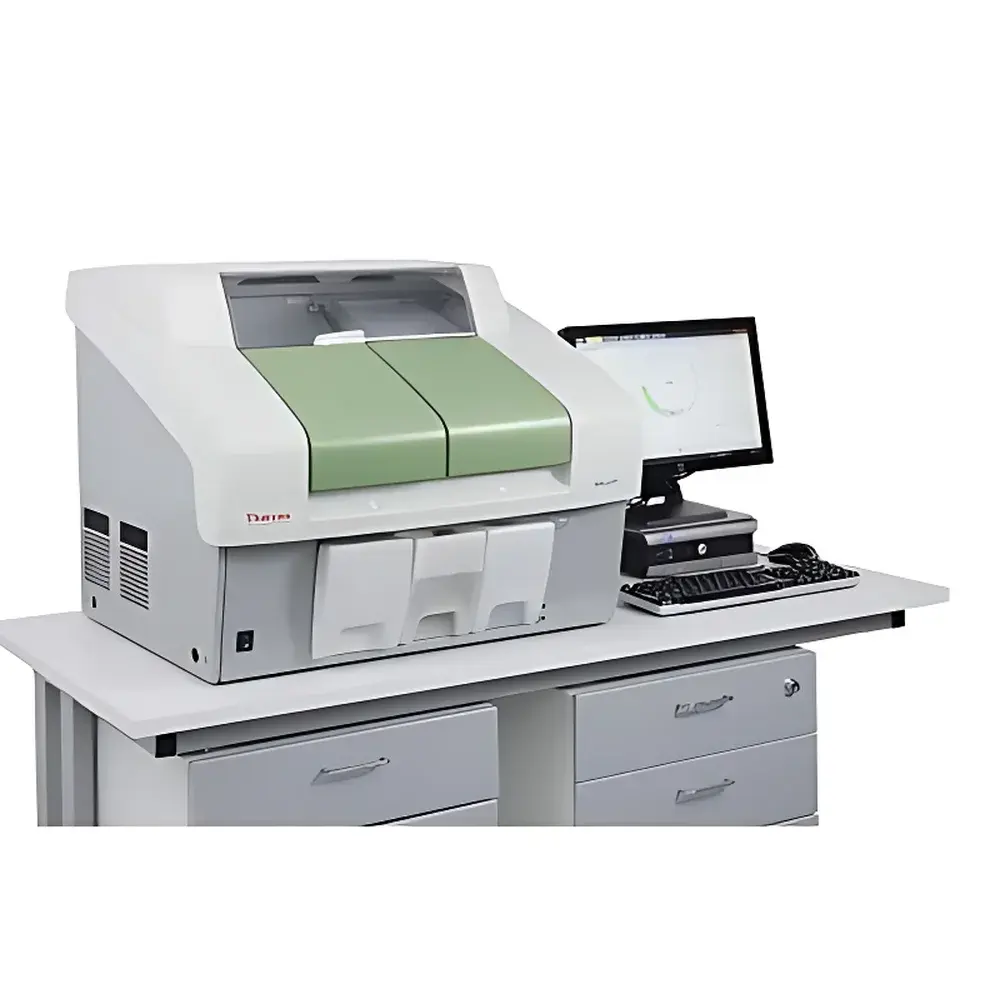
Thermo Fisher Gallery Automated Water Quality Analyzer
| Brand | Thermo Fisher |
|---|---|
| Origin | Finland |
| Manufacturer | Thermo Fisher Scientific |
| Product Type | Imported Laboratory Water Quality Analyzer |
| Model | Gallery |
| Instrument Category | Benchtop Automated Discrete Analyzer |
| Detection Methods | Photometric (275–880 nm, 12 fixed filters), Enzymatic, Electrochemical (ISE-based pH & Conductivity) |
| Throughput | Up to 200 tests/hour |
| Sample Capacity | 9-position rack × 2 = 18 racks (162 samples) |
| reagent capacity | 6 positions × 9 slots = 54 reagent positions |
| Cuvette Format | Disposable 10-cell flexible strip cuvettes |
| Incubation | Temperature-controlled incubation disc, programmable reaction time |
| Automation Features | Integrated barcode reader, auto-dilution (primary & secondary), on-board washing station, refrigerated sample/reagent carousel |
| Power/Water | <1.5 L/h water consumption |
| Regulatory Compliance | Designed for GLP/GMP environments |
Overview
The Thermo Fisher Gallery Automated Water Quality Analyzer is a benchtop discrete analyzer engineered for high-precision, fully automated photometric, enzymatic, and electrochemical analysis of water and environmental matrices. Leveraging proven discrete analysis architecture—derived from the legacy Arena and Aquakem platforms—the Gallery system applies controlled, isolated reactions in disposable 10-cell flexible strip cuvettes, eliminating carryover and ensuring analytical integrity across diverse sample types. Its core measurement principle combines spectrophotometric detection (275–880 nm, 12 fixed-wavelength filters) with enzymatic kinetics and ion-selective electrode (ISE)-based potentiometry for simultaneous pH and conductivity determination. This multi-modal architecture enables method flexibility without compromising reproducibility, making it suitable for routine compliance monitoring (e.g., EPA, ISO 7027, ISO 15704), research-grade environmental profiling, and cross-sector QC applications—from municipal wastewater to industrial effluent and natural surface waters.
Key Features
- Benchtop footprint with integrated refrigerated sample and reagent carousel (6 positions × 9 slots each), supporting unattended operation for up to two hours with full 360-test capacity (18 × 2 × 10-cuvette strips).
- Discrete analysis workflow using proprietary flexible 10-cell strip cuvettes—designed for precise alignment within the circular incubation disc—ensuring zero cross-contamination and consistent optical path length.
- Dual-mode detection: Photometric quantification across 12 fixed wavelengths (275–880 nm) combined with optional Electrochemical Module (ECM) for real-time, non-contact pH and conductivity measurement in parallel with colorimetric assays.
- Programmable incubation temperature and reaction kinetics, enabling optimization for enzyme-based methods (e.g., nitrate reductase, phosphatase) and standard colorimetric protocols (e.g., Nesslerization, phenol red, DPD).
- On-board liquid handling with independent stirring rods per reaction, integrated wash station, and auto-dilution capability (primary and secondary dilution) for dynamic range extension without manual intervention.
- Barcode-enabled sample tracking via built-in reader; real-time reagent level monitoring; “ready-to-use” kit compatibility—including Thermo Fisher Arena/Aquakem assay kits and validated third-party or in-house prepared reagents.
Sample Compatibility & Compliance
The Gallery system accepts raw, filtered, digested, or preserved aqueous samples—including drinking water, wastewater, leachates, soil extracts, and process streams—without pre-treatment in most cases. It complies with international standard methods including ISO 6060 (COD), ISO 15704 (phosphate), ISO 10304-1 (anions), ASTM D129 (sulfate), and EPA 365.2/365.3 (phosphorus). Its modular design supports regulatory readiness: when deployed with Thermo Fisher’s QIA software, the system provides full 21 CFR Part 11 compliance—including electronic signatures, audit trails, user access controls, and data integrity safeguards—meeting GLP, GMP, and ISO/IEC 17025 laboratory accreditation requirements.
Software & Data Management
Gallery operates under Thermo Fisher’s intuitive QIA (Quality Intelligence Analytics) software platform—a Windows-based interface designed for method development, validation, and routine operation. Users define custom protocols via drag-and-drop assay sequencing, set calibration curves (linear, quadratic, spline), configure dilution logic, and assign QC rules (Westgard, user-defined limits). All instrument logs, raw absorbance values, derivative calculations, and ISE voltage outputs are stored in an encrypted SQL database with timestamped metadata. Export options include CSV, PDF reports, and LIMS-compatible HL7/ASTM E1384 messaging. Software updates and method libraries are distributed through Thermo Fisher’s secure customer portal, ensuring traceability and version control.
Applications
- Regulatory water testing: Total phosphorus, orthophosphate, nitrate/nitrite, ammonia, chloride, sulfate, hardness, alkalinity, COD, BOD surrogates, fluoride, cyanide, and residual chlorine.
- Environmental research: Nutrient cycling studies, sediment porewater analysis, wetland biogeochemistry, and microplastic-associated leachate characterization.
- Industrial hygiene & process control: Boiler feedwater, cooling tower chemistry, semiconductor ultrapure water monitoring, and pharmaceutical water systems (PW, WFI per USP & EP).
- Cross-sector adaptability: Beverage QC (sugar, organic acids), food safety (nitrite in cured meats), and agricultural runoff screening (nitrates, phosphates, pesticides via derivatization).
FAQ
Is the Gallery system compatible with existing Arena or Aquakem methods and reagents?
Yes—Gallery maintains full method equivalence with Thermo Fisher’s Arena and Aquakem platforms. All validated Arena enzymatic assays and Aquakem colorimetric kits are directly transferable, including calibration curves, reaction times, and filter selections.
Can third-party or in-house reagents be used?
Yes—Gallery is an open-system platform. Users may load custom reagents, define new analytes, and program proprietary reaction protocols without vendor lock-in.
What maintenance is required for long-term reliability?
Routine maintenance includes monthly cleaning of the cuvette disc, stirrer arms, and wash station; quarterly verification of photometer linearity and ISE electrode calibration; and annual preventive service by Thermo Fisher Field Service Engineers.
Does Gallery support remote monitoring or integration with enterprise LIMS?
Yes—via QIA software’s configurable export modules and optional Thermo Fisher Connect cloud services, enabling real-time status alerts, instrument diagnostics, and bidirectional LIMS data exchange.
How is data integrity ensured during audit inspections?
With QIA software enabled, Gallery generates immutable audit trails for all user actions, method changes, calibration events, and result modifications—fully compliant with FDA 21 CFR Part 11 and EU Annex 11 requirements.







