
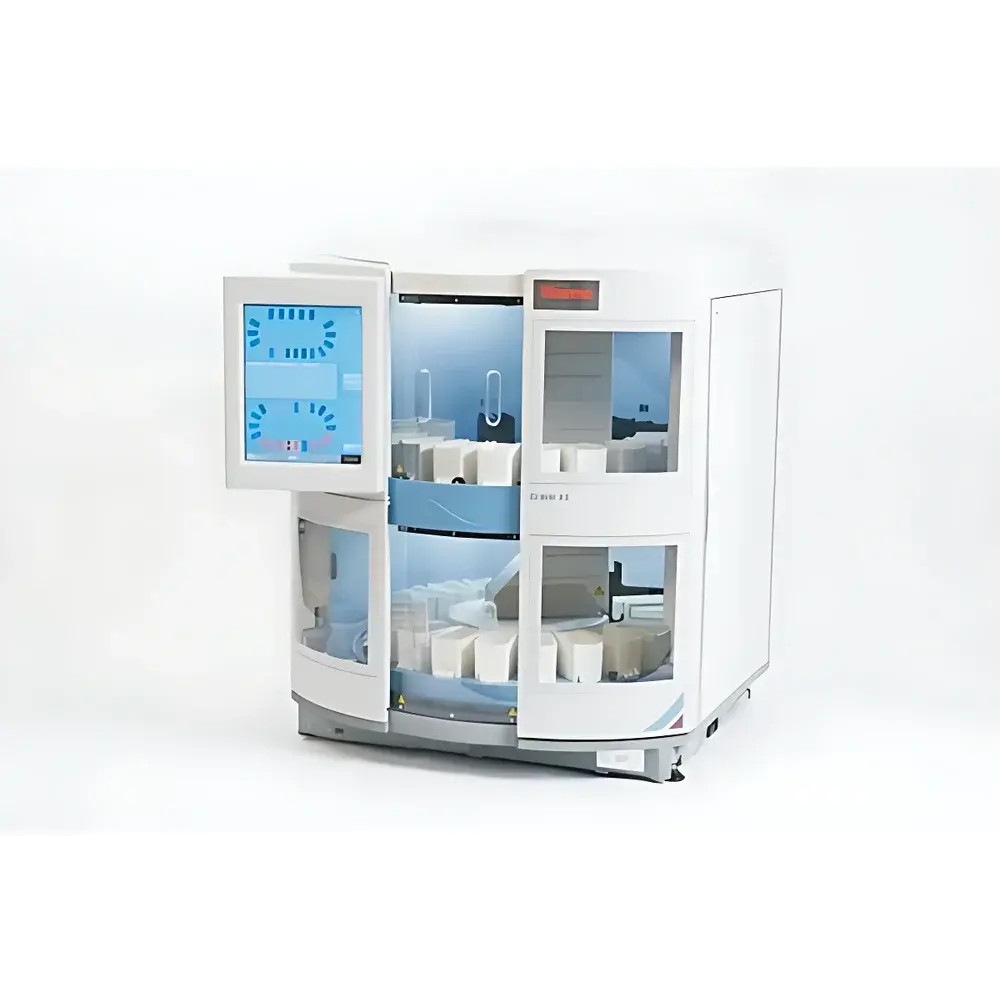
Thermo Fisher Gemini AS Fully Automated Rotary Tissue Staining System
| Brand | Thermo Fisher |
|---|---|
| Origin | United Kingdom |
| Model | Gemini AS |
| Automation Level | Fully Automatic |
| Instrument Type | Rotary Stainer |
| Heating Stations | 5 independent |
| Reagent Positions | 26 or 31 |
| Water Stations | 4 |
| Slide Capacity per Rack | Standard (compatible with standard histology slide racks) |
| Emergency STAT Processing | Yes, priority queueing for urgent cases (e.g., Mohs surgery) |
| Backup Power | 40-minute battery runtime |
| Compliance Features | Integrated fume management, anti-siphon valves, flow regulators, locked slide baskets, password-protected protocol editing |
| Software | Scheduler™ with editable protocols, preloaded Thermo Scientific Signature™ stain protocols |
| Connectivity | USB for protocol/log export |
| Footprint | Compact dual-level design with integrated touchscreen and power supply |
| Safety | Activated carbon filtration or vent adapter kit optional |
| Door Configuration | 4 configurable access doors |
Overview
The Thermo Fisher Gemini AS Fully Automated Rotary Tissue Staining System is an engineered solution for high-volume histopathology laboratories requiring reproducible, regulatory-compliant hematoxylin and eosin (H&E), special stain, and immunohistochemistry (IHC) processing. Utilizing a precision-engineered rotary motion platform, the system immerses tissue sections on glass slides in reagent baths via controlled orbital agitation—ensuring uniform reagent contact, minimized carryover, and consistent staining kinetics across all slides in a batch. Its compact dual-level architecture integrates the control interface, power supply, and fluid handling subsystems into a single footprint, enabling deployment adjacent to microtomy stations to streamline specimen-to-stain workflow. Designed for GLP- and CAP-accredited environments, the Gemini AS supports traceable, auditable operations through built-in event logging, user authentication, and electronic protocol versioning.
Key Features
- Fully automated rotary staining platform with programmable agitation speed, dwell time, and temperature profiles per step
- Integrated 7-inch full-color touchscreen interface with intuitive icon-driven navigation—no specialized training required
- Dual-level mechanical layout reduces benchtop footprint by up to 35% versus conventional floor-standing stainers
- Five independently controllable heating stations eliminate need for external drying ovens; each maintains ±0.5 °C stability across 30–70 °C range
- STAT prioritization logic enables real-time insertion and accelerated processing of urgent slide racks (e.g., intraoperative Mohs specimens) without interrupting ongoing runs
- Four configurable access doors support ergonomic loading/unloading in right- or left-handed lab configurations
- Reagent monitoring via capacitive level sensing and touch-screen status display; 26- or 31-position reagent carousel accommodates multi-step IHC panels without manual reagent swaps
- Onboard 40-minute uninterruptible power supply ensures completion of active staining cycles during brief outages
- Comprehensive safety architecture: lockable slide baskets with inverted retention clips, anti-siphon water inlet valves, flow-regulated waste drainage, and optional activated carbon fume filtration
Sample Compatibility & Compliance
The Gemini AS processes standard 1″ × 3″ (25 × 75 mm) glass microscope slides mounted with paraffin-embedded or frozen tissue sections. It supports all major aqueous- and alcohol-based histological reagents—including hematoxylin variants, eosin Y, Scott’s tap water substitute, lithium carbonate bluing solutions, and commercial IHC detection kits. The system complies with ISO 13485:2016 requirements for in vitro diagnostic medical device manufacturing environments and meets essential safety provisions of IEC 61010-1. Its software architecture supports 21 CFR Part 11 compliance when deployed with networked audit trail servers, including electronic signatures, protocol change history, and user-level access controls. Pre-validated staining protocols for Thermo Scientific Signature™ reagent series are embedded and fully editable to meet laboratory-specific validation requirements under CAP Checklist ANP.40310 and CLIA §493.1253.
Software & Data Management
Scheduler™ software provides centralized control of staining workflows via a Windows-based desktop application or direct onboard touchscreen operation. Users define multi-rack schedules with staggered start times, overlapping protocols, and dynamic resource allocation across shared reagent baths and heating zones. All protocols are stored with metadata (author, timestamp, revision number) and support version rollback. Event logs—including reagent usage, temperature deviations, door open/close events, and STAT overrides—are exportable via USB in CSV format for LIMS integration or internal QA review. Password protection secures custom protocol libraries, while role-based permissions restrict editing rights to designated supervisors. Firmware updates are delivered via secure HTTPS download and validated checksum verification prior to installation.
Applications
The Gemini AS is routinely deployed in academic medical centers, reference pathology labs, and pharmaceutical clinical trial support facilities for routine H&E staining, trichrome and PAS special stains, and multiplex IHC workflows requiring thermal stabilization. Its STAT capability is clinically validated for rapid frozen section turnaround in dermatologic oncology (Mohs micrographic surgery) and neurosurgical intraoperative consultation. The system’s reagent flexibility and precise thermal control also support emerging applications such as antigen retrieval optimization, pH-sensitive chromogen development, and standardized digital pathology slide preparation for AI algorithm training datasets.
FAQ
What types of histological stains can the Gemini AS perform?
It supports routine H&E, common special stains (e.g., Masson’s trichrome, Alcian blue, von Kossa), and immunohistochemical detection protocols using polymer- or enzyme-conjugated systems.
Does the system require external ventilation or ducting?
No—integrated activated carbon filtration handles low-level organic vapors; optional vent adapter kit enables connection to facility exhaust if local regulations mandate ducted removal.
Can multiple staining protocols run simultaneously?
Yes—Scheduler™ software allocates resources dynamically to enable concurrent processing of up to 12 slide racks with differing protocols, maintaining throughput within 10% of single-protocol performance.
Is remote monitoring or troubleshooting supported?
While the Gemini AS lacks native Ethernet connectivity, USB-exported logs and protocol files facilitate offline technical review; remote diagnostics require on-site service engineer access via secure VPN-assisted screen sharing.
How is reagent cross-contamination prevented between cycles?
The system employs sequential rinse steps with deionized water, programmable air-dry intervals, and physical separation of reagent baths by dedicated rotor positioning—validated per ASTM E2915-13 guidelines for residual carryover assessment.






