
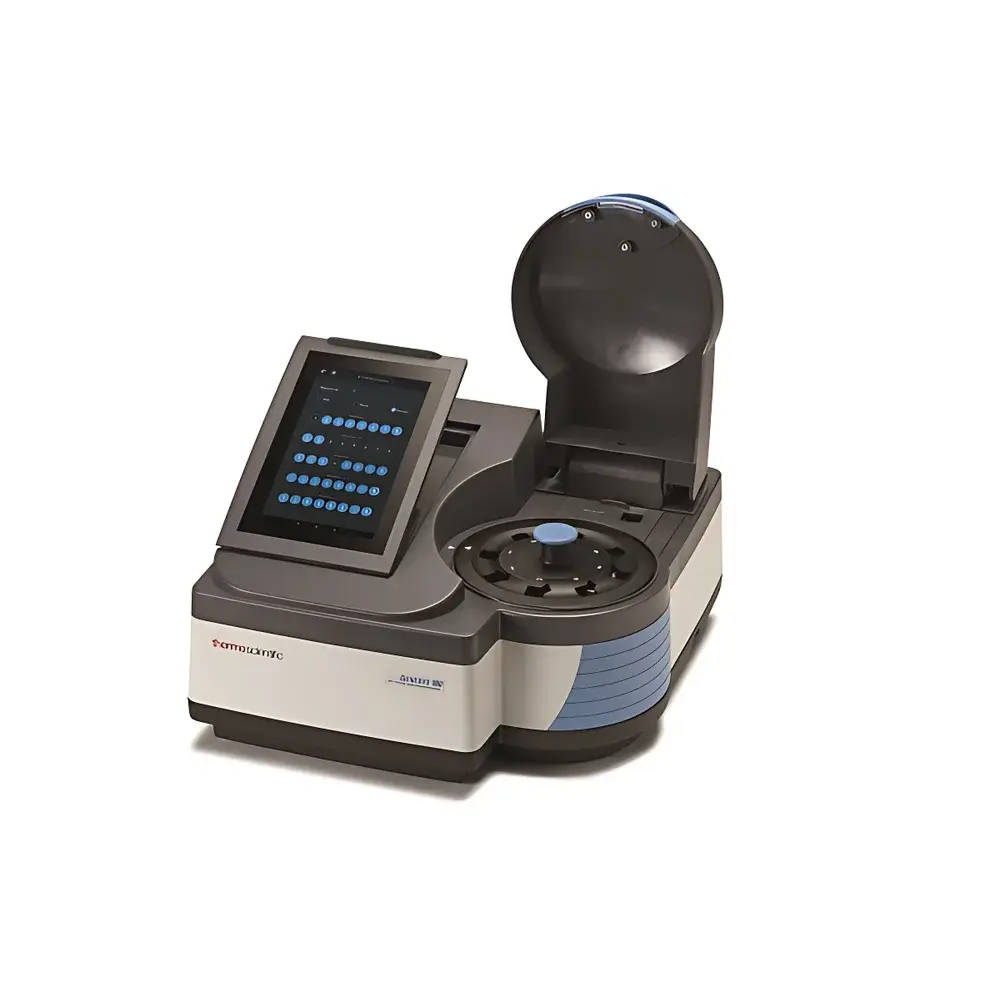
Thermo Fisher GENESYS 180 Ultraviolet-Visible Spectrophotometer
| Brand | Thermo Fisher |
|---|---|
| Origin | USA |
| Manufacturer | Thermo Fisher Scientific |
| Instrument Type | Imported |
| Model | GENESYS 180 |
| Optical Design | Double-beam |
| Detector | Photodiode Array (PDA) |
| Wavelength Range | 190–1100 nm |
| Wavelength Selection | Manual |
| Spectral Bandwidth | 2 nm |
| Wavelength Accuracy | ±0.5 nm |
| Stray Light | <1.0%T at 198 nm (KCl), <0.05%T at 220 nm (NaI), <0.03%T at 340 nm (NaNO₂) |
Overview
The Thermo Fisher GENESYS 180 Ultraviolet-Visible Spectrophotometer is a precision double-beam optical instrument engineered for routine and research-grade quantitative and qualitative analysis in academic, pharmaceutical, clinical, and industrial laboratories. It operates on the fundamental principle of Beer–Lambert law-based absorbance measurement, where sample and reference beams are simultaneously directed through separate optical paths—enabling real-time compensation for source intensity drift, lamp aging, and environmental fluctuations. The system employs a flash-type xenon lamp that activates only during measurement cycles, significantly extending operational lifetime to up to five years while eliminating continuous thermal load and reducing long-term calibration drift. This design supports high reproducibility in kinetic studies, stability-indicating assays, and time-resolved spectral monitoring where consistent baseline integrity across extended acquisition periods is critical.
Key Features
- Double-beam optical architecture with real-time reference beam correction for enhanced photometric stability and reduced baseline noise.
- Flash xenon light source with pulsed emission—activated exclusively during data acquisition—minimizing heat generation, lamp degradation, and power consumption.
- Photodiode array (PDA) detector enabling full-spectrum acquisition in under one second without mechanical scanning, supporting rapid method development and high-throughput screening.
- Fixed 2 nm spectral bandwidth optimized for resolution–sensitivity balance in compliance with pharmacopeial methods (e.g., USP & EP monographs).
- Wavelength accuracy of ±0.5 nm across the full 190–1100 nm range, verified traceably to NIST-traceable standards.
- Stray light performance meets or exceeds ISO 9001-compliant spectrophotometer specifications: <1.0%T at 198 nm (KCl), <0.05%T at 220 nm (NaI), and <0.03%T at 340 nm (NaNO₂).
- Standard 8-position automated cuvette changer included—compatible with 10 mm pathlength cells and optional fiber-optic probes for remote or non-cuvette-based measurements.
Sample Compatibility & Compliance
The GENESYS 180 accommodates standard quartz, glass, and plastic cuvettes (10 mm pathlength), as well as flow cells and fiber-optic probes via optional couplers—enabling direct in-process or hazardous-environment sampling without cell removal. Its optical configuration satisfies key regulatory requirements for analytical instrumentation used in GLP and GMP environments, including alignment with ASTM E275–22 (Standard Practices for Describing and Measuring Performance of UV–Vis Spectrophotometers) and ISO/IEC 17025:2017 clause 6.4.2 (validation of measurement equipment). While the instrument itself does not embed FDA 21 CFR Part 11 electronic signature functionality, its data export protocols (CSV, XML, PDF) support integration into validated LIMS or ELN platforms compliant with audit trail and user access control requirements.
Software & Data Management
Instrument control and data processing are managed through Thermo Scientific INSIGHT software—a Windows-based application supporting method creation, spectral overlay, kinetic profiling, concentration calculation, and multi-point calibration (linear, quadratic, and cubic regression). All spectral acquisitions include embedded metadata (timestamp, operator ID, instrument serial number, lamp usage hours), facilitating traceability in regulated workflows. Raw absorbance, transmittance, and derivative spectra are stored in vendor-neutral formats; no proprietary binary locking is applied. Software updates are distributed via Thermo Fisher’s secure customer portal and undergo internal validation per ICH Q5A and Q9 principles prior to release.
Applications
- Quantitative determination of nucleic acids (A260/A280 ratio), proteins (Bradford, BCA, Lowry), and enzymatic reaction rates in life science labs.
- Pharmaceutical assay development and QC testing—including dissolution profile analysis, excipient interference assessment, and stability-indicating methods per ICH Q1–Q5 guidelines.
- Water quality monitoring (nitrate, phosphate, COD estimation) and environmental contaminant screening (e.g., polycyclic aromatic hydrocarbons).
- Colorimetric endpoint assays in clinical chemistry (e.g., glucose oxidase, alkaline phosphatase activity).
- Material characterization of thin films, nanoparticles, and dye solutions requiring high-fidelity UV–Vis–NIR spectral response.
FAQ
Is the GENESYS 180 compliant with pharmacopeial wavelength accuracy requirements?
Yes—the ±0.5 nm wavelength accuracy meets USP , EP 2.2.25, and JP 2.05 specifications for Class A spectrophotometers.
Can the instrument perform kinetic measurements without manual intervention?
Yes—when paired with the standard 8-cell changer and INSIGHT software, it supports time-resolved acquisition at user-defined intervals (100 ms to 60 min), ideal for enzyme kinetics or chemical reaction monitoring.
Does the xenon lamp require periodic alignment or recalibration?
No—flash xenon lamps are factory-aligned and thermally stabilized; no field alignment is necessary over the 5-year service life.
Is fiber-optic probe coupling supported out-of-the-box?
Fiber-optic adapters and compatible probes (e.g., 400 µm core, UV-VIS optimized) are available as optional accessories—not included standard but fully integrated via the front-panel optical port.
What is the recommended maintenance schedule?
Thermo Fisher recommends annual performance verification using certified reference materials (e.g., Holmium oxide for wavelength, potassium dichromate for photometric accuracy); no preventive maintenance is required between verifications due to solid-state PDA and flash-lamp architecture.





