
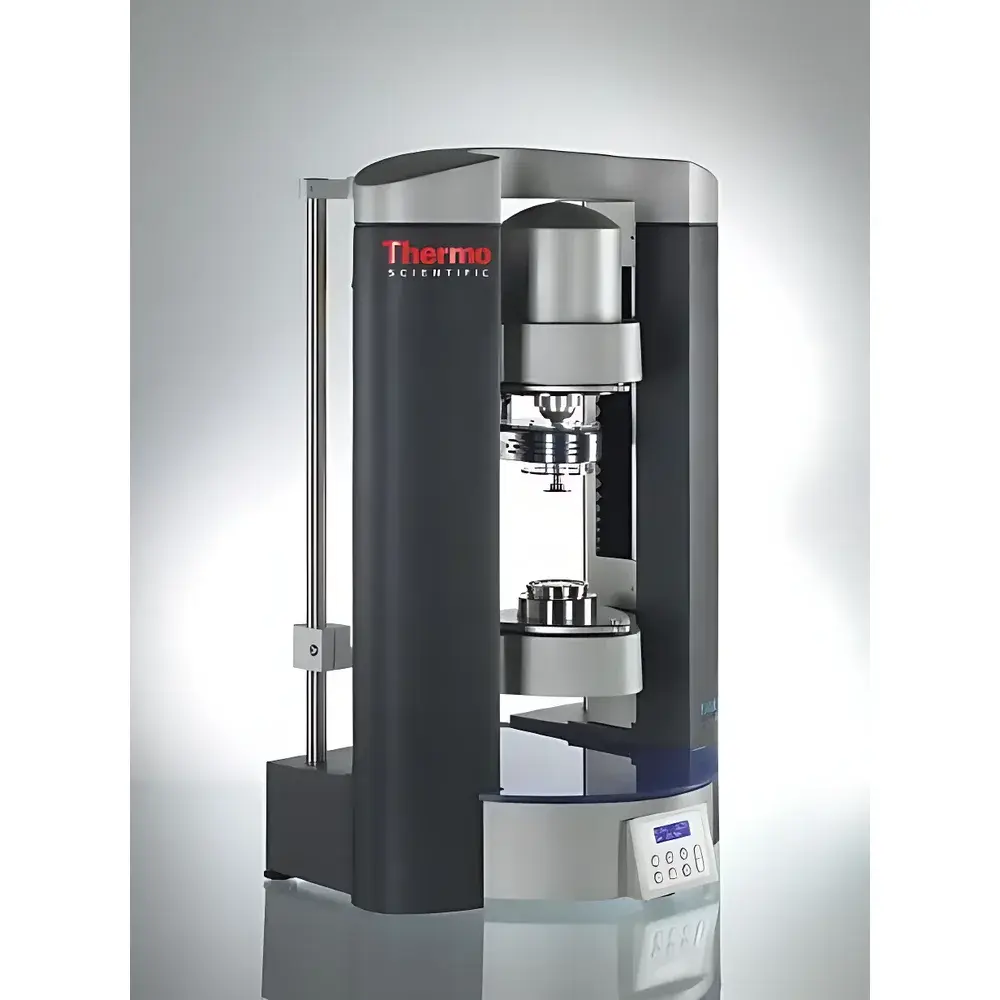
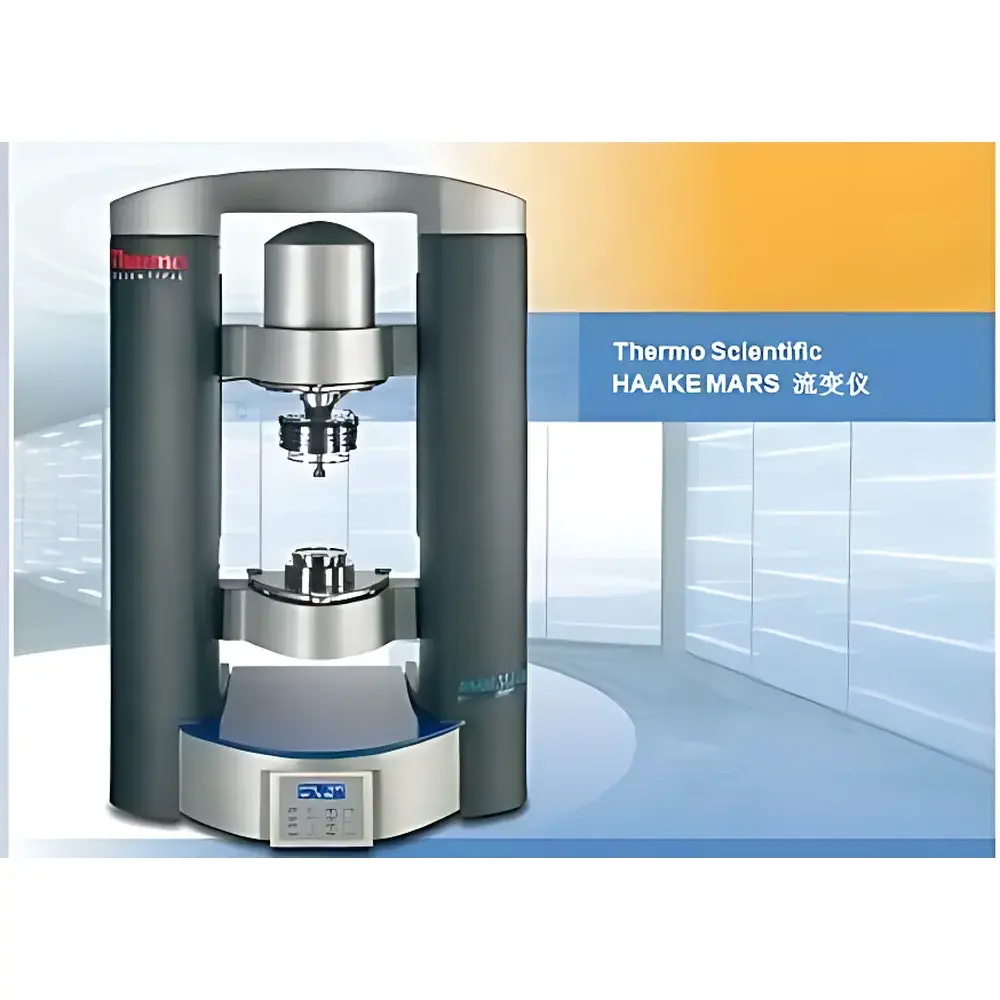
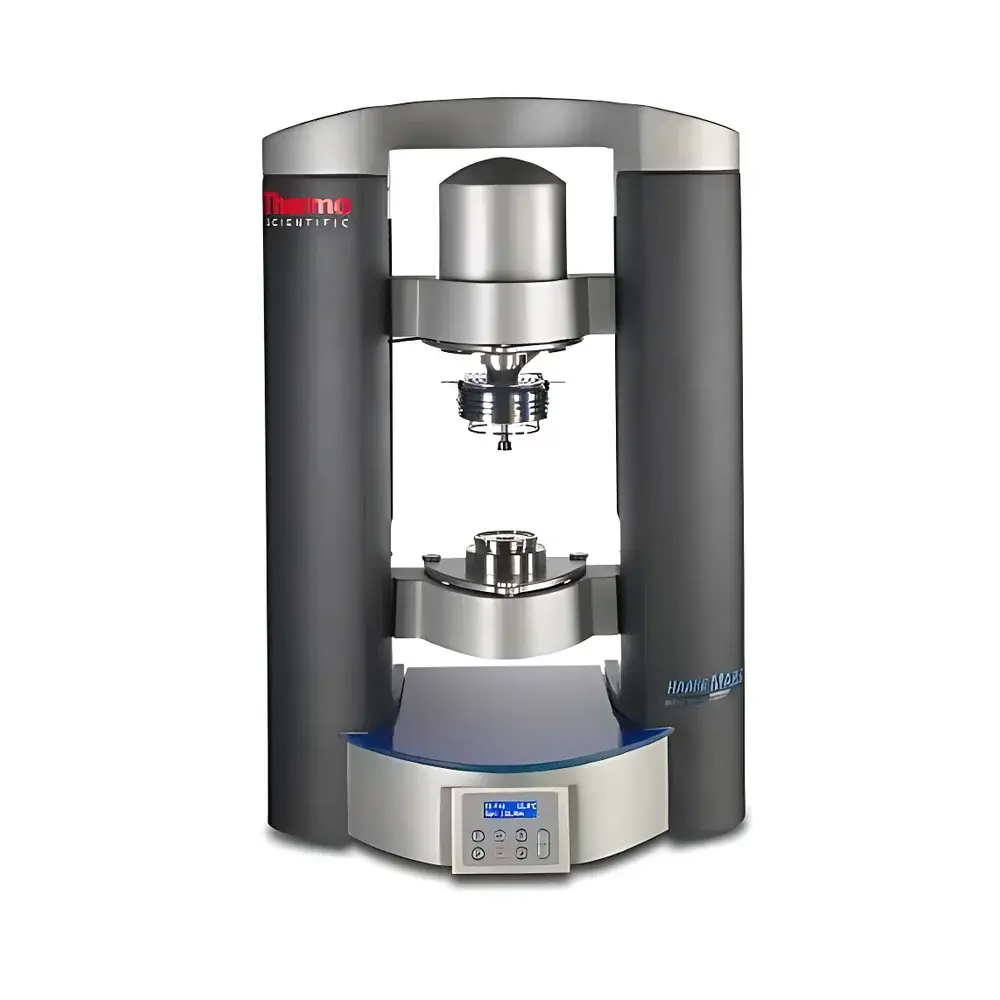
Thermo Fisher HAAKE MARS 40/60 Modular Rotational Rheometer Workstation
| Brand | Thermo Fisher |
|---|---|
| Origin | Germany |
| Manufacturer | Thermo Fisher Scientific |
| Instrument Type | Rotational Rheometer |
| Motor Bearing | Air Bearing |
| Minimum Rotational Speed | 1×10⁻⁸ rpm |
| Frequency Range | 1×10⁻⁶ – 100 Hz |
| Maximum Rotational Speed | 4500 rpm |
| Maximum Torque | 200 mNm |
| Torque Resolution | 0.1 nNm |
| Angular Displacement Resolution | 12 nrad |
| Normal Force Range | 0.01 – 50 N |
| Normal Force Resolution | 0.001 N |
| Vertical Travel | 240 mm |
| Gap Resolution | 0.5 µm |
| Minimum Vertical Speed | 0.02 µm/s |
| Maximum Vertical Speed | 20 mm/s |
| Temperature Range (with optional modules) | −150 °C to +600 °C |
| Dimensions (W×D×H) | 600 × 600 × 890 mm |
| Weight | 59 kg |
Overview
The Thermo Fisher HAAKE MARS 40/60 Modular Rotational Rheometer Workstation is an engineering-grade, high-precision rotational rheometer platform designed for fundamental and applied viscoelastic characterization of complex fluids and soft solids. Based on Couette and parallel-plate geometries, it operates on the principle of controlled-strain (CS) and controlled-stress (CR) rotational and oscillatory modes, enabling quantitative measurement of shear viscosity, storage/loss moduli (G′/G″), complex viscosity (η*), yield stress, thixotropy, and time-dependent structural recovery. Its dual-column mechanical architecture—combined with fourth-generation low-inertia drag-cup motor technology and a triaxial air-bearing system (two radial, one axial)—ensures exceptional torque sensitivity down to 0.1 nNm and angular resolution of 12 nrad, while maintaining mechanical stability across extreme frequency (10⁻⁶–100 Hz) and shear rate (10⁻⁸–4500 rpm) ranges. The system is fully compliant with ISO 16520, ASTM D4402, and DIN 53019 standards for rheological testing, and supports audit-ready data acquisition under GLP/GMP frameworks when integrated with validated software configurations.
Key Features
- Modular dual-column design enabling seamless integration of up to 12 functional modules—including RheoScope (in-situ microscopy), Rheonaut (FTIR coupling), SER (melt extensional rheology), and UV-curing accessories—without hardware reconfiguration.
- Patented low-inertia air-bearing motor system delivering <0.1 nNm torque resolution and <10⁻⁸ rpm minimum rotational speed—critical for ultra-low-shear characterization of fragile gels, colloidal dispersions, and biological macromolecules.
- “Quick-Connect Assistant” interface enabling automatic recognition of temperature modules (Peltier, liquid-circulated, radiant convection furnace) and geometry sets (parallel plates, concentric cylinders, cone-and-plate), including auto-alignment and gap calibration.
- Full normal force control (0.01–50 N) with 1 mN resolution, supporting compressive testing, texture analysis, and solid-like behavior assessment per ASTM D747 and ISO 178.
- Temperature range coverage from −150 °C (cryogenic liquid nitrogen cooling) to +600 °C (radiant convection furnace), certified for use with polymer melts, thermosets, asphalt binders, and high-Tg pharmaceutical excipients.
- Real-time Lissajous analysis and multi-wave oscillation protocols for nonlinear viscoelastic fingerprinting, compliant with ISO 13320 Annex B for advanced material structure-function correlation.
Sample Compatibility & Compliance
The MARS 40/60 accommodates diverse sample classes across R&D and QC environments: thermoplastic/thermoset polymers (including reactive resins), coatings and inks (water-based, UV-curable, solvent-borne), food matrices (dairy gels, starch pastes, plant-based emulsions), topical pharmaceuticals (creams, ointments, hydrogels), petroleum products (asphalt binders, drilling fluids), and construction materials (cement pastes, grouts). All measurement protocols adhere to internationally recognized regulatory frameworks: USP for rheological quality attributes of semisolid dosage forms; ASTM D7175 for dynamic shear rheometry of asphalt binders; ISO 3219 for viscosity classification of polymer solutions; and FDA 21 CFR Part 11 requirements when used with Thermo Fisher’s validated RheoWin 4.x software suite featuring electronic signatures, audit trails, and role-based access control.
Software & Data Management
RheoWin 4.x is the native, Windows-based control and analysis platform—engineered for traceability and reproducibility in regulated labs. It provides full method scripting (including time-sweep, frequency sweeps, amplitude sweeps, and creep-recovery), real-time parameter monitoring, automated report generation (PDF/Excel), and raw-data export in ASCII or HDF5 format. Built-in compliance features include user-defined electronic signatures, immutable audit logs tracking all parameter changes and instrument events, and configurable data retention policies aligned with ALCOA+ principles. Optional add-ons include RheoScope Live (for synchronized video-microscopy correlation), RheoIR Link (for real-time FTIR spectral overlay during deformation), and RheoSER Manager (for uniaxial extensional strain control and Trouton ratio calculation).
Applications
- Polymer science: Linear viscoelasticity mapping, melt fracture prediction, branching quantification via van Gurp–Palmen plots, and crosslinking kinetics under UV/thermal initiation.
- Coatings & inks: Settling resistance evaluation, sagging behavior modeling, and rheological response to pigment dispersion stability.
- Pharmaceutical development: Gelation temperature profiling of thermosensitive hydrogels, syringeability assessment of injectables, and spreadability metrics for topical formulations.
- Food science: Yield stress determination of yogurt and cheese analogs, breakdown/recovery dynamics of starch networks, and mouthfeel simulation via large-amplitude oscillatory shear (LAOS).
- Energy materials: Viscoelastic aging of bituminous binders, thermal cracking susceptibility of heavy fuel oils, and flow assurance of waxy crude suspensions.
- Construction chemistry: Hydration kinetics of cementitious systems, thixotropic recovery of self-leveling compounds, and pumpability validation of grouts under shear.
FAQ
What distinguishes the MARS 40 from the MARS 60 model?
The MARS 60 offers enhanced low-torque performance (2 nNm oscillatory torque floor vs. 20 nNm on MARS 40), improved normal force resolution (0.001 N), and extended vertical travel precision—optimized for high-resolution gap control in thin-film and interfacial rheology applications.
Is the system compatible with third-party temperature controllers or custom geometries?
While Thermo Fisher certifies only OEM temperature modules and geometries for full compliance, mechanical and electrical interfaces (e.g., Euroblock connectors, RS-485 bus) support qualified third-party integration under customer risk assessment and validation protocols.
Can the MARS platform meet 21 CFR Part 11 requirements out-of-the-box?
Yes—when deployed with RheoWin 4.x in “validated mode”, enabled with digital certificates, electronic signatures, and audit-trail logging activated per site-specific SOPs and IQ/OQ documentation.
Does the system support extensional rheology without adding SER hardware?
No. Uniaxial extensional measurements require the optional SER universal testing module; however, planar extensional behavior can be inferred indirectly via LAOS-derived elastic modulus asymmetry and Fourier-transformed stress harmonics.
How is thermal calibration performed across the full −150 °C to +600 °C range?
Calibration follows ISO 17025-accredited procedures using NIST-traceable reference materials (e.g., indium, zinc, aluminum for DSC verification; standard oils for viscosity traceability) and is documented per module-specific calibration certificate issued at installation.



