
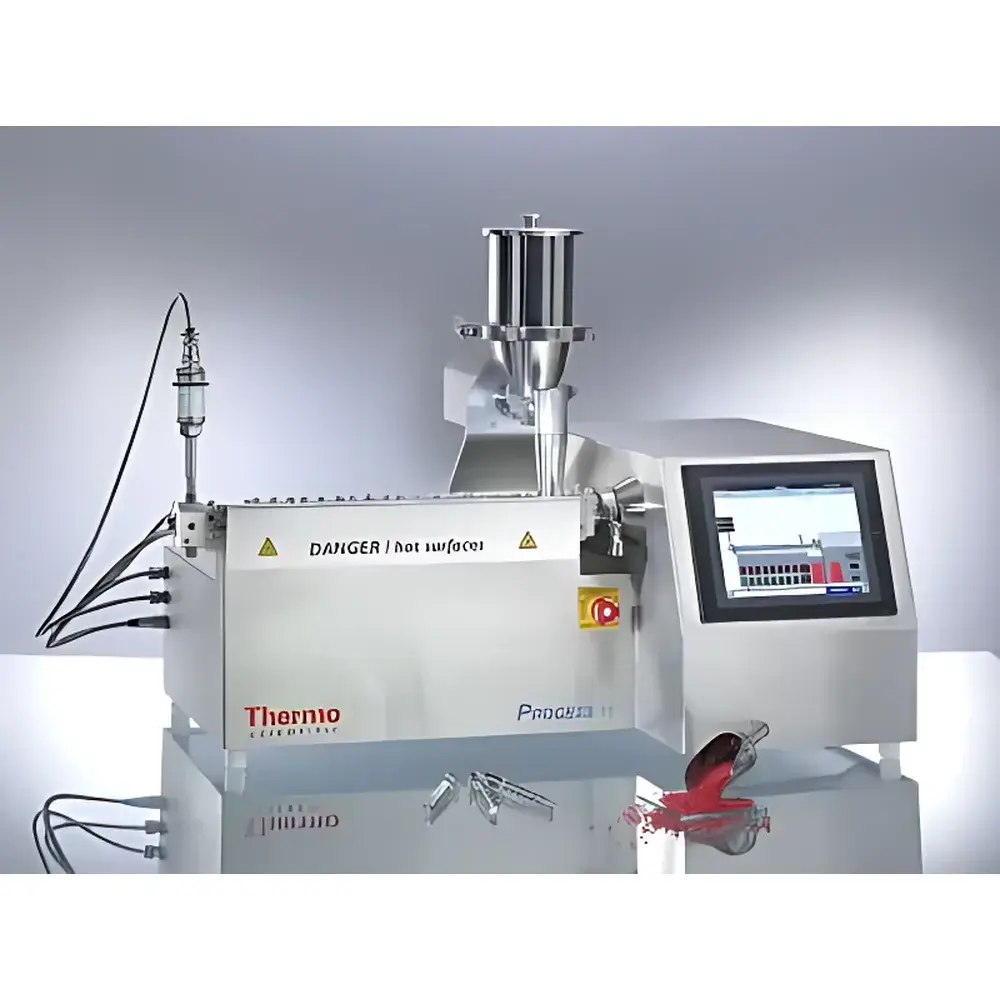
Thermo Fisher HAAKE Process 11 Miniature Twin-Screw Extruder
| Brand | Thermo Fisher |
|---|---|
| Origin | Germany |
| Manufacturer | Thermo Fisher Scientific |
| Type | Imported |
| Model | Process 11 |
| Drive Motor Power | 1.5 kW |
| Screw Diameter | 11 mm |
| L/D Ratio | 40 |
| Speed Range | 10–1000 rpm |
| Barrel Material | Nitrided Steel 1.7365 (EN 40B) |
| Max Operating Temperature | 350 °C (optional 450 °C) |
| Max System Pressure | 100 bar (with pressure monitoring) |
| Heating Zones | 7 × 5D electric heating (optional water cooling) |
| Dimensions (L×W×H) | 820 × 480 × 410 mm |
| Weight | 55 kg |
| Sample Requirement | ~20 g |
| Throughput | up to 2.5 kg/h |
| Barrel Opening | Horizontal split, two-piece design |
| Control Interface | Integrated color touchscreen |
Overview
The Thermo Fisher HAAKE Process 11 is a compact, benchtop parallel co-rotating twin-screw extruder engineered for precision polymer process development in research and formulation laboratories. Based on Couette flow principles and modular screw-barrel geometry, it replicates the fundamental shear, mixing, and conveying mechanics of industrial-scale extrusion systems—enabling direct scale-up correlation from lab to pilot or production lines. Its 11 mm screw diameter and 40 L/D barrel length provide sufficient residence time and thermal-mechanical history control for thermoplastic compounding, reactive extrusion, masterbatch development, and nanocomposite dispersion studies. Designed for minimal material consumption (~20 g per experiment), the Process 11 reduces raw material waste and accelerates iterative formulation cycles without compromising rheological fidelity or thermal stability.
Key Features
- Modular screw architecture with standardized geometric profiles—identical to those used in HAAKE’s larger production-grade extruders—ensuring linear scalability of processing parameters (e.g., specific mechanical energy, mean residence time, melt temperature profile).
- Horizontally split barrel assembly with quick-release clamping enables tool-free disassembly, full visual access to screw elements, and rapid cleaning between formulations—critical for cross-contamination-sensitive R&D workflows.
- Integrated 7-zone electric heating system (5D per zone) with independent PID control delivers precise axial temperature profiling; optional water-cooling jackets support low-temperature processing (e.g., PVC plastisol devolatilization or heat-sensitive biopolymer extrusion).
- Brushless servo motor drive delivering stable torque across the full 10–1000 rpm range, with real-time speed synchronization and overload protection to maintain consistent shear rate during viscosity transitions.
- Robust nitrided steel (1.7365 / EN 40B) barrel and screw components ensure long-term dimensional stability and resistance to abrasive fillers (e.g., glass fiber, mineral additives) under continuous operation at up to 350 °C (450 °C with high-temp option).
- Self-contained touchscreen HMI with preloaded process templates, recipe management, and real-time graphical display of torque, pressure, temperature, and throughput—no external PC required for routine operation.
Sample Compatibility & Compliance
The HAAKE Process 11 accommodates a broad spectrum of polymeric feedstocks—including polyolefins (PP, PE), engineering thermoplastics (PA6, PC, PBT), thermoplastic elastomers (TPEs), biopolymers (PLA, PHA), and reactive monomer systems—without requiring hardware modification. Its 100 bar pressure rating and integrated safety interlocks comply with EN ISO 13857 and CE machinery directive requirements. All firmware and control logic adhere to IEC 61508 SIL 2 functional safety standards. For regulated environments, optional audit-trail-enabled software modules support 21 CFR Part 11 compliance, including electronic signatures, user access levels, and immutable data logging—facilitating GLP/GMP-aligned documentation for pharmaceutical excipient extrusion or medical-grade polymer validation.
Software & Data Management
The embedded HAAKE LabManager software provides intuitive workflow-driven operation: users define material-specific protocols (e.g., ramp rates, dwell times, vacuum sequences) via drag-and-drop parameter sequencing. Real-time data streams—including torque (N·m), melt pressure (bar), barrel zone temperatures (°C), and calculated specific mechanical energy (kWh/kg)—are timestamped and stored in .csv and .hdf5 formats. Exported datasets are fully compatible with statistical analysis platforms (e.g., JMP, MATLAB) and process modeling tools (e.g., Polyflow, Autodesk Moldflow). Optional remote monitoring via Ethernet/IP enables centralized fleet management across multi-lab facilities, with TLS-encrypted data transmission and role-based API access for integration into LIMS or MES ecosystems.
Applications
- Formulation screening of polymer blends, compatibilizers, and flame-retardant systems under controlled shear and thermal histories.
- Reactive extrusion of functionalized polymers (e.g., grafting, transesterification) with inline dosing and vacuum devolatilization capability.
- Dispersion optimization of nanofillers (CNTs, graphene, nano-clays) and pigment masterbatches using variable kneading block configurations.
- Thermal stability assessment of heat-sensitive biopolymers via residence time distribution (RTD) analysis using tracer injection protocols.
- Process window mapping for regulatory submissions—generating reproducible data packages demonstrating robustness across screw speed, feed rate, and temperature gradients.
FAQ
Can the Process 11 be used for scaling extrusion processes to production equipment?
Yes—the screw geometry, conveying efficiency, and dimensionless operating parameters (e.g., specific throughput Qn, specific mechanical energy SME) are directly transferable to HAAKE’s larger Process 16, Process 20, and industrial extruders.
Is vacuum venting supported for moisture removal or monomer stripping?
Yes—optional vacuum port mounting kits allow connection to standard vacuum pumps (≤1 mbar), enabling degassing, devolatilization, and inert gas purging during processing.
What maintenance intervals are recommended for the screw and barrel assembly?
Under normal R&D usage (<10 hrs/week), visual inspection and light polishing every 200 operational hours is sufficient; nitrided surfaces typically exceed 5,000 hours of service life before measurable wear occurs.
Does the system support third-party feeding or downstream instrumentation?
Yes—standard 12 VDC and 24 VDC I/O ports, plus RS485 and Ethernet interfaces, enable synchronization with gravimetric feeders, inline rheometers (e.g., Goettfert Rheoextruder), and FTIR melt analyzers.
How is temperature uniformity validated across the 7 heating zones?
Each zone includes dual Pt100 sensors (redundant measurement); factory calibration reports include axial temperature gradient maps verified per ASTM E220 for thermal uniformity testing.




