
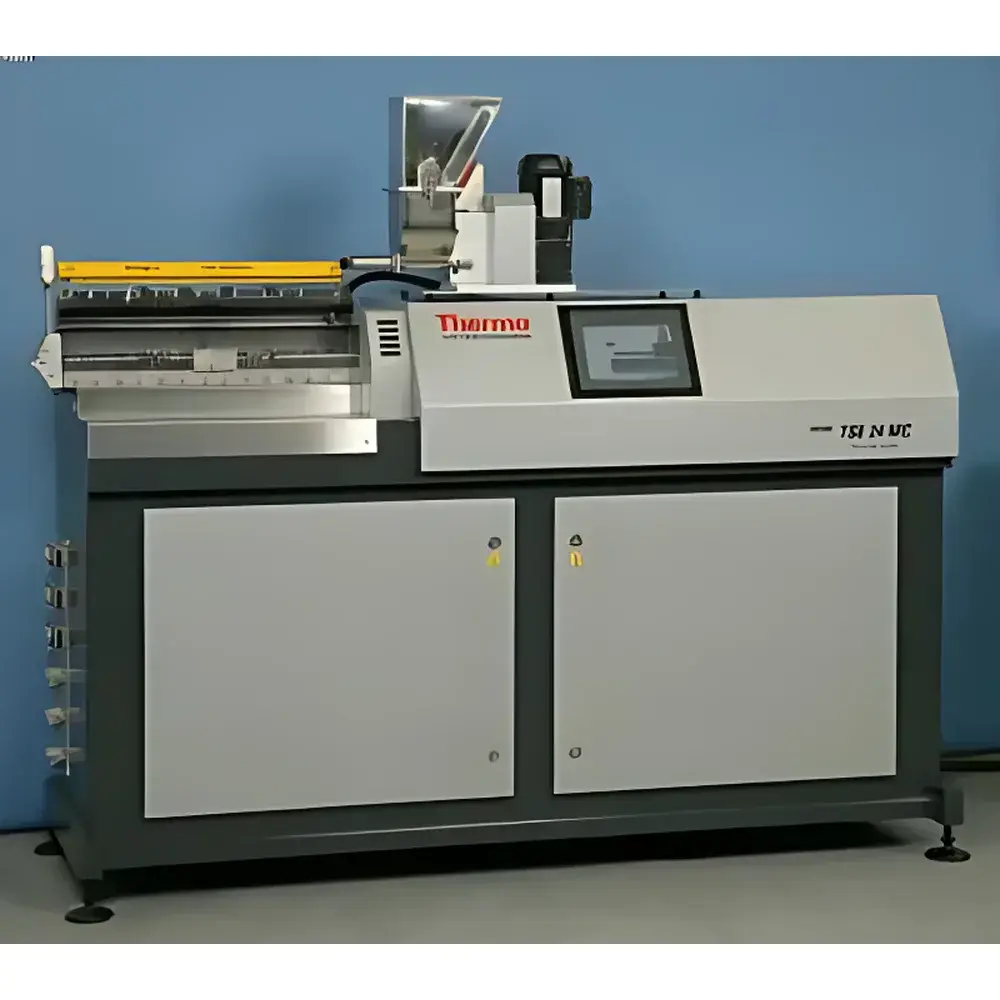
Thermo Fisher HAAKE TSE 24 Pilot-Scale Co-Rotating Twin-Screw Extruder
| Brand | Thermo Fisher |
|---|---|
| Origin | Germany |
| Manufacturer | Thermo Fisher Scientific |
| Country of Origin | Imported |
| Model | TSE 24 |
| Price | Upon Request |
| Screw Diameter | 24 mm |
| L/D Ratio | up to 40:1 |
| Motor Power | 5.5–11 kW |
| Max Speed | 500–1000 rpm |
| Max Temperature | 400 °C |
| Max Pressure | 100 bar |
| Temperature Zones | 7–10 independently controlled |
| Throughput | 2–30 kg/h |
| Drive Type | DC or AC servo motor |
| Barrel Construction | Horizontal split, hinged modular segments |
| Screw Design | Intermeshing co-rotating, fully configurable |
| Control Interface | 10.4" color touchscreen with HAAKE PolyLab OS software |
| Data Export | Real-time CSV/Excel export via Ethernet/USB |
| Compliance | CE, ISO 9001, compliant with GLP/GMP documentation requirements for process development |
Overview
The Thermo Fisher HAAKE TSE 24 is a pilot-scale, floor-standing, co-rotating twin-screw extruder engineered for scalable polymer processing development—from laboratory formulation screening to pre-commercial batch production. Based on the Couette flow principle and precise volumetric conveying geometry, the TSE 24 delivers high shear homogeneity, excellent self-wiping action, and reproducible residence time distribution—critical for compound development, reactive extrusion, compounding, devolatilization, and continuous melt blending. Its modular barrel architecture (L/D up to 40:1) and interchangeable screw elements enable systematic process mapping across feed, melting, mixing, venting, and discharge zones. Designed and manufactured in Germany under strict ISO 9001 quality control, the system meets international safety standards (CE) and supports regulatory-compliant workflows required in pharmaceutical, medical device, and automotive-grade polymer development.
Key Features
- Modular horizontal-split barrel design with hinged opening—enabling rapid access to screw elements and internal surfaces for cleaning, maintenance, or configuration changes without full disassembly.
- Interchangeable barrel liners made from wear- and corrosion-resistant materials (e.g., nitrided steel, Stellite, or ceramic-coated variants) for processing abrasive fillers, halogenated polymers, or highly corrosive formulations.
- Up to 10 independently PID-controlled heating/cooling zones, each with real-time power consumption monitoring—providing granular thermal profiling essential for scale-up correlation and DOE-based optimization.
- Configurable feeding options: main gravimetric feeder, optional side feeder (powder or pellet), liquid injection ports, vacuum venting (up to 1 mbar), and integrated degassing modules.
- HAAKE PolyLab OS software suite with intuitive 10.4″ color touchscreen interface—automatically detects connected peripherals (feeders, melt pumps, rheometers, or inline NIR sensors) and synchronizes parameter logging at ≥1 Hz sampling rate.
- Comprehensive data traceability: timestamped process logs (torque, temperature, pressure, speed, throughput), user-access-level permissions, and audit trail export compatible with FDA 21 CFR Part 11 requirements when deployed with validated IT infrastructure.
Sample Compatibility & Compliance
The TSE 24 accommodates a broad spectrum of thermoplastic and thermosetting materials—including polyolefins, engineering resins (PA, PBT, PC), biopolymers (PLA, PHA), elastomers, filled composites (glass/carbon fiber, CaCO₃, talc), conductive compounds (CNT, graphene), and reactive systems (polycondensation, grafting, curing). Its sealed, low-oxygen processing environment minimizes thermal degradation during high-temperature operations (up to 400 °C). The system complies with CE Machinery Directive 2006/42/EC, EMV Directive 2014/30/EU, and conforms to ASTM D3835 (standard test method for extrusion plastometer) and ISO 1133-2 (plastics — determination of the melt mass-flow rate). Optional GMP-ready configurations include electronic signature support, instrument qualification documentation (IQ/OQ/PQ templates), and integration with LIMS or MES platforms.
Software & Data Management
HAAKE PolyLab OS provides deterministic real-time control with <100 ms loop response time. All operational parameters—including screw speed, zone temperatures, motor torque, melt pressure (via optional transducer), and feeder mass flow—are continuously logged and time-stamped. Data export supports CSV, Excel, and XML formats; remote monitoring is enabled via Ethernet or optional Wi-Fi module. The software includes built-in calculation tools for specific mechanical energy (SME), residence time distribution (RTD) estimation, and viscosity modeling using Carreau-Yasuda or Cross models. For regulated environments, optional 21 CFR Part 11 compliance packages include role-based access control, electronic signatures, and immutable audit trails with SHA-256 hashing of raw datasets.
Applications
- Polymer compounding and masterbatch development (color, flame retardant, UV stabilizer)
- Reactive extrusion: grafting, polymerization, transesterification, and crosslinking
- Devolution and moisture removal under vacuum (<1 mbar)
- Continuous blending of immiscible polymer blends with compatibilizers
- Processing of heat-sensitive biopolymers and nanocomposites requiring precise thermal history control
- Scale-up studies supporting technology transfer from lab-scale (e.g., TSE 16) to production-scale (TSE 38/TSE 57) extruders
- Material qualification for automotive (SAE J200), medical (ISO 10993), and food-contact (FDA 21 CFR 170–199) applications
FAQ
What is the maximum allowable throughput for the TSE 24 in continuous operation?
The system supports sustained throughput between 2–30 kg/h depending on configuration (screw design, L/D ratio, material density, and thermal load). At 40:1 L/D with high-torque drive, nominal output reaches 25–30 kg/h for standard polyolefin compounds.
Can the TSE 24 be integrated with inline rheological or spectroscopic sensors?
Yes—the extruder features standardized analog/digital I/O and EtherCAT connectivity for seamless integration with HAAKE Rosand capillary rheometers, inline FTIR/NIR probes (e.g., Bruker MultiRAM), or melt pressure/temperature transducers.
Is validation support available for GxP-regulated environments?
Thermo Fisher provides IQ/OQ protocol templates, calibration certificates traceable to NIST standards, and optional vendor-led PQ execution aligned with ASTM E2500 and Annex 11 guidelines.
How does barrel segmentation support process troubleshooting?
Each modular barrel segment (heating zone) can be individually removed or replaced—enabling targeted diagnostics of localized shear heating, material degradation, or screw wear without interrupting the entire train.
What cooling options are supported for high-output or high-viscosity processing?
Standard water-cooled barrels; optional air-assisted cooling jackets and external chiller integration (−10 °C to +90 °C range) ensure stable thermal management during extended runs or exothermic reactions.





