
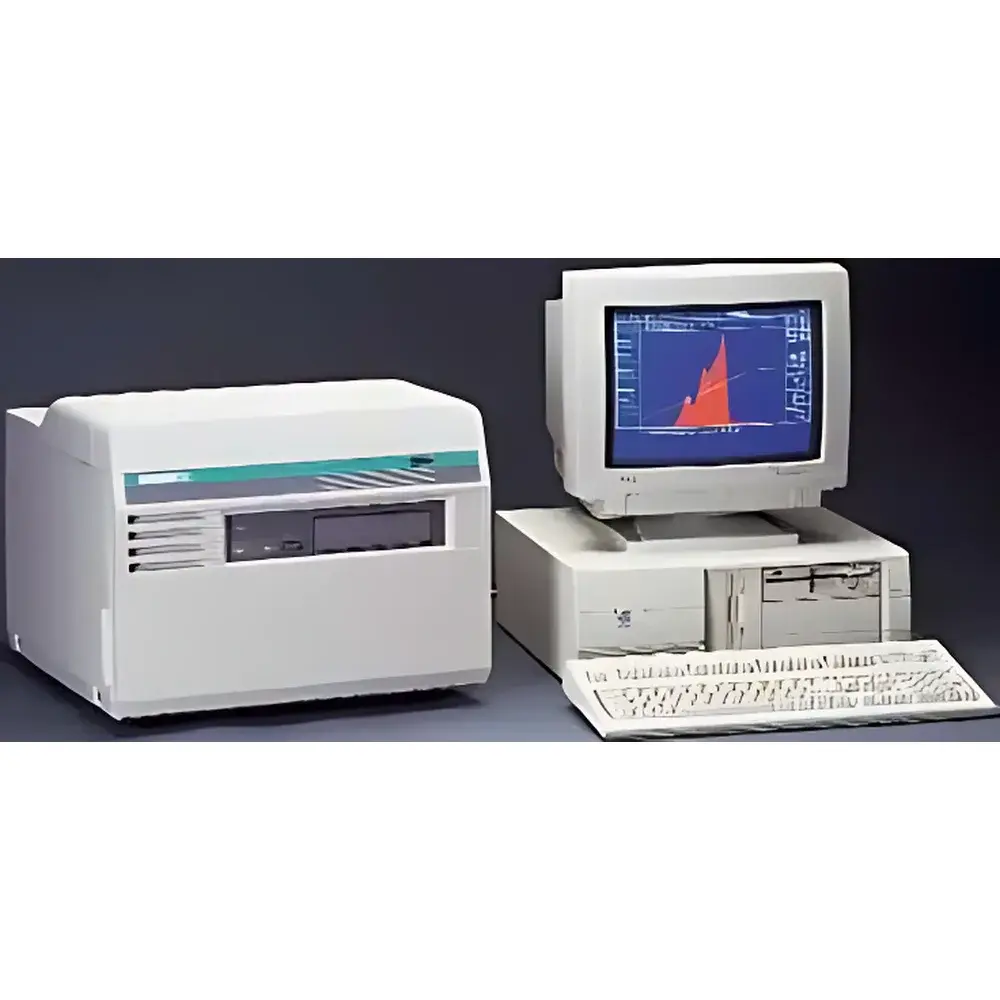
Thermo Fisher Harshaw TLD 5500 Thermoluminescent Dosimeter Reader
| Brand | Thermo Fisher |
|---|---|
| Origin | USA |
| Manufacturer | Thermo Fisher Scientific |
| Product Type | Laboratory-Based TLD Reader |
| Model | Harshaw TLD 5500 |
| Detector Type | Cooled Photomultiplier Tube (PMT) |
| Sample Capacity | Up to 50 TLD chips per cycle |
| Heating Method | Gas-Heated Linear Ramp (TTP) |
| Max Temperature | 600 °C |
| Linearity | ±1% deviation |
| Dynamic Range | 7 decades |
| Preheat Time | 30 min |
| High Voltage Range | 500–1200 V |
| HV Stability | ±0.005% |
| Dose Units | nC, µGy, mGy, Gy, mrad, mrem, µSv, mSv, Sv |
| Dark Current Equivalent | <50 mGy (Cs-137) |
| MTBF | >10,000 hours |
| Operating Temp | 0–40 °C |
| Storage Temp | −10–60 °C |
| Compliance | Designed for ISO/IEC 17025-accredited dosimetry laboratories |
| Software | Harshaw TLD Analysis Suite with audit trail and 21 CFR Part 11 readiness |
Overview
The Thermo Fisher Harshaw TLD 5500 is a high-precision, laboratory-grade thermoluminescent dosimeter (TLD) reader engineered for quantitative measurement of ionizing radiation dose in personnel, environmental, and medical physics applications. It operates on the fundamental principle of thermoluminescence: when previously irradiated crystalline dosimeters (e.g., LiF:Mg,Ti or CaF2:Dy) are heated under controlled conditions, trapped electrons recombine with lattice defects, emitting visible photons proportional to the absorbed dose. The Harshaw TLD 5500 captures this luminescence using a temperature-stabilized, cooled photomultiplier tube (PMT), enabling high signal-to-noise ratio detection across a dynamic range spanning seven orders of magnitude (10−2–105 mGy). Its gas-heated planchet system delivers reproducible linear temperature ramps (TTP mode) up to 600 °C, supporting standardized readout protocols defined in ANSI N13.22, IEC 61066, and ISO 21909. Designed for routine operation in accredited dosimetry services, nuclear medicine departments, and regulatory compliance labs, the TLD 5500 integrates metrological traceability, automated background subtraction, and full-cycle thermal conditioning—including preheat and post-readout annealing—to ensure inter-run consistency and long-term calibration stability.
Key Features
- Automated batch processing of up to 50 TLD elements per readout cycle, reducing operator dependency and improving throughput.
- Gas-heated planchet with programmable linear temperature ramp (TTP) profiles, delivering precise thermal control from ambient to 600 °C with ±0.5 °C uniformity across the heating zone.
- Cryogenically stabilized photomultiplier tube with active cooling, minimizing dark current drift and enabling sub-mGy sensitivity and <1% linearity deviation over full operational range.
- Integrated high-voltage supply (500–1200 V) with ±0.005% short-term stability, critical for maintaining PMT gain consistency during extended readout sequences.
- Full thermal cycle automation: preheat → readout → annealing — eliminating manual intervention and ensuring dosimeter reset fidelity per IEC 62387 Annex B recommendations.
- Self-diagnostic firmware with real-time error logging, hardware health monitoring, and built-in calibration verification routines compliant with ISO/IEC 17025 clause 7.7.
- Robust mechanical architecture with vibration-damped optical path and EMI-shielded electronics, validated for continuous operation in shared laboratory environments.
Sample Compatibility & Compliance
The Harshaw TLD 5500 supports standard TLD formats including 3.2 mm × 3.2 mm × 0.9 mm LiF:Mg,Ti chips (TLD-100), CaF2:Dy rods, and custom planchet-mounted phosphors. Its universal holder design accommodates both bare and encapsulated elements without mechanical adaptation. The system meets functional requirements for ISO 4037-3 (X-ray and gamma reference fields), ANSI N13.22 (performance criteria for TLD systems), and IEC 62387-1 (radiation protection instrumentation – passive integrating dosimetry systems). When operated with Thermo Fisher’s certified calibration sources and traceable reference dosimeters, it supports GLP/GMP-aligned quality assurance programs and satisfies documentation requirements for FDA 21 CFR Part 11 electronic records and signatures—provided audit trail functionality is enabled in software configuration.
Software & Data Management
The Harshaw TLD Analysis Suite (v5.x or later) provides comprehensive data acquisition, peak deconvolution, dose calculation, and report generation. All measurements are timestamped and associated with user ID, element ID, calibration factor, and thermal history metadata. The software implements role-based access control, electronic signature workflows, and immutable audit trails meeting ALCOA+ principles (Attributable, Legible, Contemporaneous, Original, Accurate, Complete, Consistent, Enduring, Available). Raw glow curve data is stored in vendor-neutral HDF5 format; export options include CSV, XML, and PDF reports compliant with ISO/IEC 17025 clause 7.8. Remote diagnostics and firmware updates are supported via secure HTTPS connection—no external internet exposure required.
Applications
- Personnel dosimetry accreditation testing and routine badge processing in nuclear power, research reactors, and radiopharmaceutical manufacturing.
- Environmental monitoring of low-dose-rate sites, including decommissioning facilities, uranium mining zones, and near-surface disposal repositories.
- Medical physics QA: verification of radiotherapy beam output, brachytherapy source calibration, and diagnostic X-ray equipment compliance.
- Space radiation dosimetry support—validated for use with NASA-approved TLD materials under microgravity-relevant thermal cycling protocols.
- Reference laboratory intercomparisons and proficiency testing under IAEA Coordinated Research Projects (CRPs) and EURADOS initiatives.
FAQ
What types of TLD materials are compatible with the Harshaw TLD 5500?
The system is optimized for LiF:Mg,Ti (TLD-100), LiF:Mg,Cu,P (TLD-100H), CaF2:Dy, and Al2O3:C. Custom phosphor response curves can be imported into the analysis software.
Does the TLD 5500 support automated calibration verification?
Yes—built-in check sources and software-driven daily performance tests validate PMT gain, heater linearity, and background stability per ISO/IEC 17025 clause 7.7.2.
Can raw glow curve data be exported for third-party spectral analysis?
Yes—HDF5-formatted datasets include temperature, time, photon count, and HV settings at 10 ms resolution, enabling independent deconvolution using MATLAB, Python, or OriginLab.
Is the system compliant with FDA 21 CFR Part 11 for regulated environments?
When configured with user authentication, electronic signatures, and audit trail logging enabled, the Harshaw TLD Analysis Suite meets technical requirements for Part 11 compliance; validation documentation is available upon request.
What maintenance is required to sustain metrological performance?
Annual PMT quantum efficiency verification and heater calibration against NIST-traceable standards are recommended; no consumables beyond standard nitrogen purge gas (99.999% purity) are required.







