
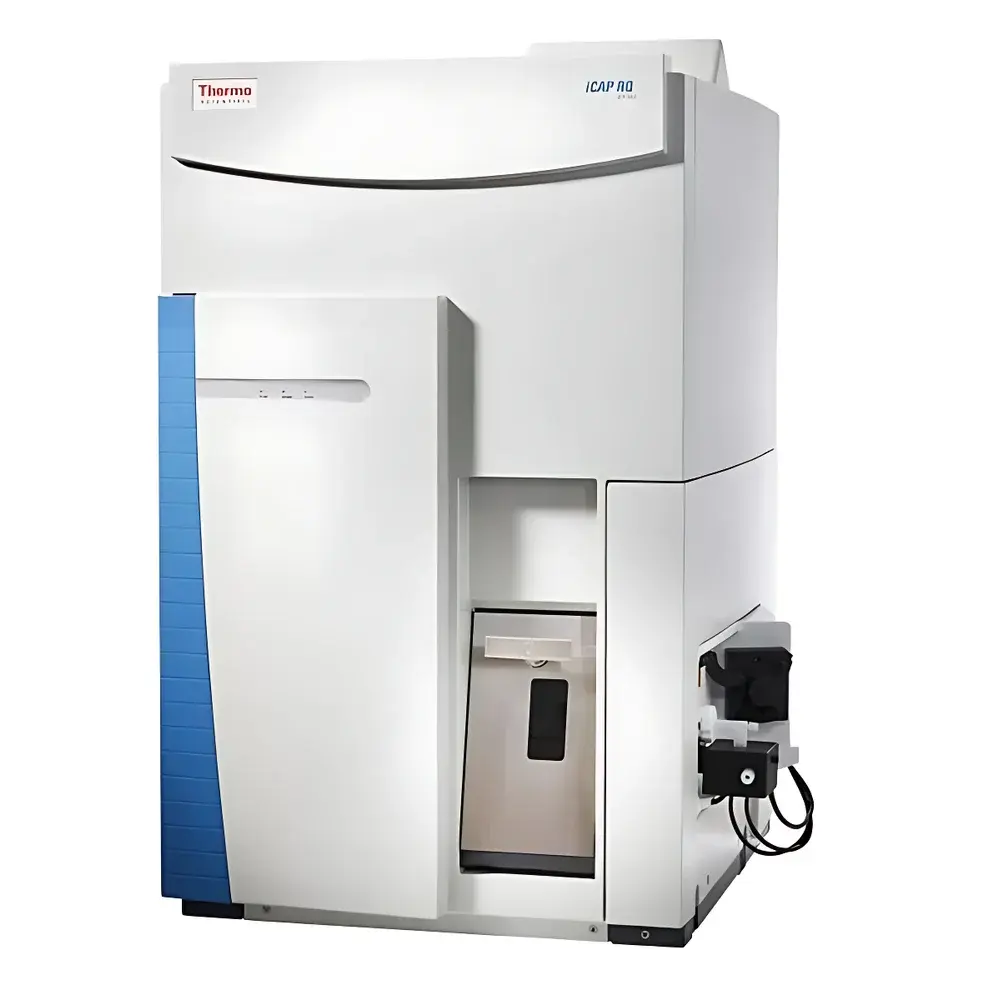
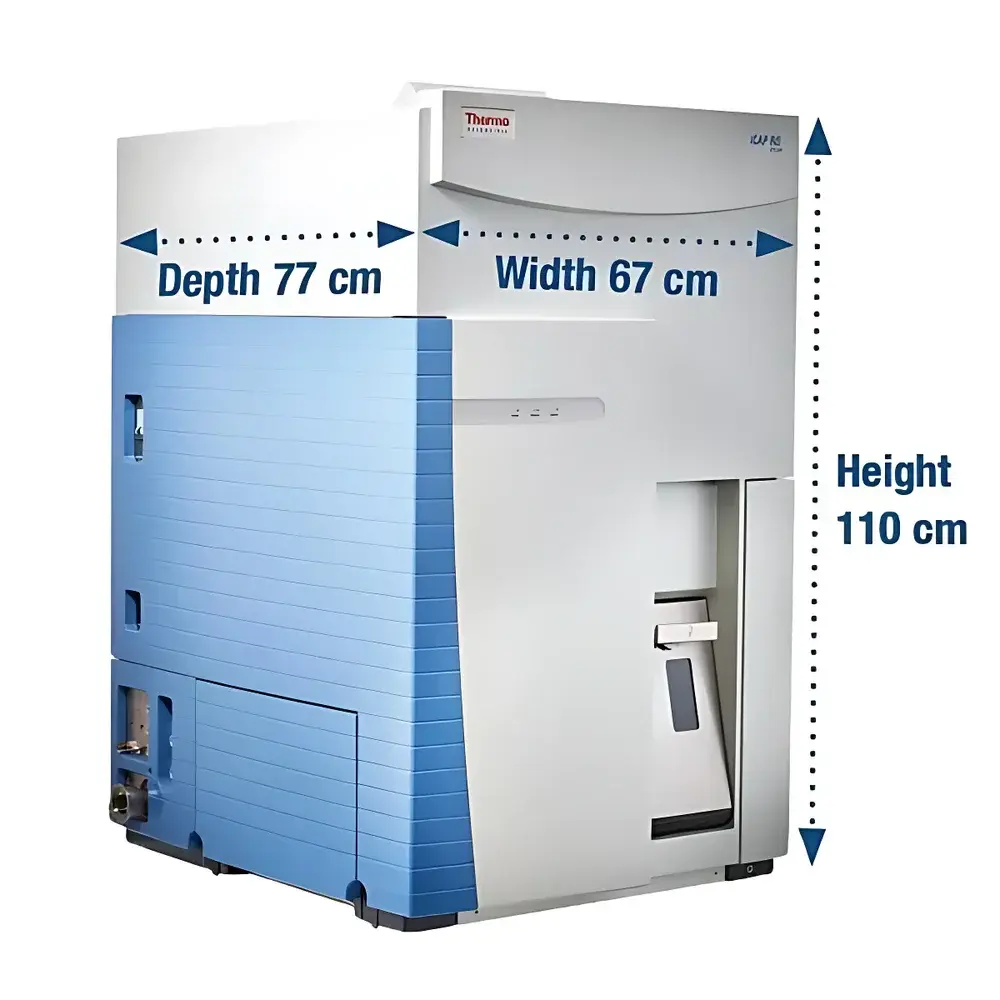
Thermo Fisher iCAP™ RQ Inductively Coupled Plasma Mass Spectrometer
| Brand | Thermo Fisher |
|---|---|
| Origin | USA |
| Manufacturer Type | Authorized Distributor |
| Origin Category | Imported |
| Model | iCAP™ RQ |
| Instrument Type | Quadrupole ICP-MS |
| Application Environment | Laboratory |
| Mass Range (amu) | Available upon request |
| Unit Mass Resolution (amu) | Available upon request |
| Detection Limit (ng·L⁻¹) | Available upon request |
| Sensitivity (Mcps / mg·L⁻¹) | Available upon request |
| Short-Term Stability (RSD) | Available upon request |
| Long-Term Stability (RSD) | Available upon request |
Overview
The Thermo Fisher iCAP™ RQ Inductively Coupled Plasma Mass Spectrometer (ICP-MS) is a high-performance, single-quadrupole mass spectrometer engineered for robust, high-throughput trace element analysis in regulated and research-intensive laboratory environments. It operates on the fundamental principle of inductively coupled plasma ionization—where liquid samples are nebulized, desolvated, atomized, and ionized in an argon plasma at ~7,000 K—followed by mass separation and detection via a radiofrequency-driven quadrupole mass filter. This architecture delivers quantitative elemental analysis at sub-picogram-per-liter (pg·L⁻¹) levels across the full isotopic mass range (typically 5–280 amu), with inherent capability for isotope ratio measurement, time-resolved analysis, and semi-quantitative screening. Designed specifically for laboratories balancing regulatory compliance with operational efficiency, the iCAP™ RQ integrates plasma source stability, interface robustness, and signal reproducibility into a unified platform optimized for routine QC, environmental monitoring, clinical toxicology, geochemical profiling, and semiconductor material purity verification.
Key Features
- Optimized interface geometry with high-transmission nickel or platinum sampling and skimmer cones, enabling superior matrix tolerance for complex samples including seawater, biological digests, and high-salinity industrial effluents.
- Advanced RF generator delivering stable 1.6 kW output with real-time impedance matching—ensuring consistent plasma ignition and thermal stability under both “hot” and “cool” plasma operating modes for interference mitigation (e.g., ArO⁺ on 56Fe).
- Modular, open-frame instrument architecture facilitating seamless integration with autosamplers (e.g., Cetac ASX-560), laser ablation systems (e.g., UP213), and hydride generation accessories without mechanical reconfiguration.
- Ergonomic front-access design: integrated drop-down door aligned with standard bench height (85 cm), enabling unobstructed cone maintenance and rapid torch alignment without tools or disassembly.
- Intuitive Qtegra Intelligent Scientific Data Solution™ software with guided method setup, automated tune optimization, and built-in QC checks—including drift correction, internal standard normalization, and isotope dilution calibration workflows compliant with ISO/IEC 17025 and ASTM D5673.
Sample Compatibility & Compliance
The iCAP™ RQ supports aqueous solutions (0.1–5% HNO₃), organic solvents (with oxygen addition), solid microsamples via LA-ICP-MS, and gaseous standards. Its robust interface accommodates total dissolved solids (TDS) up to 0.2% w/v without significant signal suppression or cone clogging. All analytical protocols align with internationally recognized standards, including EPA Method 6020B, ISO 17294-2, USP /, and ICH Q3D for elemental impurities. Full audit trail functionality, electronic signature support, and 21 CFR Part 11–compliant data handling are embedded in Qtegra software, ensuring readiness for GLP/GMP audits and regulatory submissions.
Software & Data Management
Qtegra ISDS provides a unified environment for instrument control, real-time spectral visualization, multi-isotope quantitation, and report generation. It features automated interference correction algorithms (e.g., mathematical correction for polyatomic overlaps), customizable calibration curves (linear, quadratic, weighted), and batch processing for >100 samples per run. Raw data (.raw) and processed results (.csv, .pdf) are stored in a secure, timestamped database with version-controlled method files. Integration with LIMS via ASTM E1384-compliant interfaces enables bidirectional sample tracking and result export—reducing manual transcription errors and supporting ISO/IEC 17025 clause 7.7 traceability requirements.
Applications
- Environmental labs: Quantification of As, Cd, Pb, U, and rare earth elements (REEs) in drinking water per EPA 1638 and EU Directive 2020/2184.
- Pharmaceutical QA/QC: Elemental impurity testing in APIs and excipients per ICH Q3D Stage 4 guidelines, including Co, V, Ni, and Mo in stainless-steel leachables.
- Geochemistry: High-precision isotope ratio analysis (e.g., 87Sr/86Sr) using standard-sample bracketing and external mass bias correction.
- Materials science: Depth-profiling of dopants in silicon wafers and thin-film coatings using fs-LA-ICP-MS coupling.
- Clinical research: Multi-element biomonitoring of essential/toxic metals (e.g., Zn, Cu, Se, Tl) in serum, urine, and whole blood matrices.
FAQ
What mass range does the iCAP™ RQ cover?
Standard operation spans 5–280 amu; extended low-mass capability (down to helium) and high-mass extension (to 300 amu) are available via optional tuning configurations.
Is the system compatible with laser ablation?
Yes—the open-source interface and vacuum port configuration support direct coupling to commercial ns- and fs-laser ablation systems with minimal alignment effort.
How is instrument performance verified during routine use?
Qtegra includes automated daily performance checks (e.g., sensitivity, oxide formation rate, doubly charged ion ratio) against NIST-traceable multi-element standards (e.g., CRM 3106a), generating PDF-certified reports.
Can the iCAP™ RQ be operated in regulated environments requiring 21 CFR Part 11 compliance?
Yes—Qtegra ISDS v3.5+ offers role-based access control, electronic signatures, audit trail review tools, and data integrity safeguards validated per FDA guidance for computerized systems.
What maintenance intervals are recommended for optimal uptime?
Quarterly cone cleaning, biannual RF coil inspection, and annual vacuum pump oil replacement are typical; predictive diagnostics in Qtegra alert users to component wear trends before failure occurs.




