
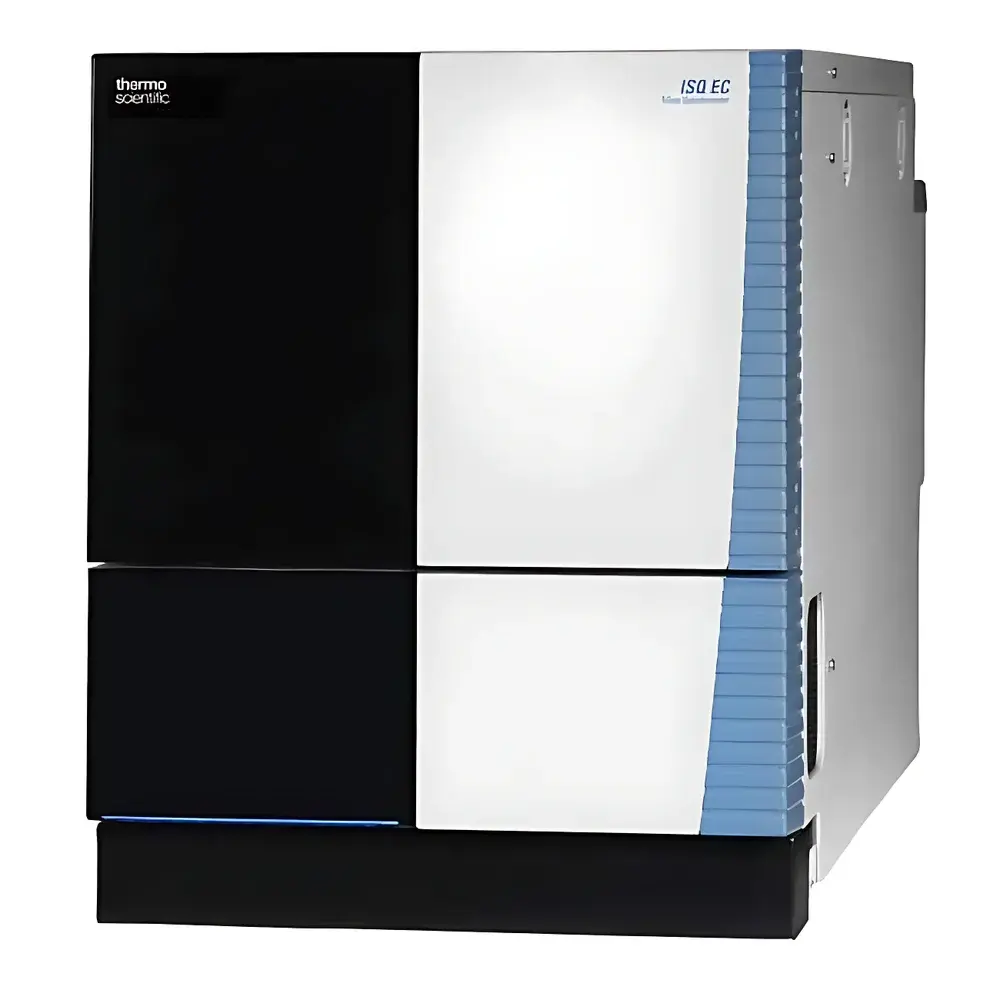
Thermo Fisher ISQ EC Single Quadrupole Mass Spectrometer
| Brand | Thermo Fisher |
|---|---|
| Origin | USA |
| Manufacturer Type | Original Equipment Manufacturer (OEM) |
| Origin Category | Imported |
| Model | ISQ EC |
| Instrument Type | Single Quadrupole Mass Spectrometer |
| Mass Analyzer | Quadrupole |
| Scan Rate | Up to 20,000 Da/s |
| Ionization Modes | Electrospray Ionization (ESI), Heated Electrospray Ionization II (HESI-II), and optional Atmospheric Pressure Chemical Ionization (APCI) |
| Software Platform | Thermo Scientific Chromeleon CDS v7.3 or later |
| Regulatory Compliance Support | 21 CFR Part 11, ALCOA+ principles, audit trail, electronic signatures, and GxP-ready workflows |
| Detection Mode | Full Scan, Selected Ion Monitoring (SIM), and Auto-SIM |
Overview
The Thermo Fisher ISQ EC Single Quadrupole Mass Spectrometer is a purpose-engineered mass detection system designed for robust, high-sensitivity coupling with both ion chromatography (IC) and liquid chromatography (LC) platforms. Operating on quadrupole mass filtering principles, the ISQ EC employs a radio frequency (RF)/direct current (DC) voltage-controlled mass analyzer to separate ions based on their mass-to-charge ratio (m/z). Its architecture integrates a modified HESI-II ion source—originally developed for tandem MS systems—optimized for enhanced ion transmission efficiency, particularly in the low-mass range (m/z < 200). This design enables reliable detection of small molecules including pharmaceutical actives, polar environmental contaminants (e.g., anions, organic acids, inorganic oxyanions), and metabolites under demanding matrix conditions. Unlike generic benchtop MS systems, the ISQ EC is engineered for routine operation in regulated environments where reproducibility, method transferability, and long-term stability are prerequisites—not features.
Key Features
- HESI-II-derived ion source: Features orthogonal spray geometry, independently optimized sheath gas, auxiliary gas, and sweep gas flows, plus a thermally stabilized cone housing and heated transfer tube—collectively improving desolvation efficiency and signal stability across variable mobile phase compositions.
- Tool-free maintenance architecture: External cone and ion transfer tube can be removed and reinstalled without tools, reducing downtime and enabling rapid cleaning or replacement during routine service intervals.
- High-speed scanning capability: Supports scan rates up to 20,000 m/z per second, facilitating high-resolution peak sampling in fast-gradient LC separations and preserving chromatographic fidelity during SIM or full-scan acquisition.
- Unified software control: Fully integrated within Thermo Scientific Chromeleon Chromatography Data System (CDS) v7.3+, eliminating third-party drivers or middleware; supports method development, instrument control, data acquisition, processing, and reporting from a single interface.
- Adaptive method editor: Offers multiple workflow modes—including Easy Mode for novice users and Advanced Mode for expert-level parameter tuning—enabling scalable adoption across mixed-experience laboratories.
- Regulatory-compliant infrastructure: Built-in 21 CFR Part 11 compliance features include role-based access control, electronic signature enforcement, immutable audit trails, and automated backup of raw data and processing parameters.
Sample Compatibility & Compliance
The ISQ EC demonstrates broad compatibility with reversed-phase, hydrophilic interaction (HILIC), and ion-exchange LC methods—as well as suppressed and non-suppressed IC protocols. It routinely quantifies analytes in complex biological matrices (serum, urine), environmental water extracts, and pharmaceutical formulations without requiring extensive sample cleanup. The system meets ISO/IEC 17025 requirements for testing laboratories and supports GLP/GMP-aligned workflows through Chromeleon’s validated configuration options. For pharmaceutical applications, it satisfies ICH Q2(R2) guidelines for method validation when used in conjunction with appropriate system suitability tests and calibration standards. All firmware and software versions undergo formal change control and release documentation per Thermo Fisher’s Quality Management System (QMS).
Software & Data Management
Chromeleon CDS serves as the central hub for ISQ EC operation—providing real-time spectral visualization, automatic peak integration, library search (NIST, Wiley, custom libraries), and customizable report templates. Raw data files (.RAW) are stored in vendor-neutral formats compatible with third-party reprocessing tools. Audit trail records capture every user action—including method modifications, integration parameter changes, and result approvals—with timestamps, operator IDs, and contextual metadata. Data integrity is preserved via write-once-read-many (WORM) storage options and periodic cryptographic hash verification. Optional Chromeleon Compliance Pack enables full lifecycle management of electronic records in accordance with FDA 21 CFR Part 11 and EU Annex 11 requirements.
Applications
- Quantitative analysis of small-molecule pharmaceuticals and impurities in drug substance and product testing (ICH Q3B/Q5)
- Detection and speciation of inorganic anions (e.g., nitrate, perchlorate, bromate) and organic acids in drinking water, wastewater, and soil leachates
- Metabolite profiling in preclinical ADME studies using LC-MS bioanalysis workflows
- Residue analysis of polar pesticides and veterinary drugs in food matrices
- Quality control of excipients and counterions in formulated dosage forms via IC-MS
FAQ
What ionization sources are supported on the ISQ EC?
The ISQ EC is factory-configured with a dual-mode HESI-II source supporting electrospray ionization (ESI) and heated electrospray ionization (HESI); atmospheric pressure chemical ionization (APCI) is available as an optional upgrade.
Is the ISQ EC compatible with non-Thermo LC or IC systems?
Yes—the ISQ EC accepts standard analog and digital trigger signals and supports generic LC/IC communication protocols (e.g., TTL, RS-232, Ethernet-based API); however, full synchronization and advanced features (e.g., peak-driven MS triggering) require native Chromeleon integration.
Does the ISQ EC support isotopic pattern simulation or formula prediction?
No—formula prediction and isotopic modeling are not embedded in Chromeleon CDS; these functions require post-acquisition processing using third-party software such as Compound Discoverer or Mass Frontier.
Can the ISQ EC operate in negative ion mode?
Yes—it supports polarity switching within a single run, with configurable dwell times and voltage ramping for optimal sensitivity across both positive and negative ion detection.
What is the recommended maintenance schedule for the ion source?
Thermo Fisher recommends daily visual inspection, weekly cone cleaning, and quarterly transfer tube inspection; actual frequency depends on sample load and matrix complexity, with typical intervals ranging from 2–8 weeks in regulated QC labs.





