
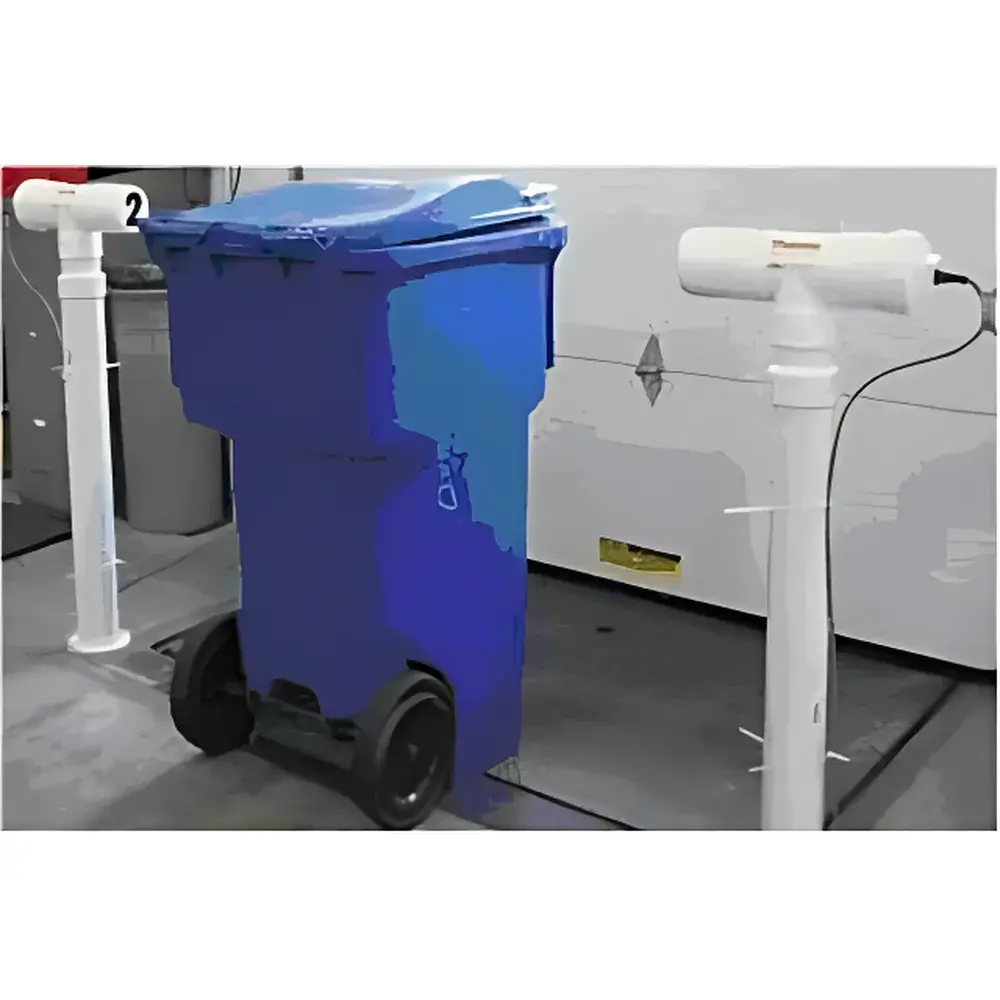
Thermo Fisher LFM-3 Waste Radiation Monitoring System
| Brand | Thermo Fisher |
|---|---|
| Origin | USA |
| Manufacturer | Thermo Fisher Scientific |
| Product Type | Imported |
| Model | LFM-3 |
| Instrument Category | Dose Rate Meter / Radiation Survey Meter |
| Form Factor | Portable |
| Measurement Target | Radioactive Sources and Nuclear Materials |
| Detector Type | Dual NaI(Tl) Scintillation Detectors |
| Energy Channels | Low-, Medium-, and High-Energy Discrimination Channels |
| Detector Housing | Lead-Shielded Enclosure |
| Dimensions | 144 × 455 × 178 mm |
| Weight | 6.7 kg |
| Compliance | Designed for compliance with ANSI N42.33, IEC 60846-1, and applicable ISO 2889 radiation monitoring requirements |
Overview
The Thermo Fisher LFM-3 Waste Radiation Monitoring System is a purpose-engineered, portable radiation survey instrument designed for continuous or spot-check monitoring of radioactive contamination in solid waste streams, recyclables, medical waste, and low-level nuclear materials. It operates on the principle of gamma-ray spectroscopy using dual thallium-doped sodium iodide (NaI(Tl)) scintillation detectors—each housed in a mechanically optimized lead-shielded enclosure to minimize background interference and enhance signal-to-noise ratio. The system implements real-time energy discrimination across three independent spectral windows (low-, medium-, and high-energy), enabling selective identification and alarm triggering based on characteristic gamma emissions from common radionuclides—including 137Cs (662 keV), 60Co (1173 & 1332 keV), 131I (364 keV), and 99mTc (140 keV). Unlike single-channel dose rate meters, the LFM-3 provides nuclide-informed decision support, making it suitable for environments where regulatory distinction between naturally occurring radioactive material (NORM), medical isotopes, and orphan sources is operationally critical.
Key Features
- Dual NaI(Tl) detector architecture with independent pulse processing for improved counting statistics and redundancy in field deployment
- Three-tier energy channel segmentation (typically 600 keV) supporting configurable alarm thresholds per channel
- Integrated lead shielding (≥3 mm Pb equivalent) around each detector to suppress terrestrial and cosmic background contributions
- Ruggedized portable form factor (144 × 455 × 178 mm; 6.7 kg) with IP54-rated enclosure for indoor/outdoor use in industrial, clinical, and municipal waste handling facilities
- Self-contained lithium-ion battery operation (≥12 hours typical runtime) with hot-swappable capability and USB-C charging interface
- Real-time audible/visual alarm outputs with channel-specific LED indicators and programmable relay contacts for integration into facility safety interlocks
Sample Compatibility & Compliance
The LFM-3 is validated for non-destructive screening of heterogeneous waste matrices—including sealed and unsealed medical waste containers, compacted municipal refuse, scrap metal loads, and decommissioning debris—without requiring sample preparation. Its detection geometry supports both static placement (e.g., over waste bins or conveyor chutes) and handheld scanning protocols. Regulatory alignment includes design conformance with ANSI N42.33 (Portable Radiation Detection Instrumentation for Homeland Security), IEC 60846-1:2014 (Radiation protection instrumentation — Ambient and/or directional dose equivalent (rate) meters and/or monitors for beta, X and gamma radiation), and relevant clauses of ISO 2889:2015 (Radiation protection — Performance criteria for radiation monitoring instruments used in nuclear facilities). While not a laboratory-grade spectrometer, its energy-channel response enables qualitative radionuclide grouping consistent with IAEA Technical Reports Series No. 441 for field radiological triage.
Software & Data Management
Data acquisition and configuration are managed via Thermo Fisher’s proprietary LFM Control Suite (v3.2+), a Windows-based application supporting firmware updates, alarm logic programming, spectral logging (CSV export), and time-stamped event reporting. All measurement logs include GPS metadata (when connected via optional Bluetooth module), operator ID fields, and audit-trail timestamps compliant with ALARA documentation practices. Exported data structures conform to ASTM E2835-21 (Standard Practice for Data Exchange of Radiation Monitoring Information) and support ingestion into enterprise radiation safety information systems (RSIS) or LIMS platforms. The system maintains full 21 CFR Part 11 readiness through user authentication, electronic signatures, and immutable log archiving—facilitating GLP/GMP-aligned quality assurance workflows in healthcare and nuclear service provider settings.
Applications
- Real-time surveillance of hospital radioactive waste collection points and decay storage areas
- Pre-screening of incoming municipal solid waste at transfer stations to prevent inadvertent entry of radiopharmaceutical-contaminated materials
- Monitoring of metal recycling streams for orphan sources (e.g., 192Ir, 60Co) in scrap yards and foundries
- Field verification during nuclear medicine department decommissioning and equipment disposal
- Mobile radiological assessment during emergency response to lost source incidents or illicit trafficking scenarios
FAQ
Can the LFM-3 identify specific radionuclides quantitatively?
No—it performs energy-windowed gross count analysis rather than full-spectrum deconvolution. Identification is limited to broad nuclide classes based on known gamma emission windows.
Is calibration traceable to national standards?
Yes. Each unit ships with a NIST-traceable calibration certificate for 137Cs and 60Co reference sources, valid for 12 months under standard operating conditions.
Does it require annual recalibration?
Thermo Fisher recommends functional verification every 6 months and full recalibration annually—or after any mechanical shock, detector replacement, or firmware update.
Can it be integrated with building management systems (BMS)?
Yes, via dry-contact relay outputs and Modbus RTU (RS-485) optional interface module for direct connection to SCADA or BMS infrastructure.
What is the minimum detectable activity (MDA) for 137Cs in a 20-L waste bag?
Under typical field conditions (10 cm source-to-detector distance, 60-second dwell), MDA is approximately 1.2 kBq—subject to matrix density and shielding effects.
Related Products







