
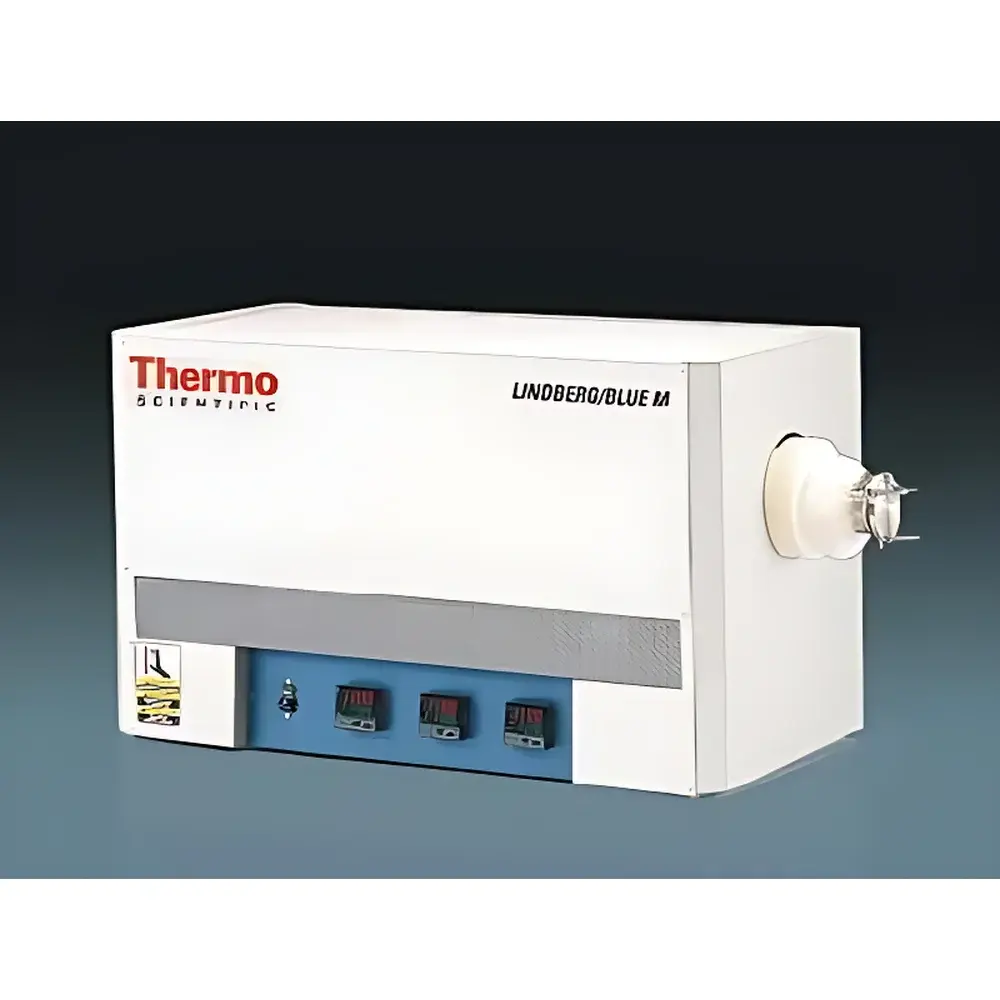
Thermo Fisher Lindberg/Blue M Horizontal & Vertical Tube Furnaces
| Brand | Thermo Fisher |
|---|---|
| Origin | USA |
| Type | Tube Furnace |
| Temperature Range | 1100°C to 1700°C |
| Heating Zone Lengths | 304.8 mm, 609.6 mm, or 914.4 mm |
| Configuration | Single-Zone or Triple-Zone |
| Controller | Integrated or External Microprocessor-Based Programmable Controller |
| Orientation | Horizontal or Vertical |
| Compliance | Designed for ASTM E1142, ISO/IEC 17025-compliant laboratory environments |
Overview
The Thermo Fisher Lindberg/Blue M series of horizontal and vertical tube furnaces are precision-engineered high-temperature thermal processing systems designed for controlled-atmosphere applications in materials science, catalysis research, semiconductor processing, and advanced ceramics development. These furnaces operate on resistive heating principles using high-purity Kanthal® A1 or MoSi₂ heating elements, housed within multi-layer ceramic fiber insulation for optimal thermal efficiency and uniform radial heat distribution. Each model is constructed with a refractory alumina or silicon carbide tube (ID options: 25–100 mm), rated for continuous operation at temperatures ranging from 1100°C up to 1700°C, depending on configuration and element type. The furnace architecture supports both inert (N₂, Ar), reducing (H₂/N₂), oxidizing (air, O₂), or vacuum-compatible atmospheres via standard flange interfaces (CF, KF, or VCR) and optional gas mass flow controllers. Critical thermal performance—such as axial temperature uniformity (±2°C over 300 mm in single-zone models; ±1.5°C over 600 mm in triple-zone configurations)—is validated per ASTM E1142 procedures.
Key Features
- Configurable orientation: Select between horizontal and vertical tube mounting to accommodate sample geometry, gravity-sensitive reactions (e.g., crystal growth), or integration into glovebox or vacuum manifold systems.
- Multi-zone thermal control: Single-zone models deliver consistent setpoint stability (±0.5°C) across defined heating lengths (304.8 mm, 609.6 mm, or 914.4 mm); triple-zone variants enable independent gradient programming—essential for annealing, sintering, or CVD precursor decomposition studies.
- Microprocessor-based programmable controller: Supports up to 32-step ramp-soak profiles with real-time logging, alarm thresholds (over-temperature, thermocouple break), and RS-232/RS-485 communication for LabVIEW™ or SCADA integration.
- Robust mechanical design: Stainless steel outer casing with forced-air cooling jacket; water-cooled flanges available for >1200°C operation under reactive gas flow; optional quartz or recrystallized alumina tubes for enhanced purity and thermal shock resistance.
- Compliance-ready architecture: Built-in hardware-level interlocks, NIST-traceable Type S or B thermocouples, and audit-trail-capable firmware align with GLP/GMP documentation requirements and FDA 21 CFR Part 11 data integrity expectations when paired with validated software.
Sample Compatibility & Compliance
These tube furnaces accept cylindrical samples, powders, thin films on substrates, wires, and crucibles—compatible with standard OD 25 mm to 100 mm quartz or ceramic tubes. Sample containment options include open-ended, sealed-end, or custom-fitted end caps with integrated feedthroughs for electrical leads or optical access. All models comply with UL 61010-1 and CE marking directives for laboratory equipment safety. For regulated environments, the system supports IQ/OQ documentation packages and can be qualified per ISO/IEC 17025 clause 5.4.2 (equipment verification) and ASTM E220 (thermocouple calibration).
Software & Data Management
Controller firmware includes embedded data logging (up to 10,000 timestamped points) with CSV export capability. Optional Thermo Fisher Connect™ Lab Analytics software enables remote monitoring, automated report generation (PDF/Excel), and electronic signature workflows compliant with 21 CFR Part 11 Annex 11. Raw thermocouple voltage outputs and analog setpoint signals are accessible for third-party DAQ systems. Firmware updates are delivered via secure HTTPS portal with version-controlled release notes and change logs.
Applications
- Thermal treatment of battery cathode/anode materials (e.g., LiCoO₂ calcination at 900°C under O₂ flow)
- Graphene synthesis via chemical vapor deposition (CVD) using CH₄/H₂ mixtures at 1000°C
- Preparation of metal-organic frameworks (MOFs) under solvent-free pyrolysis conditions
- Calibration of radiation thermometers and blackbody sources (NIST-traceable)
- High-temperature aging tests for aerospace composites per ASTM D3045
- Oxidation kinetics studies of Ni-based superalloys in controlled pO₂ environments
FAQ
What tube diameters are supported across the Lindberg/Blue M tube furnace lineup?
Standard configurations support inner diameters from 25 mm to 100 mm; custom bore sizes and tapered tubes are available upon engineering review.
Can these furnaces operate under vacuum conditions?
Yes—models equipped with CF or KF flanges achieve base pressures down to 10⁻⁶ mbar when paired with turbomolecular pumping systems; vacuum-rated seals and low-outgassing insulation are standard on 1500°C+ variants.
Is third-party calibration certification included with shipment?
Each unit ships with a factory calibration certificate referencing NIST-traceable standards; ISO/IEC 17025-accredited calibration is available as an add-on service.
How is temperature uniformity verified during installation qualification (IQ)?
Thermo Fisher provides a standardized mapping protocol using 5-point axial/radial thermocouple arrays and ASTM E1142-compliant reporting templates.
Are replacement heating elements user-serviceable?
Heating elements are field-replaceable without disassembling the furnace shell; full service manuals and torque specifications are provided with each unit.
Related Products



