
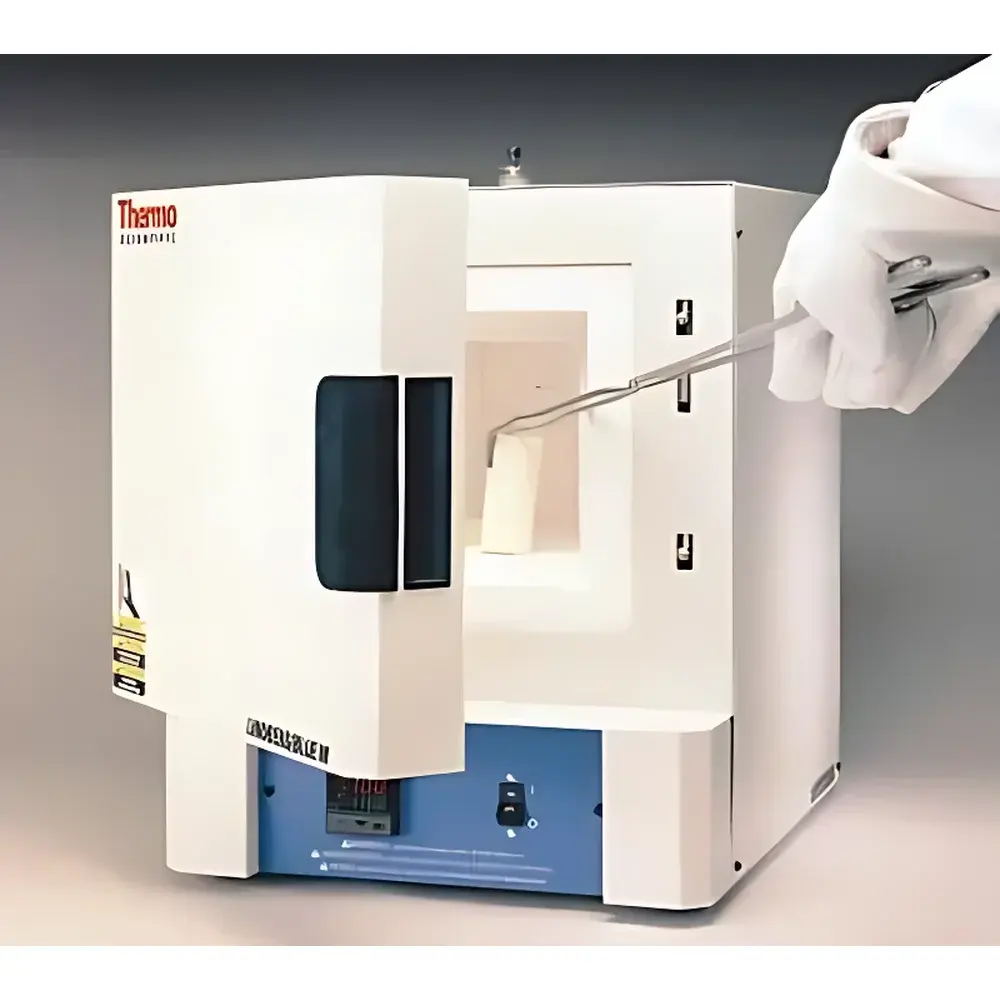
Thermo Fisher Lindberg/Blue M MoldathermR 1100°C Box Furnace
| Brand | Thermo Fisher |
|---|---|
| Origin | USA |
| Manufacturer | Lindberg/Blue M |
| Model | BF517xxC / BF518xxC Series |
| Chamber Volume | 1.99 L, 5.3 L, 18.4 L, or 42.5 L |
| Max Operating Temperature | 1100°C |
| Control Options | Digital Single-Setpoint or Multi-Step Programmable Controller |
| Power Supply | 208–240 V, 50/60 Hz |
| Heating Power | 1.8 kW (1.99–5.3 L), 3.5 kW (18.4 L), or 5.6 kW (42.5 L) |
| External Cooling Surface Temp | <60°C at 1100°C operation |
| Safety Features | Door-Interlocked Power Cut-off, Adjustable Over-Temperature Protection, K-Type Thermocouple |
| Gas Ports | 1" Top Exhaust + 3/8" Rear Inlet |
| Construction | Dual-Wall Insulated Steel Housing with Embedded Heating Elements |
| Compliance | Designed for GLP/GMP environments |
Overview
The Thermo Fisher Lindberg/Blue M MoldathermR 1100°C Box Furnace is a precision-engineered laboratory muffle furnace designed for reproducible high-temperature thermal processing in research, quality control, and regulated manufacturing settings. Operating up to 1100°C, it employs resistive heating via embedded high-alloy heating elements and advanced multi-layer ceramic fiber insulation—ensuring exceptional thermal uniformity (±5°C across chamber volume per ASTM E220 calibration guidelines) and minimized external surface temperature (<60°C under full-load operation). Its robust dual-wall steel construction integrates structural integrity with operator safety, while the side-hinged door and optimized internal geometry facilitate ergonomic sample loading and efficient spatial utilization within constrained lab footprints. Unlike open-hearth or tube-style furnaces, the MoldathermR’s fully enclosed muffle design isolates samples from combustion byproducts and external airflow, making it suitable for ashing, calcination, annealing, and inert-atmosphere thermal treatments where contamination control is critical.
Key Features
- Dual-wall insulated housing with low-thermal-conductivity ceramic fiber blanket—reduces heat loss and maintains external casing temperature below 60°C during continuous 1100°C operation
- Embedded high-strength Kanthal A1 heating elements mounted on both sidewalls—enabling rapid ramp rates (up to 15°C/min typical) and improved temperature homogeneity
- Two controller options: digital single-setpoint thermostat (BF517xxC) or multi-step programmable controller (BF518xxC) supporting up to 16 segments with soak, ramp, and hold profiles
- Integrated safety architecture including automatic power cutoff upon door opening, user-adjustable over-temperature limit (independent of main controller), and redundant K-type thermocouple monitoring
- Standard gas management ports: 1-inch NPT top exhaust and 3/8-inch NPT rear inlet—facilitating purge with nitrogen, argon, or forming gas; compatible with optional mass flow controllers and pressure regulators
- Moldatherm-specific removable hearth plate (alumina-coated steel)—protects floor insulation from thermal shock and chemical exposure during ashing or digestion protocols
- Ergonomic side-opening door with counterbalanced hinge mechanism—reducing operator strain and enabling unobstructed access to full chamber depth
Sample Compatibility & Compliance
The MoldathermR accommodates diverse sample forms—including crucibles (Pt, Al₂O₃, SiC), quartz boats, metal trays, and ceramic setters—across four chamber volumes (1.99 L to 42.5 L). Its sealed muffle environment meets requirements for ASTM D3174 (ash content in coal), ASTM C114 (cement chemical analysis), and USP <231> heavy metals testing. All models are engineered for alignment with ISO/IEC 17025 method validation criteria and support audit-ready documentation when paired with validated data logging systems. Optional RS485 serial interface enables integration into centralized LabVantage or STARLIMS platforms for 21 CFR Part 11–compliant electronic records, including timestamped setpoints, actual temperatures, ramp rates, and alarm events.
Software & Data Management
While the base controller operates independently, the BF518xxC series supports ASCII protocol communication via RS485 (Modbus RTU compatible). When connected to a host PC running Thermo Fisher’s optional FurnaceLink™ software (v3.2+), users gain real-time graphing, automated report generation (PDF/CSV), and configurable alarm escalation (email/SNMP). All temperature logs include metadata: operator ID, batch number, chamber ID, and calibration certificate traceability. Audit trails record every parameter change, manual override, or safety event—meeting GLP and GMP documentation rigor without third-party middleware.
Applications
- Gravimetric ash analysis of organic matrices (food, biomass, polymers) per AOAC 942.05 and EPA Method 1694
- Thermal decomposition and residue quantification in pharmaceutical excipients and APIs
- Heat treatment of metallurgical specimens: stress relieving, normalizing, and tempering of ferrous alloys
- Inert-atmosphere sintering of ceramic green bodies and catalyst supports
- Residue-on-ignition (ROI) testing in environmental soil and sludge characterization
- Preconditioning of reference materials prior to ICP-MS or XRF analysis
- Bitumen rheology sample preparation per ASTM D7028 and EN 14770
FAQ
What is the maximum recommended operating temperature and duty cycle?
The furnace is rated for continuous operation at 1100°C. For optimal element longevity, sustained use above 1000°C should not exceed 75% duty cycle; intermittent cycling between ambient and 1100°C is supported per Lindberg/Blue M thermal endurance specifications.
Can this furnace be used under vacuum or positive pressure?
No—it is designed strictly for atmospheric or inert-gas-purged operation. The door seal and vent configuration do not support vacuum integrity or pressurized atmospheres beyond 1.2 atm absolute.
Is calibration certification included with shipment?
Each unit ships with a factory-as-tested temperature uniformity report (per ASTM E220 Annex A3) and NIST-traceable thermocouple verification at three points (300°C, 700°C, 1100°C); full UKAS or ISO/IEC 17025 calibration is available as an add-on service.
How is thermal uniformity verified during routine use?
Users may perform in-situ mapping using a calibrated multi-point thermocouple probe (e.g., Fluke 1524 with 9-point array) and compare against the furnace’s documented uniformity profile—recommended semi-annually or after major maintenance.
Are replacement parts such as heating elements and insulation available directly from Thermo Fisher?
Yes—genuine Lindberg/Blue M spare parts (P/Ns prefixed “MOLD-”) are stocked globally and supported by Thermo Fisher’s Field Service Network, including installation guidance and preventive maintenance kits.



