
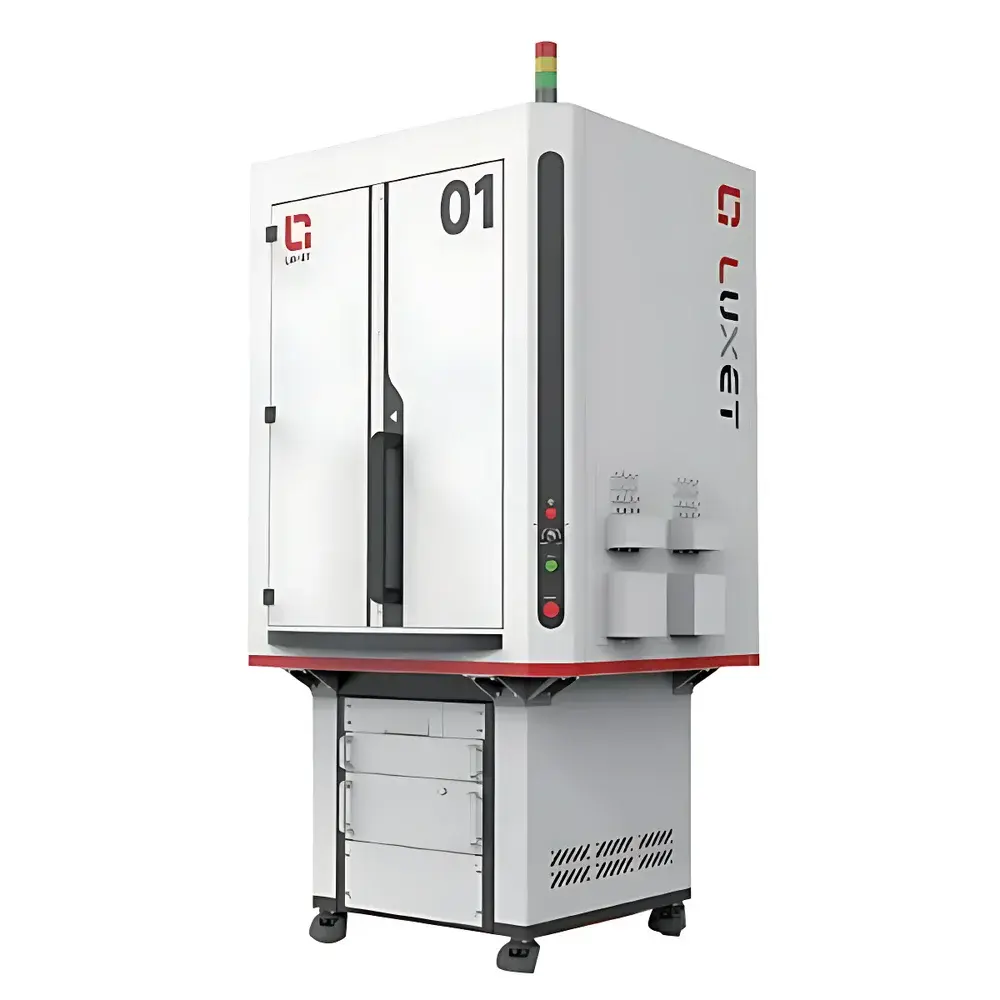
Thermo Fisher LUXET Thermo100 Lock-in Infrared Microscope
| Brand | Thermo Fisher |
|---|---|
| Origin | USA |
| Manufacturer Type | Authorized Distributor |
| Origin Category | Imported Instrument |
| Model | LUXET Thermo100 Lock-in Infrared Microscope |
| Price | USD 13,500 (FOB USA) |
Overview
The Thermo Fisher LUXET Thermo100 Lock-in Infrared Microscope is a high-sensitivity, non-contact thermal imaging platform engineered for precise failure analysis in microelectronic and semiconductor devices. It operates on the principle of lock-in thermography—modulating device current or voltage at a known frequency while synchronously detecting infrared emission using phase-sensitive demodulation. This technique significantly enhances signal-to-noise ratio (SNR) by rejecting ambient thermal noise and enabling sub-millikelvin temperature resolution under controlled excitation conditions. Unlike conventional steady-state IR microscopy, the LUXET Thermo100 isolates only the thermally responsive component correlated with electrical stimulation, making it uniquely suited for identifying resistive anomalies, localized Joule heating, and latent defects in packaged ICs, wafers, PCBs, and MEMS structures.
Key Features
- Integrated lock-in detection architecture with programmable modulation frequency range (0.1 Hz – 10 kHz), supporting both current- and voltage-driven excitation modes
- Cryogenically cooled mid-wave infrared (MWIR) focal plane array (FPA) detector (3–5 µm spectral response), delivering high quantum efficiency and low temporal noise
- Motorized XYZ stage with sub-micron repeatability and automated focus control, compatible with standard probe station interfaces
- Dual-lens optical system: wide-field lens (10× objective equivalent) for rapid survey scanning and high-magnification microscope objectives (up to 100×) for spatial resolution down to ~5 µm (diffraction-limited)
- Built-in high-voltage source-measure unit (SMU) with ±200 V / ±100 mA capability, featuring four-quadrant operation and real-time I-V monitoring synchronized to thermal acquisition
- Real-time phase and amplitude image generation, enabling quantitative thermal contrast mapping independent of absolute emissivity variations
Sample Compatibility & Compliance
The LUXET Thermo100 accommodates samples ranging from bare silicon wafers (200 mm to 300 mm) to fully assembled PCBs (up to 300 × 300 mm), flip-chip packages, ceramic substrates, and optoelectronic modules. Its modular chamber design supports optional environmental control (e.g., temperature-staged sample holders) and ESD-safe operation per ANSI/ESD S20.20. The system complies with IEC 61000-4-3 (radiated immunity) and meets CE marking requirements for electromagnetic compatibility (EMC) and low-voltage directive (LVD). Data acquisition protocols are configurable to align with internal FA lab workflows compliant with ISO/IEC 17025 and JEDEC JEP122G failure analysis guidelines.
Software & Data Management
Control and analysis are performed via Thermo Fisher’s proprietary LUXET Suite v3.x, a Windows-based application supporting multi-modal synchronization between electrical stimulus, thermal imaging, and stage motion. The software provides pixel-level lock-in amplitude/phase extraction, dynamic thermal profile tracking over time, and overlay-capable registration with optical microscope images (via integrated visible-light camera option). All raw thermal datasets are stored in HDF5 format with embedded metadata (excitation parameters, calibration timestamps, instrument configuration). Audit trails—including user login, parameter changes, and export actions—are logged in accordance with FDA 21 CFR Part 11 requirements when configured with electronic signature modules. Export options include CSV, TIFF (16-bit), and MATLAB-compatible .mat files for third-party statistical modeling.
Applications
- Localization of short circuits, leakage paths, and dielectric breakdown sites in advanced nodes (≤7 nm FinFET, GAA transistors)
- Identification of resistive opens, electromigration-induced voids, and interconnect fatigue in Cu/low-k stacks
- Thermal validation of power delivery networks (PDN) and identification of hotspot propagation under dynamic load conditions
- Failure mode discrimination in GaN HEMTs and SiC MOSFETs via transient thermal response analysis
- Non-destructive verification of underfill integrity and solder joint reliability in 2.5D/3D IC packages
- Correlative analysis with SEM-EDS, FIB-SIMS, or nano-FTIR for root-cause determination in qualification labs
FAQ
Does the LUXET Thermo100 require liquid nitrogen cooling?
No—it employs a Stirling-cycle cryocooler for the MWIR detector, eliminating consumables and enabling continuous unattended operation.
Can it be integrated with existing probe stations?
Yes—the motorized stage features standard M6 threading and XYZ homing sensors compatible with Cascade, Micromanipulator, and MPI probe station platforms.
Is emissivity correction required for quantitative temperature measurement?
Not for differential lock-in analysis; absolute temperature calibration is optional and supported via blackbody reference sources traceable to NIST standards.
What file formats are supported for data exchange with FA databases?
HDF5 (primary), TIFF, CSV, and XML-based metadata exports—fully scriptable via Python API for integration with LabVantage or SampleManager LIMS.
Is remote operation supported for multi-site labs?
Yes—secure RDP and web-based dashboard access (HTTPS/TLS 1.2) are available with role-based permissions and session logging.



