
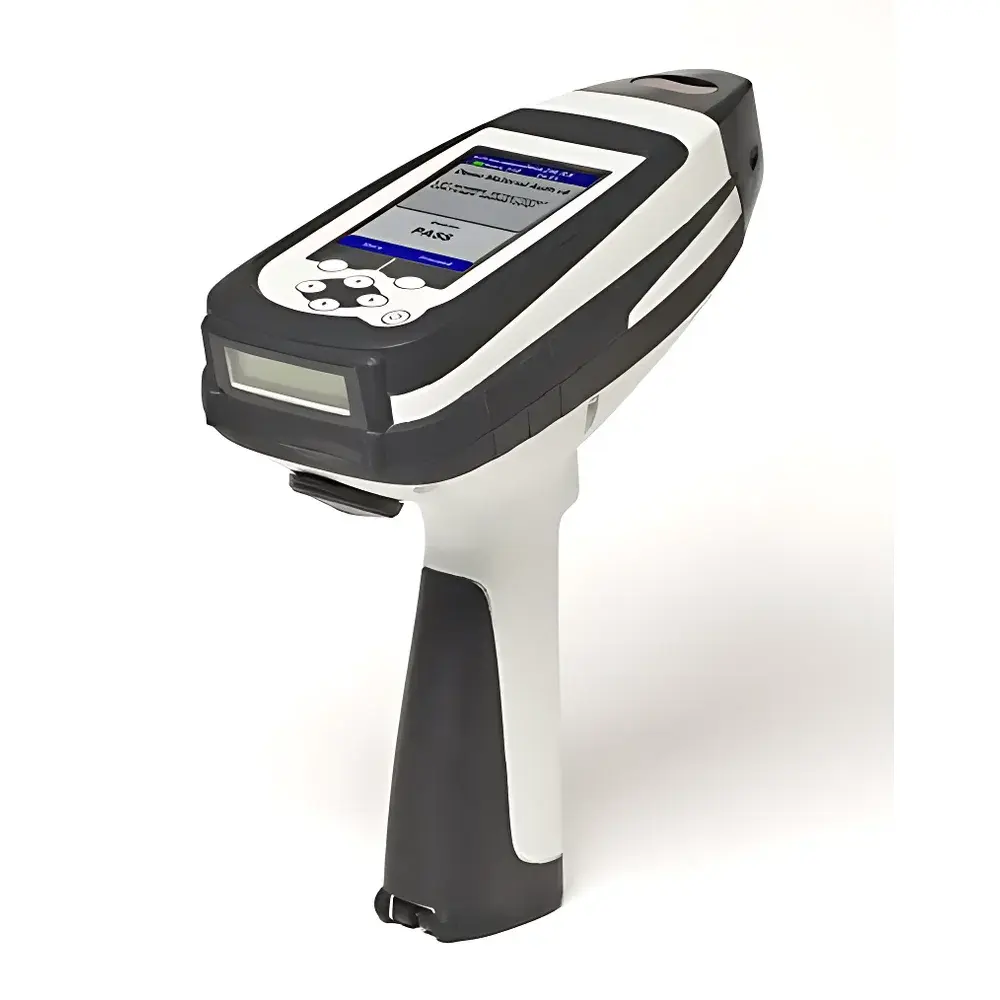
Thermo Fisher microPHAZIR PC Plastics Handheld Near-Infrared Spectrometer
| Brand | Thermo Fisher |
|---|---|
| Origin | USA |
| Manufacturer | Thermo Fisher Scientific |
| Product Type | Imported |
| Model | microPHAZIR PC Plastics |
| Principle | Portable, On-Site NIR Spectroscopy |
| Spectral Range | 1600–2400 nm (6250–4100 cm⁻¹) |
| Measurement Time | <3 s |
| Sampling Mode | Diffuse Reflectance |
| Weight | 1.25 kg |
| Housing | High-Strength Dust-Resistant Polymer Enclosure |
| Light Source | Tungsten-Halogen Lamp |
| Data Storage | Internal Memory with USB Export |
| Interface | USB |
| Operating Temperature | 5–50 °C (non-condensing) |
| Power Supply | Dual Swappable Li-ion Batteries (4.5 h runtime), AC Adapter & Charger Included |
Overview
The Thermo Fisher microPHAZIR PC Plastics Handheld Near-Infrared Spectrometer is an engineered solution for rapid, non-destructive identification and classification of polymer materials in real-world industrial and recycling environments. Based on diffuse-reflectance near-infrared spectroscopy (NIRS), the instrument operates within the 1600–2400 nm spectral window—optimized for detecting C–H, O–H, and N–H vibrational overtones and combination bands characteristic of thermoplastics, engineering resins, and common packaging polymers. Unlike benchtop FT-NIR systems requiring sample homogenization or pelletization, the microPHAZIR PC Plastics delivers lab-grade spectral discrimination directly on heterogeneous, opaque, or textured surfaces—including post-consumer plastic fragments, molded components, and mixed waste streams—without contact, cutting, or chemical treatment. Its optical architecture employs a stabilized tungsten-halogen source and solid-state detector array, calibrated against NIST-traceable polymer reference standards to ensure measurement consistency across instruments and over time.
Key Features
- Portable, battery-powered operation (1.25 kg; 2.75 lb) enabling field deployment at material recovery facilities (MRFs), sorting lines, scrap yards, and quality control checkpoints.
- Sub-3-second measurement cycle with automated spectral acquisition, background correction, and chemometric classification—no user intervention required beyond pointing and triggering.
- Dust-resistant polymer housing rated for industrial environments (IP54-equivalent ingress protection), tested for mechanical shock and thermal cycling between 5–50 °C.
- Integrated dual-swappable lithium-ion battery system providing up to 4.5 hours of continuous operation; hot-swap capability ensures uninterrupted workflow during high-throughput sorting.
- USB 2.0 interface for secure data export to Windows-based PCs; firmware and spectral libraries updated via encrypted firmware packages compliant with ISO/IEC 17025 traceability requirements.
Sample Compatibility & Compliance
The microPHAZIR PC Plastics is validated for identification of ≥25 common polymer types, including PET, HDPE, LDPE, PP, PS, PVC, ABS, PC, PA6, PA66, POM, and biodegradable polymers such as PLA and PHA. It accommodates irregular geometries, colored or pigmented surfaces, and multi-layer laminates without signal saturation or baseline drift. The instrument complies with IEC 61000-4 electromagnetic compatibility standards and meets RoHS Directive 2011/65/EU for hazardous substance restrictions. Its non-ionizing NIR radiation (Class 1 laser safety per IEC 60825-1) requires no operator training certification. Data integrity adheres to ALCOA+ principles (Attributable, Legible, Contemporaneous, Original, Accurate, Complete, Consistent, Enduring, Available) and supports audit readiness for ISO 9001, ISO 14001, and EPA-compliant recycling reporting frameworks.
Software & Data Management
The embedded software includes a pre-loaded chemometric library built from >10,000 reference spectra of virgin and recycled polymers, acquired under controlled environmental conditions and verified against ASTM D7298–22 (Standard Practice for Identification of Plastics by Near-Infrared Spectroscopy). Classification algorithms employ partial least squares discriminant analysis (PLS-DA) with cross-validated specificity >99.2% for binary polymer mixtures. All measurements are timestamped, geotagged (optional GPS module), and stored with full spectral metadata (wavelength, intensity, SNR, lamp status, ambient temperature). Exported .csv and .spc files retain raw absorbance data for third-party reprocessing in MATLAB, Unscrambler, or Python-based chemometrics pipelines. Audit trails record user actions, library updates, and calibration events—supporting 21 CFR Part 11 compliance when deployed in regulated GMP/GLP environments.
Applications
- Real-time sorting of post-consumer plastics at MRFs to improve purity of HDPE/PET bales and reduce contamination-driven downgrades.
- Verification of incoming resin lots against supplier specifications in injection molding and extrusion facilities.
- On-site forensic analysis of counterfeit consumer goods (e.g., automotive trim, medical device housings) where polymer substitution risks regulatory nonconformance.
- Field validation of compostable packaging claims per ASTM D6400 or EN 13432, distinguishing certified biopolymers from conventional PE/PP adulterants.
- Process monitoring of polymer degradation during recycling—detecting oxidation-induced carbonyl band shifts at ~1710 cm⁻¹ via spectral trend analysis.
FAQ
Does the microPHAZIR PC Plastics require routine recalibration?
No—factory calibration is stable for ≥24 months under normal operating conditions. A daily verification check using the included polymer reference tile is recommended per ISO/IEC 17025 Clause 7.7.
Can it identify black or carbon-filled plastics?
Yes—its 1600–2400 nm range avoids strong absorption bands typical of carbon black below 1500 nm, enabling reliable identification of conductive or ESD-safe grades of PP, PE, and nylon.
Is spectral data export compatible with LIMS integration?
Yes—structured CSV output includes all required fields for direct ingestion into LabVantage, Thermo Fisher SampleManager, or custom SQL-based LIMS via ODBC drivers.
What is the minimum sample area required for reliable measurement?
A circular area ≥15 mm in diameter is recommended; smaller features may be analyzed using optional close-focus lens attachment (sold separately).
How does it handle ambient light interference?
The instrument uses synchronized pulsed illumination and lock-in detection to reject broadband ambient noise, maintaining SNR >100:1 even under direct sunlight or fluorescent lighting.
Related Products





